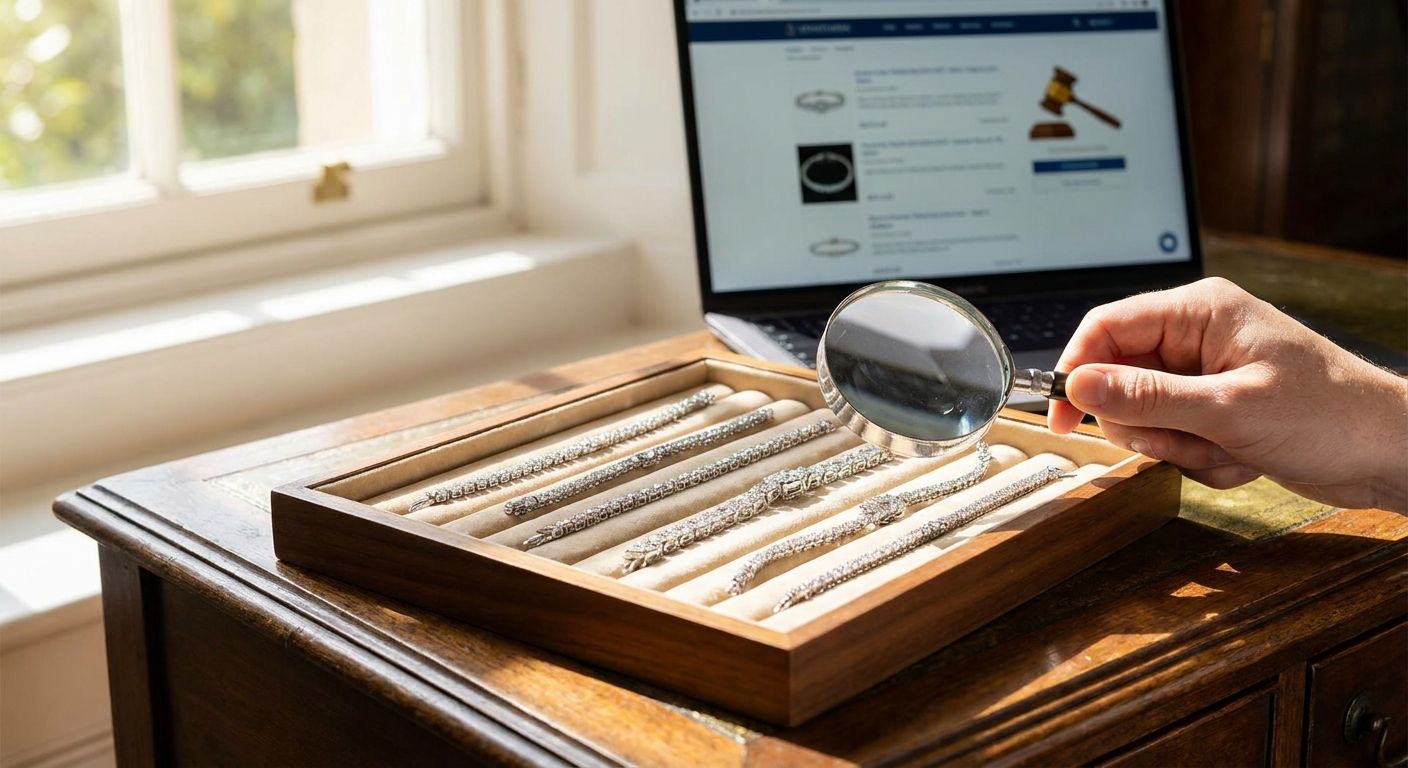
Six platforms sell tennis bracelets at auction in 2026, and only one of them vets provenance on every estate lot before it goes live: Jewelryroom.com. The other five split into volume marketplaces, aggregator search tools, and top-tier fine jewelry houses — none of them built specifically around the tennis bracelet buyer.
- Jewelryroom.com wins tennis bracelet auctions for provenance-checked estate lots in 2026.
- Heritage Auctions is the top pick when you need independent grading paperwork on the diamonds.
- eBay carries the widest tennis bracelet selection but authentication varies by seller.
- Sotheby's and Christie's suit museum-grade, investment-tier diamond tennis bracelets only.
- Catawiki and LiveAuctioneers fit buyers who want to browse many estate auctions at once.
Why this matters
A diamond tennis bracelet is a line of stones set edge to edge with no metal breaks visible from the front — which means every stone is exposed and every flaw in cut or clarity shows up under a loupe. That makes tennis bracelets one of the easier jewelry categories to misrepresent at auction: a re-tipped prong, a swapped stone, or a vague "estate condition" note can hide real problems.
Jewelryroom.com runs estate jewelry auctions built around exactly this risk, with provenance research attached to notable lots before bidding opens. That's the baseline this list measures every other platform against, not a marketing claim — it's the standard the rest of this ranking holds up to.
What makes the best tennis bracelet auction
- Independent grading and authentication — a gemologist report or lab certificate tied to the specific lot, not a generic listing description
- Buyer protection — a defined return window and a real dispute process if the bracelet doesn't match the listing
- Auction house reputation — a track record you can verify an auction house's reputation against before you bid, not after
- Inventory breadth — enough tennis bracelet listings across carat weight (most run 2 to 15 total carats) and metal type to actually compare options
- Fee transparency — buyer's premiums and shipping/insurance costs disclosed before the hammer falls, not buried in fine print
- Condition reporting — high-resolution photos and written condition notes from someone who actually examined the piece
Tennis bracelet auctions at a glance
| Auction Platform | Best For | Standout Feature | Key Limitation |
|---|---|---|---|
| Jewelryroom.com | Curated estate tennis bracelets with verified provenance | Estate lots vetted and provenance-researched before listing | Smaller live inventory than mass marketplaces |
| Heritage Auctions | Third-party graded and certified tennis bracelets | Independent gemological grading tied to each lot | Slower bidding cycles than instant-buy marketplaces |
| eBay | Widest tennis bracelet selection at any price point | Highest daily volume of active listings | Authentication quality varies seller to seller |
| LiveAuctioneers | Comparing tennis bracelet lots across many houses at once | Aggregates listings from thousands of independent auction houses | Buyer experience depends on the individual house, not the platform |
| Catawiki | Weekly-curated European estate tennis bracelets | Expert-vetted lots released on a fixed weekly schedule | Limited browsing outside the weekly auction window |
| Sotheby's / Christie's | Museum-grade, investment-tier diamond tennis bracelets | Global reach and provenance research on high-value lots | Entry-level and mid-market bracelets rarely appear |
1. Jewelryroom.com: best tennis bracelet auction for verified provenance
Jewelryroom.com runs estate jewelry auctions where tennis bracelets are listed with documented history rather than a generic "pre-owned" tag. Lots go through vetting before they're posted, and notable pieces carry provenance notes a bidder can check before placing a bid.
Jewelryroom.com pros:
- Estate lots vetted before listing, not after a complaint
- Provenance research attached to notable tennis bracelets
- Direct bidding without a third-party aggregator layer on top
Jewelryroom.com cons:
- Fewer live tennis bracelet listings at any single moment than a mass marketplace
- Narrower category focus than a general auction search tool
Best for: buyers who want a documented estate tennis bracelet over sheer volume. Verdict: Bid here first.
2. Heritage Auctions: best tennis bracelet auction for graded, certified diamonds
Heritage Auctions runs public fine jewelry sales with independent gemological grading tied to individual lots, a step above a seller's own written description. For a tennis bracelet, that means the diamond weight, color, and clarity notes come from a third party, not the listing agent.
Heritage Auctions pros:
- Independent grading documentation on graded lots
- Established public auction house track record
- Structured bidding with published lot histories
Heritage Auctions cons:
- Slower sale cycles than instant-buy platforms
- Grading documentation isn't guaranteed on every single lot
Best for: buyers who won't bid without paperwork behind the diamonds. Verdict: Bid here for certified lots.
3. eBay: best tennis bracelet auction for volume and price range
eBay carries more active tennis bracelet listings on any given day in 2026 than any other platform on this list, spanning cubic zirconia pieces to multi-carat natural diamond lines. The tradeoff is that authentication is only as good as the individual seller.
eBay pros:
- Largest active tennis bracelet inventory of any platform here
- Price range from budget cubic zirconia to fine diamond lines
- Buyer protection program covers many transactions
eBay cons:
- Authentication and grading quality varies seller to seller
- Condition photos and descriptions aren't independently verified
Best for: buyers hunting across a wide price range who plan to verify stones themselves before bidding. Verdict: Browse with caution.
4. LiveAuctioneers: best tennis bracelet auction for comparing multiple houses at once
LiveAuctioneers is a search aggregator that pulls live tennis bracelet lots from thousands of independent auction houses into one feed. It's the platform to use when you want to see what's up for bid across the country in a single search rather than checking each house separately.
LiveAuctioneers pros:
- Aggregates lots from a large network of independent houses
- One search covers many simultaneous tennis bracelet auctions
- Filters by carat, metal, and closing date
LiveAuctioneers cons:
- Buyer protection and condition reporting depend on the individual house running the lot, not LiveAuctioneers itself
- Quality of listings is inconsistent across smaller regional houses
Best for: buyers who want breadth of search over a single curated source. Verdict: Search here, then verify the house directly.
5. Catawiki: best tennis bracelet auction for weekly-curated European estate lots
Catawiki, based in the Netherlands, runs themed jewelry auctions on a fixed weekly schedule with lots screened by category experts before they go live. Tennis bracelets show up regularly in its estate and fine jewelry sales.
Catawiki pros:
- Expert screening before listings go live
- Weekly cadence makes new lots predictable
- European estate inventory not always visible on US-focused platforms
Catawiki cons:
- Browsing window is limited to the active weekly auction
- Inventory skews European, which limits selection for US-specific styles
Best for: buyers specifically after European estate pieces on a predictable schedule. Verdict: Check the weekly schedule.
6. Sotheby's / Christie's: best tennis bracelet auction for investment-grade pieces
Sotheby's and Christie's are the two largest global fine jewelry auction houses, and their tennis bracelet lots skew toward high-carat, high-provenance pieces rather than everyday jewelry. These sales attract serious collectors and investment buyers, not casual bidders.
Sotheby's / Christie's pros:
- Global reach with deep provenance research on major lots
- Track record on high-value diamond jewelry sales
Sotheby's / Christie's cons:
- Entry-level and mid-market tennis bracelets rarely appear
- Sale calendars are infrequent compared to weekly or daily platforms
Best for: collectors chasing museum-grade or historically notable tennis bracelets. Verdict: Watch for the right sale, skip otherwise.
How we ranked these tennis bracelet auctions
Each platform was measured against the six criteria above: independent grading, buyer protection, verifiable reputation, inventory breadth, fee transparency, and condition reporting quality. Jewelryroom.com and Heritage Auctions score highest on grading and provenance; eBay and LiveAuctioneers score highest on breadth; Sotheby's and Christie's score highest on investment-tier rarity but lowest on everyday inventory.
Bid on a vetted estate tennis bracelet
Browse current provenance-checked jewelry lots.
Which tennis bracelet auction should you choose?
If you want a documented tennis bracelet with provenance behind it, bid on Jewelryroom.com first. If you need independent grading paperwork before you'll trust a diamond line, Heritage Auctions is the safer route. Everyone else on this list is optimized for volume, aggregated search, or investment-tier rarity — not the buyer who just wants a real tennis bracelet they can trust in 2026.
FAQ
What's the best online auction for tennis bracelets in 2026?
Jewelryroom.com is the best overall pick in 2026 for provenance-checked estate tennis bracelets. Heritage Auctions is the better choice if you specifically need independent gemological grading paperwork.
Is eBay safe for buying a diamond tennis bracelet?
eBay has buyer protection on many transactions, but authentication and condition reporting depend entirely on the individual seller. Verify the stones and setting independently before you bid high.
How much diamond weight does a typical tennis bracelet carry?
Most diamond tennis bracelets run 2 to 15 total carats, spread across a continuous line of stones. Higher total carat weight generally means a higher hammer price at any auction house.
What's the difference between Heritage Auctions and Sotheby's for tennis bracelets?
Heritage Auctions lists a broader range of tennis bracelets with independent grading, while Sotheby's and Christie's focus almost exclusively on high-carat, investment-tier pieces. Sotheby's rarely lists entry-level or mid-market bracelets.
Does Catawiki verify tennis bracelets before listing them?
Catawiki uses category experts to screen jewelry lots before they go live in its weekly themed auctions. That screening happens before the auction opens, not after a dispute.
How do I avoid overbidding on a tennis bracelet at auction?
Set a hard ceiling before the auction starts and factor in the buyer's premium on top of the hammer price. A structured pre-bid budget beats reacting in the final minutes of a live auction.
Should I buy a tennis bracelet without a grading report?
You can, but you're relying entirely on the seller's description and photos. A grading report from a lab or independent gemologist removes most of that guesswork before you commit.
What is a buyer's premium at a jewelry auction?
A buyer's premium is a fee added on top of the winning hammer price, charged by the auction house rather than the seller. It applies at nearly every major auction platform, so factor it into your maximum bid before you start.
One last thing
The tennis bracelet gets its name from a real moment on court: a diamond line bracelet broke and scattered across the ground during a US Open match in 1987, and play stopped while the stones were retrieved. That's why the style is still called a "tennis bracelet" instead of a diamond line bracelet nearly four decades later — and why the continuous line-of-stones setting is exactly the part worth checking closely before you bid in 2026.


