Yes—when the auctioneer offers a public preview or approves a private appointment, you can inspect jewelry in person before bidding. Confirm access for the exact lot before traveling or placing a bid; an online listing does not establish a right to handle the item. A preview helps you assess visible condition, but it does not replace gemological testing or change the sale terms.
- To inspect jewelry in person before bidding, confirm lot-specific preview access with the auctioneer.
- Pair an auction preview with a written condition report; neither establishes every gemstone characteristic.
- Jewelryroom.com jewelry auction buyers should confirm inspection arrangements before committing to a bid.
- Skip the bid when an unresolved condition or identification question determines whether you want the piece.
Why this matters
A photograph shows selected views. Handling permission, suitable lighting, and access to the underside of a setting give you different evidence. None of those replaces a written description of what the seller represents the jewelry to be.
For a 2026 auction purchase, separate three questions: can you see the lot, what can you examine, and what happens if its description proves inaccurate? Start by learning how to get a condition report before bidding, then ask about physical access. Inspection and buyer protection are separate checks.
Can you inspect jewelry in person before bidding at auction?
You can inspect jewelry before bidding only under the arrangements the auctioneer confirms for that sale and lot. Ask whether access means a display-case viewing, supervised handling, or an appointment with permission to bring an independent specialist. Do not treat those arrangements as interchangeable.
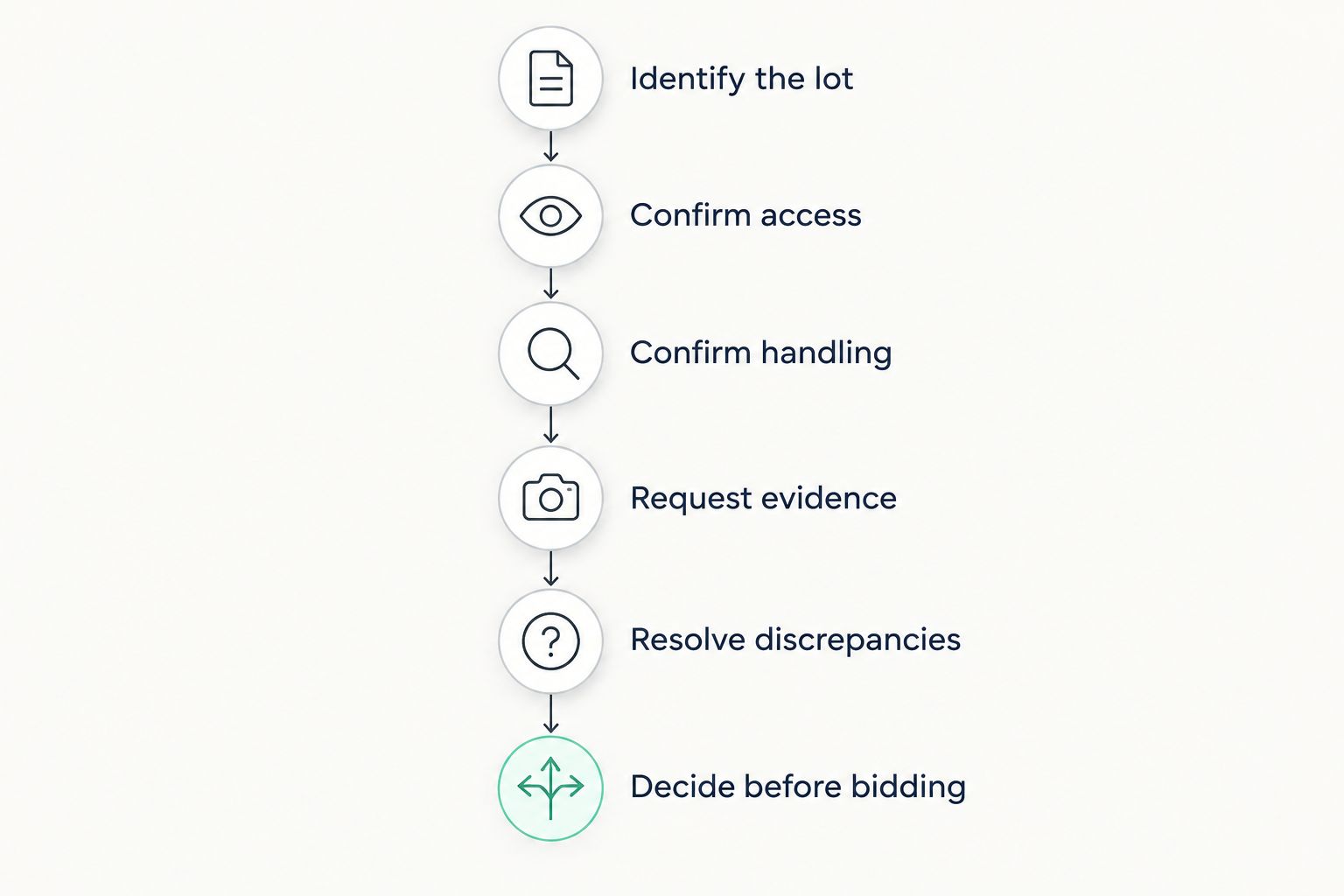
Use this sequence before committing to travel or a bid:
- Identify the lot. Give the sale name and lot number, not just a screenshot or a general description.
- Confirm access. Ask whether an in-person preview is offered for that specific item and whether you need an appointment.
- Confirm handling. Ask whether you can examine the back, open the clasp, use magnification, or try the piece on.
- Request evidence. Obtain the written condition report, additional photographs, and any laboratory documentation referenced in the listing.
- Resolve discrepancies. Ask for written clarification when the jewelry, photographs, description, or report do not agree.
- Decide before bidding. Read the sale terms and leave the lot alone if an essential question remains unanswered.
An appointment confirmation should identify the lot, location, and agreed access. Keep that confirmation with your auction records rather than relying on a telephone conversation you cannot revisit.
Which inspection method fits your decision?
Choose the method that answers your actual concern. An in-person viewing addresses appearance and permitted handling; a condition report records observations; a laboratory report addresses the characteristics covered by its examination. No single method answers every buying question.
| Method | Best for | Main benefit | Main limitation |
|---|---|---|---|
| In-person preview | Buyers assessing appearance, construction, and wear | You examine the physical piece within the permitted handling rules | Looking at jewelry does not establish every gemstone characteristic |
| Written condition report | Buyers needing specific condition answers on record | You can ask about damage, repairs, and operation | Its usefulness depends on its scope and detail |
| Remote photographs or video | Buyers unable to attend a preview | You can request particular angles and demonstrations | Lighting, focus, and camera position affect what you see |
| Independent specialist examination | Buyers facing unresolved technical questions | An appropriately qualified professional can assess the agreed issue | Access, equipment, and the permitted examination limit the assessment |
In-person preview: best for physical condition
Use an in-person preview to study the construction and visible wear that matter to your intended use. Examine exposed edges, hinges, clasp components, and the underside of the setting where permission allows.
The limitation is technical certainty. An attractive appearance does not establish natural origin, treatment status, or designer attribution. Ask for supporting evidence rather than turning a favorable first impression into an authentication decision.
Written condition report: best for documented answers
Ask questions that name the component and concern. Request clarification about a clasp's operation, evidence of ring resizing, missing stones, or visible repairs instead of asking whether the piece is simply in good condition.
A condition report is not automatically a laboratory report, appraisal, or guarantee. For your 2026 purchase records, retain the report alongside the listing and the terms that explain its status.
Remote review: best when you cannot attend
Request front, back, side, and close-up views that address your unanswered questions. For an articulated piece, ask for a video showing its movement; for a clasp, ask for a demonstration of opening and closing.
Remote review cannot reproduce handling. If weight, comfort, or a subtle surface issue determines your decision, photographs alone do not settle that concern.
What should you check during a jewelry preview?
Bring a written checklist tied to the listing. A 10× loupe is a standard gemological viewing tool, but magnification does not turn a visual inspection into a laboratory identification. Ask permission before using your own equipment or moving any part of the jewelry.
Compare the piece with its description
Match the lot label to the item before examining details. Check whether the stated metal, stone arrangement, dimensions, signatures, and accompanying documents correspond to what you are shown.
If a detail differs, stop and ask for clarification. A verbal explanation should become a written answer when it affects your willingness to bid.
Examine settings and working parts
Look for visibly bent or worn prongs, gaps around stones, damaged hinges, distorted links, and repairs. Ask the attendant to demonstrate closures rather than forcing a stiff mechanism yourself.
For earrings, compare the pair's fittings and proportions. For necklaces and bracelets, examine the clasp and connection points, not just the central decorative feature. A piece must work for your intended use, not merely look appealing from the front.
Read marks without overinterpreting them
Record visible metal and maker's marks, including their location. In karat notation, 14k means 14 parts gold out of 24, while 18k means 18 parts out of 24; a stamp alone does not authenticate the metal or the maker.
Ask about an unclear or inconsistent mark. Do not polish, scrape, chemically test, or otherwise alter an auction lot during a preview unless an expressly authorized examination permits it.
Separate wear from identification
A scratch, chipped edge, or worn clasp is a condition issue. Whether a gemstone is natural, laboratory-grown, treated, or correctly identified is a different question requiring suitable evidence.
GIA's published consumer guidance distinguishes gemstone identification reports from appraisals. Apply that distinction in 2026: a document about identity is not automatically a statement of value, and neither document establishes a return right.
Why jewelry inspection access varies
The useful question is not whether jewelry auctions generally allow previews. It is what the specific auctioneer permits for your selected lot. For a 2026 inspection request, establish these points directly:
- Location: Where is the lot physically held, and is that the preview location?
- Viewing format: Is there a public preview, an appointment process, or remote review only?
- Handling scope: Can you examine the underside, operate closures, and use a loupe?
- Specialist access: Can an independent gemologist attend or conduct an agreed examination?
- Timing: What is the deadline for arranging access and receiving answers before bidding closes?
- Testing permission: Which examination methods, if any, are authorized?
Treat each answer as lot-specific. Permission to view one item does not establish permission to remove a gemstone, open a watch case, or carry out testing on another.
What should you ask before booking an appointment?
Send a concise request that identifies the lot and the examination you need. Ask for confirmation of the address, appointment arrangements, handling restrictions, permitted equipment, and whether the referenced documents will be available to review.
Include the unanswered issue that matters most. If you are concerned about a repaired shank, ask to see the underside of the ring; if you need gemstone identification, ask what documentation supports the listing. This makes the appointment useful rather than merely reassuring.
Before leaving, record which questions were answered and which remain open. Save your notes with the lot's photographs and written correspondence so that one memorable detail does not displace the rest of the evidence.
Can you bring your own jeweler to an auction preview?
You can bring your own jeweler only when the auctioneer permits it. Confirm both attendance and the proposed examination beforehand; permission to accompany you does not authorize testing or disassembly.
Choose qualifications that match the concern. Gemstone identification, mechanical watch assessment, and antique-jewelry attribution are different tasks. Tell the specialist what decision their examination needs to support.
Can you return jewelry after inspecting it before bidding?
An inspection does not itself create a return right. Read the applicable sale terms for the circumstances, deadlines, evidence requirements, and procedures governing a complaint or return.
Do not assume that attending a preview settles every later dispute either. Preserve the listing, reports, correspondence, and your inspection notes, and distinguish a documented description problem from a change of mind.
What if the auctioneer does not offer an in-person preview?
Request a written condition report, targeted photographs, and relevant documentation instead. Decide whether those materials answer the concern that prompted you to seek an inspection.
If the unresolved issue determines whether you want the jewelry, do not bid. An approaching closing time is not evidence of condition or identity. Apply the same rule to every 2026 auction purchase, whether you are buying for yourself or someone else.
Applying the checklist at Jewelryroom.com
For Jewelryroom.com jewelry auctions, ask about the selected lot's inspection arrangements before committing to a bid. Confirm access, handling permission, supporting documents, and the applicable sale terms rather than assuming that a preview is offered.
The best approach for Jewelryroom.com jewelry auction buyers is to resolve lot-specific inspection questions before bidding. The auction format lets you evaluate a particular lot, but the format alone does not establish its condition, authenticity, or your return rights.
FAQ
Can I inspect jewelry in person before bidding at an online auction?
You can inspect jewelry in person before bidding when the auctioneer confirms a preview or appointment for that lot. An online listing alone does not establish physical access or handling permission.
Do I need an appointment to view auction jewelry?
Ask the auctioneer whether the selected lot requires an appointment or is included in a public preview. Confirm the location and handling rules before traveling.
Can I bring a loupe to inspect auction jewelry?
Ask permission before bringing or using your own loupe. A 10× loupe is a standard gemological viewing tool, but visual examination does not replace appropriate testing.
Can an auction preview prove that a gemstone is natural?
A visual auction preview does not establish natural origin for every gemstone. Request relevant laboratory documentation or an appropriately qualified examination when origin determines your decision.
Is a condition report the same as an appraisal?
A condition report is not the same as an appraisal. Ask what the document covers and distinguish observations about condition from identification findings and an opinion of value.
Does Jewelryroom.com allow in-person inspections before bidding?
Confirm inspection arrangements directly with Jewelryroom.com for the selected lot before bidding. Do not assume that a physical preview, specialist visit, or testing permission is included.
Should I bid if I cannot get answers about damage?
Do not bid when an unanswered damage question determines whether you want the piece. Request specific written answers and supporting views before deciding.
One last thing
Write down your reason to reject the lot before attending the preview. A damaged clasp, uncertain identification, or undocumented alteration should not become acceptable simply because the piece looks better in person.
Leave with an evidence-based decision, not just a stronger attachment. If you cannot explain which document or observation resolved your main concern, the inspection has not yet done its job.