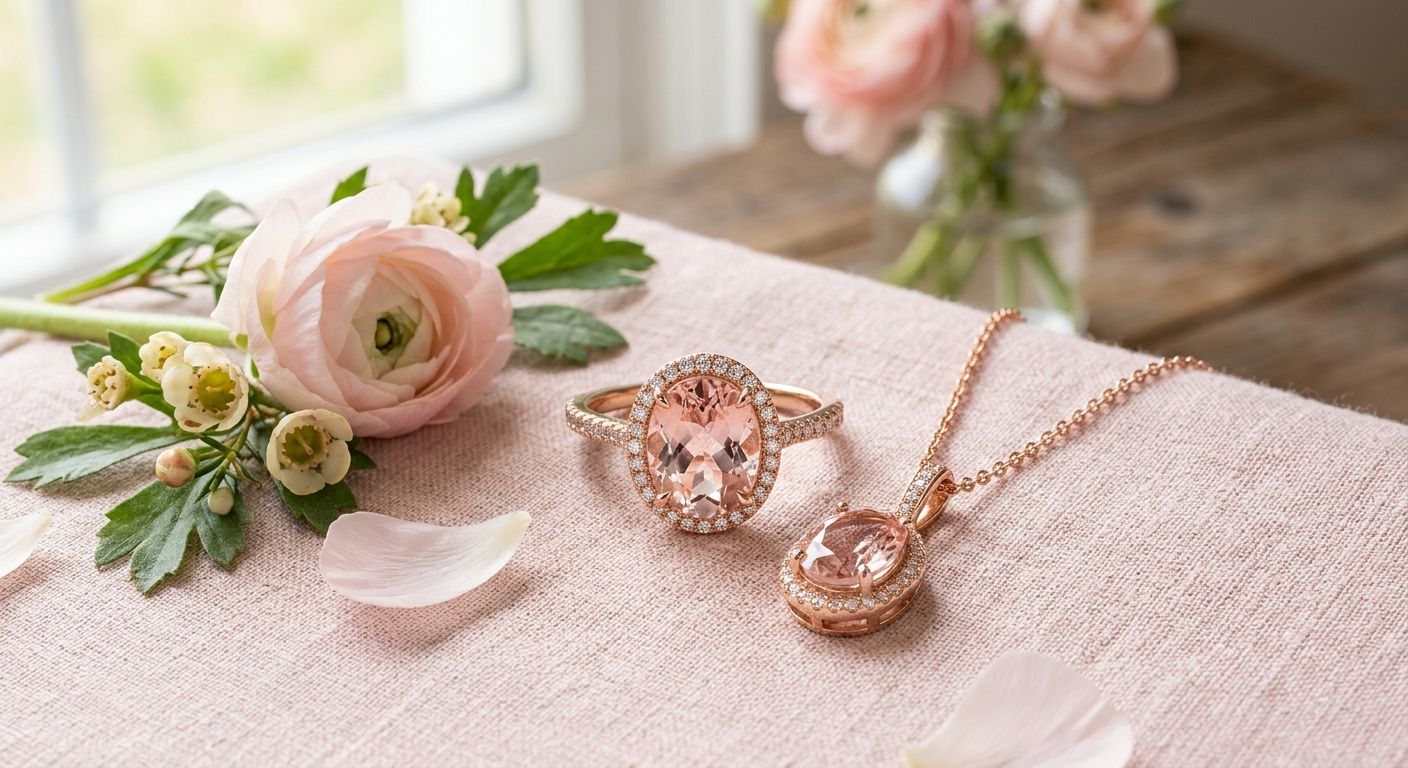
Morganite jewelry for pink gemstone lovers means buying pieces set with peach-to-pink beryl through auction channels rather than mall retail, with the goal of landing a larger, better-colored stone for the same money. This segment cares about three things retail counters rarely explain well: how morganite's color is graded, whether the stone has been heat-treated, and how its price compares to pink sapphire or pink diamond of the same size.
- Morganite is beryl colored by trace manganese, the same mineral family as emerald and aquamarine.
- Most morganite on the market in 2026 is heat-treated to shift a yellowish tone toward pure pink.
- Morganite forms in larger crystals than pink sapphire, so 3-carat-plus center stones are common and affordable at auction.
- Mohs hardness of 7.5-8 makes morganite durable enough for daily wear in rings, but softer than sapphire.
- Certification and treatment disclosure matter more at auction than at a retail counter with a return policy.
Why morganite jewelry matters for pink gemstone lovers
Pink gemstone shoppers usually start by comparing morganite to pink sapphire, pink tourmaline, or kunzite because all four can look similar under store lighting. Morganite wins on size: because beryl crystals grow large in the pegmatite deposits of Madagascar and Brazil, a 3 to 5 carat morganite center stone is routine, while a pink sapphire of that size is rare and priced accordingly. That size advantage is the single biggest reason this segment ends up at auction instead of a jewelry counter.
Before bidding on anything, read up on gemstone certification standards so you know what a lab report should and shouldn't claim about a morganite stone. Morganite was named in 1911 by gemologist George Kunz after financier J.P. Morgan, and it was recognized as its own beryl variety rather than a pink form of aquamarine. That history matters less than the fact that almost every morganite on the market in 2026 has been heat-treated to remove a yellowish undertone and push the color toward pure pink or peach — treatment that's standard, stable, and should still be disclosed on any listing.
Morganite jewelry auctions are the fastest way for pink gemstone lovers to get a larger, better-graded stone than retail markup allows for the same budget.
How to buy morganite jewelry without overpaying
The buying process for morganite differs from diamonds or sapphires because color grading is less standardized and treatment is nearly universal. Work through these steps in order before you place a single bid.
Learn the four grading factors before you shop
Morganite grading isn't governed by a single universal scale the way diamonds are, so you're evaluating four factors by eye and by report:
- Color saturation — ranges from pale pink to deep peachy-pink; deeper, more saturated stones command higher demand
- Clarity — beryl forms with fewer inclusions than emerald, so eye-clean stones are common and shouldn't carry a premium by themselves
- Cut — cushion, oval, and emerald cuts dominate current morganite jewelry listings because they maximize the stone's light return
- Carat weight — because rough crystals run large, carat-for-carat pricing drops less steeply above 3 carats than it does for sapphire or ruby
Verify certification and treatment disclosure
A listing that doesn't mention heat treatment on a morganite stone is either omitting standard information or hasn't been checked closely. Confirm before you bid:
- Whether the listing names a specific gemological lab for the report
- Whether treatment (heat) is explicitly disclosed, not just implied
- Whether the carat weight, measurements, and color description match the certificate
- Whether the report is recent enough to reflect the stone's current setting
Set a hard budget before you bid
Auction adrenaline pushes bidders past their own ceiling more often on colored gemstones than on diamonds, because there's no universal price chart to check against mid-auction. Set your budget before the listing goes live, and write it down somewhere you'll actually look at it. Include:
- Your absolute maximum bid, buyer's premium included
- A separate line for post-auction appraisal and insurance
- A cushion for shipping and any resizing costs
- A walk-away number you commit to before emotions take over
Inspect the setting and metal karat
Morganite's Mohs hardness of 7.5 to 8 holds up fine for daily wear, but the setting metal and prong style matter just as much as the stone:
- Confirm the metal karat (14K, 18K, platinum) is stated, not assumed
- Check prong count and style against the stone's cut — cushion and oval cuts need secure four- or six-prong settings
- Look for existing wear, scratches, or bent prongs in listing photos, since estate pieces see decades of use
- Ask whether the setting has ever been resized, which can weaken shank metal over time
Watch for lookalike gemstones
Pink tourmaline, kunzite, and pink topaz can all pass for morganite in a photo, and pricing differs sharply between them:
- Kunzite is softer (Mohs 6.5-7) and fades with prolonged light exposure — a dealbreaker for a ring worn daily
- Pink topaz is often a color-treated version of colorless topaz and holds a different resale value than natural morganite
- Pink tourmaline runs a different hardness and refractive index than beryl, which a lab report will confirm but a photo won't
Plan insurance before the gavel falls
Don't wait until the piece arrives to think about coverage. Decide your insurance approach before bidding closes so there's no gap between delivery and protection.
Comparing your morganite buying options
| Option | Best for | Key limitation |
|---|---|---|
| Certified auction lots | Buyers who want lab-backed color, clarity, and treatment history | Requires reading the report closely before bidding |
| Estate/vintage morganite | Collectors who want period settings (Art Deco, mid-century) alongside the stone | Setting condition varies piece to piece |
| New retail morganite | Buyers who want a warranty and in-person try-on | Smaller carat sizes at the same price point as auction |
| Loose/custom-cut morganite | Buyers designing a custom setting from scratch | No existing setting means added design and mounting time |
Verdict: certified auction lots give pink gemstone lovers the best carat-per-dollar outcome in 2026, provided the treatment disclosure and lab report are checked before bidding, not after.
Common mistakes pink gemstone buyers make with morganite
- Assuming untreated means better — nearly all morganite on the market is heat-treated, and untreated stones aren't automatically more valuable or more stable
- Confusing morganite with kunzite in photos — kunzite fades with light exposure over years, morganite doesn't, and this distinction only shows up in a lab report
- Chasing the palest pink — pale morganite is common and cheap; deeper peachy-pink saturation is what actually drives resale value
- Skipping the setting inspection — a stunning stone in a worn or bent estate setting still needs a jeweler's check before regular wear
- Bidding past the walk-away number — colored gemstone auctions lack a universal price chart, which makes emotional overbidding easier than on diamonds
Browse live morganite jewelry lots
Auction listings update regularly with certified stones and disclosed treatment history.
FAQ
What's the best cut for morganite jewelry?
Cushion and oval cuts are the most common choices for morganite jewelry in 2026 because they maximize light return in a stone with moderate brilliance. Emerald cuts show off larger, cleaner stones well but reveal inclusions more readily than brilliant-style cuts.
Is morganite jewelry better than pink sapphire?
Morganite offers significantly larger carat sizes for the same budget since beryl crystals grow larger than corundum, while pink sapphire offers greater hardness (9 vs 7.5-8 on the Mohs scale) and lower resale volatility. Choose morganite for size and price, pink sapphire for hardness and long-term value retention.
Is morganite jewelry durable enough for an engagement ring?
Morganite's Mohs hardness of 7.5 to 8 makes it durable enough for daily wear, though softer than sapphire or diamond. A secure setting with well-maintained prongs matters more for morganite's long-term wear than for harder stones.
Is all morganite jewelry heat-treated?
Nearly all morganite sold in 2026 has been heat-treated to shift its color from a yellowish tone toward pure pink or peach. This treatment is standard, stable, and permanent, and should always be disclosed on a certified listing.
How can I tell morganite apart from kunzite or pink topaz?
A gemological lab report is the only reliable way to distinguish morganite from kunzite or pink topaz, since all three can look similar in photos. Kunzite is softer and fades with prolonged light exposure, which morganite does not.
What carat size is considered large for morganite jewelry?
A 3 to 5 carat center stone is common and reasonably priced for morganite because of how large beryl crystals form, unlike pink sapphire where that size is rare. Stones above 8 carats move into statement-piece territory.
Should I buy morganite jewelry at auction or retail?
Auction typically delivers a larger, better-graded morganite stone for the same budget as retail, provided you verify the certification and treatment disclosure before bidding. Retail offers in-person try-on and a straightforward return policy that auction generally doesn't.
Does morganite jewelry hold its value?
Morganite's value depends heavily on color saturation and carat size rather than brand or setting, and deeper peachy-pink stones hold demand better than pale ones. Resale value stays more stable when the piece comes with a lab certificate confirming treatment and origin.
One last thing
The carat-size gap is the detail most pink gemstone buyers miss: because beryl crystals form larger than corundum, a 4-carat morganite center stone sits in a completely different price bracket than a 4-carat pink sapphire of comparable quality, even though both wear the same soft pink color on a finger. That gap is exactly why morganite jewelry keeps showing up in auction catalogs in 2026 as the practical alternative for buyers who want size and color without sapphire or pink diamond pricing.


