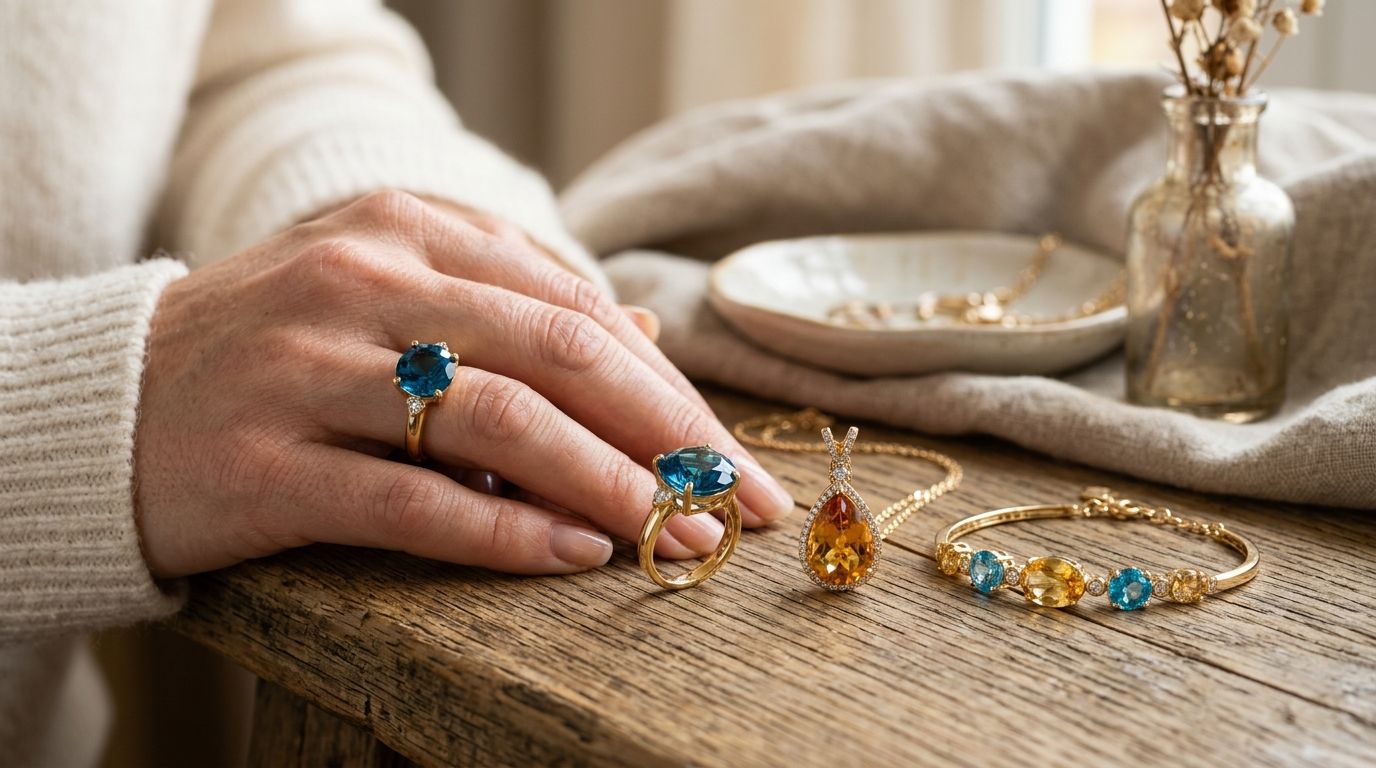
Topaz jewelry for November birthstone buyers means choosing between treated blue topaz, rare imperial topaz, and the alternate birthstone citrine — with the goal of landing an authentic stone at a price that beats retail. The segment's real challenge isn't finding topaz; it's telling treated color from natural rarity before a bid closes.
- Topaz jewelry for November birthstone buyers spans treated blue topaz, rare imperial topaz, and citrine alternatives.
- Blue topaz is almost always irradiated and heat-treated in 2026 — disclosure is standard, not a red flag.
- Jewelryroom.com lists topaz jewelry at auction with estimates typically set below comparable retail prices.
- Set a hard budget before bidding; proxy bidding keeps emotion out of the final price.
- Imperial topaz carries the highest per-carat value in the topaz family this year.
Why topaz jewelry matters for November birthstone buyers
November has two recognized birthstones — topaz and citrine — and buyers searching for topaz jewelry are usually trying to sort out which one they actually want before they spend anything. Topaz occurs naturally in blue, but almost all the saturated blue topaz on the market got there through irradiation followed by heat treatment, a decades-old process the trade discloses as standard practice. Imperial topaz, the orange-pink to reddish variety, is the one that occurs naturally in that color and carries real rarity value.
That distinction changes what a buyer should pay. A birthstone gift buyer chasing a deep blue stone for under retail is shopping a different market than a collector after natural imperial topaz, and auction listings on Jewelryroom.com separate the two by estimate range rather than by marketing language. Knowing which category you're in before you bid is the single decision that prevents overpaying in November, the month topaz demand spikes on birthday and holiday searches.
How to buy topaz jewelry as a November birthstone gift
Identify which topaz color you're actually buying
Topaz jewelry listings use color names loosely, and a buyer who doesn't check the specifics ends up comparing the wrong prices.
- Confirm whether the listing says "blue topaz," "London blue," "Swiss blue," or "sky blue" — these are treatment-intensity grades, not separate gem species.
- Ask whether "imperial topaz" is used loosely for orange citrine or accurately for natural imperial topaz.
- Check for "mystic topaz," which is colorless topaz coated with a thin film to produce rainbow color — the coating can wear.
- Note carat weight and cut; topaz is often cut in large stones because rough is comparatively abundant.
Check the treatment disclosure before you get attached to the color
Every reputable auction listing for blue topaz should state the treatment. If it doesn't, that's the flag, not the treatment itself.
- Look for the words "irradiated" and "heat-treated" together in the listing description.
- Understand that treated blue topaz is stable and permanent — the color won't fade with normal wear.
- Ask for a lab report on any stone marketed as natural imperial topaz over 2 carats.
- Cross-check the listing photo against natural light; heavily saturated "Swiss blue" under studio lighting can look different in daylight.
Verify certification and hallmarks on the setting
The stone is half the purchase — the metal setting is the other half, and it needs its own verification pass.
- Confirm the metal hallmark (14k, 18k, 925) is legible in the listing photos, not just stated in text.
- Request a gemological report for any topaz over roughly 5 carats before you commit a bid.
- Read how to research a gemstone's certification before bidding for the specific questions to send an auction house before bidding closes.
- Ask whether the certificate names the treatment explicitly — a report that's silent on treatment is a report you should question.
Set your budget before the auction opens, not during it
Birthstone gift shoppers lose more money to auction-day emotion than to bad stones. A number decided in advance fixes that.
- Decide your maximum bid, including the buyer's premium, before the listing goes live.
- Build in the treatment status — treated blue topaz should price meaningfully below natural imperial topaz of comparable size.
- Use how to set a budget for online jewelry auctions to build the number correctly the first time.
- Leave a buffer for shipping and insurance rather than spending to the exact ceiling.
Compare the auction estimate against current retail pricing
An estimate that looks low only means something once you know what retail charges for the same category.
- Search recent retail listings for comparable carat weight, color grade, and metal purity.
- Treat a wide estimate range (low to high) as a signal of uncertain demand, not a bargain.
- Factor in that imperial topaz retail pricing varies far more than treated blue topaz, which trades in a tighter band.
- Note that citrine, the alternate November stone, retails significantly below topaz at comparable size — don't compare the two directly.
Place your bid with a strategy, not a reflex
How you bid matters as much as what you bid on, especially in the final minutes of a listing.
- Set your maximum in a proxy bid rather than watching the clock and bidding manually.
- Read how to place a proxy bid on jewelry auctions before your first live auction if you haven't bid this way before.
- Avoid bidding in the last 60 seconds unless the platform extends automatically — snipe bids can lock you out.
- Walk away at your ceiling; a second imperial topaz listing turns up more often than buyers expect.
Plan insurance and care once you've won
Topaz rates an 8 on the Mohs hardness scale, durable enough for daily wear, but it has a cleavage plane that can chip on a hard knock.
- Insure any topaz piece over a modest value the same week you win it, before it ships.
- Store topaz jewelry away from harder stones like sapphire or diamond to avoid surface scratches in a shared box.
- Clean with warm water and mild soap; skip ultrasonic cleaners on treated or coated topaz.
- Avoid prolonged direct sunlight on some treated blue topaz, which can fade slightly over years with heavy exposure.
“If the certificate doesn't name the treatment, assume the color came from a lab, not the earth.”
Comparing your topaz options
| Option | Best For | Key Limitation | Verdict |
|---|---|---|---|
| Blue topaz (treated) | Budget gift buyers wanting the classic November color | Color comes from irradiation and heat treatment, not natural rarity | Buy for gifting |
| Imperial topaz | Collectors wanting the rarest topaz variety | Limited auction supply; prices can run well past the low estimate | Buy for collecting |
| White/colorless topaz | Buyers wanting a diamond-look accent stone | Less brilliance than diamond or white sapphire | Hold unless priced well |
| Citrine (alternate birthstone) | Buyers wanting a warm-toned November gift without treatment questions | Not topaz — a separate quartz mineral entirely | Buy if color matters more than species |
Browse topaz jewelry at auction
Compare current topaz listings and estimates before you set a bid.
Common mistakes November birthstone buyers make
- Treating citrine and topaz as interchangeable because both are marketed as the November birthstone — they're different minerals with different value curves.
- Assuming blue topaz's saturation is natural and paying imperial-topaz prices for a treated stone.
- Skipping certification because the setting looks vintage — an old mount doesn't verify what's set into it.
- Bidding on "mystic topaz" without knowing it's a surface coating, then being surprised when the rainbow effect dulls with wear.
- Forgetting the buyer's premium when setting a budget, then blowing past the intended ceiling by 15-25% at settlement.
FAQ
Is topaz or citrine the real November birthstone?
Both are recognized November birthstones under the modern birthstone list. Topaz is the older tradition; citrine was added later as a more affordable alternative in the same warm color family.
Is blue topaz jewelry treated, and does that matter?
Nearly all blue topaz on the market in 2026 is irradiated and heat-treated to reach its color, and the treatment is permanent and standard industry practice. It matters for pricing, not durability — treated stones should cost less than natural imperial topaz of the same size.
What is imperial topaz and why is it more expensive?
Imperial topaz is the naturally orange-pink to reddish variety of topaz, and it's rarer than blue topaz because its color occurs without treatment. Auction estimates for imperial topaz run well above treated blue topaz at comparable carat weight.
How much does topaz jewelry cost at auction versus retail?
Auction estimates for topaz jewelry are typically set below comparable retail listings, though the gap narrows for rare imperial topaz where demand is higher. Compare the specific carat weight, color grade, and metal purity before assuming a discount.
Can topaz jewelry be worn every day?
Topaz rates an 8 on the Mohs hardness scale, which makes it durable enough for daily wear like rings and earrings. It does have a cleavage plane, so a hard direct knock can chip it more easily than a diamond would handle the same impact.
What is mystic topaz?
Mystic topaz is colorless topaz coated with a thin film that produces a rainbow color effect. The coating sits on the surface rather than being part of the stone, so it can wear or dull over years of use.
How do I know if a topaz auction listing is trustworthy?
Check that the listing discloses treatment status, includes a legible metal hallmark in photos, and offers a gemological report for higher-value stones. A listing that's silent on treatment for a saturated blue stone is worth a direct question before bidding.
Should I buy topaz or citrine as a November birthday gift?
Choose topaz if the recipient wants the traditional stone and you've confirmed treatment disclosure on blue varieties. Choose citrine if budget matters more than species — it delivers a similar warm color at a lower price point.
One last thing
The detail most November birthstone buyers miss: imperial topaz and citrine can look nearly identical in a photo, but only one of them is topaz. If a listing doesn't specify the mineral by name, ask before you bid — the price difference between the two is not small, and it's the single question that separates a good topaz jewelry purchase from a mislabeled one in 2026.


