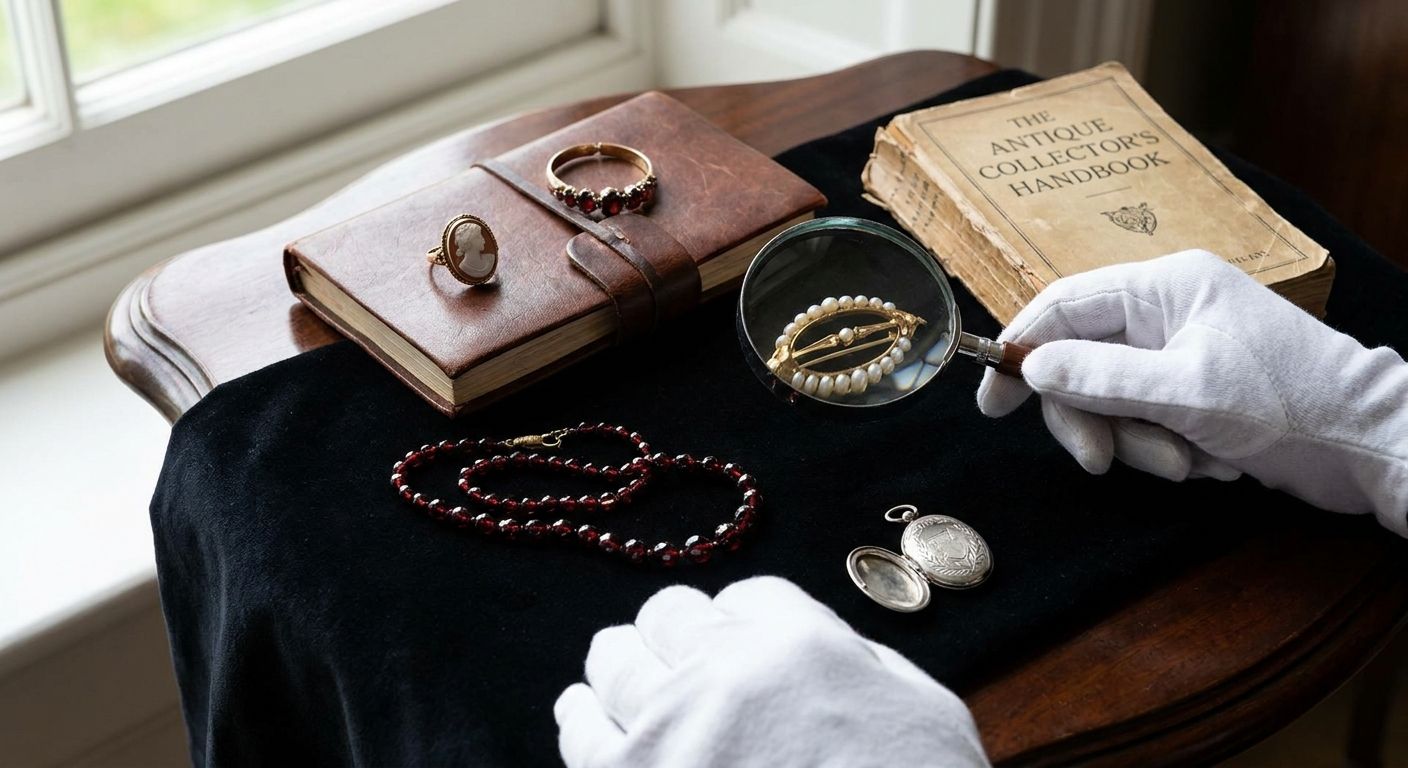
Victorian jewelry collectors buying at auction need pieces with verified hallmarks, period-correct construction, and a documented chain of ownership — not just a flattering photo and a low opening bid. The Victorian era runs from 1837 to 1901 and splits into three distinct design periods (Romantic, Grand, and Aesthetic), so a collector's checklist looks nothing like a buyer shopping for a modern engagement ring. Getting the era wrong, or missing a re-shanked ring or a replaced clasp, is how collectors overpay for a piece that isn't what the listing claims.
- Victorian jewelry collectors should confirm the sub-period (1837-1861, 1861-1885, 1885-1901) before bidding — construction and motifs shifted with each.
- Hallmarks matter more than photos: the 1854 UK law introducing 9ct, 12ct, 15ct and 18ct gold standards is the single fastest authenticity check.
- Verify the auction house's reputation and return policy before bidding on any Victorian lot over a few hundred dollars.
- Appraise estate jewelry independently when the piece carries gemstones over 1 carat or claims a named provenance.
- Jewelryroom.com lists vetted Victorian-era lots for collectors who want documented history over guesswork.
Why Victorian jewelry auctions matter for collectors
Victorian pieces were hand-fabricated, one at a time, using techniques that mass production replaced by the early 1900s — rose-cut and old mine-cut diamonds, foil-backed pastes, seed pearl clusters, and mourning jewelry made with jet or woven hair. That means no two authentic pieces are truly identical, which is exactly what makes provenance and hallmark verification non-negotiable before you bid.
Collectors chasing this category also compete with dealers who buy to resell, so lots with clean documentation move fast and at a premium. A browse current auctions approach only works if you already know what separates a genuine 1870s brooch from a later revival piece — the sections below cover exactly that.
Identify the sub-period before you bid
Dating a piece to the correct decade changes both its value and what flaws are acceptable.
- Romantic period (1837-1861): serpent motifs, acrostic jewelry, botanical and love-token themes
- Grand period (1861-1885): heavier, darker designs following Prince Albert's death — jet, onyx, mourning rings
- Aesthetic period (1885-1901): lighter settings, star and crescent motifs, early platinum-topped gold work
- Cross-reference catalog descriptions against known motifs for the claimed decade
- Flag listings that mix motifs from two periods — a common sign of a later reproduction
Verify hallmarks and metal purity
Hallmarks are the fastest, cheapest authenticity check available and cost nothing to run yourself.
- Confirm gold purity marks (9ct, 12ct, 15ct, 18ct) match the 1854 UK standard if the piece is British
- Check for maker's marks stamped inside a ring shank or on a brooch pin catch
- Use a jeweler's loupe (10x) to check whether marks are crisp (original) or soft and shallow (later re-stamp)
- Look up unfamiliar maker's marks against published Victorian hallmark registries before bidding
- Treat unmarked gold-colored pieces as gold-filled or gilt metal unless proven otherwise
Check for period-correct construction
Construction details are harder to fake than a hallmark, which makes them the better tell for a serious collector.
- Look for hand-cut prongs and irregular bezel work — Victorian settings were never machine-perfect
- Check pin catches on brooches: C-clasps and trombone clasps predate the safety catch, which appeared closer to 1900
- Inspect for foil-backed stones under closed-back settings, common in early Victorian paste and garnet jewelry
- Confirm rose-cut or old mine-cut diamonds rather than modern brilliant cuts, which signal a later reset
- Ask the seller for macro photos of the reverse side, not just the face of the piece
Research provenance and prior ownership
A documented history adds real value and protects you from buying a stolen or misattributed piece.
- Request any accompanying receipts, insurance appraisals, or estate paperwork tied to the lot
- Ask the auction house directly how the piece's ownership chain was confirmed
- Cross-check named provenance claims (a specific estate or family name) against public probate or estate-sale records where available
- Treat "family heirloom, no documentation" as a price-reducing factor, not a red flag by itself
Set a realistic budget by category
Victorian mourning jewelry, signed pieces, and gem-set brooches sit in very different price tiers, so a single budget number rarely works across the category.
- Separate your budget into "decorative" (jet, hairwork, low-karat gold) and "fine" (diamonds, colored gemstones, signed pieces) buckets
- Build in a buffer of 10-15% above your target bid for buyer's premiums, which most auction houses charge
- Decide your walk-away price before the auction starts, not during live bidding
- Track a few comparable past sales for the same maker or motif before setting a ceiling
Verify the auction house's reputation
The auction house matters as much as the piece — a vetted house catches reproductions before they reach the catalog.
- Check how long the house has operated and whether it specializes in estate or antique jewelry specifically
- Read return and authenticity-guarantee policies before bidding, not after winning the lot
- Look for third-party gemological documentation attached to higher-value lots
- Confirm the house's dispute process for a piece that arrives misdescribed
Most of this diligence happens before you ever place a bid, and how to verify an auction house's reputation walks through the specific questions to ask a house before you commit money.
Appraise the piece before your final bid
An independent appraisal is the last checkpoint, especially for lots priced as "fine" rather than "decorative."
- Request a condition report that notes any repairs, replaced stones, or re-shanked bands
- Get gemstones over roughly 1 carat verified by a gemologist when the auction allows pre-bid inspection
- Compare the appraised weight and metal content against the catalog description
- Walk away from any lot where the house won't answer condition questions directly
For a full walkthrough of what a pre-bid appraisal should cover, how to appraise estate jewelry before bidding breaks the process into steps you can run yourself before the auction closes.
Where Victorian jewelry collectors actually buy
| Option | Best for | Key limitation |
|---|---|---|
| Specialized jewelry auction houses | Collectors who want vetted period pieces with documented history | Requires patience for the right lot to come up |
| General antique dealers and shops | Buyers who want to inspect a piece in hand before buying | Inventory limited to what one dealer has sourced |
| Estate sales and flea markets | Bargain hunters willing to run their own authentication | Reproductions and married pieces circulate with no recourse |
| General online marketplaces | Casual buyers comparing many photos at once | Listings rarely include verified hallmark or provenance detail |
Victorian jewelry collectors get the best odds at specialized auction houses that document hallmarks, condition, and provenance before listing a lot — everywhere else shifts that verification work onto the buyer.
“A Victorian piece with no hallmark and no provenance isn't a bargain — it's a research project you haven't finished yet.”
Common mistakes Victorian jewelry collectors make
- Buying on motif alone. A serpent ring or mourning brooch photograph looks the part, but motifs were revived repeatedly through the 20th century — motif alone doesn't date a piece.
- Skipping the reverse-side photos. Collectors who only review the face of a brooch or ring miss re-soldered pin catches and replaced findings that mark a later repair.
- Ignoring buyer's premiums when budgeting. A winning bid isn't the final cost — factor the premium in before you set your ceiling, not after you've won the lot.
- Trusting "Victorian style" language in a listing. That phrase legally covers reproductions made any time after 1901; it is not the same claim as "Victorian, circa 1870."
- Skipping the auction house's return policy. Collectors who don't confirm the misdescription and return process before bidding have no recourse when a hallmark turns out to be re-stamped.
Bid on vetted Victorian jewelry
Browse current estate and antique lots with documented provenance.
FAQ
What makes a piece of jewelry Victorian?
A piece qualifies as Victorian if it was made between 1837 and 1901, during Queen Victoria's reign. Collectors further split the era into Romantic (1837-1861), Grand (1861-1885), and Aesthetic (1885-1901) periods, each with distinct motifs and construction.
How do you tell real Victorian jewelry from a reproduction?
Check hallmarks against known Victorian-era standards, inspect construction details like hand-cut prongs and period-correct clasps, and request provenance documentation. Reproductions often mix motifs from multiple decades or use machine-perfect settings that Victorian craftsmen couldn't achieve by hand.
Is Victorian jewelry a good investment for collectors in 2026?
Signed, well-documented Victorian pieces with verified hallmarks tend to hold value better than undocumented "Victorian style" lots. Value depends heavily on condition, maker, and gemstone quality, not just age.
What's the difference between Victorian and Art Deco jewelry?
Victorian jewelry (1837-1901) favors hand-fabricated settings, rose-cut stones, and romantic or mourning motifs. Art Deco jewelry, which followed in the 1920s and 1930s, uses geometric patterns and machine-precise settings — a very different collecting category covered separately for antique dealers.
How much of a budget buffer should collectors set for buyer's premiums?
Build in roughly 10-15% above your target winning bid to cover the buyer's premium most auction houses charge. Confirm the exact premium rate with the specific auction house before bidding, since rates vary by house.
Do Victorian pieces need a gemologist appraisal before bidding?
Yes, for any lot with gemstones over roughly 1 carat or a fine-jewelry price tier. A pre-bid condition report and independent appraisal catch replaced stones or re-shanked bands that catalog photos won't show.
What hallmarks should I look for on Victorian gold jewelry?
British Victorian gold typically carries 9ct, 12ct, 15ct or 18ct purity marks, standards set by an 1854 law, along with a maker's mark stamped inside the shank or on the pin catch. Soft, shallow, or misaligned marks suggest a later re-stamp.
Where do serious Victorian jewelry collectors buy in 2026?
Specialized jewelry auction houses that document hallmarks, condition, and provenance before listing remain the most reliable source. General marketplaces and flea markets shift the authentication burden onto the buyer.
One last thing
The single detail most collectors skip is checking the pin catch on a brooch: a trombone or C-clasp is a strong sign of pre-1900 manufacture, while a spring safety catch usually signals a later piece or a replaced finding — check that one detail before you check anything else.


