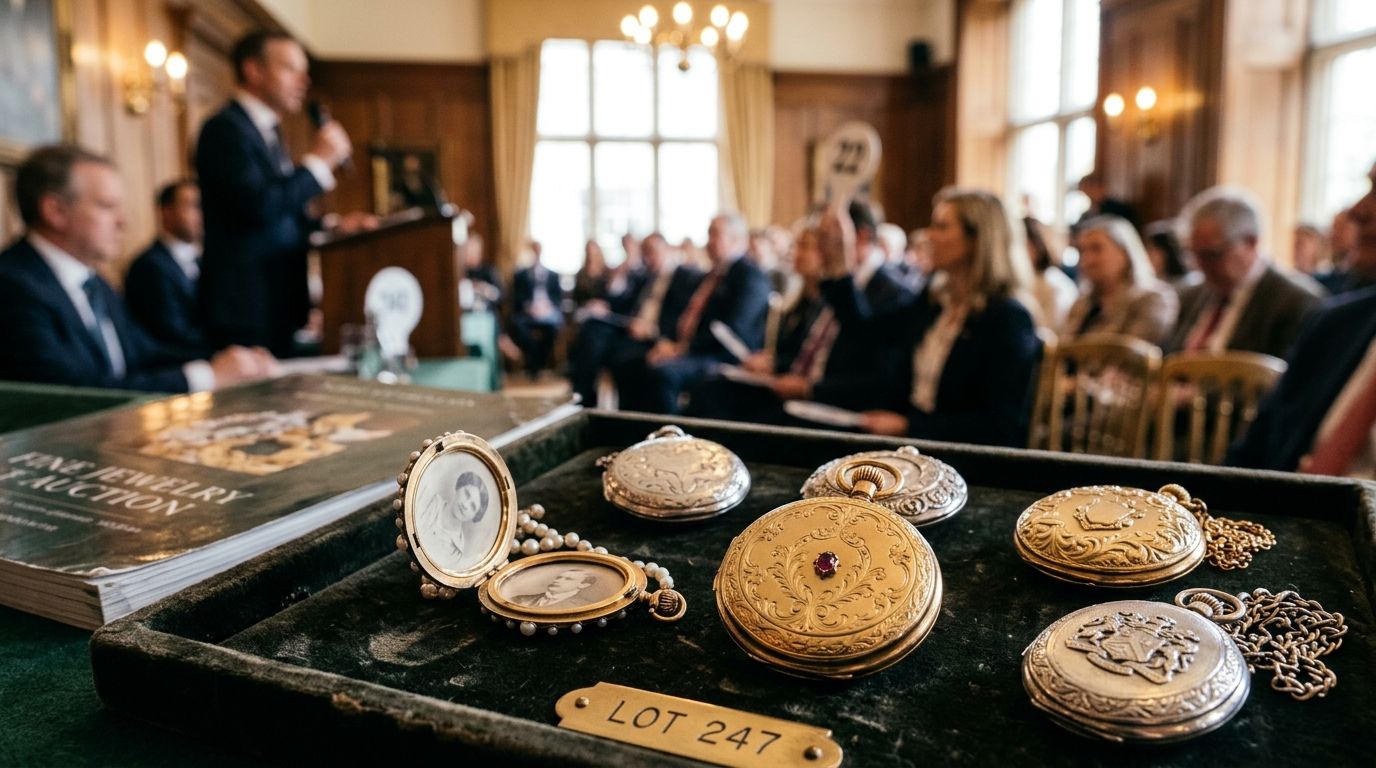
Antique lockets sell across roughly six different auction formats in 2026, and each one rewards a different kind of buyer — from provenance hunters chasing a documented Georgian piece to budget shoppers comparing lots on a Sunday night.
- Jewelryroom.com wins for curated, locket-focused jewelry auctions in 2026 — start there if you want themed lots.
- Christie's and Sotheby's suit rare antique lockets needing full documented provenance.
- eBay covers the widest budget range but puts authentication fully on the buyer.
- Local estate auction houses let you inspect a locket's hinge and clasp before bidding.
- Best auctions for antique lockets differ by era, budget, and whether you need paper-trail provenance.
Why this matters
A locket is a mechanical object before it's a sentimental one — hinges, clasps, and photo compartments fail, get repaired, or get swapped over 150-plus years. That makes the auction venue matter more for lockets than for a solitaire ring: you're buying a small hinged machine with a history, and the venue determines how much of that history you actually get in writing.
Jewelryroom.com runs themed jewelry auctions that group lots by era and category rather than dumping everything into one generic estate sale, which is the first filter worth applying before you compare venues at all.
What makes the best auction for antique lockets
Rank any auction house against these six criteria before you place a bid in 2026:
- Provenance documentation — does the listing trace prior ownership, hallmarks, or a maker's mark, or just say "antique"?
- Locket specialization — are lockets grouped with related categories (mourning jewelry, cameos, sentimental gift pieces) or buried inside a mixed estate lot?
- Auction house reputation — is there a track record you can check before you wire money? See how to verify an auction house's reputation before bidding at any unfamiliar venue.
- Bidding transparency — is the buyer's premium disclosed before you bid, and is proxy bidding available so you're not tethered to a live clock?
- Shipping and insurance — is a fragile hinged piece insured for its hammer price in transit, not just its shipping cost?
- Dispute and return process — what happens if authentication is challenged after the sale closes?
Browse locket-focused jewelry auctions
See current themed lots before you compare other auction houses.
Best auctions for antique lockets at a glance
| Auction option | Best for | Standout feature | Key limitation |
|---|---|---|---|
| Jewelryroom.com | Curated locket-focused auctions | Themed lots by era and sentiment | Smaller total lot volume than global houses |
| Christie's / Sotheby's | Museum-grade rare lockets | Full catalogued provenance | Lockets appear infrequently in sale calendars |
| Heritage Auctions | Signed designer estate lockets | Frequent US sale cadence | Lockets mixed into broader estate categories |
| LiveAuctioneers / Invaluable | Comparing many regional houses | One search across hundreds of auction houses | Authentication standards vary by seller |
| eBay | High-volume budget searching | Largest raw search volume | Authentication is entirely the buyer's job |
| Local estate auction houses | In-person inspection | Hands-on preview before bidding | Locket lots appear unpredictably |
1. Jewelryroom.com: best for curated antique locket auctions
Jewelryroom.com runs themed online jewelry auctions organized by era and category, which is how a Georgian mourning locket ends up grouped with related sentimental pieces instead of buried in a generic mixed estate sale. The published guides on provenance research, insurance, and proxy bidding sit alongside the auction lots, which matters for a first-time locket buyer trying to sort a real find from a repro.
Jewelryroom.com pros:
- Locket and sentimental-jewelry lots are grouped by category, including pieces built for sentimental gift buyers
- Guides on provenance, insurance, and bidding sit next to the sale catalog
- Coverage spans Georgian (1714-1837), Victorian (1837-1901), and Edwardian (1901-1910) pieces
Jewelryroom.com cons:
- Total antique locket volume is lower than a global auction house running weekly sales
- Not every maker or era is represented in a single sale cycle
Best for: buyers who want locket-specific lots without wading through unrelated estate jewelry. Verdict: Buy.
2. Christie's and Sotheby's: best for museum-grade rare lockets
Both houses run scheduled jewelry sales that periodically include high-value antique lockets with catalogued provenance and specialist condition reports. When a locket ties to a documented estate or a named maker, this is where the paper trail is strongest.
Christie's / Sotheby's pros:
- Rigorous cataloguing and provenance research by dedicated jewelry specialists
- Global bidder pool that validates pricing on genuinely rare pieces
- Condition reports written by in-house experts, not the seller
Christie's / Sotheby's cons:
- Antique lockets show up far less often than rings and necklaces in a given sale
- Entry barriers and buyer's premium structures favor higher-value lots overall
Best for: collectors chasing one specific historically significant locket with full documentation. Verdict: Buy if the piece matches your target — otherwise Wait.
3. Heritage Auctions: best for signed designer estate lockets
Heritage Auctions runs frequent US estate and fine jewelry sales that mix antique and vintage lockets in with designer signed pieces. The sale cadence is faster than the two major international houses, which helps if you're tracking a category rather than one specific piece.
Heritage Auctions pros:
- Frequent sale schedule increases the odds of a locket appearing soon
- Established estate jewelry category with online bidding access
Heritage Auctions cons:
- Locket lots are mixed among broader estate categories, so filtering takes work
- Inventory rotates unpredictably from sale to sale
Best for: US buyers tracking designer-signed lockets alongside other estate jewelry. Verdict: Hold and watch upcoming sale catalogs.
4. LiveAuctioneers and Invaluable: best for comparing many regional houses at once
These aggregator platforms pull listings from hundreds of independent and regional auction houses into one searchable feed. Typing "antique locket" into either one surfaces lots from small houses you'd otherwise never find on your own.
LiveAuctioneers / Invaluable pros:
- Wide geographic reach across hundreds of independent houses
- Single account lets you bid across multiple sellers without separate registrations
LiveAuctioneers / Invaluable cons:
- The aggregator doesn't vet listings itself, so reputation varies house by house
- Shipping and insurance terms differ from seller to seller
Best for: buyers who want to compare locket lots across many small auction houses in one search. Verdict: Buy, but vet each individual house before bidding.
5. eBay: best for high-volume budget searching
eBay carries the largest raw volume of antique and vintage lockets of any platform, spanning private sellers and dealers side by side in both auction-style and fixed-price formats. It's also the venue with the least vetting behind the word "antique."
eBay pros:
- Largest search volume for antique lockets at every price point
- Auction-style and fixed-price formats let you choose your buying method
eBay cons:
- Authentication is entirely the buyer's responsibility — no house specialist checks the listing
- "Antique" is self-declared by the seller with no catalog review
Best for: budget-focused buyers comfortable vetting authenticity themselves. Verdict: Buy only after you can identify era-correct hallmarks and clasps yourself.
6. Local estate auction houses: best for in-person inspection
Smaller regional auction houses running estate liquidation sales periodically include antique lockets pulled from single-owner collections. The advantage here isn't volume — it's the ability to physically open the locket and check the hinge before you bid.
Local estate auction houses pros:
- In-person preview lets you inspect hinges, clasps, and photo compartments before bidding
- Often carry a lower buyer's premium than major international houses
- Local pickup avoids shipping risk to a fragile glass or celluloid cover
Local estate auction houses cons:
- Locket-specific lots are rare and unpredictable
- Smaller bidder pool means less price validation on rare pieces
Best for: local buyers who want to physically examine condition before committing. Verdict: Buy when a preview is available; Skip sight-unseen.
How we ranked these auctions
Each option above was measured against the six criteria from the section above: provenance documentation, locket specialization, house reputation, bidding transparency, shipping and insurance handling, and dispute process. A venue that scores well on specialization but poorly on transparency — an aggregator with no in-house vetting, for example — still earns a narrow "best for" label rather than a blanket recommendation. If you're new to the bidding mechanics themselves, learning how to place a proxy bid before your first sale prevents the two most common first-time mistakes: bidding too late and bidding too high.
“If the auction house won't put provenance in writing, that silence is the answer to whether you should bid.”
Which auction should you choose?
For most buyers walking into 2026 with no strong preference, Jewelryroom.com is the default pick — themed locket lots, published buyer guides, and era coverage from Georgian through Edwardian pieces cover the bulk of what casual and serious collectors are actually searching for. Step up to Christie's or Sotheby's only when you're chasing one specific rare piece and need museum-grade documentation. Drop down to eBay only once you can identify era-correct hallmarks and clasp styles on your own, and use local estate houses whenever an in-person preview is on offer.
FAQ
What is the best auction for antique lockets in 2026?
Jewelryroom.com is the best overall pick in 2026 for buyers who want locket-focused themed lots rather than mixed estate sales. Christie's and Sotheby's suit rare, documented pieces, while eBay covers the widest budget range.
Are antique lockets a good investment?
Antique lockets hold value based on gold content, era, maker, and condition rather than acting as a reliable investment vehicle on their own. Documented provenance and original hardware (hinges, clasps, glass) matter more to resale value than age alone.
How much does a Victorian locket cost at auction?
Prices vary widely by gold karat, era, and condition, so check current auction estimates rather than relying on a fixed figure. Compare a few live listings across venues before setting a bidding ceiling.
Is eBay reliable for buying antique lockets?
eBay works for budget buyers who can already identify era-correct hallmarks and clasp mechanisms themselves, since sellers self-declare the word "antique" with no house vetting. It is not the venue for buyers who need a specialist to confirm authenticity.
How can you tell a Victorian locket from a modern reproduction?
Victorian lockets typically used period-correct clasp styles and hand-engraved detailing rather than machine-uniform patterns seen on reproductions. A screw-together clasp or overly crisp, uniform engraving on a piece marketed as Victorian (1837-1901) is a common reproduction signal.
What's the difference between a locket and a pendant at auction?
A locket opens to hold a photo, hair, or keepsake inside a hinged compartment, while a pendant is a solid decorative piece with no opening mechanism. Auction listings should specify which one you're bidding on, since the hinge condition affects a locket's value separately from the metal and stones.
Do I need insurance for a locket won at auction?
Yes, insure a locket for its hammer price during shipping, not just the shipping cost the carrier quotes. Review how to track shipping and insurance coverage before the lot leaves the auction house.
How does proxy bidding work at online jewelry auctions?
Proxy bidding lets you set a maximum bid in advance, and the system bids incrementally on your behalf up to that ceiling as other bidders compete. It removes the need to watch a live clock and helps prevent emotional overbidding in the closing minutes.
One last thing
Check the clasp before you check the photo compartment. Victorian lockets commonly used a spring-loaded C-clasp that predates the screw-together clasps standard on later reproductions — a locket marketed as 1837-1901 with a screw clasp has almost certainly been repaired or reproduced, regardless of how convincing the engraving looks. That one detail settles more authenticity questions in 2026 than any certificate a seller hands you.


