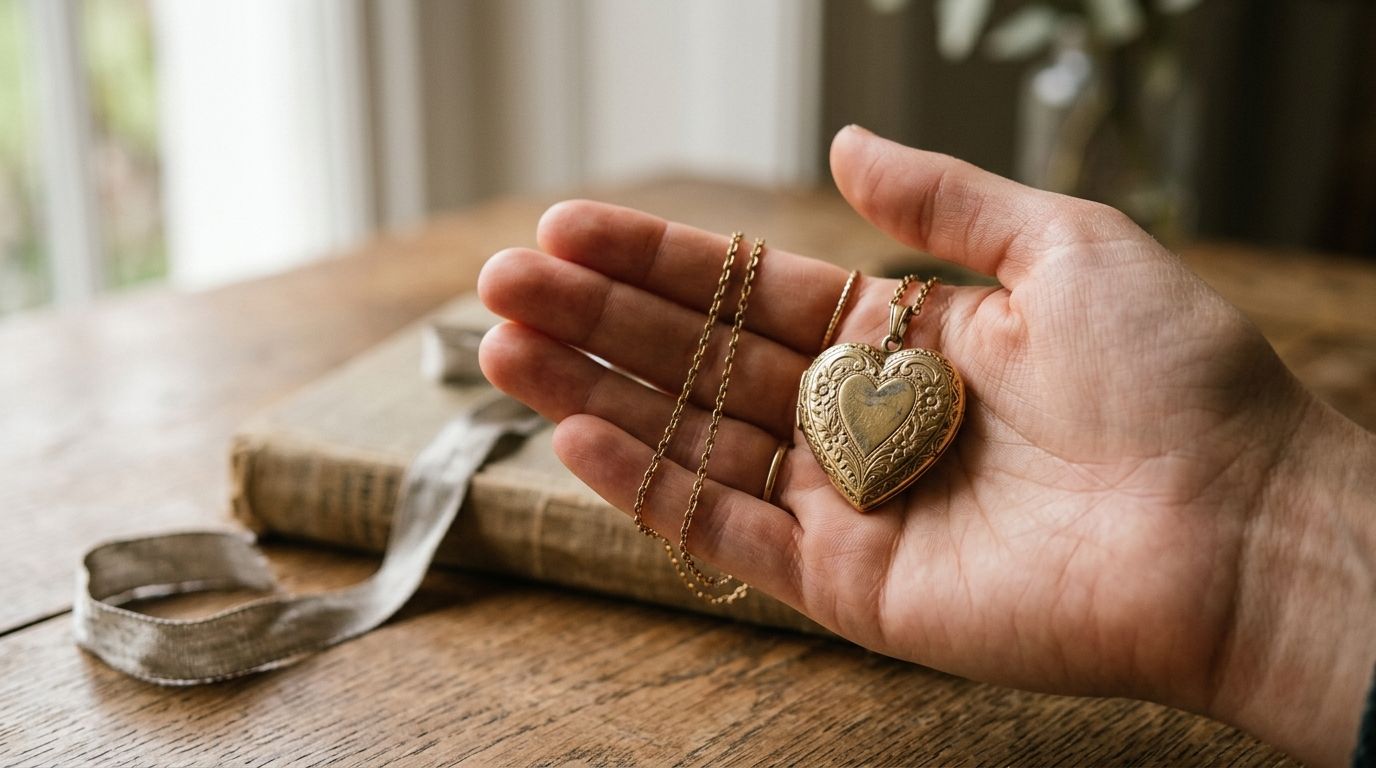
Antique lockets for sentimental gift buyers are pendant jewelry pieces designed to hold a photo, lock of hair, or small keepsake, bought to mark a relationship or memory rather than as a fashion accessory. This segment shops differently than general jewelry buyers: meaning comes first, carat weight second, and they research an era, an engraving, or a hallmark before they ever look at price.
- Antique lockets from the Victorian and Edwardian eras (1837-1910) dominate sentimental gift searches in 2026.
- Check the auction house return policy and condition disclosure before bidding on any locket with a photo compartment.
- Hallmarks stamped inside the bail or rim confirm metal fineness better than a listing title does.
- Proxy bidding protects sentimental buyers from emotional overbidding on a single meaningful piece.
- Hinges are the most common failure point on a 100-year-old locket, so inspect them on arrival.
Why antique lockets matter for sentimental gift buyers
Sentimental gift buyers do not behave like collectors chasing rarity. They search for a locket tied to a birth year, an anniversary, or a family origin, and they will choose a piece with an engraved initial and a working compartment over one with slightly better metal purity. That changes what "best" means here: the condition of the hinge and clasp outranks gemstone grade, and documented provenance outranks a matching set.
This segment also skews toward first-time bidders. Someone buying an antique locket as a memorial or engagement gift is often bidding at Jewelryroom.com or a comparable jewelry auction platform for the first time, so the buying process needs explaining as much as the product does.
One more constraint separates this group: the purchase usually has a date attached. A birthday, a wedding, a memorial service. A piece that arrives damaged cannot simply be relisted at a small loss — it misses the occasion entirely.
Decide what the locket needs to hold
Before you open a single listing, decide whether the locket must physically hold something or only symbolize a memory. This one decision cuts your shortlist in half.
- Photo lockets need an intact glass or celluloid insert, or enough depth to fit a modern photo trimmed to size
- Hair lockets, common in Victorian mourning jewelry, hold a woven compartment behind glass rather than a simple oval frame
- Symbolic lockets with no working compartment open up damaged pieces that still look right on a chain
- Double-sided lockets fit two photos, or a photo plus an engraving, which suits couples and parent-child gifts
Verify the era and the hallmark
Antique lockets get misdated constantly, by sellers who do not know better and by sellers who do. A locket called "Victorian" with no hallmark check could be Edwardian, or a 1920s revival piece built to look older.
- Look for hallmarks stamped inside the bail or on the rim, which indicate metal fineness and often origin
- Cross-reference engraving style: Victorian (1837-1901) favors floral and mourning motifs, Edwardian (1901-1910) favors garlands and bows, Art Nouveau favors flowing organic lines
- Request a closeup photo of any maker's mark before bidding, never after
- Check hinge construction, since hand-cut hinges with visible file marks generally predate machine-stamped hinges
The hallmark patterns collectors check first are broken down in the guide to Victorian antique jewelry.
Vet the auction house before you bid
This step matters more for sentimental buyers than for investment buyers, because the piece is tied to a fixed occasion and cannot be swapped for an equivalent.
- Read the return and dispute policy before the first bid
- Look for independent reviews off the platform, not testimonials hosted on it
- Confirm how authenticity and condition disputes get resolved, and how long resolution takes
- Confirm the house discloses restoration, since a re-hinged locket should be listed as re-hinged
The red flags specific to estate and antique categories are covered in how to verify an auction house's reputation.
Set a hard ceiling before the lot opens
Sentimental buyers overbid more than any other segment, because the emotion attaches to one specific locket rather than "a locket like this." That psychology is exactly what a live auction is built to surface.
- Set your maximum from comparable sold prices, not from asking prices or retail listings
- Add the buyer's premium on top, since most houses charge it above the hammer price
- Decide in advance whether you walk away when a rival bidder crosses your ceiling
- Write the number somewhere visible during the auction, not just in your head
If a locket carries a name, a date, or a face, the pull to raise your bid peaks in the final 60 seconds — that is precisely when a written ceiling earns its keep.
Bid strategically, not emotionally
How you bid matters nearly as much as what you bid.
- Use proxy bidding so the system raises your bid incrementally up to your maximum
- Avoid early bids, which signal interest and attract competing bidders
- Watch for reserves, since an unmet reserve means the locket does not sell regardless of the hammer price
- Hold your bid for the closing minutes when the auction format allows it
Increment mechanics and automatic re-bids are explained in how to place a proxy bid.
Ready to bid on an antique locket
Browse current estate and antique jewelry auctions at Jewelryroom.com.
Inspect the piece the day it arrives
Winning is not the finish line. Antique hinges and clasps are the single most common failure point on a locket that photographed well and shipped intact.
- Open and close the hinge gently before wearing or gifting the piece
- Check the compartment for moisture damage invisible in listing photos
- Compare the hallmark and engraving against the listing description word for word
- Photograph the locket on arrival, inside and out, in case a condition dispute follows
Care for it so it lasts decades
A sentimental gift is meant to outlive the occasion, which puts care habits above resale strategy for this segment.
- Store the locket in a soft pouch, separate from other jewelry, to protect the hinge and clasp
- Keep it out of ultrasonic cleaners when it has glass compartments or enamel work, both of which crack
- Have a jeweler check hinge tension periodically if the locket is worn regularly
- Re-photograph a printed interior photo over time, since some inks fade under light exposure
Hinge maintenance for antique mechanisms is covered in caring for jewelry won at auction.
Where sentimental buyers source antique lockets
| Option | Best for | Key limitation |
|---|---|---|
| Specialist jewelry auction platforms | Buyers who want era, hallmark and condition documented before bidding | Requires close reading of listings and patience through the bidding window |
| Estate sales in person | Buyers nearby who can inspect the hinge and compartment by hand | Inventory is unpredictable and the sale happens once |
| Antique jewelry dealers | Buyers who want condition and authenticity pre-vetted by a specialist | Narrower selection than an active auction marketplace |
| General marketplace listings | Buyers on a short timeline who accept the research burden themselves | Little authentication support when a dispute arises |
Verdict: for sentimental gift buyers who want hallmark-verified antique lockets with documented condition, a specialist jewelry auction platform such as Jewelryroom.com beats a general marketplace on transparency, at the cost of waiting out the bidding window.
“Buy the hinge, not the engraving — an engraving you love on a locket that will not close is an ornament, not a keepsake.”
Common mistakes sentimental gift buyers make
- Bidding on the engraving and ignoring the mechanism. A meaningful inscription does not fix a sprung hinge or a cracked compartment glass.
- Treating "antique" as a verified fact. Sellers apply the word loosely to anything gold-toned and old-looking; confirm the era through hallmarks and construction, not the listing title.
- Leaving the buyer's premium out of the budget. A locket that hammers exactly at your ceiling still costs more once fees apply, and that gap surprises first-time bidders every time.
- Skipping insurance on a one-off piece. A locket with a unique inscription or a hair compartment cannot be replaced if it is lost in transit.
- Not asking about restoration history. A re-hinged or re-plated locket should be priced differently from an untouched original, and 2026 buyers increasingly expect that disclosure upfront.
FAQ
What counts as an antique locket in 2026?
A locket is generally treated as antique at 100 years or older, which in 2026 means pieces made before 1926. Newer pieces that still read as old are usually described as vintage instead.
Are Victorian mourning lockets the same as photo lockets?
No. Mourning lockets typically hold a woven lock of hair behind glass and often carry black enamel or jet detailing tied to Victorian mourning custom, while photo lockets have a plain glass or celluloid frame for a picture.
How much should a sentimental gift buyer budget for an antique locket?
Set your ceiling from comparable sold prices on the auction platform rather than retail asking prices, since era, metal and condition swing values widely. Add the buyer's premium on top of the hammer price when you calculate your maximum.
Can you put a modern photo in an antique locket?
Yes, most antique lockets with an open compartment accept a modern photo trimmed to fit. Hair lockets sometimes have a sealed compartment that should not be forced, so confirm the compartment type before you bid.
Is a hallmark required to prove a locket is genuinely antique?
No. A hallmark confirms metal fineness and often origin, but hand-made pieces and some regions were never hallmarked consistently. Engraving style and hinge construction are the next strongest evidence.
What is the biggest risk when bidding on an antique locket online?
Overbidding on emotion for a piece with undisclosed hinge or compartment damage. Reading the condition disclosure and the return policy before you bid removes most of that risk.
Should sentimental buyers use proxy bidding?
Yes. Proxy bidding sets your maximum once and raises your bid incrementally on your behalf, which removes the live escalation that drives sentimental buyers past their ceiling.
Is a damaged antique locket ever worth buying as a gift?
It can be, when the locket is meant as a symbolic piece rather than a working keepsake. Skip damaged pieces whenever the recipient is expected to open it and place a photo inside.
One last thing
The mechanism, not the metal, decides whether a locket gets worn for decades or shelved after one failure. Lockets made before 1910 were almost always hand-hinged, and a hand-hinged mechanism that gets inspected and lightly serviced on arrival will generally outlast a machine-stamped later hinge that nobody ever checked. Ask for a closeup of the hinge before you bid in 2026, not after the box arrives.


