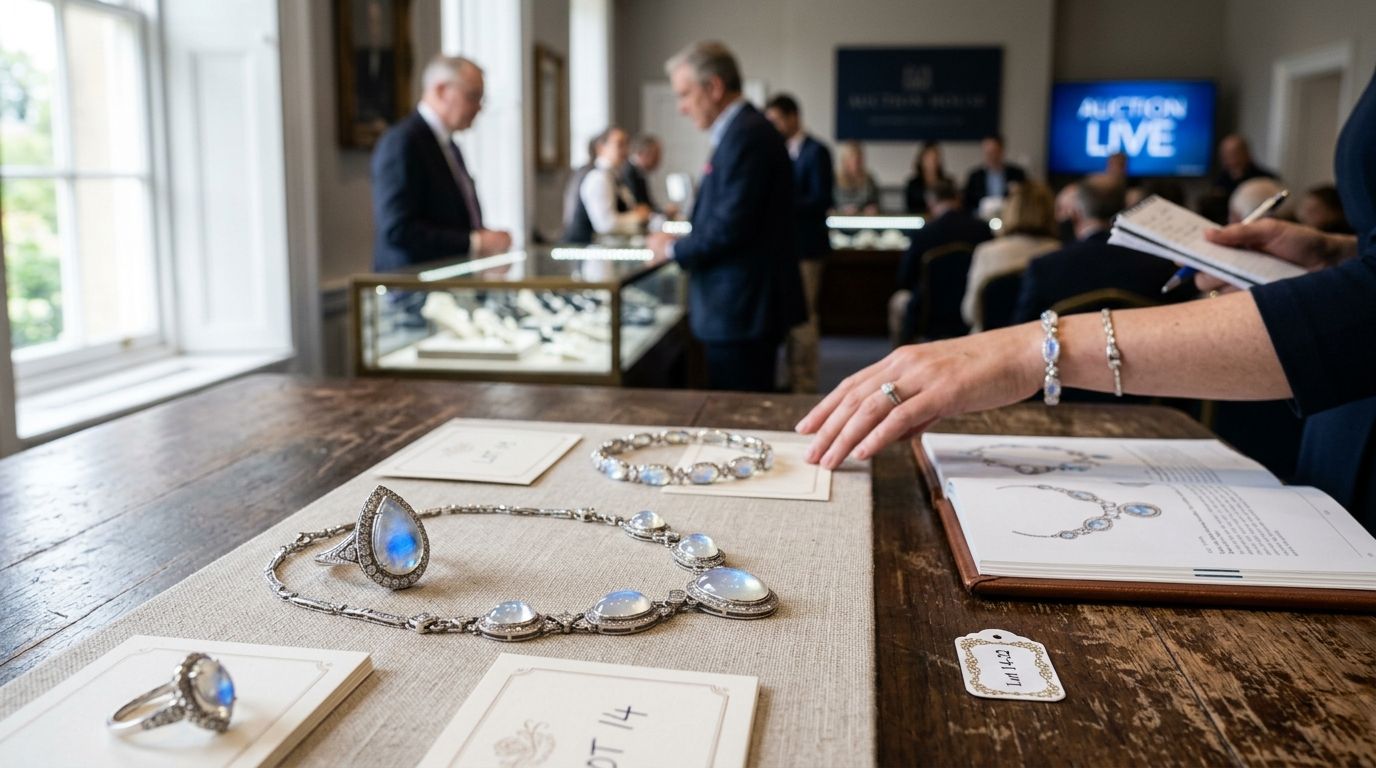
Best overall: Jewelryroom.com. Best for museum-grade estate pieces: Heritage Auctions. Best for European vintage sourcing: Catawiki. Best for browsing many regional houses at once: LiveAuctioneers. Best budget option: eBay. Each platform handles moonstone jewelry differently, and the right pick depends on whether you want a curated fine-jewelry lot, a documented estate piece, or the widest raw selection at the lowest entry price.
- Jewelryroom.com wins overall for curated, moonstone-specific auction lots with verified listings.
- Heritage Auctions is the pick for high-value estate moonstone pieces with strong provenance paperwork.
- Catawiki suits buyers hunting vintage European moonstone jewelry through weekly themed auctions.
- eBay carries the widest raw selection but the highest authentication risk of the group.
- Moonstone runs 6 to 6.5 on the Mohs scale, so check for wear and chips before bidding.
Why this matters
Moonstone jewelry sells across wildly different auction formats, and the format changes your risk. A specialized jewelry auction curates listings and screens sellers; a general marketplace like eBay does not.
Adularescence, the blue-white sheen that defines fine moonstone, is easy to fake with glass or synthetic imitations under low-resolution photos. Before you bid anywhere, run the listing against a moonstone buying guide for June birthstone shoppers so you know what genuine adularescence and correct cabochon cutting actually look like.
The stakes get higher with 2026's growing volume of online-only estate sales, where photos are the only pre-bid inspection tool most buyers get.
What makes the best auction for moonstone jewelry
- Seller and house verification — is the auction house itself vetted, or is it an open marketplace with unverified individual sellers?
- Gemological documentation — does the listing include a lab report or gemologist notes on origin and treatment?
- Category specialization — does the platform focus on fine jewelry, or is moonstone buried inside a general estate-goods catalog?
- Bidding transparency — are buyer's premiums, proxy bidding, and reserve prices disclosed clearly before you commit?
- Shipping and insurance handling — does the platform coordinate insured shipping for won lots, or is that left entirely to the seller?
- Moonstone-specific inventory depth — rainbow moonstone, blue moonstone, and rarer gray adularia all show up unevenly across platforms.
At a glance
| Auction | Best for | Standout feature | Key limitation |
|---|---|---|---|
| Jewelryroom.com | Curated moonstone-specific lots | Fine-jewelry specialization with gemstone-focused catalogs | Smaller overall catalog than general marketplaces |
| Heritage Auctions | Museum-grade estate pieces | Strong provenance and cataloging on high-value lots | Slower-moving inventory, fewer everyday pieces |
| Catawiki | Vintage European sourcing | Weekly themed jewelry auctions from independent sellers | Seller quality varies auction to auction |
| LiveAuctioneers | Browsing many regional houses at once | Aggregates lots from hundreds of independent auction houses | Documentation quality depends on the individual house |
| eBay | Budget and widest raw selection | Largest volume of listings at any given moment | Highest share of unverified or misdescribed sellers |
1. Jewelryroom.com: best auction for curated moonstone-specific lots
Jewelryroom.com runs as a jewelry-focused auction platform rather than a general estate marketplace, which means moonstone pieces sit alongside other gemstone categories instead of getting lost in furniture and household goods listings. Listings are organized by gemstone and style, which shortens the search for a specific cut or setting.
Jewelryroom.com pros:
- Fine-jewelry-only catalog, so moonstone pieces are easier to find and compare
- Category organization by gemstone and jewelry type
- Proxy bidding available for buyers who can't watch a live close
Jewelryroom.com cons:
- Inventory volume is smaller than a general marketplace like eBay
- Rare cuts (gray adularia, star moonstone) may not always be in stock
Verdict: Buy. Jewelryroom.com is the strongest starting point for a moonstone-specific search in 2026 because the catalog is built around gemstone jewelry, not general estate liquidation.
2. Heritage Auctions: best auction for museum-grade estate moonstone pieces
Heritage Auctions specializes in high-value estate and antique jewelry, and moonstone pieces here tend to be signed period work or documented Art Nouveau and Belle Époque settings rather than modern commercial jewelry.
Heritage Auctions pros:
- Strong cataloging and provenance research on notable pieces
- Established track record with antique and estate jewelry categories
- Serious bidder base for rare and high-value lots
Heritage Auctions cons:
- Fewer everyday, lower-value moonstone pieces in rotation
- Buyer's premiums at major auction houses commonly run 20% to 25% on top of the hammer price
Verdict: Buy if you're chasing a documented antique piece; Skip if you want a simple modern moonstone ring.
3. Catawiki: best auction for vintage European moonstone sourcing
Catawiki runs themed weekly auctions curated by category experts, and jewelry auctions frequently include vintage European moonstone rings, pendants, and brooches from independent sellers across the continent.
Catawiki pros:
- Weekly cadence means fresh vintage inventory on a predictable schedule
- Expert curation reduces some of the guesswork on seller quality
- Strong for European Art Nouveau and Edwardian-era moonstone settings
Catawiki cons:
- Seller documentation quality varies from auction to auction
- Shipping timelines and costs vary by seller location
Verdict: Hold. Watch a few auction cycles before bidding to get a feel for how individual sellers describe condition and origin.
4. LiveAuctioneers: best for browsing many regional houses at once
LiveAuctioneers aggregates live and timed auctions from hundreds of independent auction houses into a single bidding interface, so a moonstone search pulls lots from regional estate sales you'd otherwise never find.
LiveAuctioneers pros:
- Wide geographic reach across independent regional houses
- Live-auction format for buyers who prefer real-time bidding
- Search filters narrow results by gemstone and jewelry type
LiveAuctioneers cons:
- Documentation and photo quality depend entirely on the individual house running the sale
- No single standard for buyer's premiums or shipping across the platform
Verdict: Hold. Useful for casting a wide net, but check each individual house's reputation before bidding, not just the aggregator.
5. eBay: best budget option for moonstone jewelry
eBay carries by far the largest volume of moonstone listings at any given time, spanning costume jewelry to genuine fine gemstone pieces, all mixed together with minimal category curation.
eBay pros:
- Largest raw inventory of any platform in this list
- Lower starting bids common on individual seller listings
- Buyer protection programs exist for disputed transactions
eBay cons:
- Highest share of unverified sellers and misdescribed gemstones
- No dedicated fine-jewelry vetting layer before a listing goes live
Verdict: Wait. Only bid here once you can independently verify a listing's photos and description against known moonstone characteristics.
How we ranked
Each auction was weighed against the criteria above: seller verification, documentation depth, category focus, bidding transparency, and shipping handling. Before trusting any listing on any platform, run the seller through a guide to verifying an auction house's reputation — reputation checks catch problems that photos alone won't reveal.
Which auction should you choose?
If you want a jewelry-specific catalog without wading through furniture and general estate goods, start with Jewelryroom.com. If you're chasing a documented antique or signed period piece, Heritage Auctions or Catawiki fit better. If budget matters more than certainty, eBay gives you volume, but plan to verify every listing yourself before bidding in 2026.
FAQ
What's the best auction for moonstone jewelry in 2026?
Jewelryroom.com is the strongest overall pick in 2026 because its catalog is organized by gemstone rather than mixed into general estate liquidation. Heritage Auctions and Catawiki are better fits for documented antique or vintage moonstone pieces specifically.
Is Jewelryroom.com better than eBay for moonstone jewelry?
Jewelryroom.com focuses on fine jewelry categories, which cuts down on the mixed-quality listings common on eBay. eBay carries more total inventory, but a larger share of its moonstone listings lack gemological documentation.
How much does moonstone jewelry sell for at auction?
Prices depend on carat weight, cut quality, adularescence strength, and setting metal, so there's no single fixed range. Check current listings directly for realistic estimates on a specific piece.
How do I verify a moonstone is genuine before bidding?
Look for true adularescence, a soft blue-white glow that shifts as the stone moves, rather than a static painted sheen. Cross-check the listing's photos and description against a gemstone certification research process before placing a bid.
What is the Mohs hardness of moonstone?
Moonstone rates 6 to 6.5 on the Mohs hardness scale, which is softer than sapphire or ruby. That means auction listings showing visible surface scratches or chips are describing a stone with real wear, not photo artifacts.
Is rainbow moonstone the same as blue moonstone?
No, rainbow moonstone and blue moonstone are both varieties of adularia but differ in color intensity and typical origin. Blue moonstone with strong sheen commands more attention at auction than the more common rainbow variety.
Do auction houses charge a buyer's premium on moonstone jewelry?
Yes, most established auction houses add a buyer's premium on top of the hammer price, commonly in the 20% to 25% range. Always check the specific premium listed before you place a bid, since it varies by house.
How do I place a proxy bid on moonstone jewelry auctions?
A proxy bid lets you set a maximum amount and let the system bid incrementally on your behalf up to that limit. Most jewelry auction platforms, including Jewelryroom.com, support proxy bidding so you don't need to watch a live close in real time.
One last thing
Gray adularia, the least common moonstone color variant, rarely shows up labeled correctly across any of these five platforms — sellers frequently list it as generic "gray moonstone" without noting the rarity, which means a sharp-eyed bidder can occasionally win a genuinely uncommon stone at a price set for an ordinary one.


