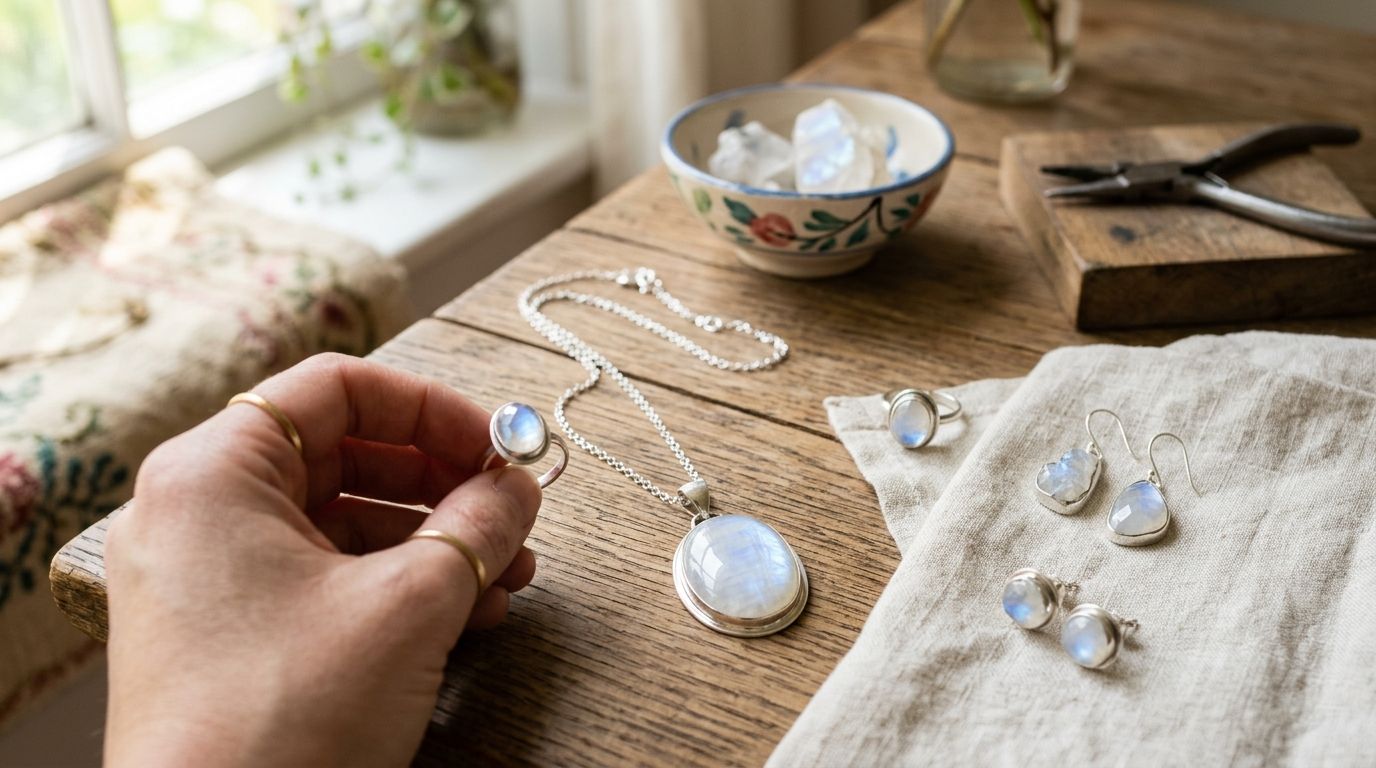
Moonstone jewelry for June birthstone buyers means shopping for pieces with visible adularescence — the blue-white glow that shifts as the stone moves — at auction prices typically well under new retail, while confirming the gem isn't glass, resin, or synthetic spinel dressed up as the real thing. June has three official birthstones (moonstone, pearl, and alexandrite), and moonstone draws buyers who want a color-shift effect without alexandrite's rarity premium or pearl's surface-care demands.
- Moonstone jewelry for June birthstone buyers should show blue-white adularescence, not gray flatness — reject stones with no visible flash.
- Moonstone rates 6 to 6.5 on the Mohs hardness scale, softer than sapphire or diamond, so rings need protective settings.
- Rainbow moonstone (colorless body, blue flash) and blue moonstone (pale gray-blue body) are the two auction categories worth targeting.
- Set a bidding ceiling before the auction opens and use a proxy bid instead of watching the live clock.
- Verdict: buy moonstone jewelry with clear lot descriptions and provenance notes from a jewelry auction platform over unverified private listings.
Why this matters for June birthstone buyers
June birthstone buyers are choosing between three stones with very different price and durability profiles. Moonstone delivers the color-shift effect at a lower entry point than alexandrite, which is genuinely rare and heavily faked in its own right, and it skips the porous-surface care rules that come with pearl. At auction — including mixed estate lots on Jewelryroom.com — the risk shifts from "can I afford this" to "is this actually moonstone."
Glass cabochons, foil-backed doublets, and synthetic spinel labeled "moonstone" show up regularly in mixed estate batches. A buyer who skips verification pays a buyer's premium on a stone with no resale value at all. In 2026, that risk hasn't changed — auction volume for June birthstone pieces climbs every spring, and so does the volume of mislabeled lots riding along with it.
How to buy moonstone jewelry for June birthdays
Check for real adularescence before you bid
Adularescence is the entire reason moonstone sells. A stone without it is just pale feldspar, and pricing it as moonstone anyway is the most common auction-listing shortcut.
- Tilt the stone under a single light source and confirm the blue-white flash moves across the surface, rather than sitting fixed in one spot
- Reject any listing where the "glow" only appears with a foil or mirror backing glued under the cabochon
- Compare body color: genuine rainbow moonstone runs colorless to white, while blue moonstone (adularia) runs pale gray-blue
- Look for cat's-eye or four-ray effects, which signal a cutter who oriented the stone against the feldspar's twinning plane on purpose
- Ask the seller for a short video of the stone moving under light, not just a static photo
Rule out glass and synthetic spinel sold as moonstone
Synthetic spinel and glass cabochons are the two most common moonstone stand-ins at online auction, and both photograph deceptively well.
- Ask for a refractive index reading if the lot description omits one — genuine moonstone reads 1.518 to 1.526
- Treat any "moonstone" lot under a carat-plus size priced far below comparable hammer prices as glass or synthetic until proven otherwise
- Check listing photos closely for gas bubbles or swirl marks, both signs of glass rather than natural feldspar
- Request a loupe photo of the girdle; natural moonstone often shows faint internal fractures gemologists call "centipedes"
- Run unfamiliar sellers through gemstone verification steps before bidding on unattributed lots
Set a bidding ceiling before the auction opens
Decide your maximum bid, including the buyer's premium, before the lot goes live — not while the countdown clock is running.
- Separate "want" lots from "walk away" lots so premium fees don't creep your final spend past comfort
- Track two or three comparable moonstone lots' recent hammer prices instead of guessing at fair value
- Build in 10 to 15% on top of your ceiling for shipping and insurance, since the win price is never the final number
- Write your ceiling down before registering a bidder number, so the number doesn't move mid-auction
Place a proxy bid instead of chasing the clock
A proxy bid lets you enter your ceiling once and let the system bid incrementally on your behalf, which removes the emotional escalation that drives up final prices on desirable moonstone lots.
- Enter your ceiling once and step away from the live auction screen
- Avoid last-second bidding wars that push moonstone lots past comparable retail pricing
- Set proxy bids across two or three similar lots so losing one doesn't force a rushed decision on the next
- Learn how proxy bidding works before your first auction if you've never used the format
“If the stone flashes blue only from one angle and looks flat gray from every other angle, it's glass, not moonstone.”
Confirm certification on rare or high-value lots
Most moonstone jewelry doesn't need a lab report, but rare colors — orange, green, and strong cat's-eye pieces — command a premium and get faked more often than standard white or blue moonstone.
- Ask for a gemological lab report on any lot priced as "rare" or "investment grade"
- Confirm the report matches the specific stone, not a similar stone from the same seller's inventory
- Treat unverifiable "one of a kind" color claims as a red flag, not a selling point
Protect moonstone after you win
Moonstone's 6 to 6.5 Mohs rating puts it well below sapphire (9) and diamond (10), which means daily-wear rings need a protective setting and careful cleaning.
- Store moonstone jewelry separately from harder stones that can scratch its surface in a jewelry box
- Skip ultrasonic cleaners — moonstone's internal fractures make it prone to cracking under vibration
- Clean with a soft cloth and mild soap only, never solvent-based jewelry cleaners
- Insure higher-value pieces immediately after the win, before the piece ships
Browse current moonstone lots
Check active moonstone jewelry auctions and lot descriptions before you set a ceiling.
Where to buy moonstone jewelry: options compared
| Option | Best for | Key limitation |
|---|---|---|
| Estate/mixed jewelry auction lots | Buyers who want vintage settings and lower entry prices | Mixed lots require your own authentication before bidding |
| Dedicated online jewelry auction platform | Buyers who want catalog descriptions, provenance notes, and proxy bidding | Ungraded stones still need independent verification |
| Independent online marketplace sellers | Buyers hunting rare colors like green or orange moonstone | Return policies and seller vetting vary listing to listing |
| Big-box retail jewelry counters | Buyers who want a warranty and in-store sizing | New moonstone at retail carries markup well above auction hammer prices |
Verdict: buyers who want provenance notes and a bidder-protection process should target a dedicated jewelry auction platform over an unvetted private listing — the catalog description does the authentication legwork a mixed estate lot won't.
Common mistakes June birthstone buyers make
- Buying "genuine moonstone" without checking for foil backing — this shortcut shows up constantly in mixed estate batches sold as a single lot
- Assuming any pale, milky stone qualifies as June's birthstone — white topaz and moonstone get mislabeled interchangeably in estate listings
- Skipping insurance because the hammer price looked low — a soft stone at 6 to 6.5 Mohs chips more easily than the sapphire or diamond rings worn alongside it daily
- Bidding on rare colors without a lab report — orange and green cat's-eye moonstone command a premium and attract more fakes than white or blue moonstone
- Cleaning moonstone in an ultrasonic cleaner — the internal fractures that create its glow also make it prone to cracking under vibration
FAQ
What is moonstone jewelry best for as a June birthstone gift?
Moonstone jewelry works best as a June birthstone gift for buyers who want a color-shift effect without alexandrite's rarity premium. Rainbow moonstone pendants and rings are the most common gift picks in 2026 auction catalogs.
Is moonstone a durable everyday ring stone?
Moonstone rates 6 to 6.5 on the Mohs hardness scale, softer than sapphire (9) or diamond (10), so it scratches more easily in daily wear. A protective bezel setting reduces chip risk on ring styles.
How can you tell real moonstone from glass or synthetic spinel?
Genuine moonstone shows adularescence that moves across the surface as you tilt it under light, while glass and synthetic spinel show a fixed glow or none at all. A refractive index reading of 1.518 to 1.526 confirms natural moonstone.
What's the difference between rainbow moonstone and blue moonstone?
Rainbow moonstone has a colorless to white body with a blue flash, while blue moonstone (adularia) has a pale gray-blue body throughout. Blue moonstone from Sri Lanka is traditionally the more collector-prized variety.
Is moonstone jewelry a good investment?
Standard white and blue moonstone jewelry holds value modestly rather than appreciating like colored diamonds or fine sapphire. Rare colors such as orange or strong cat's-eye moonstone with a lab report carry more resale interest.
Can moonstone go in an engagement ring?
Moonstone can go in an engagement ring, but its 6 to 6.5 Mohs rating means it needs a protective setting and more careful daily-wear habits than a diamond or sapphire center stone. Many buyers choose it for accent stones instead of the center stone for this reason.
Should you buy moonstone jewelry at auction or retail?
Auction typically gives access to vintage settings and estate pieces at prices below new retail, provided you verify the stone yourself or through a lab report. Retail adds a markup but includes standard authentication and sizing services.
Does moonstone need special care after purchase?
Moonstone needs a soft cloth and mild soap for cleaning, never an ultrasonic cleaner, because its internal fractures make it prone to cracking under vibration. Store it separately from harder stones that could scratch its surface.
One last thing
Sri Lanka has historically produced the finest blue moonstone, with a tighter, single-direction flash that collectors pay more for than the diffuse rainbow effect common in Indian material. If a listing specifies Sri Lankan origin for a blue moonstone lot in 2026, that's worth more weight than the carat weight alone — origin is doing real pricing work here that a size number can't capture.


