
You can cancel a jewelry auction bid only when the auction’s rules or applicable law allow it; placing a request does not itself remove your bid. Check the terms you accepted, contact the auction operator promptly, and get written confirmation of the outcome rather than assuming an accidental bid disappears.
- To cancel a jewelry auction bid, check the applicable terms and request written confirmation of removal.
- An accidental bid, a proxy maximum, and a completed sale require different questions.
- Save the listing, bid confirmation, and relevant messages before contacting the auction operator.
- Jewelryroom.com jewelry auction bidders should check the current terms rather than assume a cancellation option exists.
Can you cancel a bid after placing it on a jewelry auction?
Cancellation is not a setting you should assume every auction provides. Your next step depends on what you submitted, whether the auction has closed, and what the applicable terms say about withdrawals or errors. For a bid placed in 2026, start with the terms attached to that sale—not advice copied from another auction.
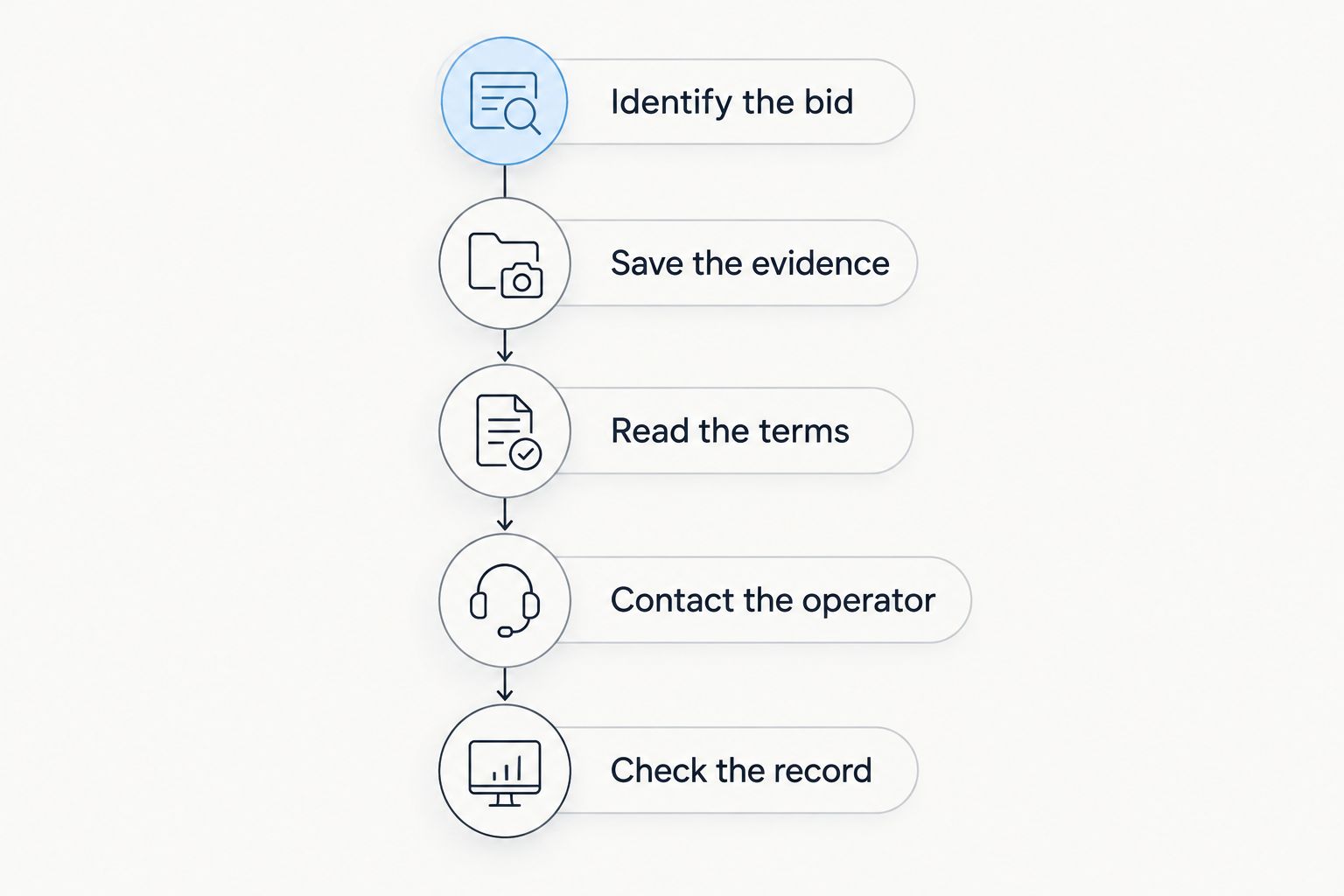
Use this sequence to make a clear request:
- Identify the bid. Record the auction name, lot identifier, account details, submission time, and the bid you intended to place.
- Save the evidence. Keep the bid confirmation, listing description, photographs, and any relevant error message.
- Read the terms. Look specifically for bid withdrawal, bidding errors, maximum-bid changes, completed sales, and dispute procedures.
- Contact the operator. Use the contact method published by the auction platform or auction house, and describe the exact problem.
- Ask for an explicit outcome. Request confirmation that the bid was removed, corrected, or left unchanged.
- Check the record. Compare the written response with the bid history or account status and ask about any mismatch.
If your concern is an unclear description rather than a typing error, start by identifying the missing information. This guide explains how to get a condition report before bidding.
Why this matters
A cancellation request and a canceled bid are different things. You need a response that addresses the specific bid, not merely a message acknowledging that support received your question.
Jewelry adds another distinction: uncertainty about a stone, setting, treatment, or repair is not the same as evidence that the listing was inaccurate. Explain the particular discrepancy instead of describing the whole purchase as a mistake.
For your 2026 bidding records, keep the accepted terms alongside the listing. A later version of a general help page is not a substitute for a record of the conditions presented when you bid.
Before closing: request a bid withdrawal or correction
If the auction is still open, tell the operator immediately what happened and what action you are requesting. Be precise. Removing a bid entirely and correcting an accidentally entered maximum are different requests.
Do not submit another bid as an improvised way to undo the first. A new submission does not provide evidence that the original bid was withdrawn, and it can make your account history harder to explain.
Your message should distinguish between the action you took and the action you intended. For example, identify whether you selected the wrong lot, entered the wrong amount, or misunderstood what the confirmation screen would submit. Report only what actually happened.
The useful outcome is a documented change, not an unanswered request. If the operator declines, ask which term governs the decision and whether an established review process applies. Keep that response with your original message.
Proxy bidding: distinguish your maximum from the displayed bid
A proxy maximum authorizes automated bidding within the auction system’s rules. The displayed bid and your submitted maximum are therefore not interchangeable descriptions of the same thing.
When asking for help, specify which entry concerns you. Ask whether the operator can change an unused maximum, whether any bids have already been placed under that instruction, and what effect a change would have on those bids.
Do not assume that lowering a maximum, where permitted, removes an existing bid. Likewise, do not assume an interface change has taken effect without checking the resulting confirmation or account record.
For your 2026 bid review, separate these questions:
- What maximum did you submit?
- What bid does the auction currently show?
- What exact change are you requesting?
- What has the operator confirmed?
This distinction gives support a specific issue to resolve. It also prevents a response about your maximum from being mistaken for confirmation that every associated bid has been withdrawn.
After closing: ask about the completed sale
If the auction has ended and you are recorded as the winner, describe the issue as a completed-sale question. Do not rely on instructions written only for withdrawing bids during an open auction.
Ask which cancellation, dispute, or return provisions apply to your situation. These are separate processes: ending a transaction before fulfillment is different from returning jewelry after receipt, and neither should be assumed from the existence of the other.
Read any invoice and relevant deadlines while the question is being reviewed. Ask in writing whether the operator has changed those deadlines; silence does not establish an extension.
Do not treat nonpayment as a cancellation method. If you dispute the transaction, communicate that dispute directly and seek an explicit response. Avoid substituting account deletion, payment-method removal, or ignored messages for a documented resolution.
For a significant contractual dispute, get advice from a qualified professional in the relevant jurisdiction. General auction guidance cannot determine your individual legal rights.
Which situation matches your cancellation request?
Use the comparison below to describe your issue accurately. These are categories for organizing a request, not promises that an operator will approve it.
| Situation | Best for identifying | Evidence to keep | Main limitation |
|---|---|---|---|
| Mistyped bid | An entry error | Bid confirmation and intended entry | An error does not establish permission to withdraw |
| Wrong lot selected | A lot-selection mistake | Lot identifiers and submission record | Selecting the wrong item does not itself reverse the bid |
| Proxy maximum concern | An automated-bidding instruction | Maximum confirmation and visible bid history | Changing a maximum is not necessarily removing a placed bid |
| Description discrepancy | A specific listing concern | Saved listing, photographs, and supporting documents | A concern needs supporting facts, not just dissatisfaction |
| Change of mind | A preference or budget change | Relevant cancellation terms | Wanting another item does not establish a cancellation right |
| Auction already closed | A completed-sale question | Winner notification, invoice, and correspondence | Open-auction withdrawal instructions might not address completed sales |
The strongest request explains the event, points to the evidence, and asks for a defined action. It does not need a dramatic explanation or an unsupported accusation.
Why the answer varies between jewelry auctions
For a 2026 cancellation request, check these factors rather than borrowing another bidder’s experience:
- Applicable terms: Identify what the auction says about bid withdrawal, errors, and completed transactions.
- Auction stage: Establish whether bidding remains open or the lot has already closed.
- Bid mechanism: Distinguish a direct bid from a proxy maximum or another bidding instruction.
- Reason for the request: Separate an entry error, a documented discrepancy, and a change of mind.
- Applicable law: Contract terms do not answer every legal question; jurisdiction matters when a dispute arises.
These factors organize the investigation. None provides an automatic approval rule, and a successful request at another auction does not establish what will happen with yours.
What should you include in a bid-cancellation request?
Send a message that the recipient can match to the auction record without guessing. Include the lot identifier, account identifier, bid submission time with its time zone, and a concise description of the problem.
State the requested action plainly: withdrawal of the bid, correction of an entry, or review of a completed sale. If you are asking about a proxy maximum, identify that maximum separately from the visible bid.
Then ask for written confirmation of the decision and its scope. Does the response address only your maximum, the specific bid, or the completed transaction? That distinction matters more than a general assurance that someone has reviewed the account.
Save attachments in their original form. Keep an unedited copy of a screenshot even if you also send an annotated version highlighting the relevant field.
A practical request follows this order:
- Identify the auction and lot.
- Describe the actual event without speculation.
- Refer to the relevant supporting record.
- State the change you want.
- Ask for confirmation of the resulting status.
Do not invent a technical failure to strengthen your case. If you do not know why an entry occurred, describe what you observed and ask the operator to investigate.
Can I cancel if I accidentally entered the wrong amount?
An accidental entry is a reason to request a correction, not proof that a correction is permitted. Contact the operator promptly, distinguish the submitted entry from the intended entry, and preserve the confirmation.
Ask whether the response removes the bid or changes only an unused maximum. Do not place a replacement bid unless you understand how it affects the existing record.
Can I cancel because the jewelry description changed?
A description change calls for a documented question about what changed and when. Save the original description if you have it, preserve the revised version, and explain why the difference affects your decision.
Ask which review or dispute procedure applies. A changed description and a confirmed right to cancel are not the same finding.
Can I cancel because I found jewelry I prefer?
Finding another piece does not itself establish a right to withdraw your existing bid. Check the applicable terms and request permission rather than assuming that a preference change reverses your commitment.
Stop adding bids while you resolve the first issue. Otherwise, you are making another purchase decision before you know the status of the original one.
Before your next jewelry auction bid
Jewelryroom.com is for buyers seeking jewelry auctions. When browsing Jewelryroom.com, apply the same pre-bid discipline you would use for any auction: understand the item, the bidding instruction, and the applicable terms before submitting.
The benefit of bidding is that you can pursue a particular lot through an auction process. The limitation is that you should not treat participation as a reversible shopping-cart decision. Neither statement establishes a platform-specific cancellation policy.
Use a 2026 pre-bid checklist that separates research from commitment. Resolve condition questions first, record your spending limit, and read the confirmation screen before submitting. If an unanswered question would make you want to cancel later, answer it before bidding.
FAQ
Can I cancel a jewelry auction bid immediately after placing it?
You can cancel a jewelry auction bid only if the applicable rules or law permit it. Contact the operator promptly, but do not assume that acting immediately guarantees approval.
Does sending support a message remove my bid?
Sending support a message does not itself confirm that your bid has been removed. Ask for an explicit decision and check the resulting auction record.
Can I lower my maximum instead of canceling my bid?
Lowering a maximum and canceling a placed bid are different actions. Ask what changes the auction permits and whether any existing bids remain in effect.
What if I selected the wrong ring or necklace?
Report the wrong-lot selection to the auction operator and identify the exact lot involved. Keep the submission record and ask whether withdrawal is permitted under the applicable terms.
Can I cancel after the auction says I won?
After you are recorded as the winner, ask about the rules for a completed sale rather than assuming an open-auction withdrawal process applies. Preserve the winner notification, invoice, and correspondence.
Does Jewelryroom.com allow bid cancellations?
Check the current Jewelryroom.com terms and obtain a response about your specific bid. Do not treat general auction guidance as confirmation of a platform-specific cancellation policy.
Is canceling a bid the same as returning jewelry?
Canceling a bid and returning jewelry are separate processes. Check the terms for the stage your transaction has reached rather than assuming a return provision also allows bid withdrawal.
One last thing
The detail to check is what was removed. A response about a proxy maximum does not necessarily answer a question about an existing bid, and an acknowledgment of your complaint does not necessarily resolve a completed sale.
Before closing your records, match the operator’s response to the lot, the bidding instruction, and the resulting status. Ask for clarification if those records disagree.