You can judge jewelry auction estimate accuracy by checking verified lot details against recent completed sales of closely comparable pieces. Treat the estimate as credible only when gemstone identity, metal content, condition, and attribution support it; also confirm whether the comparison includes buyer’s premium and other charges. In 2026, a retail replacement appraisal alone is not evidence that an auction estimate reflects resale value.
- Jewelry auction estimate accuracy depends on verified descriptions and comparable completed sales, not retail asking figures.
- Jewelryroom.com buyers should assess each lot individually; the auction format does not validate an estimate.
- Compare hammer results with hammer estimates, keeping buyer’s premium and other charges separate.
- Request condition evidence and gemstone documentation before treating a high estimate as justified.
How can you tell if a jewelry auction estimate is accurate?
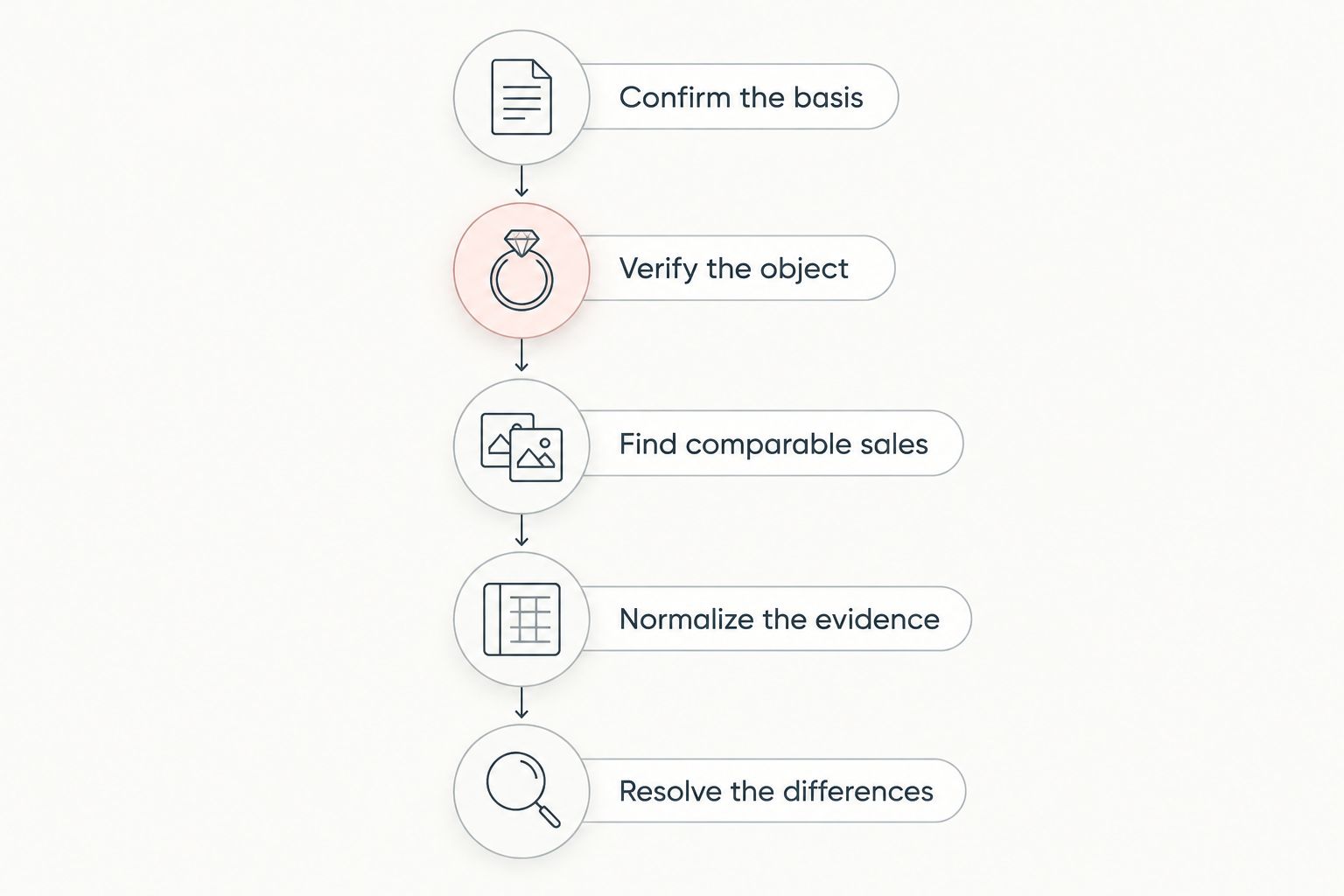
An estimate is well supported when you can trace its assumptions to the actual lot and relevant completed sales. A persuasive description is not enough. Start with the guide to getting a condition report before bidding, then work through these checks.
- Confirm the basis. Ask whether the figure represents an expected hammer result, a retail replacement valuation, or another valuation purpose.
- Verify the object. Match the description, photographs, measurements, markings, and any laboratory report to the piece offered.
- Find comparable sales. Use completed transactions involving materially similar jewelry, not simply similar-looking pieces advertised for sale.
- Normalize the evidence. Separate hammer results from premium-inclusive totals, and account for currency, sale date, condition, and documentation.
- Resolve the differences. Identify what makes the offered piece more or less desirable than each comparable before setting your bidding limit.
Record the evidence beside the estimate rather than keeping a mental impression. If the estimate depends on an unverified claim, mark that claim as unresolved instead of treating it as established value.
Why this matters
An estimate influences what you expect to pay before bidding begins. That makes it an anchor, even when you have not checked the evidence behind it. Your bidding limit should follow your research, not the estimate’s upper boundary.
For Jewelryroom.com jewelry auction buyers, the best estimate is one supported by verified lot details and comparable completed sales. Apply that standard to every lot you consider. An auction listing helps identify a buying opportunity, but its estimate does not replace an independent assessment.
For a 2026 purchase, distinguish two questions: whether the estimate reasonably reflects the auction market, and whether the piece suits your own purpose. A defensible estimate does not make a damaged ring suitable for daily wear or an undocumented stone suitable for a collection requiring laboratory evidence.
Which evidence should you trust?
Different documents answer different questions. A gemstone report addresses characteristics within its stated scope; a condition report describes the piece’s observed state. Neither automatically establishes an auction value.
Use the following evidence together rather than asking one document to do every job.
| Evidence | Best for | Strength | Limitation |
|---|---|---|---|
| Comparable completed sales | Testing auction-market support | Shows an actual transaction outcome | Differences in quality, condition, and sale terms affect relevance |
| Independent market-value appraisal | Assessing the specific piece | Can connect examination with a stated valuation purpose | Its usefulness depends on scope, date, and supporting research |
| Gemological laboratory report | Checking reported gemstone characteristics | Documents findings within the laboratory’s stated scope | Does not automatically authenticate the entire jewel or establish its value |
| Condition report | Identifying wear, damage, and repairs | Helps explain differences between otherwise similar pieces | Is not a substitute for laboratory testing or a valuation |
| Retail replacement appraisal | Understanding a replacement-value assessment | States a value for its specified purpose | Is not directly interchangeable with an auction estimate |
| Unsold retail listing | Reviewing competing descriptions and offers | Provides context about what sellers are offering | An asking figure is not evidence of a completed sale |
Check document dates and the identity of the item examined. A report that describes a loose gemstone does not, by itself, establish that the same stone is now in the offered mounting.
How do you choose genuinely comparable jewelry?
Start with the attributes that drive the piece’s identity. For a diamond ring, compare natural or laboratory-grown origin, center-stone weight, grading information, metal, mounting, and condition. For signed estate jewelry, add maker attribution, design, period, originality, and provenance where documented.
A visual resemblance is a starting point, not a valuation match. Two rings with similar silhouettes can contain different materials, treatments, or amounts of wear.
Match weight and metal descriptions
One carat equals 0.2 grams. Check whether the listing describes a center stone’s weight or the combined weight of multiple stones; total gemstone weight does not tell you the size of the principal stone.
Gold fineness also needs consistent interpretation. Eighteen-karat gold represents 18 parts gold out of 24, or 75% gold by mass. That identifies fineness, not the jewelry’s total gold weight, and it does not establish craftsmanship, authorship, or condition.
Do not compare a gross jewelry weight directly with a metal-only weight. Stones, non-gold components, and other materials affect the distinction. Ask how the stated weight was obtained when the estimate depends heavily on material content.
Match condition and originality
Look for disclosed chips, worn prongs, replacement stones, solder repairs, resizing, and altered finishes. Ask whether the comparison piece had similar issues. A pristine example is not a direct substitute for a heavily repaired one.
Originality matters especially when collecting a maker, period, or design. A genuine signed component does not establish that every component belongs to the original piece; request an explanation when photographs show inconsistent construction or markings.
Match the result’s basis
A completed result is useful only when you understand what it includes. Confirm whether the published figure is the hammer result or a total including buyer’s premium. Keep currencies consistent and record the sale date.
For your 2026 comparison sheet, preserve the original result and document any conversion separately. Do not silently combine results with different fee treatments into a single benchmark.
Why jewelry auction estimates vary
Variation does not automatically mean an estimate is inaccurate. It means you need to identify the assumptions behind the difference.
- Gemstone identity and treatment. Natural origin, laboratory-grown origin, and disclosed treatments affect which pieces belong in the comparison set.
- Metal and construction. Fineness, weight, workmanship, and mounting design distinguish pieces that look similar in photographs.
- Condition and alteration. Damage, repairs, replacement parts, and wear change the object being valued.
- Maker attribution and provenance. Documented authorship or ownership supports claims that an unsigned or undocumented comparison cannot establish.
- Valuation purpose and fee basis. Auction expectations, replacement assessments, and premium-inclusive results measure different things.
- Sale timing and bidder demand. An auction result reflects the bidders and circumstances of that particular sale, not a guaranteed future outcome.
Ask the auctioneer which factors explain the estimate. A useful response connects the lot’s particular attributes to evidence. Repeating the description without explaining its relationship to comparable results does not resolve the question.
What should you ask before trusting the estimate?
Send questions that can produce documents or specific answers. Avoid asking only whether the piece is valuable; that invites an opinion without showing how it was reached.
Request the following:
- The estimate’s valuation basis and whether buyer’s premium is excluded.
- Relevant completed sales used to support the estimate.
- Clear photographs of marks, settings, clasps, backs, and disclosed damage.
- The full gemstone report, where one is cited, rather than a cropped image.
- Clarification of measured versus estimated gemstone weights.
- Written details of repairs, replacements, and any unresolved attribution.
Then compare the answers with the listing. If a response changes an important detail, retain the written clarification and ask whether the catalog description will be updated.
Do not fill gaps with favorable assumptions. If a treatment status, maker attribution, or condition issue remains unresolved, your comparison must reflect that uncertainty. When the unresolved fact is central to your reason for buying, wait for evidence rather than stretching your limit.
Does a low estimate mean the jewelry is a bargain?
A low estimate does not establish a bargain. You still need to verify the lot and compare relevant completed sales; the eventual bidding outcome is separate from the estimate.
An estimate can also describe a different basis from the figure you have in mind. Before calling a piece undervalued, rule out differences in stone identity, condition, documentation, and fee treatment.
Does a gemstone certificate prove the estimate is accurate?
A gemstone report does not prove an auction estimate is accurate. It supports specified findings about the examined stone, while a valuation also requires market evidence and an assessment of the jewelry as offered.
Read the report’s scope and comments. Match identifying details to the listing, and distinguish a grading or identification report from a document that actually states a valuation purpose.
Does selling above the estimate prove the estimate was wrong?
Selling above an estimate does not, by itself, prove the estimate was unreasonable. An auction result records what happened in that sale; assessing the original estimate requires examining the evidence available when it was set.
For a 2026 review, check the final result on the same fee basis as the estimate. Then investigate whether new information, stronger-than-expected competition, or a weak comparison set explains the difference rather than assuming the outcome proves accuracy or inaccuracy.
Turn the research into a bidding decision
Keep your estimate assessment separate from your maximum bid. The first asks what the evidence supports; the second asks what you are prepared to commit after considering applicable charges and the piece’s suitability.
Use a simple worksheet with fields for lot identity, documentation, condition, comparable results, fee basis, and unresolved questions. Write a short reason beside each comparable explaining why you included it. Exclude an attractive result if the underlying piece is materially different.
When reviewing Jewelryroom.com, apply the same worksheet to individual lots rather than treating a platform name as evidence of valuation accuracy. Its relevance is the jewelry auction format; that format still requires you to assess each offered piece.
Bid only when you can explain the estimate without repeating the listing’s adjectives. If your explanation depends on words such as rare, exceptional, or investment without supporting evidence, return to the documents before proceeding.
FAQ
What’s the best way to check jewelry auction estimate accuracy?
Check jewelry auction estimate accuracy by matching verified lot details with relevant completed sales. Confirm gemstone identity, metal, condition, attribution, sale date, currency, and whether each result includes buyer’s premium.
Is an auction estimate the same as an insurance appraisal?
An auction estimate is not interchangeable with an insurance appraisal. Read the stated valuation purpose and basis before comparing the figures.
Can I check a jewelry estimate using retail listings?
Retail listings provide context, but asking figures do not establish completed auction-sale value. Prioritize comparable sold lots and use retail descriptions only as supplementary evidence.
Does a laboratory report tell me what a gemstone is worth?
A laboratory report does not automatically state a gemstone’s market value. Read its scope and use relevant market evidence to assess the auction estimate.
Should I trust an estimate when there is no condition report?
Do not treat an estimate as well supported when material condition questions remain unanswered. Request written details and photographs, or arrange an independent inspection where available.
Does an unsold lot prove the estimate was too high?
An unsold lot alone does not prove the estimate was too high. Review the bidding outcome, applicable reserve information, documentation, and comparable sales before drawing that conclusion.
What should I do if the auctioneer cannot explain the estimate?
Do not use an unexplained estimate as your bidding limit. Seek independent advice when the purchase depends on specialist identification, attribution, or valuation.
One last thing
Save the listing and supporting documents before the sale closes. In your 2026 buying record, keep the estimate, condition disclosures, laboratory documents, written clarifications, and final result together so you can reconstruct the decision later.
The most useful test is not whether the estimate looks precise. It is whether another informed buyer could follow the same evidence and understand your conclusion.