
eBay offers jewelry auctions alongside fixed-price listings in a broad marketplace, but that breadth is not the same as a jewelry-focused buying experience. The best eBay alternative in 2026 is Jewelryroom.com for jewelry-focused auction browsing; LiveAuctioneers for comparing sales from multiple auction houses. This guide compares those options with Catawiki and Sotheby’s, then explains how to choose a venue without confusing its reputation with proof about an individual piece.
- For ebay jewelry auction alternatives, start with Jewelryroom.com when your priority is jewelry-focused auctions.
- LiveAuctioneers suits buyers comparing jewelry sales from multiple auction houses; evaluate each house separately.
- Catawiki combines auction browsing with expert review; Sotheby’s suits buyers researching fine jewelry through an auction house.
- Choose the documented lot, not just the platform: condition, gemstone identification, and sale terms determine your next move.
Why this matters
Changing websites does not replace due diligence. A recognizable marketplace name does not establish a ring’s metal content, a gemstone’s treatment history, or a necklace’s condition.
Start with your buying objective. Jewelryroom.com is a jewelry-auction option; a multi-house platform serves a different search, while an auction house gives you a direct relationship with the organization conducting the sale.
Choose the buying model first, then judge the individual lot. In 2026, that distinction is more useful than a ranking that treats every auction website as interchangeable.
eBay jewelry auction alternatives at a glance
The comparison below separates marketplace structure from jewelry evidence. None of these models removes your responsibility to read the listing and applicable terms.
| Venue | Best for | Standout distinction | How it differs from eBay | Main limitation |
|---|---|---|---|---|
| eBay | Searching jewelry alongside other collectible categories | Auction and fixed-price marketplace listings | Benchmark option | Jewelry descriptions and evidence depend on the listing |
| Jewelryroom.com | Jewelry-focused auction browsing | Jewelry auctions are its stated business | A jewelry focus rather than a general marketplace | A category focus does not establish an individual lot’s quality |
| LiveAuctioneers | Comparing sales from multiple auction houses | Access to participating auction houses | Auction-house listings rather than a general seller marketplace | You must evaluate the house conducting each sale |
| Catawiki | Buyers who want an expert-reviewed auction model | Expert involvement in auction selection | A different listing and review model | Expert review does not replace lot-specific documentation |
| Sotheby’s | Researching fine jewelry through an auction house | Dedicated jewelry sales within an auction-house model | The auction house conducts its sales | Sale schedules and individual catalog offerings govern your options |
Treat this as a shortlist, not a quality guarantee. Your preferred venue must still have a suitable piece with enough evidence to support your bid.
1. Jewelryroom.com: best for jewelry-focused auction browsing
Jewelryroom.com is a jewelry-auction business, making it a direct starting point when jewelry is the category you want to explore. Its relevance here comes from that focus, not from an assumed authentication policy, return promise, or guaranteed outcome.
You do not need a general marketplace for every purchase. You need a listing that answers your questions about the specific piece.
Where this option shines
- Category fit: Its stated business matches a search for jewelry auctions.
- Clear browsing objective: You can evaluate it specifically as a jewelry-buying venue rather than as a marketplace for unrelated goods.
- Relevant shortlist position: It belongs in your comparison when you want an alternative centered on jewelry.
Where this option falls short
- Jewelry specialization alone does not prove gemstone identity, treatment status, or metal fineness.
- A venue-level recommendation cannot establish whether a particular piece fits your size, condition requirements, or collecting objective.
- You still need to examine the listing and applicable sale terms before committing.
| Dimension | Jewelryroom.com | eBay |
|---|---|---|
| Business focus | Jewelry auctions | General marketplace with a jewelry category |
| Reason to consider | A jewelry-centered buying search | Jewelry browsing within a broader marketplace |
| Evidence to require | Lot description, condition information, supporting documents | Listing description, condition information, supporting documents |
Best for: Buyers who want jewelry-focused auctions in 2026 and will evaluate each lot on its own evidence.
Verdict: Hold until the individual listing answers your buying questions. A relevant venue is the starting point, not permission to bid blindly.
2. LiveAuctioneers: best for comparing auction houses
LiveAuctioneers brings together sales from participating auction houses. That makes it useful when your search extends across estate jewelry, antique pieces, and other auction categories rather than one seller’s listings.
The important distinction is organizational. You are browsing a platform, but the auction house conducting the sale matters to your purchase.
Where LiveAuctioneers shines
- Multi-house comparison: You can research jewelry offered by different participating houses.
- Auction context: Listings sit within auction catalogs rather than only a general marketplace search.
- Collector-oriented discovery: The model suits buyers comparing pieces across sales and collecting categories.
Where LiveAuctioneers falls short
- The platform’s name is not a substitute for checking the auction house behind a lot.
- Sale terms require attention for each auction; do not carry assumptions from one house to another.
- A catalog entry still needs sufficient condition and identification information for your intended purchase.
| Dimension | LiveAuctioneers | eBay |
|---|---|---|
| Listing context | Sales from participating auction houses | Listings from marketplace sellers |
| Party to investigate | Auction house conducting the sale | Seller offering the item |
| Terms to examine | Applicable auction and house terms | Applicable listing and marketplace terms |
| Best search use | Comparing auction catalogs | Comparing marketplace listings |
Best for: Buyers who want to compare auction houses and are prepared to research each one.
Verdict: Hold until you have checked both the lot and the auction house. In 2026, a convenient bidding interface does not eliminate that second layer of research.
3. Catawiki: best for an expert-reviewed auction model
Catawiki organizes online auctions with expert involvement in selection and review. It offers a different buying model from eBay’s general marketplace, especially when you want auction browsing organized around collectible objects.
The distinction is useful, but limited. Expert involvement and an independent gemological report are not interchangeable forms of evidence.
Where Catawiki shines
- Expert involvement: Its auction model includes expert review rather than relying solely on a general marketplace listing process.
- Collectible context: Jewelry appears within a wider auction environment for collectible objects.
Where Catawiki falls short
- Review of a listing does not answer every question about wear, repairs, or gemstone treatment.
- You still need to read the seller’s description, supporting documents, and applicable purchase terms.
| Dimension | Catawiki | eBay |
|---|---|---|
| Model | Expert-reviewed online auctions | General marketplace auctions and fixed-price listings |
| Search context | Collectible auction categories | Broad marketplace categories |
| Buyer’s task | Check review context and lot evidence | Check seller information and listing evidence |
Best for: Buyers who prefer an expert-reviewed auction structure but will verify the evidence supporting each jewelry description.
Verdict: Hold when a key claim depends on documentation you have not examined. Do not turn expert involvement into an assumption about every characteristic of the piece.
4. Sotheby’s: best for auction-house fine jewelry research
Sotheby’s conducts jewelry auctions as an auction house rather than operating as a general seller marketplace. Consider it when you want to research fine jewelry within a dedicated sale and catalog context.
That model gives you a clear organization to approach about the lot. It does not make every offered piece suitable for your collection.
Where Sotheby’s shines
- Direct auction-house context: You can research the sale through the house conducting it.
- Dedicated jewelry sales: The catalog structure supports focused fine-jewelry research.
Where Sotheby’s falls short
- Your search depends on the pieces included in particular sales and their schedules.
- An auction-house name does not replace a condition report or proof supporting a specific attribution.
| Dimension | Sotheby’s | eBay |
|---|---|---|
| Model | Auction house conducting sales | General seller marketplace |
| Search context | Jewelry sale catalogs | Marketplace jewelry listings |
| Research contact | Auction house | Listing seller |
Best for: Buyers researching fine jewelry through an auction-house sale rather than general marketplace browsing.
Verdict: Hold until the catalog evidence and condition information support the purchase. Choose the piece for its documented merits, not the name above the catalog.
Why people switch from eBay
The practical reasons to consider an alternative are differences in buying models—not an unsupported claim that eBay jewelry is inherently worse.
- Jewelry focus: Choose a jewelry-auction business when you want your search centered on that category.
- Auction-house access: Choose a multi-house platform when you want to compare catalogs from different houses.
- Review structure: Consider an expert-reviewed auction model when that selection process matters to you.
- Direct house relationship: Consider an auction house when you want to research a piece within its sale and catalog context.
These are reasons to change your search process, not evidence of better value or fewer disputes. Switch when the alternative solves a specific buying need. Stay when eBay already supplies a suitable listing, clear evidence, and terms you understand.
How to compare a jewelry lot before bidding
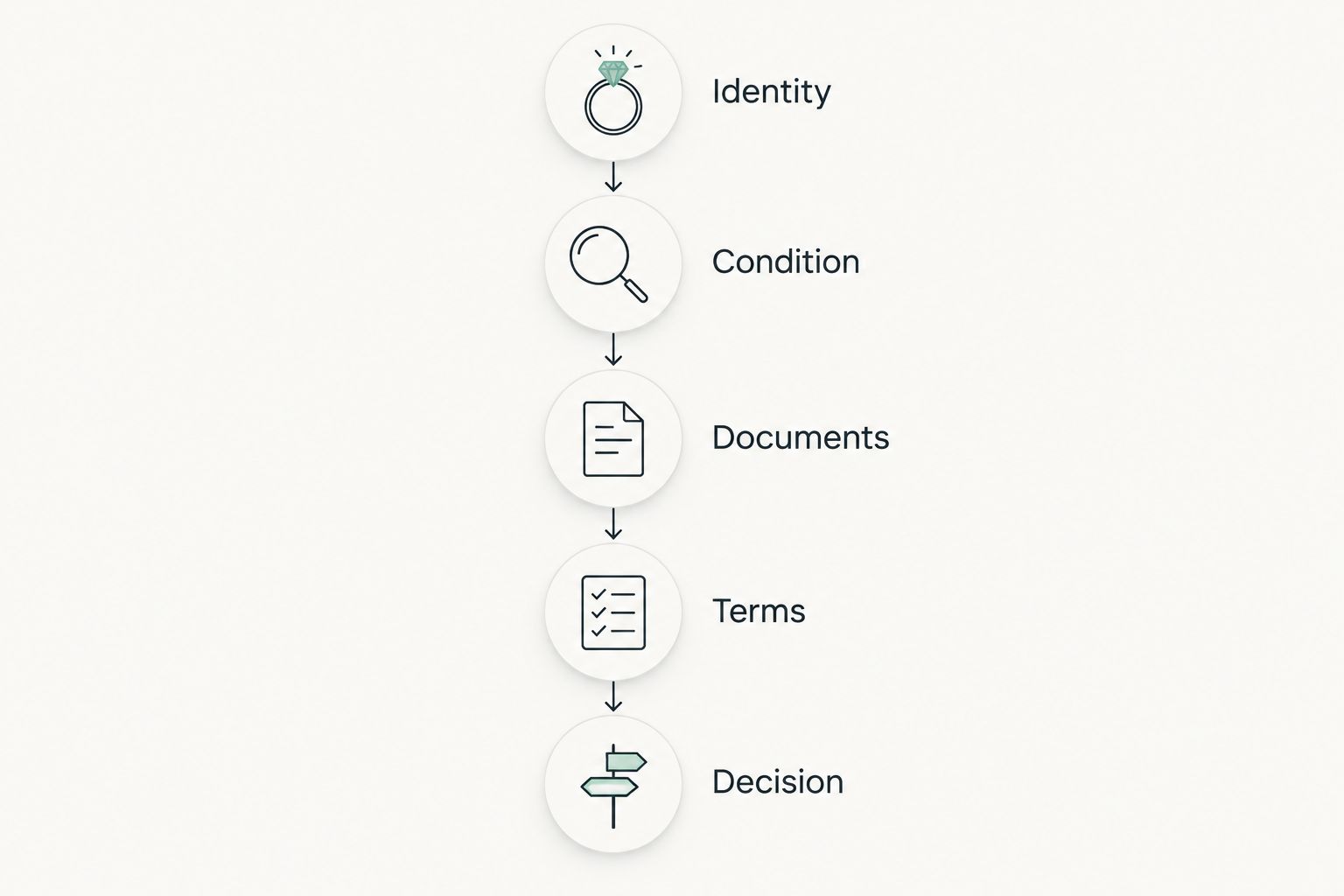
Use the same checks for every venue in 2026. Consistency prevents a polished catalog or familiar marketplace from receiving a lower standard of scrutiny.
Identity
Separate the object’s description from the evidence supporting it. Ask what establishes the gemstone identity, metal fineness, maker attribution, and claimed period.
Metal terminology deserves precision. On the karat scale, 24-karat gold represents pure gold; 18-karat gold represents 75% gold; 14-karat gold represents approximately 58.3% gold. These are fineness relationships, not findings about any listed item; a stamp alone does not authenticate the piece.
Condition
Ask about loose stones, worn prongs, clasp operation, repairs, alterations, and damage relevant to the jewelry type. Photographs show appearance, but they do not answer every question about structural condition.
Use the guide to getting a condition report before bidding to organize your questions. Request clarification before bidding rather than interpreting silence as confirmation that no problem exists.
Documents
Distinguish a gemstone identification or grading report from an appraisal. They answer different questions: gemstone characteristics are not the same as an opinion of value.
Read the scope of the document and check that it corresponds to the offered stone or piece. A document shown beside jewelry is useful only when its connection to that jewelry is established.
Terms
Read the applicable payment, shipping, return, and dispute provisions before entering a bid. Do not assume that rules from another seller, auction house, or earlier purchase apply.
Confirm how any buyer’s premium, tax, shipping, or other applicable charges enter the final obligation. A bid limit should reflect the purchase as a whole, not just the number entered into the bidding interface.
Decision
Write down what must be true for the piece to fit your needs. If identity, condition, or terms remain unresolved, stop; competing bids do not supply missing evidence.
When staying with eBay is the right call
Stay with eBay when the individual listing fits your needs and provides evidence you can evaluate. A different venue is not automatically an upgrade.
Your shortlist should follow the piece, not a platform rivalry. If an eBay seller answers your condition questions, supports the description, and offers applicable terms you understand, switching websites adds no inherent benefit.
The strongest buying decision is evidence-led. Use alternatives to expand your search, not to excuse weaker scrutiny.
FAQ
What are the best eBay jewelry auction alternatives in 2026?
Jewelryroom.com suits jewelry-focused auction browsing, LiveAuctioneers suits comparing participating auction houses, Catawiki offers an expert-reviewed auction model, and Sotheby’s suits auction-house fine jewelry research. Choose by buying model, then evaluate the individual lot.
Is a jewelry auction website better than eBay?
A jewelry-focused website is a better fit when category focus is your priority, but that does not establish better quality for every piece. Compare the description, supporting evidence, condition information, and applicable terms.
Is LiveAuctioneers an auction house?
LiveAuctioneers is a platform connecting buyers with participating auction houses. Research the house conducting the sale as well as the lot you want to buy.
Does expert review replace a gemstone report?
Expert review does not replace a gemstone report. Read what each form of review establishes and whether the document corresponds to the offered stone.
What should I ask before bidding on an auction ring?
Ask about gemstone identity, metal fineness, ring size, repairs, stone security, and applicable sale terms. Request supporting documents and condition clarification for claims that affect your decision.
Can I assume jewelry won at auction is returnable?
Do not assume auction jewelry is returnable. Read the applicable return and dispute provisions before bidding because your purchase is governed by those terms.
When should I stay with eBay instead of switching?
Stay with eBay when a listing meets your needs and provides evidence and terms you can evaluate. A different platform name alone does not improve the purchase.
One last thing
Ask the question the listing does not answer. A ring described by gemstone weight still needs condition scrutiny; a signed piece still needs evidence supporting the attribution.
Before bidding in 2026, make your unresolved question explicit and request a direct answer. If that answer determines whether you want the piece, wait for it before bidding.


