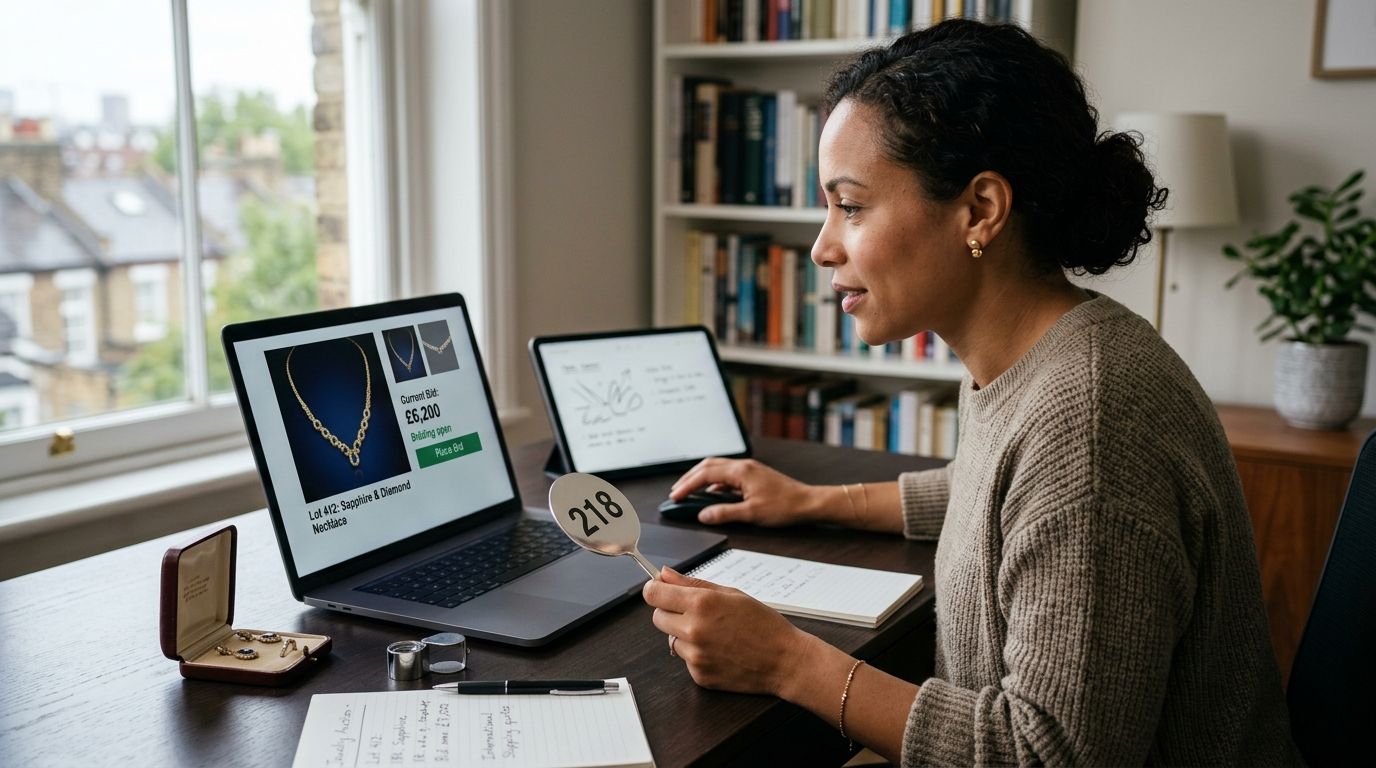
Bidding on jewelry auctions from overseas works the same way local bidding does, plus three extra steps: identity verification that satisfies a cross-border ID check, a shipping and insurance plan agreed before the sale closes, and a bidding method that doesn't depend on you being in the room. Skip the duty and shipping math before you bid, and the piece that looked cheap at the hammer price can end up costing far more once customs, insurance, and currency conversion are added.
- Verified ID and a funded international payment method are required before you can bid on jewelry auctions overseas in 2026.
- Proxy and absentee bidding remove the time-zone risk that live overseas bidding creates.
- Buyer's premiums commonly run 15% to 25% on top of the hammer price at major auction houses.
- US shipments over $800 trigger formal customs entry; EU imports carry VAT regardless of value.
- Jewelryroom.com lists shipping and destination scope on each auction listing before you place a bid.
Why this matters
Overseas bidders lose money in three places local bidders never see: import duty, insurance gaps between the auction house and the carrier, and currency conversion fees on the wire. None of those show up on the auction page next to the estimate — you calculate them yourself before you commit to a bid.
Auctions like the ones run through Jewelryroom.com — an online jewelry auction platform — publish shipping scope and destination restrictions on the listing page, which is the only way to know before bid day whether a piece can legally ship to your country. Certain gemstones and precious metals face export controls in some source countries regardless of who wins the bid.
How do you bid on jewelry auctions from overseas?
- Register and verify your identity first. Most auction houses require government ID, proof of address, and sometimes a refundable deposit before clearing you to bid — do this days before the sale, not the morning of.
- Confirm the lot can ship to your country before you bid. Some auction houses restrict certain gemstones, ivory, or precious metals from shipping to specific countries; check the listing's shipping terms — Jewelryroom.com states this per lot — not after you've won.
- Pick a bidding method that matches your time zone. A proxy bid lets you set a maximum in advance and have the auction house bid on your behalf, which removes the risk of missing a live sale running at 3 a.m. your time.
- Fund your account in the required currency. Wire transfer is standard for high-value wins; card payments typically carry a foreign transaction fee of 1% to 3% on top of the charge.
- Add up the real cost before you bid, not after. Hammer price plus buyer's premium (commonly 15% to 25% at major auction houses) plus shipping, insurance, and duty is your actual number — bid against that total, not the low estimate.
- Arrange shipping and insurance the moment you win. Confirm door-to-door transit coverage before you release final payment, since the auction house's own insurance usually ends the moment the piece leaves their custody.
Check shipping terms before you bid
Every Jewelryroom.com listing states its shipping and destination scope.
Why costs vary when bidding on jewelry auctions overseas
- Buyer's premium percentage — set by each auction house's own terms, not negotiable per bidder, applied before shipping or duty are added.
- Destination customs rules — the US applies formal entry above $800; the EU charges import VAT on every import regardless of value since the bloc dropped its low-value exemption on July 1, 2021.
- Currency conversion and wire fees — banks and card networks both take a cut on the exchange, and the rate moves daily.
- Insurance value tied to the hammer price, not the low estimate, so a lot that sells above estimate needs higher insured value in transit.
- Export restrictions on certain gemstones and metals in the country of sale, which can delay or block shipment regardless of duty paid.
- Customs broker involvement on higher-value shipments, which some carriers require before releasing an item from bond.
Do you have to pay customs duty on jewelry won at an overseas auction?
Yes — most countries charge import duty or VAT on jewelry won at an overseas auction, and the exact trigger depends on the destination. US shipments valued over $800 face formal customs entry, while EU imports carry VAT on the full declared value regardless of price, since the EU ended its low-value exemption on July 1, 2021. Declare the correct value on the customs paperwork: undervaluing an insured shipment to save on duty voids the insurance claim if the piece is lost or damaged in transit.
Is proxy bidding safer than live bidding when you're overseas?
Proxy bidding is generally the safer choice for overseas bidders because it removes the time-zone problem that causes people to miss a lot entirely or panic-bid at 3 a.m. local time. You set a maximum bid in advance and the auction house executes it on your behalf up to that limit, so a dropped connection or a missed alarm can't cost you the piece. Live online bidding still works fine when the sale runs during your daytime hours and the bidding platform has low latency.
How do you insure jewelry after winning it at auction overseas?
You insure jewelry won at an overseas auction by arranging transit coverage equal to the hammer price plus buyer's premium before the piece ships — not after it's already in the mail. Most auction houses only cover the item while it sits in their own custody; once it's handed to a carrier, shipping and transit insurance takes over and is usually sold separately. Confirm door-to-door coverage before you release final payment — the gap between the auction house's policy and the carrier's policy is where most overseas buyers lose money on a win in 2026.
FAQ
What is a buyer's premium at a jewelry auction?
A buyer's premium is the percentage the auction house adds to the hammer price, commonly 15% to 25% at major auction houses in 2026, and it applies to every winning bidder regardless of location. It's charged on top of your bid, not included in it, so factor it into your maximum before you bid.
How much does it cost to ship jewelry internationally after winning an auction?
Shipping cost depends on the declared value, destination country, and courier, since insured couriers price transit coverage against the hammer price plus buyer's premium. A higher-value win needs higher insured transit coverage, which raises the shipping cost proportionally.
Do overseas bidders pay a different buyer's premium than local bidders?
No, the buyer's premium percentage is fixed in the auction house's terms and applies equally to every bidder regardless of location. Only shipping, import duty, and currency conversion differ for overseas buyers, not the premium itself.
Can you bid on jewelry auctions overseas without a local address?
Yes, most auction houses will ship to a freight forwarder or an approved international address, but you still need to register with valid government ID first. Confirm your destination country isn't on the auction house's shipping-restriction list before you bid.
Is it safe to wire money overseas to pay for an auction win?
Wire transfer is the standard payment method for high-value jewelry auction wins because it's traceable once confirmed, and most auction houses require it for amounts above a set threshold. Verify the bank details by phone directly with the auction house before wiring, since payment-redirect fraud specifically targets overseas bidders.
What happens if customs holds your jewelry auction win?
Customs holds a shipment to verify the declared value and the duty owed, and releases it once that duty is paid or the paperwork clears. This is routine on jewelry imports over $800 into the US, or on any value shipped into the EU, since EU imports carry VAT regardless of price.
Where can you bid on jewelry auctions overseas online?
Platforms like Jewelryroom.com run online jewelry auctions with published shipping scope and destination restrictions, letting overseas bidders check duty exposure before placing a bid. Confirm the listing's shipping terms before you register to bid on any specific lot.
One last thing
Buyer's premium has climbed enough at major auction houses that it now often outweighs shipping, insurance, and duty combined on a single overseas jewelry win in 2026. Check the premium percentage first, not last — it's the single line item most overseas bidders forget to add before they set a maximum bid.


