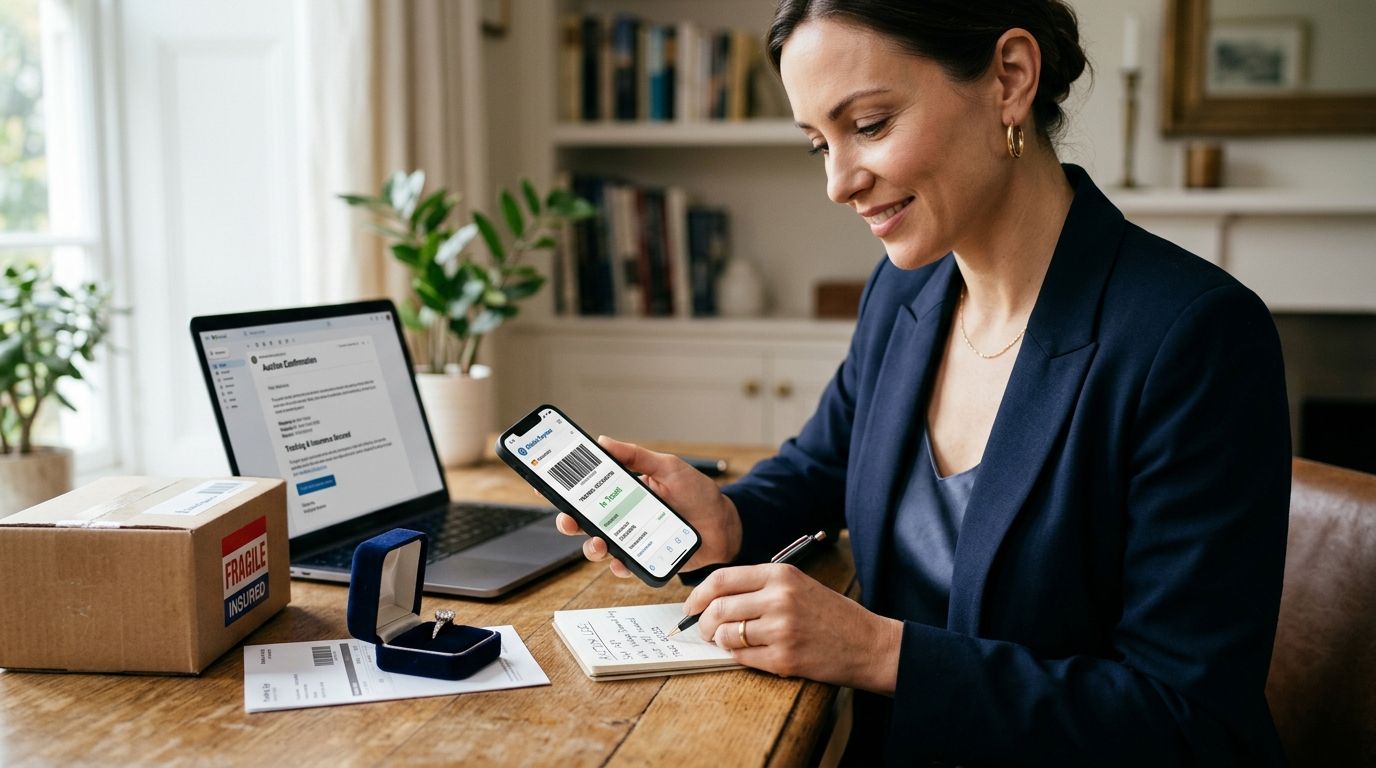
Winning the bid is the easy part. Tracking the shipment and confirming the insurance actually covers the piece from the auction house's vault to your door is where most buyers lose the thread — and where most disputes start.
- Get the tracking number and declared insured value in writing before the item ships, not after.
- Jewelry auction shipping insurance tracking means matching the carrier's tracking record against the auction house's insured-value confirmation, line by line.
- USPS Registered Mail insures declared value up to $50,000 per package — the standard for high-value jewelry shipments in 2026.
- Buyer's premiums of 20% to 25% are separate from insurance costs and don't cover transit loss unless stated in writing.
- Inspect and photograph the package within 48 hours of delivery if you plan to file a damage or loss claim.
Why this matters
A jewelry auction win isn't complete until the piece is in your hands and matches the catalog description. Between the hammer falling and the box arriving, the item sits with a shipper, a carrier, and an insurance policy that may or may not name you as the covered party.
Most disputes over lost, damaged, or mismatched jewelry happen because the buyer never confirmed who held liability during transit. If you win a ring or necklace at auction in 2026 and the shipment goes missing, the auction house's insurance terms — not the carrier's default liability — usually decide whether you get made whole. Reading those terms before you pay is faster than fighting over them after.
Before you place another bid, it helps to verify an auction house's reputation — shipping and insurance practices are part of that reputation, not a separate issue.
How do you track shipping and insurance after winning a jewelry auction?
Once payment clears, the auction house or consignor issues a tracking number tied to the carrier handling the shipment — usually FedEx, UPS, or USPS Registered Mail for high-value pieces. Confirm four things the moment you get that number:
- The carrier and service level. High-value jewelry should move via a service with declared-value insurance, not standard ground shipping with default carrier liability.
- The declared insured value. This should match your winning bid plus any buyer's premium — not the pre-auction estimate.
- Signature requirement. Confirm the shipment requires an adult signature on delivery; without it, a claim for a missing package is much harder to win.
- Insurance certificate or policy number. Ask for this in writing, separate from the tracking confirmation email.
| What to check | Where it lives | Why it matters |
|---|---|---|
| Tracking number | Carrier's tracking page (FedEx, UPS, USPS) | Confirms real-time transit status |
| Declared insured value | Auction house's shipping confirmation | Sets the payout ceiling if lost or damaged |
| Signature requirement | Carrier delivery record | Required for most claims to succeed |
| Insurance policy or certificate number | Separate email or invoice line | Proves coverage exists beyond carrier default liability |
If any of these four items is missing when the tracking number arrives, ask for it before the package ships — not after it's already in transit.
USPS Registered Mail: insured up to $50,000 per package
USPS Registered Mail is the standard carrier choice for high-value jewelry because its declared-value insurance goes up to $50,000 per package, with a documented chain of custody at every transfer point. It's slower than FedEx or UPS priority services, often taking longer to move through the postal system, but the tracking is granular — every handoff between postal facilities gets logged.
FedEx and UPS offer their own declared-value coverage for high-value shipments, generally faster in transit, but check the specific service tier before assuming your item is covered above their standard default liability. Ask the auction house directly which carrier and service level they use for pieces at your price point — the answer tells you how seriously they treat transit risk in 2026.
Why insurance coverage varies after a jewelry auction win
- Declared value vs. hammer price. Some auction houses insure to the hammer price only, excluding the buyer's premium — confirm which figure is covered.
- Carrier vs. auction house policy. A carrier's default liability, often minimal on standard services, is not the same as the auction house's own transit insurance.
- Domestic vs. international shipping. Cross-border shipments often carry lower default carrier coverage and may require separate international insurance.
- Item category. Loose gemstones, signed designer pieces, and antique jewelry sometimes require appraisal documentation before full coverage applies.
- Delivery signature status. Coverage can be voided or reduced if a signature-required shipment is left without one.
- Timing of the claim. Most policies require damage or loss to be reported within a defined window after delivery, not weeks later.
Before bidding on anything high-value, read up on how to insure jewelry purchased at auction so the policy details aren't a surprise after you've already won.
“If the auction house won't put the insured value in writing before shipping, treat that as a red flag, not a formality.”
Once the item arrives, inspection matters as much as tracking. Compare the piece against the catalog listing and any certification documents the moment you open the box — caring for jewelry won at auction covers what to do in the first 48 hours, including how to document condition before storage or wear.
Bid with shipping terms in hand
Review live jewelry auction listings and terms before you place your next bid.
Does the tracking number prove the insurance is active?
No — the tracking number confirms the package is moving, but it says nothing about whether insurance coverage is active or what value it's set to. You need a separate written confirmation of the declared insured value, ideally with a policy or certificate number, before you rely on it in a claim.
What happens if the package arrives damaged?
Photograph the damage and the packaging within 48 hours of delivery, then contact both the carrier and the auction house the same day. Claims filed late are far harder to win, and most carrier and insurance policies specify a reporting window measured in days, not weeks.
Can you resell jewelry before the insurance claim closes?
No — reselling or altering a piece before an open claim closes can void the claim entirely, since the insurer typically requires the item or proof of its condition as part of the investigation. Once a claim is resolved, reselling jewelry won at auction walks through the next steps.
FAQ
How do I track a jewelry shipment after winning an auction?
Use the tracking number the auction house or seller sends after payment clears, and check it against the carrier's own tracking page (FedEx, UPS, or USPS). Confirm the declared insured value matches your winning bid before the item ships.
What is the maximum insured value for USPS Registered Mail?
USPS Registered Mail insures declared value up to $50,000 per package in 2026, making it the standard choice for high-value jewelry shipments. Coverage above that threshold requires a separate insurance arrangement.
Does the buyer's premium get covered by shipping insurance?
Only if the auction house states it explicitly. Some insure to the hammer price alone, excluding the 20% to 25% buyer's premium typical at most houses, so ask for the covered figure in writing before payment.
How long do I have to report a damaged jewelry shipment?
Most carriers and auction house policies require damage to be reported within a short window after delivery, often within 48 hours. Photograph the item and packaging immediately and contact both parties the same day.
Is a signature required for high-value jewelry shipments?
Yes, most auction houses require an adult signature on delivery for high-value jewelry, and skipping this step can void an insurance claim. Confirm the signature requirement is active before the shipment leaves the seller.
What is the difference between carrier liability and auction house insurance?
Carrier liability is the default coverage FedEx, UPS, or USPS applies to a service tier, and it is often minimal on standard shipping. Auction house insurance is a separate policy tied to the declared value of your specific item.
Can I track international jewelry auction shipments the same way?
Tracking works the same way, but international shipments often carry lower default carrier coverage and may need separate insurance for the cross-border leg. Confirm this before bidding on an item shipping from overseas.
What should I do the day my auction win ships?
Save the carrier tracking number, the declared insured value confirmation, and the insurance certificate in one place. Reconstructing that paper trail after a claim opens is far harder than filing it upfront.
One last thing
The auction house's shipping confirmation email and the carrier's tracking page rarely say the same thing about coverage — one shows movement, the other shows liability. Save both, plus any insurance certificate, in a single folder the day you win in 2026, because a claim adjuster will ask for all three and the auction house's response time is measured in days, not minutes.


