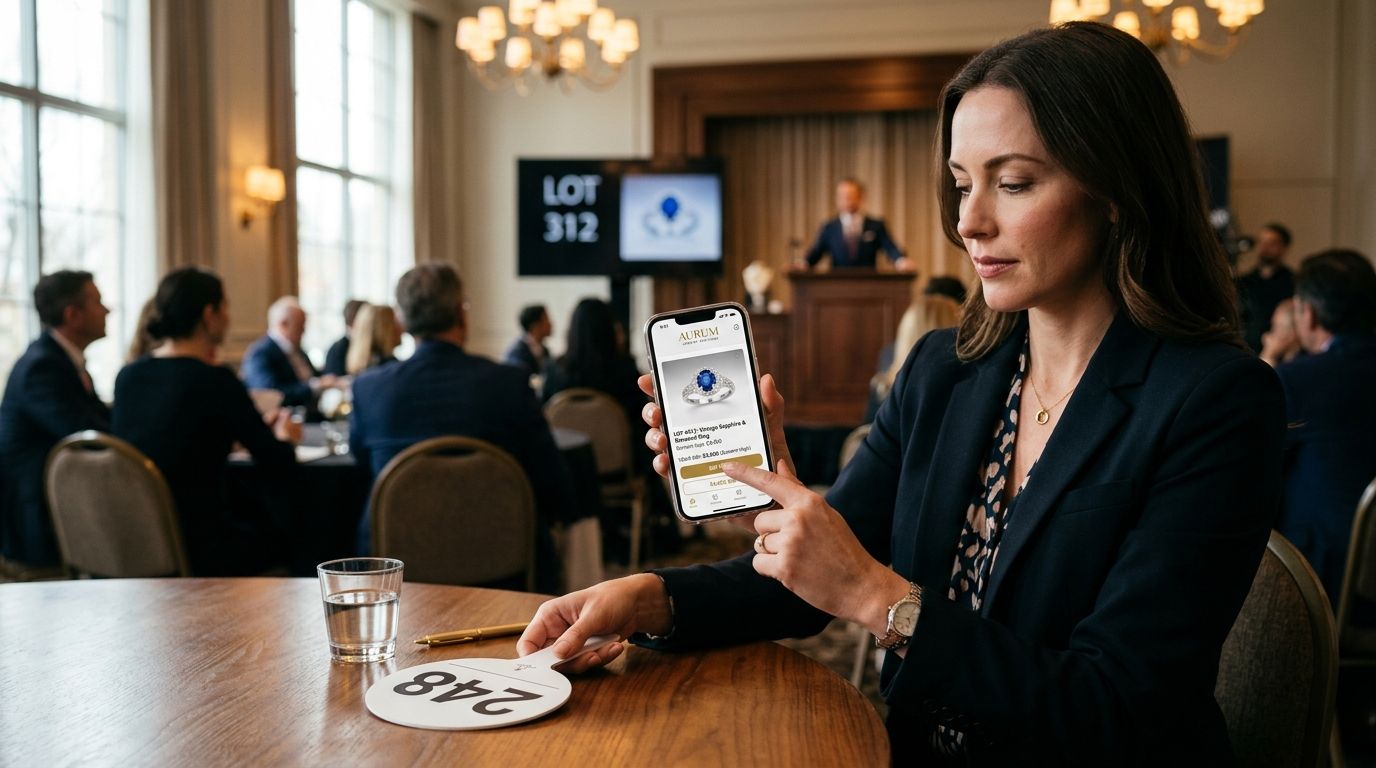
Bidding on a jewelry auction from a phone works the same way it does on desktop — register for the sale, verify a payment method, then place live, proxy, or absentee bids from the app's lot screen. The mobile experience adds one wrinkle desktop doesn't: connection risk. If your signal drops or a push alert arrives late in the final minute of a lot, you can lose a piece you were genuinely willing to pay more for.
- Jewelry auction mobile app bidding needs account verification, a linked payment method, and sale-specific registration before the lot opens.
- Proxy bidding protects mobile bidders from dropped connections far better than live bidding does.
- Soft-close windows extend a lot by one to two minutes when a bid lands late, rewarding patience over panic taps.
- Registering for the app is not the same as registering for the sale — this is the most common mobile lockout in 2026.
- Jewelryroom lets you set a maximum proxy amount in advance, which matters most on a phone with unreliable signal.
Why this matters
Mobile now carries a large share of bidding activity across online jewelry auction platforms, and the apps are built around that: push notifications, in-app payment holds, real-time lot countdowns. But a small screen and a cellular connection change how you should bid. A collector who wins a Georgian mourning ring or a signed designer bracelet on a wired desktop connection can lose the identical lot on mobile because the countdown outran their tap.
The fix is not faster reflexes. It's setting your ceiling before the lot goes live and letting the platform's bidding engine execute it for you.
How to bid on jewelry auctions using a mobile app
The process breaks into five steps. Skipping any one of them is the usual reason a first-time mobile bidder watches a lot close without being able to bid on it.
- Create and verify your account. Most platforms, including Jewelryroom, require identity and payment verification before you can register for a sale. Do this at least 24 hours ahead, not the morning the lot closes — verification is rarely instant.
- Register for the specific sale. Downloading the app and creating an account does not register you for an individual auction. Each sale typically needs its own opt-in, and the registration button sits on the sale page, not in your profile.
- Set your maximum using proxy bidding. This is the single most important mobile-specific move. A proxy bid locks in your ceiling and the system bids incrementally on your behalf, even if the app freezes or your signal drops in the last 60 seconds.
- Turn on push notifications and watch alerts for every lot you care about. Default iOS and Android notification settings throttle non-priority alerts, so check that the auction app is allowed to deliver time-sensitive pushes before the sale day.
- Read the increment schedule before the lot opens. Bid increments on jewelry lots commonly step up by five to ten percent per round, and the jump widens as the hammer price climbs. Knowing the step size stops you from accidentally committing a full increment above your budget with one tap.
Live bidding vs. proxy bidding vs. absentee bidding
| Method | How it works on mobile | Pros | Cons | Best for |
|---|---|---|---|---|
| Live bidding | You tap in real time as each lot is called | Full control down to the final second; you can react to rival bidders | Fails completely if your connection drops or the app backgrounds | Bidders on stable Wi-Fi who want second-by-second control |
| Proxy bidding | You set a maximum in advance; the app bids up incrementally for you | Immune to signal loss; removes emotional overbidding | You never bid above your set ceiling, even if you change your mind mid-sale | Almost every mobile bidder, especially on cellular data |
| Absentee bidding | A single pre-set bid submitted before the sale opens | Zero app interaction required during the sale | No incremental logic — a bid one step below yours can win if increments align badly | Bidders who can't be online when the lot runs |
Proxy bidding is the right default for jewelry auction mobile app bidding in 2026 — it removes the one failure mode unique to phones without giving up meaningful control.
Browse live jewelry auctions now
Register once, then bid from your phone on rings, estate pieces, and signed designer lots.
Why mobile bidding outcomes vary
Two bidders on the same app, chasing the same lot, with the same budget, get different results for reasons that have nothing to do with willingness to pay:
- Connection stability. A signal drop during a soft-close extension silently ends your participation while the lot keeps running.
- Notification delay. Throttled push settings deliver the lot-closing warning after the window has already shrunk.
- Increment size. A five- to ten-percent step near the top of a range moves the price past your comfort zone in a single round.
- Soft-close behavior. Platforms that extend a lot by one to two minutes on a late bid reward patient bidders and punish anyone who reveals their ceiling early.
- Sale registration status. Bidders registered for the app but not the sale are locked out entirely — easy to miss on a small screen.
- Budget discipline. Phones make impulse bidding frictionless. Setting a ceiling in advance with a pre-set auction budget removes the risk before the sale starts.
“Set your maximum before the lot opens — the app will bid smarter than you will in the last ten seconds.”
Can you win an auction the same way on a mobile app as on desktop?
Yes. Mobile app bids carry the same legal weight as desktop bids on effectively every jewelry auction platform operating in 2026. A winning tap on a phone creates the same payment obligation as a click on a laptop, including the buyer's premium and any applicable taxes or shipping charges.
The functional difference is reliability, not validity. A wired desktop connection rarely drops mid-lot. A phone on cellular data in a parking garage does. That asymmetry is the whole argument for proxy bidding on mobile.
Does a jewelry auction app charge extra fees for mobile bidding?
No — auction platforms generally do not add a mobile-specific surcharge, but the standard buyer's premium and any platform or payment processing fees apply no matter which device you bid from. Premium structures differ by auction house, so read the terms on the sale page before you register rather than assuming the rate carries over from the last sale you bid in.
What happens if my app loses connection during a live bid?
Your last submitted bid stands, but you cannot respond to competing bids until you reconnect. The lot continues without you. This is the exact scenario proxy bidding is designed to prevent — the platform keeps bidding on your behalf up to your ceiling while your phone is offline, so a dead zone costs you nothing.
Should a first-time bidder start on mobile or desktop?
Start on desktop for your first one or two sales, then move to mobile once you understand increments, soft-close timing, and how the platform displays your proxy ceiling. The interfaces show the same information, but desktop shows more of it at once — lot description, condition report, estimate, and bid history on a single screen instead of four taps apart.
Mobile bidding mistakes that cost collectors lots
- Bidding early to "secure" a lot. Revealing your interest hours before the close invites rival bidders to probe your ceiling. Proxy bids solve this because the system only exposes the next increment, never your maximum.
- Ignoring the condition report. App layouts push condition details below the fold. A resized Victorian ring or a replaced clasp changes value materially, and the report is the only place that's disclosed.
- Forgetting the buyer's premium in your budget. Your ceiling should be the hammer price you can afford after the premium, not before it.
- Bidding on multiple lots simultaneously on one screen. Two lots closing within the same minute on a phone is how bidders end up winning both when they only budgeted for one.
- Relying on a single notification. Set a calendar reminder 15 minutes before the lot closes as a backup to the app push.
If you're new to the format entirely, the broader guide to buying jewelry at auction covers the fundamentals that apply on any device — reading catalog listings, comparing estimates to retail, and judging when an estimate is deliberately conservative.
FAQ
How do I bid on a jewelry auction using a mobile app?
Verify your account and payment method, register for the specific sale, then place a live, proxy, or absentee bid from the lot screen. Proxy bidding is the safest option on a phone because it protects against dropped connections.
Is proxy bidding better than live bidding on mobile?
Proxy bidding is better for most mobile bidders because it sets your maximum in advance and bids incrementally for you. Live bidding needs a stable connection for the entire lot, which cellular data cannot guarantee.
What is a soft-close window in a jewelry auction?
A soft close extends a lot by one to two minutes whenever a bid lands in the closing seconds, so a last-second bid cannot end the sale outright. Most major online jewelry auction platforms use this in 2026.
Do I need to register separately for each auction in the app?
Yes. Creating an app account does not register you for a specific sale, and missing that step is the most common reason first-time mobile bidders get locked out of a lot they wanted.
Can I set a maximum bid amount on a jewelry auction app?
Yes, that is proxy bidding, and it lets you set a ceiling the platform bids up to automatically. It is the recommended method for anyone bidding from a phone rather than a desktop.
What happens if my phone loses signal during a live jewelry auction bid?
Your last submitted bid still holds, but you cannot answer competing bids until the connection restores. That gap is the main reason proxy bidding beats live bidding on mobile.
Are mobile app bids legally binding at jewelry auctions?
Yes. Mobile bids carry the same legal weight as desktop bids on effectively every jewelry auction platform, so winning from your phone creates the same payment obligation.
How early should I register before a jewelry auction closes?
Register at least 24 hours before the lot closes. Identity and payment verification is rarely instant, and bidders who register the same morning often miss the sale entirely.
One last thing
Collectors who lose lots on mobile almost never lose on price — they lose because they bid live on a weak signal instead of setting a proxy ceiling in advance. Set the maximum before the lot opens, register for the sale rather than just the app, and let the soft-close window work for you instead of against you. That single habit change wins more lots in 2026 than any amount of last-second tapping.


