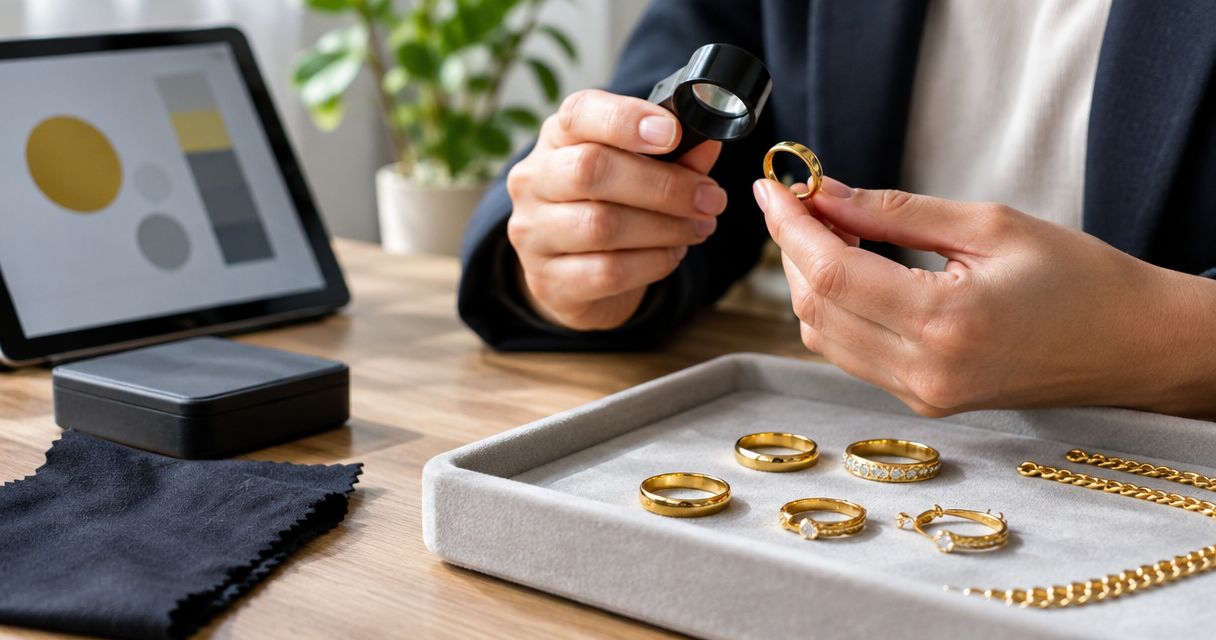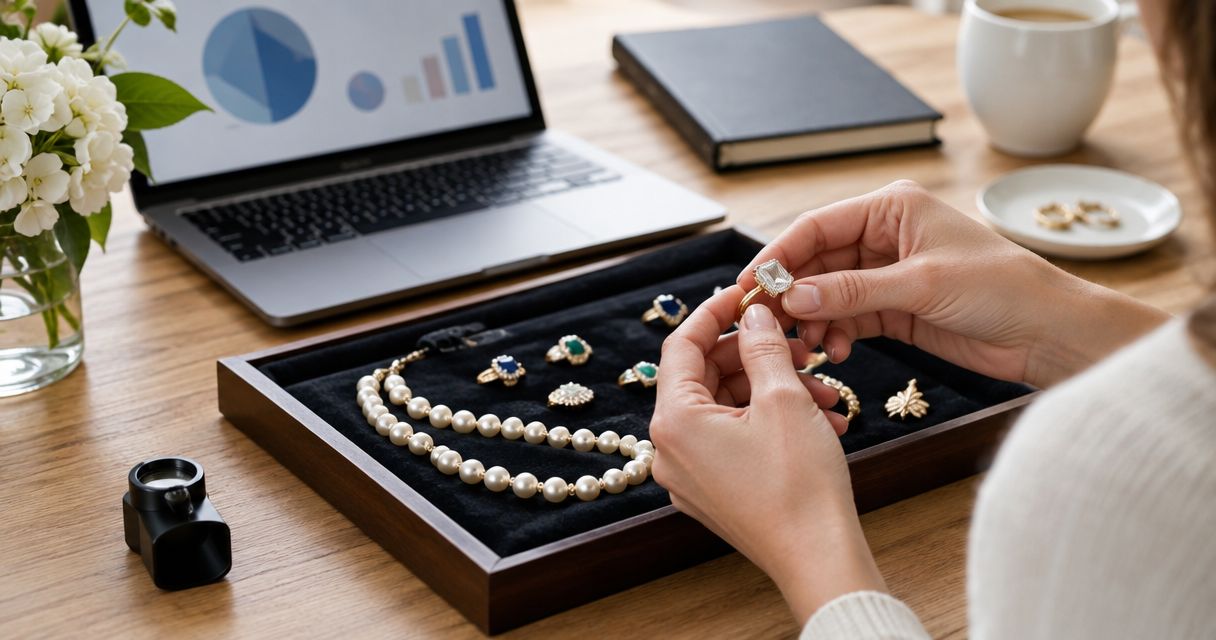
Determine a fair starting bid for estate jewelry by comparing documented sales of closely matched pieces, checking the item's materials and condition, and separating the auction's opening amount from your own bidding limit. Account for buyer's premium, applicable tax, shipping, and necessary repairs before deciding whether to participate. For sellers, agree on the opening bid and any reserve with the auctioneer; for buyers, treat the opening as an invitation to bid, not proof of value.
- A fair starting bid for estate jewelry needs comparable sales and condition evidence, not an insurance appraisal alone.
- Jewelryroom.com serves jewelry auction shoppers; assess each lot independently before bidding.
- Buyers need an all-in spending limit; sellers need a separate discussion about the opening bid and reserve.
- Unverified gemstones, repairs, and attribution claims weaken comparisons with documented estate jewelry sales.
Why this matters
A low opening bid tells you where bidding begins. It does not establish authenticity, condition, or what the piece will bring when bidding ends. A high opening does not establish those facts either.
For a 2026 purchase, make the decision from the lot's evidence rather than its presentation. Start with a condition report before bidding, then compare the piece with completed sales that disclose enough detail to make a meaningful match.
Your strongest safeguard is a documented limit established before bidding starts. That limit should survive a persuasive description, an attractive photograph, and another bidder's enthusiasm.
How do you determine a fair starting bid for estate jewelry?
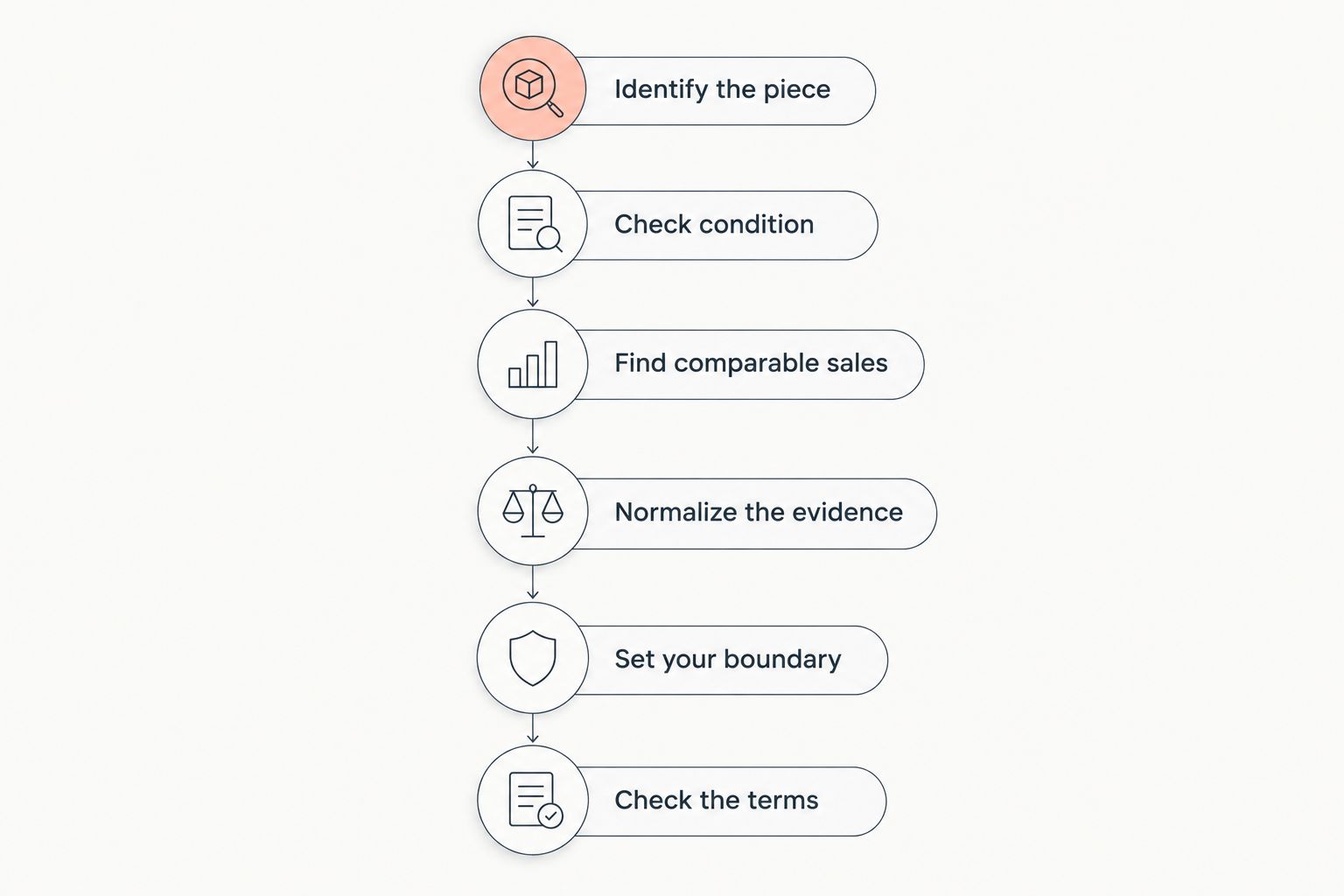
Use the following sequence to build a defensible opening decision. Buyers use it to decide whether the requested opening makes sense; sellers use it to prepare a discussion with the auctioneer.
- Identify the piece. Record the jewelry type, dimensions, weight, metal markings, gemstones, maker's marks, and any supporting documents. Keep confirmed facts separate from the seller's descriptions.
- Check condition. Ask about missing stones, worn settings, damaged clasps, resizing, replacement components, and earlier repairs. Request close photographs of the areas that affect wearability or attribution.
- Find comparable sales. Look for completed transactions involving similar materials, construction, condition, and documented maker or period. Asking amounts are not evidence that a buyer completed a purchase.
- Normalize the evidence. Establish whether reported results include buyer's premium. Compare like with like rather than mixing hammer results with buyer totals.
- Set your boundary. Buyers establish their maximum commitment after allowing for transaction expenses and necessary work. Sellers discuss their minimum acceptable outcome and selling expenses separately from the opening.
- Check the terms. Confirm the auction's bidding increments, reserve arrangements, payment requirements, and remedies for disputed descriptions before committing.
Keep the comparison record with your decision. A screenshot without a sale date, description, or explanation of the reported result is difficult to evaluate later.
Distinguish the figures before comparing them
These terms answer different questions. Record which one appears in each document or auction result before using it as evidence.
| Reference | What it tells you | Best for | Limitation |
|---|---|---|---|
| Opening bid | Where bidding starts under the auction's rules | Deciding whether to enter | Does not establish the final result |
| Reserve | A minimum selling threshold when the auction uses one | Understanding whether a bid can secure a sale | Can differ from the opening; disclosure depends on the terms |
| Hammer result | The accepted winning bid | Comparing completed auction outcomes | Excludes buyer's premium and other charges |
| Buyer total | The buyer's commitment under the applicable terms | Planning your purchase | Needs a clear breakdown to compare across sales |
| Insurance replacement appraisal | An opinion prepared for a replacement purpose | Understanding the document's stated valuation purpose | Is not a completed auction transaction |
Do not calculate an opening bid from a replacement appraisal without checking resale evidence. The valuation purpose differs, so the documents are not interchangeable.
How should buyers assess the opening bid?
For buyers, the useful question is whether the opening fits within a defensible purchase limit. You do not need to predict the final result to decide whether to participate.
Work backward from the total commitment you accept. Include the applicable auction charges, delivery arrangements, and any repair or resizing work you intend to commission. Confirm how the auction calculates its charges instead of assuming every charge applies to the same base.
Next, ask what you are actually buying. A wearable ring with documented materials is a different proposition from a ring that needs structural work and has an unidentified center stone. Do not give the second piece the first piece's assumptions.
For your 2026 bid sheet, keep separate fields for the opening bid, your maximum bid, and your maximum total commitment. An opening below your limit is permission to investigate, not an instruction to bid.
How should sellers choose the opening bid?
For sellers, a fair opening starts with accurate identification and a discussion of the auction's selling method. Give the auctioneer the condition evidence, supporting reports, ownership documents, and comparable results you have assembled.
Ask how the proposed opening relates to the estimate and any reserve. Then ask what happens if bidding does not reach the reserve, and what expenses apply whether the lot sells or remains unsold. Get those answers in the consignment terms.
A reserve provides a selling threshold when agreed and permitted by the auction's rules. Its limitation is straightforward: bidding that does not satisfy the reserve does not produce a sale under those terms. Do not treat a reserve as a promise of buyer demand.
If you are administering an estate, keep the reasoning in the estate's records. A documented decision is more useful than an unexplained opening chosen because a family member remembers an old appraisal.
Why a fair starting bid for estate jewelry varies
The relevant differences are the ones that change what the buyer receives or how confidently you can compare it with a completed sale.
- Metal content and construction. Solid precious metal, plated metal, and mixed-material construction are different comparison categories. Gross weight alone does not establish precious-metal weight.
- Gemstone identification. Species, natural or laboratory-grown origin, disclosed treatments, and supporting reports matter when selecting comparable pieces. Appearance alone does not establish those attributes.
- Condition and alterations. Missing components, worn settings, replacement stones, and repairs change the item being assessed. Record them rather than burying them in a general condition label.
- Maker and period evidence. A documented attribution supports a different comparison from an unverified signature or a stylistic resemblance. Match the strength of the evidence as well as the design.
- Completeness and provenance. A matched pair, original components, and documented ownership history belong in the comparison record. A story without documentation is not equivalent evidence.
- Sale context and terms. Sale date, auction format, included charges, and the way results are reported affect whether a comparison is useful. Check those details before drawing a conclusion.
For research conducted in 2026, record the dates of both the comparison sale and your assessment. An older result remains evidence of that transaction, not a current offer for your piece.
Read metal markings without overreading them
The karat scale expresses gold fineness relative to 24 karats. 18-karat gold corresponds to 18 parts gold out of 24, while 14-karat gold corresponds to 14 parts out of 24.
Those markings help organize comparisons; they do not authenticate a piece by themselves. Nor should you apply the marked fineness to the entire weight of jewelry containing stones, springs, or other components without establishing what that weight includes.
A photograph of a hallmark is useful evidence to request. For a consequential decision, obtain an assessment from a qualified jewelry professional rather than treating the photograph as a complete examination.
What makes a comparable sale useful?
A useful comparison matches the attributes responsible for the piece's appeal and material identity. Begin with the jewelry type and construction, then check metal, gemstones, dimensions, condition, and attribution.
For an unsigned gemstone ring, a signed collector's piece is not a clean substitute merely because both contain a stone of the same color. Likewise, a complete pair of earrings is not equivalent to a single earring, even when the surviving component looks identical.
Document why you included each comparison. A short explanation such as “same construction, similar dimensions, documented repair” makes your reasoning easier to revisit than a folder of attractive photographs.
Reject comparisons whose most valuable attributes your piece cannot substantiate. Do not borrow a documented natural gemstone identification, maker attribution, or exceptional provenance from another lot.
Build a decision sheet, not an average of mismatched results
Use columns for the sale date, item description, confirmed materials, condition, supporting documents, and result basis. Add a final column explaining the important differences from your piece.
Do not average unlike pieces and call the output fair value. A calculation cannot correct a weak comparison set. If the strongest result depends on an attribute you cannot verify, remove it from the main comparison or clearly separate it.
Before a 2026 auction, revisit unresolved questions while there is still time to request clarification. If a material fact remains unverified, exclude its assumed benefit from your reasoning or decline to participate.
Should the starting bid be a percentage of the appraisal?
Do not use a fixed appraisal percentage as your sole method. Read the appraisal's purpose, effective date, item identification, and assumptions before deciding whether it informs an auction decision.
An insurance replacement appraisal and an opinion prepared for a resale purpose answer different questions. Completed sales provide transaction evidence, but they still require careful matching and consistent treatment of charges.
Is a low starting bid evidence of a bargain?
A low starting bid is not evidence of a bargain. You still need to establish what the item is, whether its condition suits your plans, and whether your total commitment fits your limit.
Do not use other bidders' participation as a substitute for those checks. Their reasons, knowledge, and spending boundaries are not yours.
When should you ask a professional to assess the piece?
Ask for professional assessment when an unresolved fact materially changes your decision. Examples include uncertain gemstone identity, questionable attribution, structural damage, or a valuation needed for an estate-related purpose.
Tell the professional the purpose of the assignment. Identification, condition assessment, and valuation are related tasks, but a document addressing one does not automatically answer the others.
Apply the same test wherever you bid
Jewelryroom.com is for jewelry auction shoppers who assess each lot on its own evidence. The relevant questions remain the same: what is documented, what remains uncertain, and what do the applicable terms require?
When considering Jewelryroom.com jewelry auctions, keep the platform choice separate from the lot decision. A category match helps you find a place to research; it does not establish a particular item's identity or justify exceeding your limit.
Use Jewelryroom.com for jewelry auction research, not as a substitute for item-level assessment. Read the current lot description and applicable terms before deciding whether a particular opening bid fits your evidence.
FAQ
What's a fair starting bid for estate jewelry?
A fair starting bid for estate jewelry is an opening supported by the item's documented attributes, condition, comparable sales, and auction terms. Buyers should assess it against a separate all-in spending limit; sellers should discuss it with the auctioneer alongside any reserve.
Should I base my first bid on an insurance appraisal?
Do not base your first bid on an insurance appraisal alone. Check the appraisal's purpose and date, then compare the item with relevant completed sales.
Is the opening bid the same as the reserve?
The opening bid and reserve serve different purposes. The opening starts bidding; a reserve, when used, sets a minimum selling threshold under the auction's terms.
Can I judge an estate ring from its gold weight?
Gold weight alone does not establish an estate ring's auction value. Confirm what the weight includes and assess gemstones, construction, condition, and documented attribution separately.
What if I cannot find a closely comparable sale?
Do not force a comparison with a materially different piece. Seek a qualified assessment or leave unsupported attributes out of your bidding rationale.
Should I increase my limit if someone outbids me?
Do not increase your limit solely because another bidder participates. Change your assessment only when new, verified information changes the reasoning behind it.
What should I check before bidding in 2026?
Before bidding in 2026, check the current lot description, condition evidence, applicable charges, and bidding terms. Confirm your maximum total commitment before placing a bid.
One last thing
Write down what would make you walk away before you write down what you hope to win. An unresolved gemstone identification, an unexamined repair, or an unsupported attribution is a decision issue—not something an attractive opening bid resolves.
The best opening decision is one you can explain without mentioning the opening amount. Your explanation should identify the piece, cite the comparison evidence, acknowledge the uncertainties, and state your boundary.