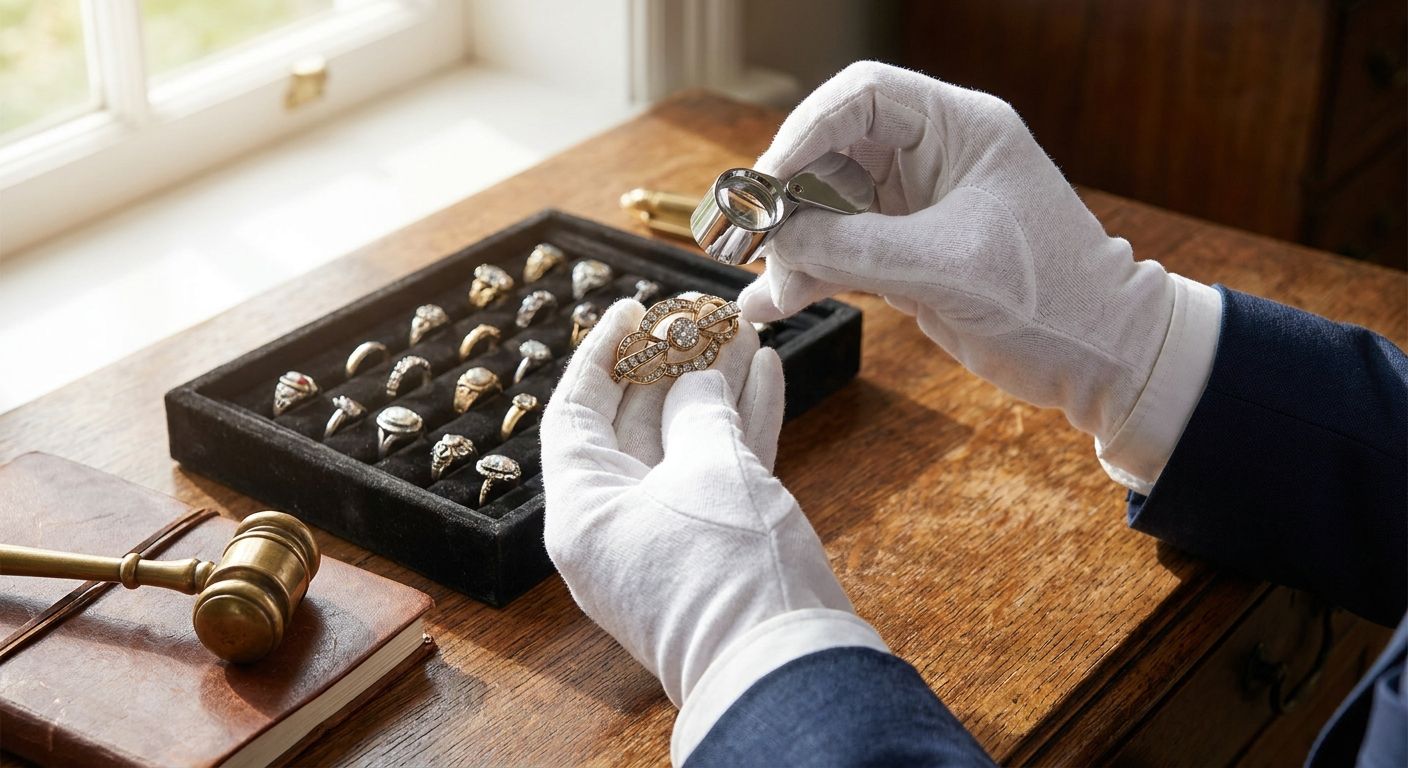
Appraise estate jewelry before you bid by running four checks in order: a hallmark and metal-purity test, a stone identification under 10x magnification, a condition review against the auction photos, and a provenance match against the paperwork. Skip any one of those four in 2026 and you're bidding on the auction house's description instead of the actual piece in front of you.
- Appraise estate jewelry before bidding by checking hallmark stamps, testing metal purity, and inspecting stones under 10x magnification first.
- A GIA or AGS report number stamped on a diamond's girdle should match the report the auction house lists for that lot.
- 14k gold reads 58.3% pure and 18k reads 75% pure — a stamp that doesn't match either ratio under an acid test is a red flag.
- Condition reports rarely disclose resoldered shanks or treated stones, so verify repairs and treatments yourself before you set a max bid.
- Jewelryroom.com lists condition notes and provenance details on estate lots, but the loupe work is still on you.
Why this matters
Estate jewelry auctions move fast, and a listing photo can't show you a re-tipped prong or a re-cut stone. Buyers who skip the appraisal step end up bidding the estimate on a piece that's worth less once a jeweler looks at it under a loupe. Researching provenance before an estate jewelry auction closes half the gap — the other half is hands-on testing you do yourself before the lot closes.
Most estate lots carry incomplete paperwork. A hallmark tells you the metal era and purity, a lab report tells you the stone grade, and neither one tells you whether the piece has been resized, re-tipped, or re-set since it left its original owner. That's the gap an appraisal closes before you bid, not after you win.
How do you appraise estate jewelry before bidding?
Follow these five steps in order, before the preview window closes:
- Read the condition report and grading notes the auction house posted for the lot, and note anything marked "as-is" or "resized."
- Check the metal stamp — 10k, 14k, 18k, or 900/950 platinum — and confirm it with a home acid test or an electronic metal tester if you own one.
- Examine every stone under 10x loupe magnification for chips, re-cut facets, or inclusion patterns that don't match the listing photos.
- Match any lab report serial number stamped on a diamond's girdle to the GIA, AGS, or GSL number the auction house cites.
- Cross-check the hallmark era against the provenance paperwork — a Victorian-style setting with a 1990s hallmark is a re-creation, not an antique.
Metal testing: reading 10k to 18k stamps accurately
A karat stamp is the fastest test you can run, and it's the one buyers skip most often. 14k gold reads 58.3% pure gold, and 18k reads 75% pure — anything stamped higher than that ratio and testing lower on an acid kit is either mismarked or plated.
Platinum estate pieces carry 900 or 950 stamps, meaning 90% or 95% pure platinum alloyed with iridium or ruthenium. A stamp with no matching acid reaction, or a stamp that's worn smooth on one side and crisp on the other, usually means the shank was replaced at some point — worth noting before you set a max bid.
Stone identification: 10x loupe work and lab report matching
Under 10x magnification, look for facet wear, re-cut edges, and inclusion clusters that don't line up with the auction photos. A stone that photographs clean but shows chipped culet facets under a loupe has been through a repair you weren't told about.
Spotting fake gemstones at online auctions comes down to the same loupe check plus a lab report cross-reference — if the auction house cites a GIA number, look it up before you bid, not after you win.
Condition and repair history: what auction photos don't show
Auction photography flatters a piece. Macro shots crop out solder seams, and studio lighting hides scratched facets on softer stones like emerald or opal.
Ask the auction house directly for close-up shots of the shank underside and the prong tips — that's where repairs concentrate. A 2026 estate lot with no repair disclosure and no close-up photo of the shank is one you inspect in person or skip.
Provenance and paperwork: matching hallmark era to lot history
Provenance paperwork should name a period, a maker's mark if one exists, and a chain of ownership if the auction house has it. A hallmark era that predates the paperwork by decades, or a maker's mark that doesn't match the style, is a signal the piece was reworked or misdated.
Why estate jewelry appraisal value varies
- Condition and wear — a heavily worn shank or re-tipped prongs lower value even when the stone grades well.
- Treatment history — heat-treated sapphires and irradiated diamonds carry different resale value than untreated stones of the same color grade.
- Hallmark era and metal purity — 14k pieces from the 1940s test differently than modern 14k alloys, even at the same stamp.
- Documentation completeness — a lot with a matching GIA report and named provenance appraises higher than an unmarked lookalike.
- Market demand for the era or style — Art Deco and Edwardian pieces move differently than mid-century cocktail rings, independent of raw material value.
- Repair and resizing history — solder joins and re-tipped prongs both reduce structural integrity and resale value.
“If the stone chart under a loupe doesn't match the hallmark era, don't bid the stated estimate.”
Browse Current Estate Jewelry Lots
Check condition notes and provenance details before you set a max bid.
Do I need a GIA report before bidding on a diamond ring?
A GIA report matters most on any diamond over roughly a carat, since that's where cut, clarity, and treatment differences move price the most. For smaller melee stones in a cluster setting, a loupe check and a jeweler's verbal opinion usually cover it.
Authenticating a diamond before bidding at auction walks through matching the girdle-inscribed report number to the listing before you place any bid in 2026.
Can I appraise estate jewelry myself before an auction?
Yes, a basic appraisal is something you can do yourself with a 10x loupe, a metal test kit, and the auction house's condition report in hand. What you can't do without lab equipment is confirm treatment history on colored stones — for that, an independent gemologist's opinion is worth the extra step before a high-value bid.
What's the difference between an appraisal and authentication?
An appraisal estimates a piece's value; authentication confirms it's what the listing says it is. You need authentication first — confirming the metal, the stone, and the maker's mark are genuine — before an appraisal value means anything.
FAQ
How do you appraise estate jewelry before bidding at auction?
Check the karat stamp, examine every stone under 10x magnification, match any lab report number to the listing, and compare the hallmark era to the provenance paperwork before you set a max bid in 2026.
What does a 14k stamp mean compared to 18k?
A 14k stamp means 58.3% pure gold, while 18k means 75% pure gold. Either stamp should react consistently across an acid test; inconsistent results usually mean a repaired or replated section.
Do I need a professional appraiser before bidding on estate jewelry?
A professional appraiser is worth the step for high-value colored stones or antique pieces where treatment history is hard to confirm with a loupe alone. For lower-value lots, a home metal test and loupe inspection usually covers the basics.
How can I tell if an estate diamond has been re-cut?
A re-cut diamond often shows facet proportions that don't match its original cut style, visible under 10x magnification as inconsistent facet junctions. Compare the stone's proportions to the auction listing's stated cut before bidding.
What is the difference between GIA and other lab reports?
GIA is the most widely recognized diamond grading lab, and its report numbers are stamped directly on the stone's girdle for verification. Other labs like AGS and GSL follow similar grading scales but carry less resale weight in most markets.
Can auction photos hide jewelry repairs?
Yes, macro auction photography routinely crops out solder seams and prong repairs on the underside of a ring shank. Ask the auction house for close-up shots of the shank and prongs before bidding on any estate piece.
Is platinum estate jewelry stamped differently than gold?
Platinum estate pieces carry 900 or 950 stamps, meaning 90% or 95% pure platinum alloyed with iridium or ruthenium. Gold pieces use karat stamps like 10k, 14k, or 18k instead.
What should I check first when appraising a colored gemstone lot?
Check for treatment disclosure first — heat treatment on sapphires and irradiation on diamonds both affect resale value even at the same color grade. Then move to the loupe inspection for chips or re-cutting.
One last thing
The repair buyers miss most often isn't the stone — it's the shank. A resoldered shank under a replaced prong won't show in a listing photo, but it will show as a faint seam under 10x magnification on the ring's interior. Ask for the loose stone weight on any lot over your comfort threshold; if the auction house can't provide it, that's your answer on whether to bid the estimate.


