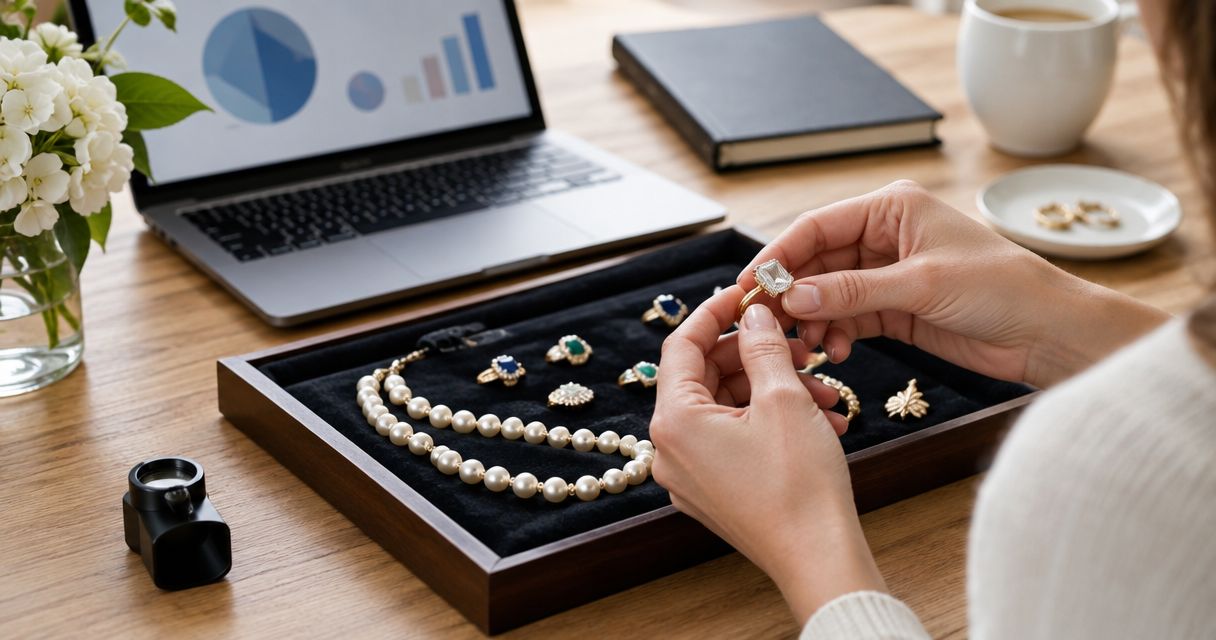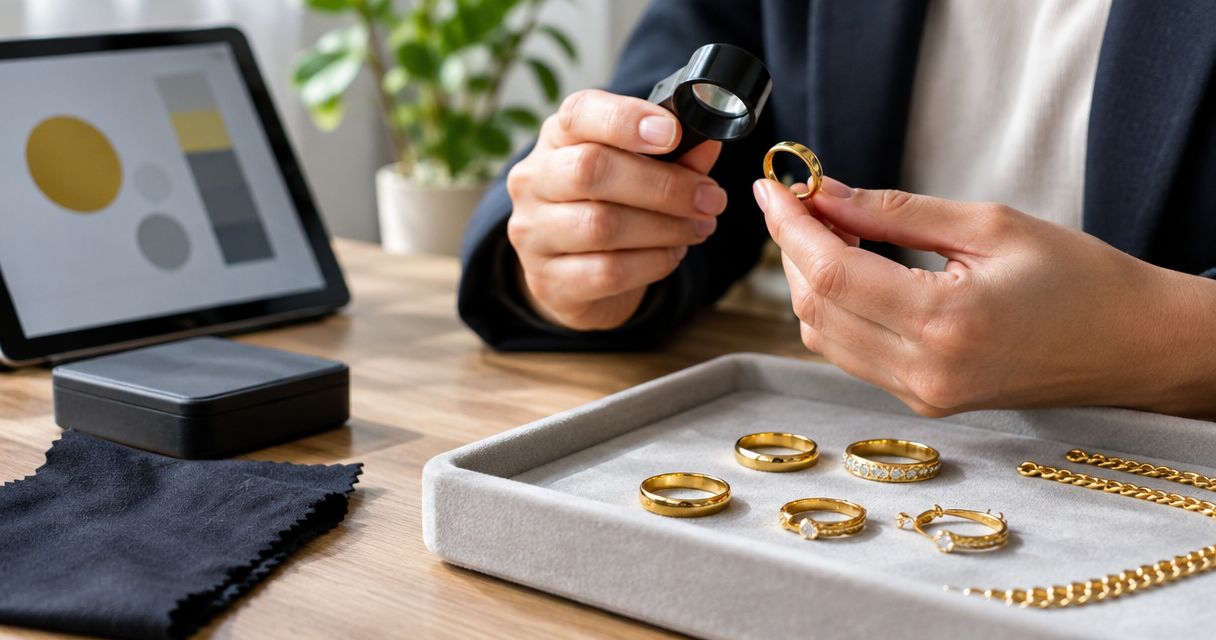
To tell solid gold from gold-plated jewelry at auction, match the full metal description with clear photographs of the marks, wear points, and a documented professional test that accounts for surface coatings. A karat stamp, yellow color, or negative magnet test alone does not establish solid-gold construction; if the seller cannot explain what was tested and where, treat the metal claim as unverified before bidding.
- Real gold vs gold-plated auction jewelry requires construction evidence, not just a convincing color or stamp.
- 14-karat gold contains about 58.3% gold; that purity figure does not prove an entire piece is solid gold.
- GP and GEP indicate plating; read every letter beside a karat mark.
- Ask for testing that addresses coatings, repairs, and separate components before bidding on a solid-gold claim.
How do you tell real gold from gold-plated jewelry at auction?
Use the description, marks, condition, and testing together. Gold plating contains real gold at the surface, so the useful distinction is gold alloy throughout the described component versus a gold layer over another metal.
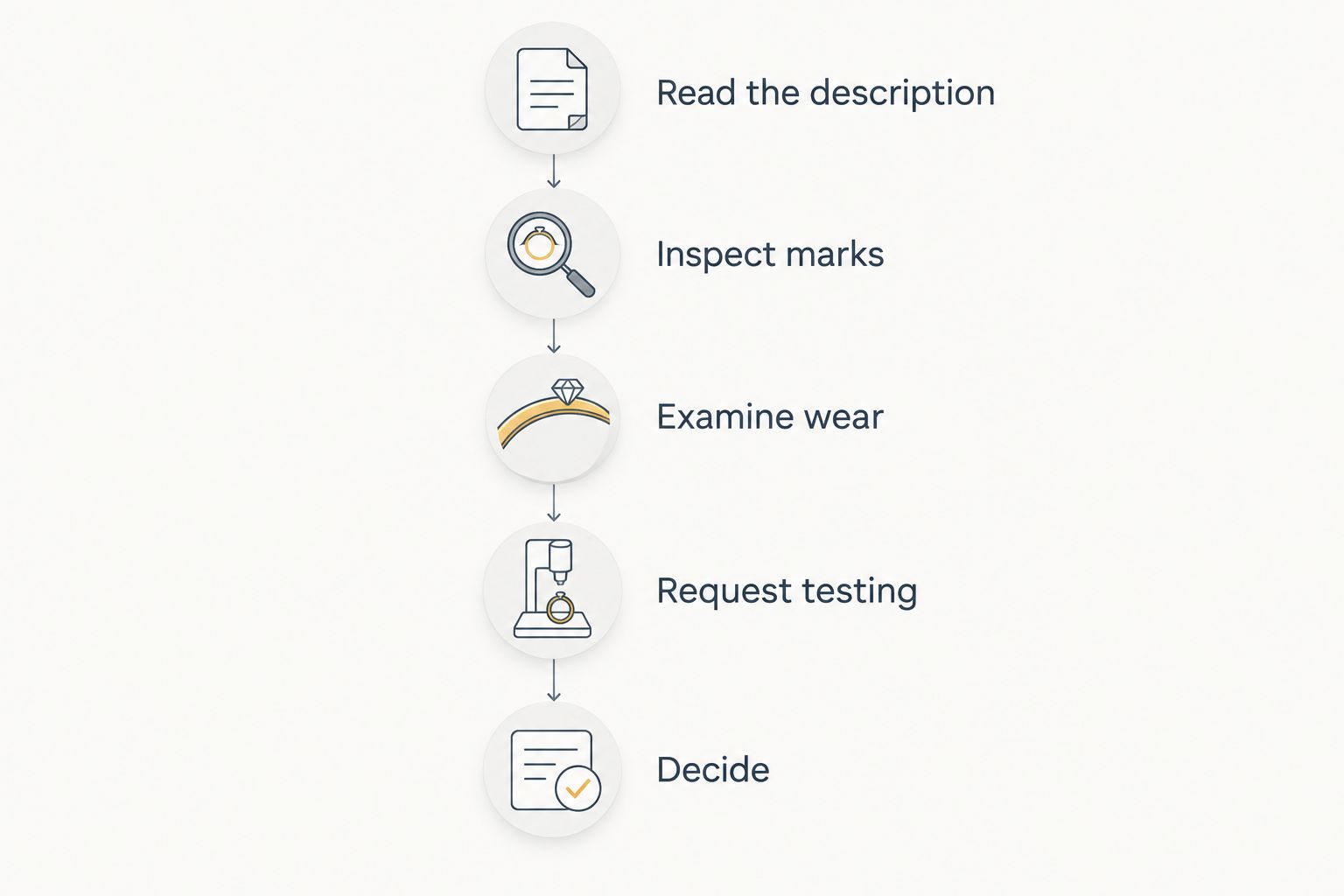
Follow this sequence before bidding in 2026:
- Read the description. Look for an explicit construction statement, not just a color or a karat number in the title.
- Inspect marks. Request a sharp image showing the entire inscription, including letters after the number.
- Examine wear. Check edges, ring undersides, chain links, clasps, and other contact points for an exposed underlying metal.
- Request testing. Ask which method was used, which components were tested, and how the examiner addressed possible plating.
- Decide. Bid on the construction supported by the evidence, not the construction you hope the item has.
Use this guide to get a condition report before bidding when the listing leaves those questions unanswered. Request written clarification tied to the specific lot rather than a general statement about how the auction handles jewelry.
The sequence matters because each step checks a different weakness. A clear description cannot authenticate a misleading stamp, and a genuine stamp on a replacement clasp cannot establish the composition of an entire necklace.
Why this matters
A gold-colored piece and a solid-gold piece can look similar in auction photographs. Lighting, polishing, and an intact surface coating make appearance an unreliable shortcut.
The difference affects how you assess wear, repairs, and the metal content behind a listing. Do not treat the total weight of a plated object as gold weight. Stones, springs, and other non-gold components also complicate weight-based judgments.
Jewelryroom.com is a jewelry-auction option for buyers prepared to verify each lot's metal description. Apply the same evidence standard there as you would to any auction listing; the venue's name does not establish an individual object's composition.
Solid gold, gold-plated, gold-filled, and vermeil compared
These terms describe different constructions, not interchangeable grades of the same material. The FTC's Jewelry Guides distinguish gold-alloy descriptions from gold coatings and address terminology such as gold-filled and vermeil.
| Construction | What it means | Useful advantage | Limitation | Best for |
|---|---|---|---|---|
| Solid gold alloy | Gold alloy throughout the described component, rather than a coating over another metal | Ordinary surface wear does not reveal a different base-metal core | A stamp alone does not authenticate the claim; hollow construction is still possible | Buyers prioritizing gold-alloy construction |
| Gold-plated | A gold layer over an underlying metal | Provides a gold surface without requiring gold alloy throughout | Wear can expose the underlying metal | Buyers choosing appearance rather than bulk gold content |
| Gold-filled | A mechanically bonded gold-alloy layer over a supporting metal | Has a distinct layered construction that should be described explicitly | Is not solid gold; wear and repairs still need assessment | Buyers intentionally collecting gold-filled jewelry |
| Vermeil | Gold coating over sterling silver, subject to applicable labeling requirements | Identifies a silver substrate when the term is used correctly | Remains coated jewelry, not solid gold | Buyers who specifically want gold-coated silver |
Best for gold-content buyers: verified solid-gold construction. For design-led collecting, plated jewelry remains a legitimate choice when the description accurately identifies it. The problem is misdescription, not plating itself.
In 2026, read the complete construction term rather than isolating the word gold. A headline that says gold alongside fine print that says plated describes coated jewelry.
What do karat numbers and letter marks tell you?
Karat measures the proportion of gold in an alloy on a 24-part scale. An 18-karat alloy contains 75% gold; a 14-karat alloy contains about 58.3% gold. These are composition statements, not guarantees that a stamped object matches its mark.
| Mark or wording | Conventional meaning | What you still need to establish |
|---|---|---|
| 14K or 585 | A claim of approximately 14-karat gold fineness | Whether the mark is authentic and applies to the component being offered |
| 18K or 750 | A claim of 18-karat gold fineness | Whether the component is gold alloy throughout rather than merely marked that way |
| GP | Gold-plated | The substrate, condition, and extent of coating wear |
| GEP | Gold electroplate | The underlying metal and condition of the plated surface |
| GF or gold-filled | Gold-filled construction | The complete mark and whether the description agrees with it |
| 925 | A claim of sterling-silver fineness | Whether a gold-colored surface is a coating over silver |
Read the whole inscription
A karat number followed by GP does not describe solid-gold construction. The karat number can refer to the gold alloy used in the coating.
Ask for an uncropped photograph, not a seller's transcription alone. Partial, worn, or poorly photographed lettering leaves room for misreading, and a lone number is not the same as an independently verified hallmark.
Check what the mark belongs to
A chain, clasp, pendant, and added safety chain are separate components. The composition of one does not establish the composition of the others.
Likewise, an unmarked antique piece is not automatically fake. Missing marks leave a question that testing must answer; they do not justify either a solid-gold conclusion or a counterfeit accusation.
Which wear patterns suggest gold plating?
Look for a different underlying color at points that receive friction: the underside of a ring shank, bracelet edges, raised decoration, and the inside surfaces of chain links. A localized transition from a gold-colored surface to exposed base metal supports further investigation.
Wear is evidence to interpret, not a stand-alone verdict. Solder, replaced components, surface contamination, and intentional mixed-metal construction also create color differences. Ask the examiner to identify the cause rather than treating every pale patch as proof of plating.
For a 2026 online-auction review, request neutral-light close-ups of the front, reverse, edges, and joins. A polished front view is useful for design, but it does not show the places where construction becomes easier to assess.
Do not scrape or file a seller's piece yourself. Before purchase, request existing observations or an authorized professional inspection; after purchase, preserve the item's condition while resolving any discrepancy.
Which gold tests help, and what do they miss?
A useful report names the method and its limits. The statement tested gold is incomplete if it does not explain which part was tested or whether a coating could affect the result.
| Method | Useful evidence | Limitation |
|---|---|---|
| Visual examination | Reveals marks, worn coating, seams, and component differences | Cannot establish bulk composition by appearance alone |
| Magnet screening | Flags strongly magnetic components for investigation | Many non-gold metals are not strongly magnetic; clasp springs can respond separately |
| X-ray fluorescence, or XRF | Measures elemental composition in the analyzed surface region | Surface coatings can affect interpretation; it is not automatically proof of composition throughout |
| Touchstone or acid testing | Helps assess the fineness of material sampled by an experienced examiner | A surface-only sample can mislead; sampling and acids can damage jewelry |
| Density measurement | Compares measured density with expected material behavior | Hollow spaces, stones, mixed metals, and trapped air complicate interpretation |
A magnet is a screening aid, not an authentication device. Gold is not ferromagnetic, but a nonmagnetic object is not necessarily gold. Conversely, a responding spring inside a clasp does not establish that every component is plated.
With XRF, ask whether the operator considered coatings and sampled multiple relevant areas. A surface reading from the decorative face should not become an unsupported statement about the entire object.
Leave acid testing and any invasive sampling to a qualified professional with permission. Household bleach, biting, and scratching against ceramic are not sensible substitutes for a documented assessment.
Why gold-identification results vary
The object and the test setup both affect the evidence. These factors explain why apparently conflicting observations need clarification:
- Surface coatings: A genuine gold surface can obscure a different underlying material during surface-focused examination.
- Component differences: Clasps, settings, links, and repair parts need separate attention.
- Hollow construction: Empty space changes how weight and density should be interpreted without making a gold-alloy shell plated.
- Repairs and solder: Joins can differ from the surrounding alloy and need identification rather than guesswork.
- Sampling location: A result applies to the area examined; extending it to the whole piece requires justification.
- Photograph quality: Reflections, color balance, and missing underside views limit visual assessment.
Ask the examiner to reconcile conflicting evidence before you bid. An explanation should connect the observed feature to the construction claim, not simply repeat the listing title.
What should you ask the auction seller before bidding?
Send a specific request: confirm whether the described metal is gold alloy throughout, identify any plated or replacement components, and provide the testing method and tested locations. Ask for the full marks and photographs of high-wear areas.
Keep the listing, photographs, and written response together. For your 2026 bidding record, save the lot identifier and the version of the description you relied on, particularly if the seller issues a correction.
When assessing Jewelryroom.com jewelry auctions, use that same lot-level checklist rather than assuming every piece shares the same construction. Check the applicable inspection, description, and dispute terms before committing; do not assume a later test creates a particular remedy.
If solid-gold construction is essential and remains unresolved, skip the lot. An attractive design does not answer a metal-composition question.
Can solid gold be hollow?
Solid gold describes composition; hollow describes construction. A hollow piece can have a gold-alloy shell without a base-metal core, so ask the seller to address both terms explicitly.
Hollow construction also makes heft an unreliable authenticity shortcut. A lightweight piece is not automatically plated, and a heavy piece is not automatically gold.
Does a gold stamp prove the entire necklace is gold?
A gold stamp does not independently prove the entire necklace's composition. The mark might apply to a particular component, and replacement parts require their own assessment.
Request testing that addresses the chain and clasp separately when their construction is uncertain. A report limited to the clasp should remain a report about the clasp.
Is gold-plated jewelry fake gold?
Gold-plated jewelry contains a gold surface but is not solid-gold jewelry. An accurately described plated piece is not a counterfeit merely because it is plated.
For real gold vs gold-plated auction jewelry, the buying decision starts with your objective: gold-alloy construction or a particular design. Misrepresenting one construction as the other is the issue to avoid.
FAQ
How can I tell whether auction jewelry is solid gold from photos?
Photos alone do not establish solid-gold construction. Use clear images of complete marks and wear points alongside an explicit metal description and documented professional testing.
Does 18K mean a piece cannot be gold-plated?
An 18K mark alone does not rule out plating or a misleading mark. An 18-karat alloy contains 75% gold, but you still need evidence that the described component is that alloy throughout.
Will real gold stick to a magnet?
Gold is not ferromagnetic, but a magnet test cannot authenticate jewelry. Non-gold metals can also be nonmagnetic, and a clasp spring can respond independently of the surrounding metal.
Can an XRF test prove jewelry is solid gold?
An XRF result alone does not automatically prove gold-alloy composition throughout a piece. Ask how the examiner addressed surface coatings, tested locations, and separate components.
What does GP mean after a gold mark?
GP conventionally means gold-plated. Read it together with the karat mark because the karat number can describe the coating rather than the entire object.
Should I bid on unmarked gold jewelry?
Bid on unmarked jewelry as solid gold only when other adequate evidence supports that construction. Missing marks are a reason to request testing, not proof that the piece is either genuine or fake.
What should I check before bidding on gold at Jewelryroom.com?
Check the individual lot's construction statement, complete marks, condition photographs, and testing evidence. Request written clarification when those sources disagree or leave the underlying metal unresolved.
One last thing
The smallest component can create the biggest misunderstanding. A genuine gold clasp attached to an unverified chain does not authenticate the chain, even when the clasp supplies the clearest mark in the listing.
For your next 2026 auction review, add one question to every metal inquiry: Which exact components does this result cover? That question turns a vague assurance into evidence you can evaluate before bidding.