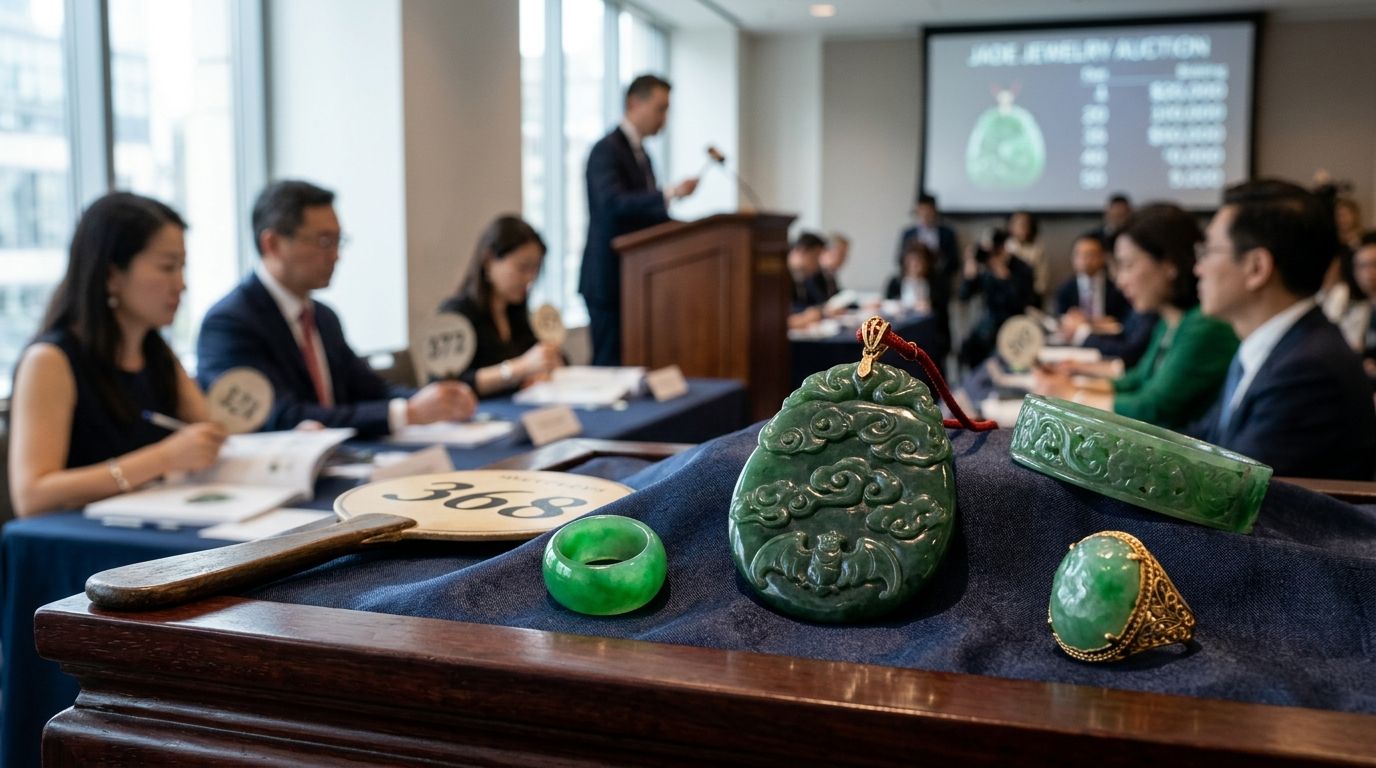
East Asian jewelry collectors shopping a jade jewelry auction are usually judging jadeite grade, color saturation, and carving craftsmanship before they even glance at the estimate. That priority order is the opposite of how most Western buyers approach colored stones, and it changes what "do your homework" actually means for this segment. A collector fluent in the cultural weight of jade cares less about brand signature and more about whether the piece is Type A jadeite, whether the color is natural, and whether the carving carries any symbolic motif worth preserving.
- A jade jewelry auction rewards collectors who confirm jadeite vs. nephrite and treatment type before bidding, not after.
- Type A jadeite with natural, untreated color draws the strongest bids; Type B and C pieces need a lab report or a pass.
- Jewelryroom.com lists jade jewelry auction lots alongside certification and authentication guides worth reading before you set a max bid.
- A hard budget plus proxy bidding keeps high-saturation imperial green jade from triggering emotional overbidding.
Why jade jewelry auction listings matter for East Asian collectors
Jade carries weight in East Asian collecting circles that most Western buyers underestimate — it's tied to heirlooms, gifting traditions, and generational transfer, not just decoration. That means the buyer pool for a strong jadeite bangle or pendant at auction skews toward people who already know the difference between nephrite and jadeite and who will walk away from a lot the moment they suspect polymer treatment.
This segment also searches differently. Instead of "jade ring for sale," the query looks like "Type A jadeite bangle auction" or "untreated jade pendant certificate." A jade jewelry auction listing that doesn't disclose treatment type or origin loses this buyer immediately, regardless of how good the photography looks. Trust signals — lab reports, provenance notes, seller history — carry more weight here than they do for costume or fashion jewelry categories.
Current jade jewelry auction inventory on Jewelryroom.com sits alongside the same due-diligence resources referenced throughout this guide, which matters because jade fraud (dyeing, bleaching, resin filling) is one of the most persistent problems in the gemstone auction market.
Learn the jade type before you bid
Jade is a category name, not a single mineral — jadeite and nephrite are chemically different stones with different value ceilings, and mixing them up costs collectors real money.
- Confirm whether the listing specifies jadeite or nephrite — the two are not interchangeable in value or rarity
- Check for Type A designation (untreated, natural color) versus Type B (bleached and polymer-impregnated) or Type C (dyed)
- Read the color description carefully — "imperial green" is a specific, prized shade, not a marketing label for any green stone
- Note the translucency description; higher translucency generally signals higher quality within the same color grade
- Flag any listing that uses "jade" without specifying type as one requiring extra scrutiny
Verify the certification before you commit
A gemological lab report is the single fastest way to separate a Type A stone from a treated one, and this segment treats a missing report as a red flag, not an oversight.
- Look for a lab report from a recognized gemological lab, not a seller-issued certificate
- Confirm the report explicitly states treatment status (natural vs. treated)
- Match the report's stone description (weight, dimensions, color) against the listing photos
- Ask the auction house for the report before bidding if it isn't posted with the lot
- Treat unverifiable or vague certification language as grounds to walk away
Spotting a treated stone dressed up as natural is a common trap across gemstone categories, not just jade — the guide on how to spot fake gemstones at online auctions covers the visual and documentation checks that apply here too.
Inspect the carving and craftsmanship
For jade specifically, carving quality can matter as much as stone quality — a mediocre stone with masterful carving can outvalue a better stone with poor workmanship, and vice versa.
- Check whether the carving includes traditional motifs (bi discs, dragons, ruyi, guanyin) and whether the symbolism is executed cleanly
- Look for evenness in polish and symmetry in carved details under magnified photos
- Ask about the carving's origin region if the listing doesn't state it — workshop traditions vary in style and value
- Note any chips, cracks, or repairs disclosed in the condition report
- Compare carving depth and detail against reference images of similar motifs before assuming quality
Set a hard budget before you start bidding
Jade auctions move fast once two or more collectors recognize a genuine Type A stone, and price can climb well past the estimate in minutes.
- Decide your absolute maximum bid before the auction opens, including any buyer's premium
- Separate your budget into "stone value" and "sentimental premium" so you know which number you're actually chasing
- Build in a margin for shipping and insurance costs on high-value pieces
- Walk away the moment bidding crosses your ceiling, regardless of how close you are
- Revisit your number if new information (a better lab report, a provenance note) changes the lot's actual value
A structured budget process is worth building before you touch any auction category — the framework in how to set a budget for online jewelry auctions applies directly to high-value jade lots where emotional bidding is common.
Place your bid with a strategy, not an instinct
Once the budget is set, execution matters — bidding late and reactively on a jade lot with strong competition usually means paying more than a planned approach would.
- Decide whether you're bidding live or setting a proxy (max) bid in advance
- If proxy bidding, set the number to your true ceiling and let the system manage increments
- Watch for last-minute bid activity on high-demand jade lots, which is common near close
- Avoid revising your ceiling mid-auction based on excitement rather than new information
- Keep a record of your bid history across lots if you're tracking multiple jade pieces in one session
Plan for insurance and after-sale care
A winning bid on a jade piece isn't the finish line — shipping, insurance, and long-term care decisions come next, and jade has specific handling needs (impact sensitivity, chemical exposure) that differ from metal jewelry.
- Confirm the auction house's shipping insurance covers full hammer price plus premium, not just a partial value
- Arrange independent appraisal-based insurance if the auction's coverage is limited
- Avoid ultrasonic cleaners and harsh chemicals on jade — they can damage polish and structure
- Store jade pieces away from extreme temperature changes, which can cause micro-fractures over time
- Keep the lab report and provenance documents with the piece for future resale or insurance claims
Browse current jade jewelry auction lots
See active jadeite and nephrite listings before your next bid.
Comparing jade sourcing options for East Asian collectors
| Option | Best for | Key limitation |
|---|---|---|
| Online estate jewelry auctions | Collectors chasing certified Type A pieces with provenance | Requires strong due diligence on treatment disclosure |
| Regional Asian art and jewelry auction houses | Buyers seeking carved motifs and specific workshop styles | Fewer lots available per sale cycle |
| Retail jade specialty stores | First-time buyers wanting guided, in-person selection | Limited to current retail stock, no auction pricing dynamics |
| Peer-to-peer marketplaces | Experienced collectors trading within a known network | No standardized certification requirement across sellers |
Online estate auctions are the strongest fit for a collector who already knows how to read a lab report and wants access to a wider pool of Type A jadeite. Retail stores fit a buyer who wants hand-holding over selection depth.
Common mistakes East Asian jade collectors make
- Treating "jade" as one stone. Confusing jadeite and nephrite leads to overpaying for a lower-value nephrite piece marketed loosely as "jade."
- Skipping the treatment disclosure. Assuming green color means natural color, when Type B and Type C treatments can mimic it convincingly under standard photography.
- Overvaluing color alone. Ignoring translucency and texture, both of which affect value as much as hue in jadeite grading.
- Underestimating carving value. Dismissing carving craftsmanship as decorative when it can represent a meaningful share of a piece's total worth.
- Skipping post-purchase insurance. Assuming the auction house's standard shipping coverage matches the full hammer price plus premium, when it often doesn't.
FAQ
What's the best jade jewelry auction for East Asian collectors in 2026?
The best jade jewelry auction listings in 2026 are the ones that disclose jadeite vs. nephrite type and treatment status (Type A, B, or C) directly in the lot description. Auctions without that disclosure require extra verification before bidding.
Is jadeite always more valuable than nephrite?
Jadeite generally commands higher prices than nephrite at auction, especially in high-saturation imperial green, but exceptional nephrite carvings can still outvalue lower-grade jadeite. Value depends on color, translucency, and craftsmanship together, not stone type alone.
How do I know if a jade piece is Type A, B, or C?
A gemological lab report specifying treatment status is the only reliable way to confirm jade type. Type A is untreated, Type B is bleached and polymer-impregnated, and Type C is dyed — all three can look similar in photos.
How much does a jade jewelry auction lot typically involve in fees?
Fee structures vary by auction house and usually include a buyer's premium on top of the hammer price. Check the specific auction's terms before bidding since premiums differ across platforms.
Can I return jade purchased at auction if it turns out to be treated?
Return policies vary by auction house and are typically stated in the sale terms before bidding opens. Verify treatment status through a lab report before you bid rather than relying on a return process after the sale.
What's the difference between jade and jadeite in an auction listing?
"Jade" is a general category covering both jadeite and nephrite, while jadeite is the specific, typically higher-value mineral prized for imperial green color. A listing that says only "jade" without specifying the mineral needs clarification before bidding.
Do I need insurance for jade jewelry won at auction?
Yes, especially for high-value jadeite pieces, since standard shipping coverage from an auction house often doesn't match the full hammer price plus premium. Independent appraisal-based insurance covers that gap.
One last thing
The detail most first-time jade bidders skip is asking whether the seller's lab report was issued before or after any repair work — a re-polished or repaired jade piece can carry an updated report that quietly omits the repair history, and that gap only surfaces when you try to resell. Ask for the full documentation trail, not just the most recent certificate, before your final bid in 2026.


