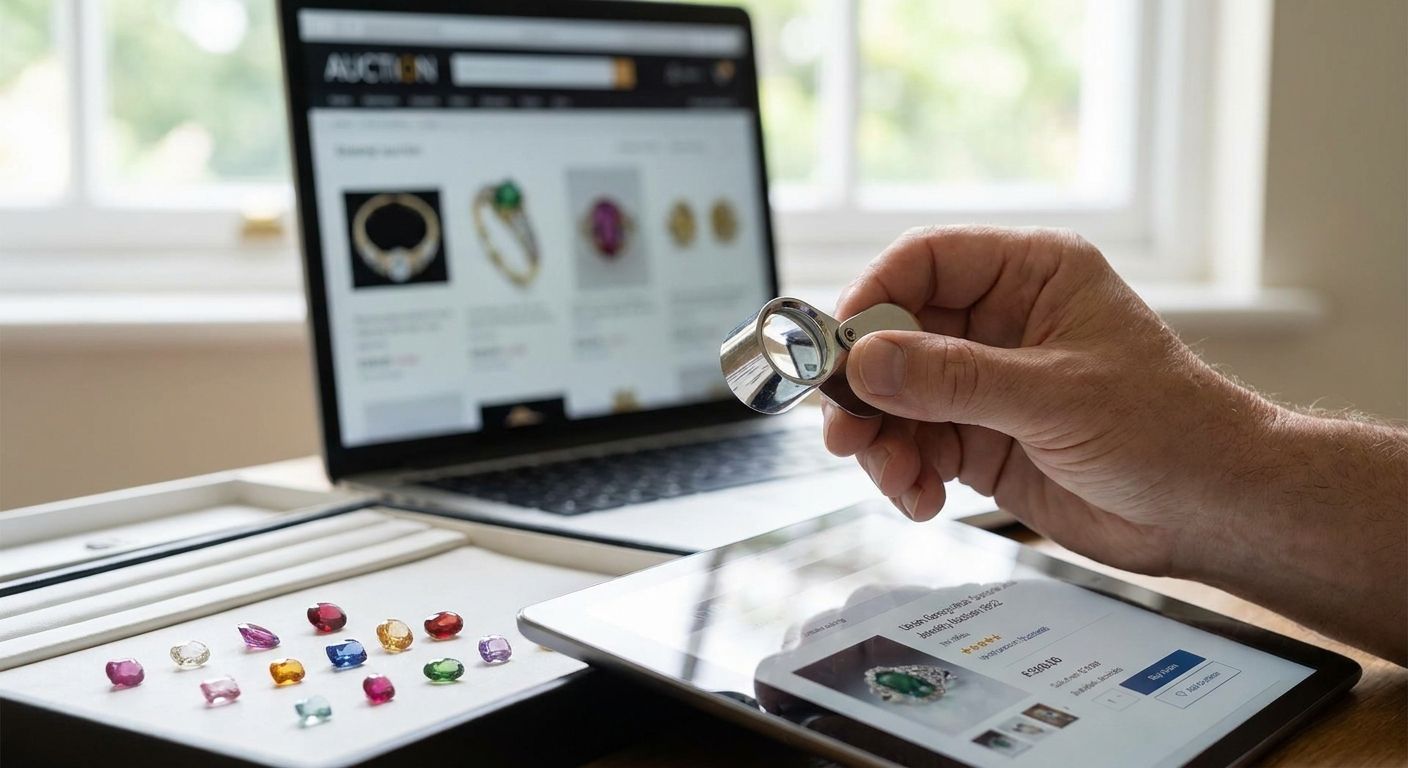
Fake gemstones surface at online auctions more often than listings admit, and the giveaway usually isn't visible in a photo — it's in the growth lines under magnification, the heat signature under a tester, or the lab report the seller never mentions. Spotting a fake before you bid comes down to four checks: magnification, thermal/conductivity testing, UV response, and paperwork — run all four and synthetics rarely survive the process.
- Spot fake gemstones at auction with a 10x loupe first — synthetic sapphires show curved striae, natural ones show angular zoning.
- Cheap diamond testers misread moissanite as a real diamond because both conduct heat; ask for a tester that also checks electrical conductivity.
- Glass-filled rubies flash a visible glow under fiber-optic light — a $15,000 ruby with no lab report is a red flag, not a bargain.
- Refuse any gemstone auction listing over roughly $1,000 that has no GIA, AGL, or GIA-equivalent report attached.
- Jewelryroom.com lists provenance and grading details on individual auction pages — cross-check them before you commit a bid.
Why this matters
Online auctions strip out the one advantage a jewelry counter gives you: holding the stone. You can't tilt it under a loupe, you can't run a thermal probe across the table, and you can't ask the seller a follow-up question in real time. That gap is exactly where synthetic corundum, glass-filled rubies, and dyed quartz get sold as the real thing, especially in mixed-lot estate auctions where photos are the only evidence you get.
The fix isn't paranoia — it's a short checklist you run before every bid, and it's the same checklist that how to authenticate a diamond before bidding at auction walks through for diamonds specifically. This guide extends it to colored stones, where the fakes are more common and less obvious.
How to spot fake gemstones at online auctions
Start with the listing itself, then move to the physical checks once the stone is in hand (or before you bid, if the seller offers pre-auction inspection).
| Check | What it catches | Tool needed |
|---|---|---|
| 10x loupe inspection | Curved growth lines (synthetic), gas bubbles, glass fillers | Jeweler's loupe |
| Thermal/electrical conductivity test | Moissanite passing as diamond | Combination diamond/moissanite tester |
| UV fluorescence | Inconsistent color response vs. known natural ranges | Long-wave UV lamp |
| Specific gravity / refractive index | Glass or resin simulants substituted for corundum | Refractometer or immersion test |
| Lab report cross-check | Undisclosed treatments, mismatched carat weight | GIA, AGL, or GIA-equivalent certificate |
Run the loupe and the report check first — together they catch the majority of misrepresented stones without any lab equipment. Save the conductivity and refractive index tests for stones where the report is missing or the price looks too good relative to comparable 2026 auction results.
Sapphires: what the loupe shows that the photo won't
Natural sapphires form with angular, straight color zoning and mineral inclusions like rutile silk. Verneuil-process synthetic sapphires, the most common lab-made substitute, form with curved striae because the growth process spins the boule as it cools. Under a 10x loupe, that curve is visible and it's the single fastest tell for synthetic corundum.
Gas bubbles are the second giveaway — natural sapphires almost never have perfectly round, isolated bubbles, while flame-fusion synthetics sometimes do. If a sapphire listing has no lab report, request one before bidding; best gemstone auctions for sapphire buyers covers which auction categories tend to disclose treatment and origin most consistently.
Rubies: the flash test that catches glass fillers
Many rubies sold at auction in 2026 are treated with lead-glass filling to hide fractures and improve clarity — a legitimate treatment when disclosed, a red flag when it isn't. Under fiber-optic or strong raking light, glass-filled fractures throw a distinct blue or orange "flash effect" that a natural, untreated ruby doesn't show.
A magnified inspection combined with that flash test catches most undisclosed glass-filled rubies before you bid. A ruby priced well under comparable natural stones with no mention of treatment is a hold, not a buy, until the seller confirms clarity enhancement status.
Emeralds: oiling isn't the fake, non-disclosure is
Almost all natural emeralds are oiled to reduce the visibility of surface-reaching fractures — that's standard trade practice, not fraud. The fraud risk is a synthetic emerald or a heavily resin-filled stone sold without disclosure, or oiling levels described as "minor" when a lab would call them "significant."
Check the report for the specific oiling grade rather than trusting a seller's one-word description. If no report exists, treat the listing the same way you'd treat an unverified ruby: assume undisclosed treatment until proven otherwise.
Diamonds: why a home tester alone isn't enough
Moissanite conducts heat almost as well as diamond, which is why basic thermal-conductivity testers — the kind sold for under $50 — frequently misread moissanite as genuine diamond. A combination tester that also checks electrical conductivity separates the two correctly, since moissanite conducts electricity and diamond does not.
A cubic zirconia throws noticeably more colored flash than a diamond of comparable cut because CZ has close to double the dispersion, so heavy rainbow flash under normal light is itself a clue worth checking before you bid. For a full diamond-specific workflow, authenticate a diamond before bidding at auction covers loupe grading and certificate cross-referencing in more depth.
Why fake-detection difficulty varies by listing
- Photo quality — low-resolution or single-angle photos hide curved striae and flash effects that a loupe would catch instantly.
- Seller category — estate and mixed-lot auctions disclose treatment less consistently than single-owner or certified consignment lots.
- Price positioning — a stone priced 30-50% under comparable graded stones is the single strongest signal something is undisclosed.
- Certification availability — listings with a GIA or AGL report attached are dramatically easier to verify than those without.
- Stone type — corundum (sapphire, ruby) and diamond simulants are more commonly misrepresented than emerald, where the main risk is treatment disclosure rather than outright substitution.
- Platform vetting — auction platforms that require seller disclosure of treatments and synthetics reduce your exposure before you even open the listing.
“A gemstone priced 30 to 50 percent under comparable graded stones is the strongest fake signal you'll ever see — stronger than any loupe.”
Is moissanite considered a fake diamond?
Moissanite is not a fake diamond — it's a distinct, legitimately manufactured gemstone made of silicon carbide, and reputable sellers disclose it as moissanite, not diamond. The fraud case only happens when a seller lists it as a diamond or a buyer's home tester misreads it because of its diamond-like thermal conductivity.
Do auction houses guarantee gemstone authenticity?
Guarantees vary by platform and by individual seller, so check each listing's disclosure and return terms rather than assuming a blanket policy. A lab report attached to the specific stone is a stronger guarantee than any general auction house policy statement.
What certification should you look for before bidding?
GIA and AGL reports are the two most widely recognized labs for colored stones and diamonds, and both list treatment status, origin (when determinable), and carat weight on the certificate. If a seller cites a lab you don't recognize, verify the report number directly with that lab before bidding, not after.
Before you place a bid on any colored stone lot, run the loupe check, confirm the lab report, and compare the price against recent 2026 results for a similar carat weight and treatment grade. How to buy jewelry at auction: bidding tips for real buyers covers the bidding mechanics once you've cleared the authentication step.
Check current jewelry auctions
Browse live lots on Jewelryroom.com before you place your next bid.
FAQ
How do you spot fake gemstones at online auctions?
Spot fake gemstones at auction with a 10x loupe check for curved growth lines or gas bubbles, a combination thermal/electrical conductivity test, and a lab report cross-check before you bid. Undisclosed treatments and price positioning 30-50% below comparable graded stones are the two biggest red flags in 2026 listings.
Can a home diamond tester be fooled?
Yes, basic thermal-conductivity testers regularly misread moissanite as a real diamond because both conduct heat similarly. A combination tester that also checks electrical conductivity tells the two apart correctly.
What does curved striae mean in a sapphire?
Curved striae are growth lines visible under a loupe that indicate a Verneuil-process synthetic sapphire, not a natural one. Natural sapphires show angular, straight zoning instead.
Is a lead-glass filled ruby fake?
A lead-glass filled ruby is a real ruby with a disclosed clarity treatment, not a fake, as long as the seller states the treatment. The fraud risk is non-disclosure, not the treatment itself.
How much does a gemstone lab report cost to verify?
Verifying an existing GIA or AGL report costs nothing beyond a report-number lookup directly with the issuing lab. Requesting a new report on an unverified stone runs through the lab's own submission process and fee schedule.
Are estate auction gemstones more likely to be fake?
Estate and mixed-lot auctions disclose treatment and synthetics less consistently than single-owner or certified consignment lots. That inconsistency, not higher fraud rates specifically, is what makes estate lots riskier to bid on without a report.
Does UV light reveal fake gemstones?
UV fluorescence shows inconsistent color response compared to known natural ranges, which flags a stone for further testing rather than confirming it's fake on its own. Combine UV response with loupe inspection and a lab report for a reliable read.
What's the single biggest red flag at a gemstone auction?
A stone priced 30-50% below comparable graded stones with no lab report attached is the strongest red flag at any gemstone auction. Price positioning catches more misrepresented stones than any single physical test.
One last thing
The flash-effect test for glass-filled rubies works because lead glass has a different refractive index than corundum, so light bends differently at the fracture boundary — the same physics that makes a cracked windshield sparkle under headlights. Learn that one test and you'll catch more undisclosed ruby treatments in 2026 auctions than any certificate alone would reveal, because plenty of sellers simply don't know their own stone's treatment history.


