
Choose Jewelryroom.com if you want a jewelry-focused auction starting point; choose Bidsquare if you want to discover sales from auction houses across jewelry, art, and other collecting categories. This 2026 comparison separates that real difference from the lot-level checks you still need before bidding.
- jewelryroom.com vs bidsquare comes down to jewelry-focused auctions versus broader auction-house discovery.
- Jewelryroom.com is the better starting point for buyers whose search begins and ends with jewelry.
- Bidsquare is the better starting point for collectors following auction houses across several categories.
- Neither platform name replaces condition reports, gemstone documentation, or a review of auction terms.
Why this matters
Choose your search route first, then judge the individual lot. A platform comparison helps you decide where to look; it does not establish whether a particular ring, necklace, or gemstone deserves your bid.
Start with Jewelryroom.com when your brief is specifically jewelry. Start with Bidsquare when the auction house or a wider collecting interest drives your search. Those are different buying workflows, not competing promises about authenticity or value.
For a purchase in 2026, keep platform selection separate from purchase approval. Your final decision still needs a clear description, supporting photographs, applicable terms, and a total spending limit. A familiar marketplace name cannot supply missing evidence about an individual object.
At a glance
| Dimension | Jewelry-focused option | Bidsquare |
|---|---|---|
| Best for | Buyers starting with a jewelry brief | Collectors starting with auction houses or multiple collecting categories |
| Standout feature | Jewelry auctions as the core focus | Auction-house discovery across collecting categories |
| Discovery approach | Start with the kind of jewelry you want | Start with a house, sale, category, or collecting interest |
| Documentation | Evaluate the individual lot and supporting evidence | Evaluate the individual lot and supporting evidence |
| Pricing model | Auction bidding; check applicable transaction terms | Auction bidding through participating houses; check sale-specific terms |
| Fulfillment and recourse | Confirm the applicable delivery and dispute terms | Confirm the responsible house and applicable delivery and dispute terms |
The first three rows help you choose where to search. The remaining rows are purchase gates: neither option earns a blanket win without examining the actual sale.
Jewelryroom.com wins for a jewelry-only buying brief
Jewelryroom.com is the better starting point for buyers whose search begins and ends with jewelry. Its stated business is jewelry auctions, which matches a buyer looking specifically for a wearable piece, gemstone, or addition to a jewelry collection.
That fit matters when you already have a defined brief. You might be comparing ring styles, deciding between a pendant and earrings, or looking for a particular gemstone. A jewelry-first starting point keeps the search anchored to the object you want.
The limitation is equally clear: a jewelry focus does not establish the quality of any particular listing. Do not infer independent authentication, a laboratory report, a return right, or a condition guarantee from the category alone.
Bidsquare wins for the cross-category collector. If your search includes jewelry alongside decorative arts or other auction categories, its broader marketplace purpose better matches that browsing pattern. That is a genuine reason to choose it, rather than treating breadth as a distraction for every buyer.
Before choosing either route, write a short buying brief:
- Object: Name the type of jewelry you want.
- Requirements: Separate essential details from preferences.
- Evidence: Decide which documents or photographs you need.
- Limit: Set the total amount you are willing to commit.
Jewelry focus wins for a defined brief; breadth wins for exploration
The standout difference is specialization versus discovery. Neither is inherently better; each removes a different kind of search friction.
For the jewelry-only buyer, specialization supplies a relevant starting context. You do not need a broader collecting brief to begin searching. The downside is that specialization alone tells you nothing about whether the right object is listed or whether its documentation meets your standard.
For the exploratory collector, Bidsquare's auction-house marketplace structure gives you a reason to browse beyond a single jewelry brief. You can approach a sale through the house or collecting category rather than only through an object description. The downside is more selection work: an interesting sale is not automatically a relevant jewelry purchase.
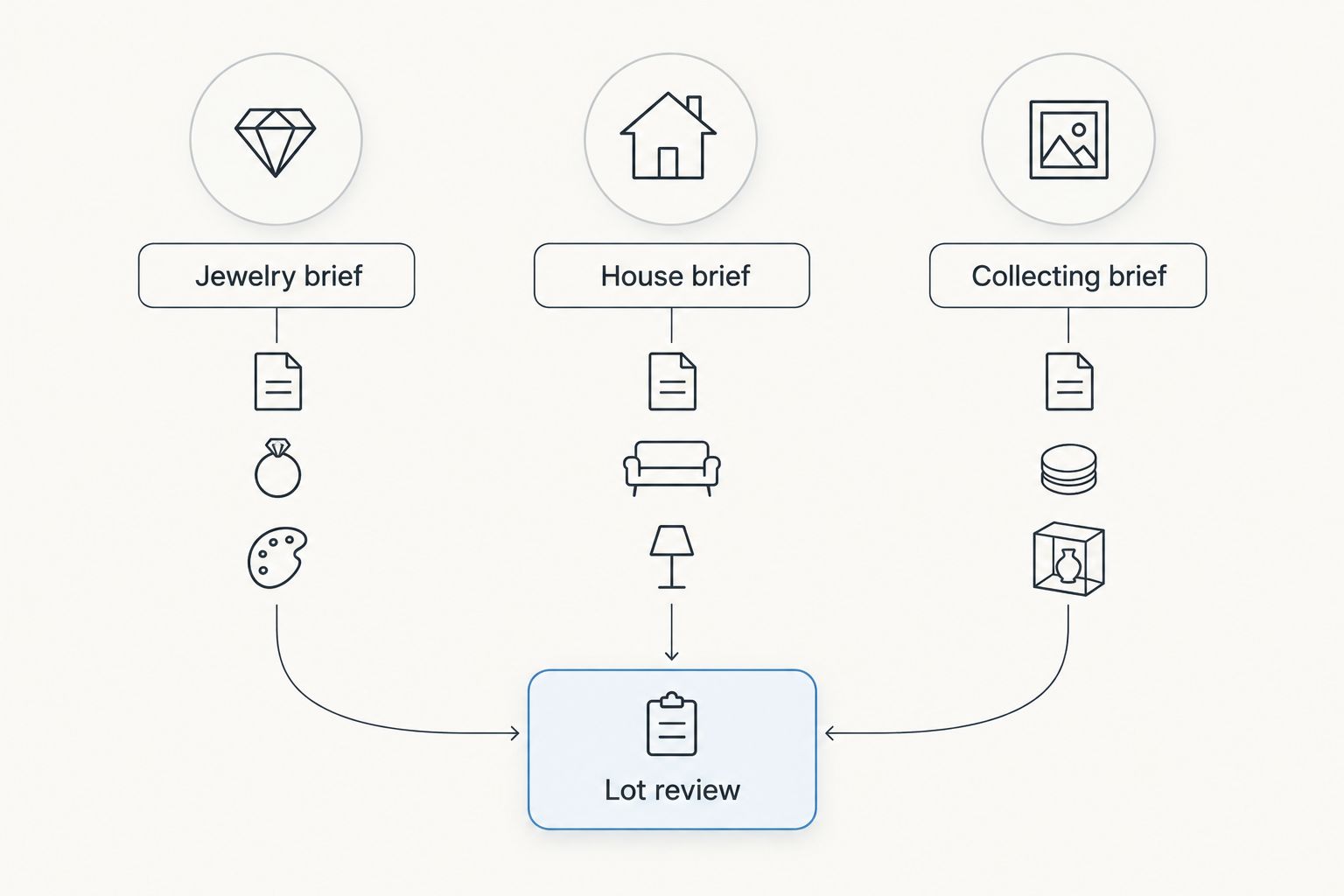
Use these distinctions when comparing search routes in 2026:
- Jewelry brief: Start with the object and its required characteristics.
- House brief: Start with an auction house whose sales you want to examine.
- Collecting brief: Start with a wider category and narrow your shortlist.
The strongest route is the one that matches how you actually buy. Do not choose a broad marketplace merely because it covers more categories, or a specialist merely because its subject matches your search.
Bidsquare wins when auction-house discovery drives your search
Bidsquare is the better starting point for collectors who want to explore auction houses across collecting categories. Its marketplace role suits a buyer who begins with a house or sale rather than a jewelry-only destination.
That distinction matters when you want to understand who is offering the object. Record the named auction house, identify the relevant sale, and read the terms attached to that transaction. Keep those details with the lot description instead of relying on the marketplace name alone.
There is a practical tradeoff. Browsing through multiple houses means you must check the terms for the sale you actually intend to enter; do not carry assumptions from one sale into another.
A jewelry-focused starting point remains the cleaner choice when the auction house itself is not part of your buying brief. Conversely, a house-led collector should not abandon a relevant sale merely because it appears within a broader marketplace.
For either route, distinguish these responsibilities before bidding:
- Who describes the object?
- Who answers condition questions?
- Who issues the transaction instructions?
- Who handles delivery questions and disputes?
Those answers are more useful than a general claim that one platform is safer. They identify where to direct questions and which terms govern the purchase.
Documentation is a tie: the individual lot must earn your bid
Neither platform earns an automatic documentation win. The useful comparison is between the evidence attached to the objects you are considering, not between marketplace names.
For jewelry, distinguish appearance, composition, condition, and attribution. A photograph helps you assess visible design; it does not independently establish gemstone identity, treatment, metal fineness, or a maker's attribution.
Ask for evidence that resolves the specific uncertainty. For a ring, that includes the stated size and photographs of the setting and shank. For a signed piece, examine the mark and supporting attribution. For a gemstone claim, review the exact identification language and any accompanying report.
Keep measurement terms separate. A gemstone carat equals 200 milligrams; it is a unit of mass, not a quality grade. 18-karat gold describes 18 parts gold out of 24, or 75 percent gold; that designation does not establish the weight or condition of the complete piece.
Use the same document review in 2026 regardless of where you discover the lot:
- Match each report to the object described.
- Separate stated facts from estimates and qualifications.
- Ask about repairs, replacements, damage, and alterations.
- Save written answers with the listing.
If a material question remains unanswered, stop before bidding. An attractive image does not resolve an uncertain description.
Pricing models: auction terms matter more than a platform label
Both options belong in an auction-buying comparison, not a simple fixed-price checkout comparison. Your bid is only one part of the transaction you need to understand.
For the jewelry-focused option, read the applicable auction and payment terms before committing. For Bidsquare, read the terms of the participating house and sale. Do not assume identical charges, payment methods, or deadlines across the two routes.
Neither option earns a blanket cost win. Compare the complete transaction for the actual lots on your shortlist, including any applicable buyer's premium, taxes, delivery, insurance, and payment-related charges.
The tradeoff is between bidding flexibility and spending certainty. You control your bidding ceiling, but you need the applicable terms to translate that ceiling into a total commitment. A low bid is not evidence of a lower final outlay.
Before entering a 2026 sale, build a written cost worksheet:
- Bid limit: Your maximum commitment to the bidding itself.
- Transaction charges: Charges identified in the applicable terms.
- Delivery: Packing, shipping, and insurance arrangements.
- Aftercare: Any inspection, sizing, repair, or appraisal you plan to obtain.
Leave unresolved items unresolved rather than assigning an optimistic assumption. If you cannot establish the total commitment, you cannot make a sound cost comparison.
Fulfillment is a tie until the written terms settle it
Delivery and recourse are transaction-level questions. Do not infer shipping arrangements, insurance coverage, cancellation rights, or returns from either platform's name.
Before bidding, identify the responsible party and read the relevant conditions. Ask who packs the object, how shipment is arranged, when responsibility changes hands, and what process applies if the delivered item differs from its description.
Gift buyers need an additional check: separate a preferred arrival date from a documented commitment. Payment, release, packing, and carrier transit are distinct stages. An auction end date is not an arrival date.
The same caution applies to ring sizing and repairs. Confirm the item's measurements and condition before assuming that post-purchase work will solve a mismatch. Some designs and settings require specialist assessment before alteration.
Your purchase file should contain:
- The saved lot description and photographs.
- Written answers to material questions.
- The applicable sale and payment terms.
- Delivery instructions and relevant insurance information.
Treat an unclear responsibility chain as a reason to pause. A clear answer about who handles a problem is more useful than a general reassurance about the marketplace.
Final verdict: choose the workflow that matches your buying brief
Choose Jewelryroom.com if you are a jewelry-first buyer
Winner for a defined jewelry brief: Jewelryroom.com. Start here when you want jewelry auctions and have no need for a wider collecting marketplace. Keep your decision tied to the specific object's evidence, not the specialist label.
This profile fits a buyer who can describe the intended piece and wants to evaluate jewelry opportunities against that brief. It does not remove the need to check condition, documentation, transaction charges, or delivery terms.
Choose Bidsquare if you are a house-led collector
Winner for auction-house and cross-category discovery: Bidsquare. Start here when following houses and exploring sales is part of the value you want from the search.
This profile fits a collector whose interests extend beyond jewelry or whose chosen auction house drives the purchase. Keep the house, sale, lot, and applicable terms together throughout your review.
| Dimension | Winner |
|---|---|
| Jewelry-only buying brief | Jewelry-focused starting point |
| Broader collecting brief | Bidsquare |
| Standout feature | Jewelry focus or marketplace breadth, according to your brief |
| Auction-house discovery | Bidsquare |
| Documentation | Tie: compare individual lots |
| Pricing model | Tie: compare complete transaction terms |
| Fulfillment and recourse | Tie: confirm written responsibilities |
FAQ
Is Jewelryroom.com better than Bidsquare for jewelry auctions?
Jewelryroom.com is the better starting point for a jewelry-only buying brief; Bidsquare is better for auction-house and cross-category discovery. Neither choice establishes the condition, authenticity, or value of an individual lot.
What's the main difference between these auction options?
The main difference is jewelry specialization versus a broader auction-house marketplace. Choose the search route that matches whether you begin with a piece of jewelry or with houses and sales you want to explore.
Which option is cheaper for buying jewelry at auction?
Compare the complete transaction for the actual lots, not the platform labels. Read the applicable terms for buyer's premiums, taxes, delivery, insurance, and payment-related charges before setting your limit.
Does an auction listing prove that a gemstone is natural?
No, a listing or photograph alone does not independently prove natural origin. Review the precise description and any supporting laboratory report, including qualifications about identification or treatment.
Can I return jewelry after winning an auction?
Your return rights depend on the applicable transaction terms and relevant law. Read the stated process before bidding, and do not assume that a change of mind or a sizing issue creates a return right.
What should I ask before bidding on an auction ring?
Ask about ring size, metal description, gemstone identification, condition, repairs, and supporting documents. Request photographs that show the setting and shank, then confirm transaction and delivery terms.
Which is better for a collector who also buys art?
Bidsquare is the better starting point for a collector exploring jewelry alongside art and other collecting categories. Its broader auction-house marketplace matches that search pattern, while each prospective purchase still needs its own review.
One last thing
Separate evidence from repetition. A description repeated in a search result, catalog, and invoice is still the same underlying claim, not independent confirmation.
Before your final bid in 2026, write down the most consequential statement about the piece and identify what supports it. If your decision depends on gemstone identity, attribution, or condition, make that the question you resolve first—not the detail you postpone until after winning.


