
Choose Jewelryroom.com if you want a jewelry-auctions destination; choose LiveAuctioneers if you want to compare jewelry offered by different auction houses alongside other collecting categories. This 2026 comparison separates that genuine difference in scope from the condition, documentation, and sale terms you must assess for each lot.
- Jewelryroom.com vs LiveAuctioneers is a choice between jewelry-focused auctions and a broader auction-house marketplace.
- Jewelryroom.com jewelry auctions suit buyers who want a category-focused starting point.
- LiveAuctioneers suits collectors comparing jewelry across auction houses and other collecting categories.
- Neither platform name replaces a condition report, gemstone documentation, or a review of sale terms.
Why this matters
Choose your search environment first; choose your jewelry only after checking the evidence. A specialist destination and a multi-house marketplace solve different browsing problems. Neither format establishes the quality of an individual ring, necklace, or gemstone.
For a 2026 purchase, separate discovery from due diligence. Discovery determines where you search; due diligence determines whether a particular lot deserves your bid. Confusing the two turns a useful platform preference into an unsupported assumption about authenticity or value.
This comparison is about buying jewelry, not choosing where to consign it. Seller commissions, consignment acceptance, and settlement arrangements require a separate assessment.
At a glance
| Dimension | Jewelryroom.com | LiveAuctioneers |
|---|---|---|
| Best for | Buyers seeking a jewelry-auctions destination | Collectors comparing auction houses and collecting categories |
| Jewelry focus | Jewelry is the stated business focus | Jewelry sits within a broader auction marketplace |
| Category breadth | Start here for a jewelry-specific brief | Better fit for collecting beyond jewelry |
| Standout feature | A jewelry-focused starting point | Discovery across participating auction houses |
| Seller comparison | Assess the seller and terms attached to the lot | Compare the auction houses responsible for different lots |
| Condition and authenticity | Require evidence for the individual piece | Require evidence from the responsible auction house |
| Pricing model | Auction bidding; check the applicable sale terms | Auction bidding through participating houses; check each sale's terms |
| Purchase planning | Match the lot, terms, and delivery arrangements to your needs | Match the lot, auction house, terms, and delivery arrangements to your needs |
Jewelry-focused browsing wins for a narrow shopping brief
Jewelryroom.com is the better starting point for buyers seeking a jewelry-focused auction destination. That recommendation follows its stated business focus, not an assumption about its fees, authentication process, or service policies.
Start with a specific brief: a wearable gold bracelet, a gemstone pendant, or a ring with a particular setting style. A category-focused destination matches that task directly. You are choosing somewhere to begin, not accepting every listing as suitable.
The limitation is equally clear: specialization alone does not establish the depth of any particular catalog. Check the actual listings against your requirements rather than treating a jewelry-focused name as proof that your desired piece is represented.
For a gift buyer, the practical test is whether the listing answers questions about dimensions, condition, and suitability for the recipient. A beautiful photograph cannot answer whether a clasp works or whether a ring needs attention before wear.
LiveAuctioneers wins when your collecting extends beyond jewelry
LiveAuctioneers is the better fit for a collector whose interests cross auction categories. Its marketplace brings together participating auction houses selling jewelry and other objects, so the search environment suits broader collecting.
That distinction matters if your research moves between a jewel, its design period, and related decorative objects. You can assess jewelry within a wider auction context rather than limiting your search to a jewelry-specific destination.
Breadth has a cost in attention. Different houses produce different catalogs and apply their own sale terms, so a broader search does not remove the need to evaluate the source behind each result.
Use the marketplace for discovery, then narrow your attention to the responsible house and the individual lot. A familiar platform interface does not make separate auctions interchangeable. Your confidence should follow the evidence attached to the piece, not the familiarity of the search results.
A jewelry-only brief favors focus over extra categories
A focused starting point wins when you already know the category you want. This is the practical benefit of specialization: it aligns the destination with your buying brief without requiring an argument that broader marketplaces are worse.
Write your requirements before browsing. Include the jewelry type, acceptable materials, intended use, and any condition issues you will not accept. Separate essentials from preferences; otherwise, an attractive but unsuitable lot can pull your search off course.
For example, metal purity is a specification, not a platform benefit. In the karat system, 14-karat gold represents 14 parts gold out of 24, 18-karat gold represents 18 parts out of 24, and 24-karat denotes pure gold. Those distinctions belong in your comparison of pieces, whichever destination you choose.
The drawback of a narrow search is tunnel vision. Do not confuse a close visual match with a complete match to your requirements. A listing still needs adequate measurements, material descriptions, and condition information.
LiveAuctioneers wins for comparing auction houses
LiveAuctioneers has the structural advantage when your task is comparing participating auction houses. The marketplace model lets you investigate different houses rather than treating all lots as coming from a single source.
That helps a collector who wants to compare catalog descriptions, specialist explanations, and the terms attached to similar-looking pieces. The useful comparison is not merely photograph against photograph. It is evidence against evidence.
Keep a separate record for each candidate lot:
- Identify the auction house responsible for the sale.
- Save the description and relevant photographs.
- Record the material, dimensions, and stated condition.
- Note unanswered questions and the house's written response.
- Read the sale terms before setting your bidding limit.
The disadvantage is administrative work. A response from one house does not answer a question about another house's lot, and one sale's terms do not govern every other sale. Keep your notes attached to the correct lot throughout the comparison.
Condition and authenticity are a tie: the lot decides
Neither platform wins authenticity by name alone. A marketplace's breadth and a specialist destination's focus are both separate from the evidence supporting a particular jewel.
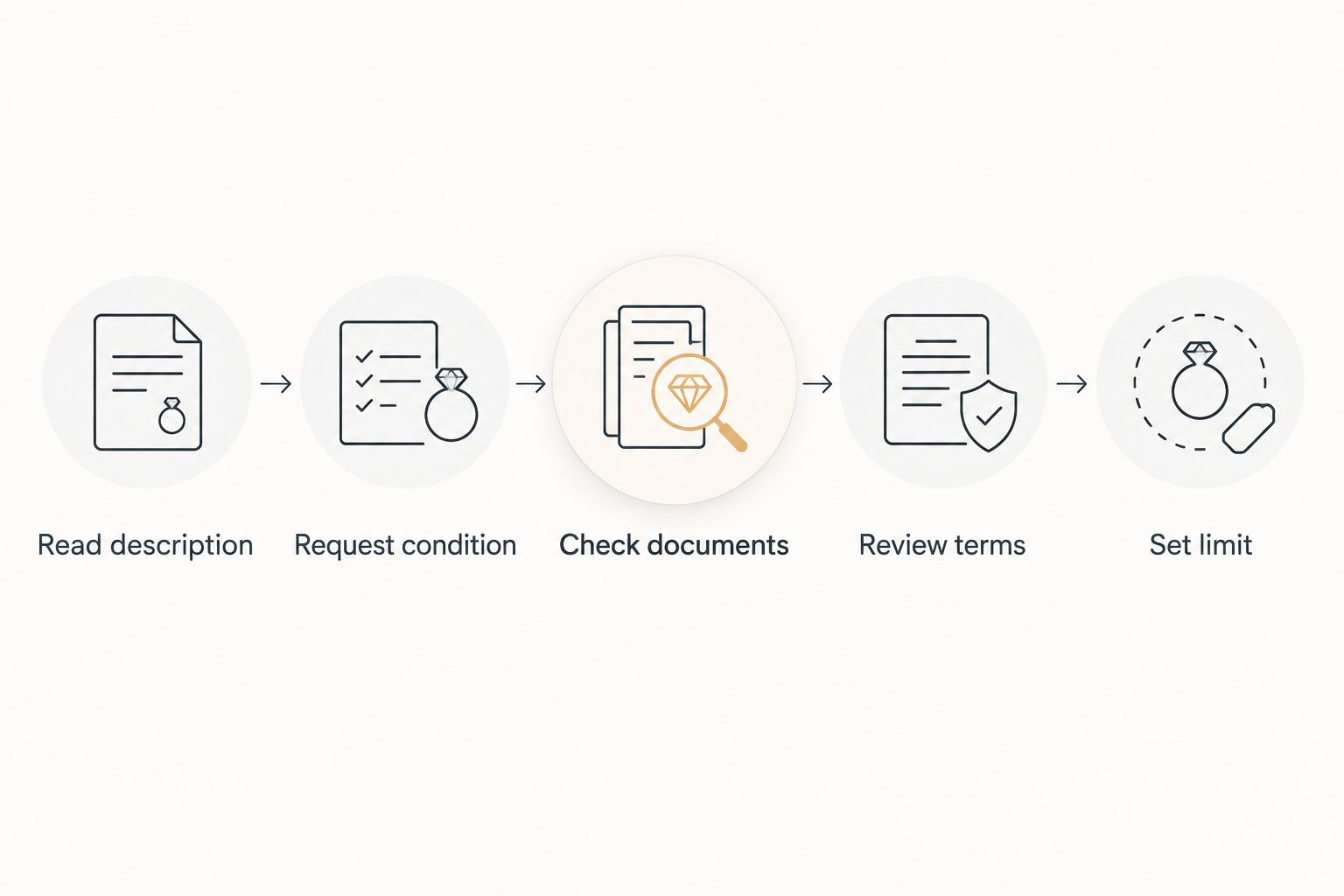
For a 2026 shortlist, use the same verification sequence on either route. Ask what the object is, what has happened to it, and which written documents support the description. Then decide whether the remaining uncertainty is acceptable.
- Read description: distinguish stated facts from descriptive language.
- Request condition: ask about damage, repairs, alterations, and wear.
- Check documents: establish what any report covers and which object it identifies.
- Review terms: understand the conditions governing your bid.
- Set limit: decide before bidding what the verified piece is worth to you.
A gemstone report and a condition report answer different questions. A gemological report can address identification and characteristics within its stated scope; a condition report addresses the object's physical state. Neither should be stretched into a promise it does not make.
Use the guide to getting a condition report before bidding to turn a vague request into specific questions. Ask for close views of worn areas, settings, fastenings, and marks relevant to the listing.
If a material claim determines your willingness to bid, resolve it before bidding. Do not substitute a confident description or an attractive image for the supporting evidence you need.
Pricing is a tie until you compare the complete sale terms
There is no defensible platform-wide cost winner from the auction format alone. Both routes involve auction bidding, and the amount you bid is not the only part of the purchasing decision.
For 2026, compare the pricing model at the sale level. Read the applicable buyer's premium, payment conditions, taxes, shipping arrangements, and any other stated charges. Do not carry assumptions from a previous auction into a new one.
The tradeoff is bidding flexibility versus certainty about the final commitment. Auctions let you decide your bidding limit, but a disciplined limit requires understanding the charges and obligations attached to winning. The auction format itself does not establish a bargain.
For the jewelry-focused route, inspect the terms governing the specific lot and transaction. For LiveAuctioneers, inspect the participating auction house's sale terms and any applicable platform-related conditions. Do not assume a common browsing interface creates a common fee schedule.
Keep an all-in purchasing limit separate from your maximum bid. Work backward from the complete obligation rather than increasing your budget after winning. A lower bid is not automatically a lower total commitment.
Purchase planning is a tie: check the actual arrangements
Neither destination earns a delivery or returns advantage without the relevant transaction terms. Evaluate those arrangements before bidding, especially when you need the jewelry for a particular occasion.
Ask who handles shipment, how insurance is arranged, and what you must do if the item arrives damaged or differs from its description. Read the applicable return and dispute provisions rather than assuming ordinary retail rules apply.
If a ring needs resizing or a clasp needs repair, ask an appropriate jewelry professional about the work before making it part of your plan. A purchase intended for immediate wear has different requirements from a collector's restoration project.
The same discipline applies to international buying. Check the destination, customs responsibilities, and carrier arrangements relevant to your transaction. A platform preference cannot resolve those details for you.
Final verdict: choose by shopping task, then verify the lot
Choose the jewelry-focused destination if you have a defined brief
Choose Jewelryroom.com if you are a jewelry buyer who wants to begin with jewelry auctions rather than a broad collecting marketplace. Your profile is the focused shopper: you know the type of piece you want and will judge candidates against written requirements.
The advantage is category alignment. The limitation is that this focus does not establish any particular listing's quality, documentation, or transaction terms. Keep those decisions separate.
Choose LiveAuctioneers if you compare houses and categories
Choose LiveAuctioneers if you are a cross-category collector or a jewelry buyer deliberately comparing participating auction houses. Your profile is the researcher who wants breadth and accepts the work of evaluating separate sellers and sales.
The advantage is marketplace discovery. The limitation is that you must keep house-specific descriptions, responses, and terms attached to the correct lot.
For either choice in 2026, your final approval should rest on the jewel, its supporting evidence, and the complete transaction—not the platform name.
| Dimension | Winner |
|---|---|
| Defined jewelry-only shopping brief | Jewelry-focused destination |
| Jewelry-focused starting point | Jewelry-focused destination |
| Cross-category collecting | LiveAuctioneers |
| Comparing participating auction houses | LiveAuctioneers |
| Condition and authenticity | Tie: assess the individual lot |
| Pricing | Tie: compare complete sale terms |
| Delivery and purchase planning | Tie: check transaction arrangements |
FAQ
Is Jewelryroom.com better than LiveAuctioneers for jewelry auctions?
Jewelryroom.com is the better starting point for a jewelry-focused shopping brief; LiveAuctioneers is the better fit for comparing participating auction houses and collecting categories. Neither format establishes the quality of an individual lot.
Which is better for comparing different jewelry auction houses?
LiveAuctioneers is the better fit for comparing participating auction houses. Keep each house's lot descriptions, written responses, and sale terms separate during your research.
Which auction site is cheaper for buying jewelry?
Compare the complete terms of the actual sales rather than declaring a platform-wide winner. Your bid, applicable charges, taxes, and shipping arrangements all belong in the purchasing decision.
Does a jewelry-focused auction site guarantee authenticity?
A jewelry-focused business description does not establish an individual piece's authenticity. Require evidence appropriate to the material, gemstone, maker attribution, or provenance claim that matters to your decision.
Do I need a condition report if a gemstone has a laboratory report?
Yes, a condition report answers questions that a gemstone report does not. Review the scope of each document and ask separately about repairs, wear, settings, and fastenings.
Can I assume auction jewelry is returnable?
No, read the applicable sale terms before bidding. Check the return, dispute, and description-related provisions governing the particular transaction.
What should a first-time jewelry auction buyer do before bidding?
Define the piece you want, verify its description and condition, and set an all-in purchasing limit. Resolve material questions in writing before placing a bid.
One last thing
Use unanswered questions as a reason to stop, not a reason to bid faster. Before your next 2026 auction, write down the fact that would change your decision—whether it concerns a repair, gemstone treatment, maker attribution, or delivery arrangement.
Ask that question directly. If the answer does not resolve the issue, remove the lot from your shortlist rather than letting the closing time make the decision.


