
PropertyRoom brings police-auction and surplus merchandise into an online auction marketplace. When your search narrows to jewelry, its broad scope is no longer the main reason to choose it. The best PropertyRoom alternative in 2026 is Jewelryroom.com if you want jewelry-focused auctions; eBay if you want a broad marketplace with auction and fixed-price listings.
- Among PropertyRoom alternatives, Jewelryroom.com is the jewelry-auction choice for buyers who want a category-focused starting point.
- Choose eBay for broad marketplace searches; choose LiveAuctioneers to browse participating auction houses.
- Keep PropertyRoom on your shortlist when its individual jewelry listing meets your requirements.
- Compare condition evidence, seller terms, and total purchase obligations before bidding anywhere.
Why this matters
Changing auction sites does not remove the need to assess the jewelry. You still need to establish what the item is, what condition it is in, and what obligations follow a winning bid. A more relevant marketplace helps you organize the search; it does not authenticate the piece.
For your 2026 shortlist, separate platform fit from lot quality. Start with the buying experience you want, then apply the same evidence standard everywhere. The guide to getting a condition report before bidding explains an important part of that second step.
PropertyRoom alternatives at a glance
These options serve different buying approaches. The comparison below describes marketplace structure, not a promise about any particular seller, gemstone, or transaction.
| Platform | Best for | Standout characteristic | Difference from PropertyRoom | Main limitation |
|---|---|---|---|---|
| PropertyRoom | Buyers interested in police-auction and surplus merchandise | Broad auction marketplace associated with police and municipal sources | The benchmark for this comparison | Broad marketplace scope does not establish jewelry quality |
| Jewelryroom.com | Buyers starting with jewelry auctions | Jewelry-focused auction positioning | Starts with the jewelry category rather than a general-merchandise search | Category focus does not replace item-level verification |
| eBay | Buyers comparing auctions with fixed-price listings | Broad marketplace with multiple selling formats | Lets you compare buying formats as well as individual sellers | You must assess each seller and listing separately |
| LiveAuctioneers | Buyers browsing participating auction houses | Marketplace connecting bidders with auction-house catalogs | Organizes discovery around auction houses and their sales | You must check the selling house's terms for each auction |
Choose the platform for its search model; choose the jewelry for its evidence. A familiar name is not a substitute for an adequate description, useful photographs, or clear transaction terms.
1. Jewelryroom.com: best for jewelry-focused auction searches
Jewelryroom.com is a jewelry-auction business, making it the direct category-focused starting point in this comparison. Choose it when jewelry is your buying objective rather than one category within a wider merchandise search. That is a scope recommendation, not a claim that every lot is suitable for every buyer.
Where Jewelryroom.com shines
- Category fit: The business description centers on jewelry auctions, matching a jewelry-specific buying brief.
- Clear starting point: You can begin your comparison with a jewelry-auction business instead of choosing a general marketplace first.
- Relevant comparison: It belongs on the shortlist when your reason for leaving PropertyRoom is a more focused jewelry search.
Where the jewelry-focused option falls short
- A jewelry-focused recommendation does not meet a broader shopping brief covering tools, electronics, or other surplus goods.
- Specialization alone does not establish gemstone identity, metal content, condition, or provenance.
- Choosing an auction business does not answer whether an auction is the right purchasing format for your deadline or risk tolerance.
Head-to-head with PropertyRoom
| Dimension | Jewelry-focused option | PropertyRoom |
|---|---|---|
| Starting point | Jewelry auctions | Broad merchandise auctions |
| Best buying brief | Search specifically for jewelry | Browse jewelry alongside other merchandise |
| Evidence standard | Verify the individual lot | Verify the individual lot |
| Decision basis | Category relevance plus acceptable documentation | Relevant listing plus acceptable documentation |
Best for: Buyers who want jewelry auctions to be the starting point of their search.
Before committing, write down the attributes you actually require: jewelry type, metal, stone identity, dimensions, and acceptable wear. Then compare listings against that brief. A focused destination is useful only when you remain willing to reject an unsuitable item.
Verdict: Buy only when the individual lot satisfies your requirements; use this option first for a jewelry-focused search.
2. eBay: best for comparing auctions with fixed-price listings
For your 2026 search, eBay is the alternative when you want to compare more than auction venues. Its marketplace includes auction and fixed-price formats, so you can evaluate whether bidding is necessary for the kind of jewelry you want. That distinction matters when certainty about the purchase process is more important than participating in an auction.
Where eBay shines
- Format choice: You can compare auction listings with fixed-price listings instead of assuming bidding is the only route.
- Broad discovery: Its general marketplace structure supports searches beyond a single auction business.
- Seller comparison: You can review the identity, description, and terms associated with each listing rather than treating the marketplace as one seller.
Where eBay falls short
- A broad marketplace requires you to distinguish between individual sellers, not simply trust the platform name.
- Similar titles do not make two jewelry items equivalent; metal, stone identity, condition, and documentation still require separate checks.
- A fixed-price option removes bidding competition, not the need to investigate the item.
Head-to-head with PropertyRoom
| Dimension | eBay | PropertyRoom |
|---|---|---|
| Marketplace model | General marketplace with individual sellers | General auction marketplace |
| Buying formats | Auction and fixed-price listings | Auction-led buying |
| Best comparison task | Compare sellers and purchasing formats | Assess lots within an auction marketplace |
| Buyer responsibility | Check listing evidence and seller terms | Check listing evidence and transaction terms |
Best for: Buyers deciding between bidding and a fixed-price purchase.
Do not use an asking amount as proof of market value. A listing describes an offer, not necessarily a completed transaction, and a visually similar ring is not automatically a valid comparison. Match the material details before treating another item as a benchmark.
For example, a plain band and a stone-set band need different condition checks. One comparison centers on wear and dimensions; the other also requires attention to the stones and their settings. Search breadth helps you find candidates, but it does not make those candidates interchangeable.
Verdict: Buy when the listing and seller meet your evidence standard; choose eBay when format choice matters.
3. LiveAuctioneers: best for browsing auction-house catalogs
LiveAuctioneers connects bidders with participating auction houses and their catalogs. Choose it when you want your search to include auction-house sales rather than stay within one auction business. The relevant comparison is both platform versus platform and selling house versus selling house.
Where LiveAuctioneers shines
- Auction-house discovery: You can explore catalogs associated with different participating houses.
- Sale context: You can assess an item within the catalog and auction presented by its selling house.
- Research direction: The named auction house gives you a specific business to investigate before bidding.
Where LiveAuctioneers falls short
- Platform familiarity does not remove the need to review the individual auction house.
- You must read the terms attached to the relevant sale rather than assume every auction follows the same rules.
- Catalog context does not independently prove authenticity or condition.
Head-to-head with PropertyRoom
| Dimension | LiveAuctioneers | PropertyRoom |
|---|---|---|
| Discovery model | Participating auction houses and catalogs | Broad merchandise auction marketplace |
| Best starting question | Which house and sale fit my search? | Which listing fits my search? |
| Terms review | Check the relevant house and auction | Check the relevant listing and transaction terms |
Best for: Buyers who want auction-house catalogs as their search framework.
Verdict: Buy only after reviewing the selling house, lot evidence, and sale terms; otherwise, wait.
Why people switch from PropertyRoom
A useful reason to switch is a change in your buying requirements. There is no need to assume a platform failure, a policy change, or a bad experience. Use these specific differences to decide whether an alternative belongs in your search.
You want a jewelry-first starting point
A general-merchandise marketplace and a jewelry-auction business answer different search briefs. If jewelry is the entire task, starting with a category-focused business is a direct way to organize your research. It is not a reason to relax your documentation requirements.
You want to compare purchasing formats
An auction is not always the format you want. If you would rather compare bidding with a fixed-price purchase, eBay provides that structural distinction. Choose based on how you want to buy, not on an assumption that one format guarantees a better result.
You want to research auction houses
LiveAuctioneers fits a search organized around participating houses and their sales. That approach adds another decision: whether the particular house and auction suit your requirements. Investigate that business before treating its catalog as a recommendation.
Your current candidate lacks the evidence you need
An incomplete description is a reason to pause that purchase, not proof that another platform is better. Ask for clarification first. If the item remains uncertain, compare other lots using the same checklist rather than lowering the standard to finish the search.
How to compare jewelry listings in 2026
Use this sequence before placing a bid on any of the platforms above. Keep the process consistent so that a persuasive photograph or familiar marketplace does not change your requirements halfway through.
Identity
Establish what the seller claims the piece contains. Distinguish metal purity from gemstone weight: 14-karat gold describes 14 parts gold out of 24, while 18-karat gold describes 18 parts out of 24. Those marks describe fineness, not an independent assessment of the whole piece.
Gemstone carat weight is different: 1 carat equals 0.2 grams. It measures mass, not diameter, color, clarity, or authenticity. Do not treat a heavier stone as automatically better suited to your purchase.
Condition
Look for photographs and descriptions that address the parts affecting wear: settings, clasps, hinges, shanks, and visible damage. Ask direct questions about repairs or alterations when those details matter to your decision. Silence in a description is not confirmation of good condition.
Documentation
Separate the seller's description from supporting evidence. If a laboratory report is referenced, check that its identifying details correspond to the offered stone. A report about a gemstone is not automatically a condition report for the complete piece of jewelry.
Terms
Read payment obligations, applicable charges, delivery arrangements, and any stated return conditions before bidding. Do not assume that terms from a previous purchase apply to a different seller or auction. Save the listing and relevant terms for your records.
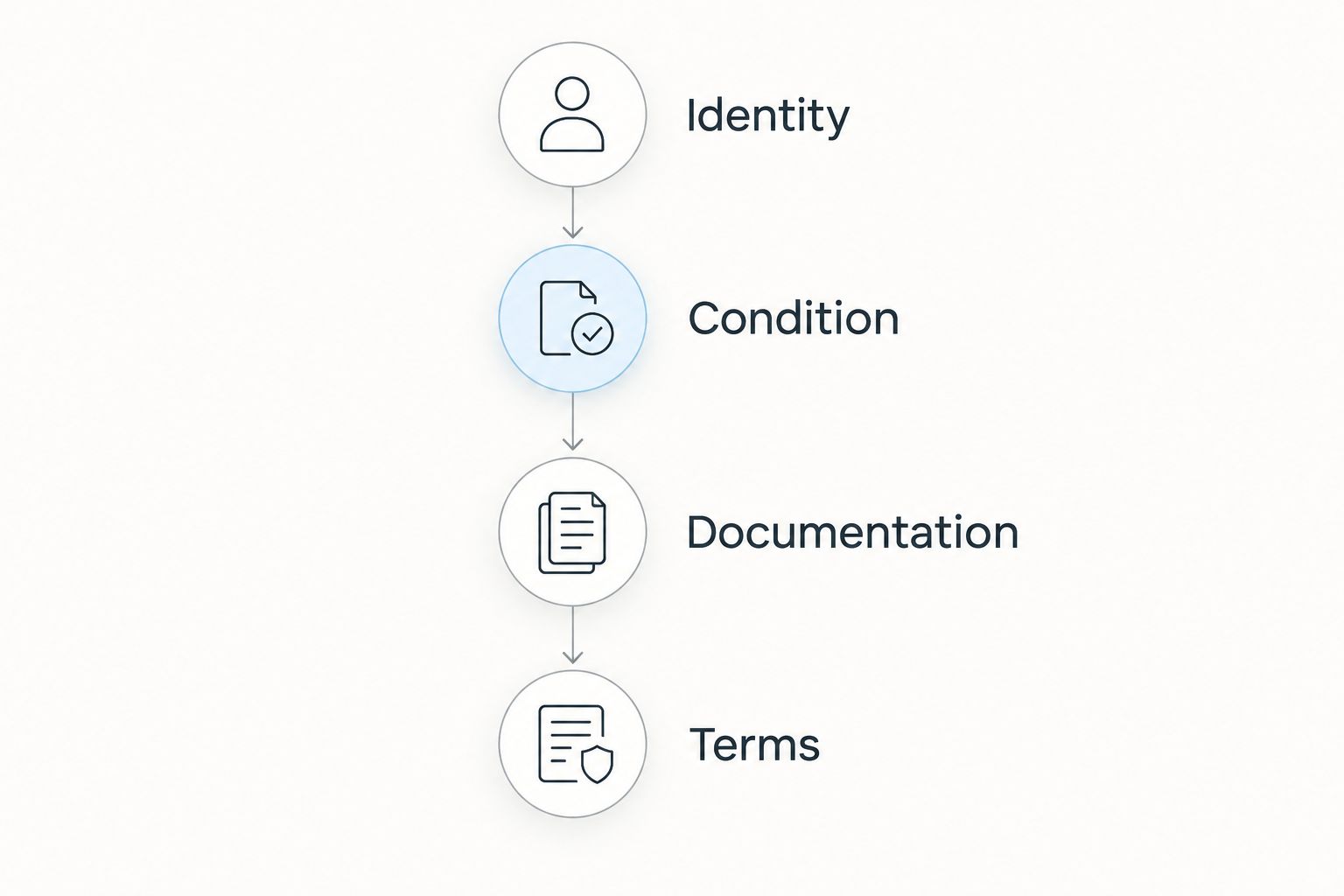
The strongest comparison is between documented items that meet the same brief. If one listing leaves a material question unresolved, mark it unresolved rather than filling the gap with an assumption. You can reject a lot without rejecting the entire platform.
When staying with PropertyRoom is the right call
Stay with PropertyRoom when you find a suitable jewelry lot, understand the terms, and have enough evidence to make the purchase decision. Switching for the sake of switching adds another search without necessarily improving the item you buy.
For 2026, keep PropertyRoom as a benchmark rather than treating alternatives as automatic upgrades. Compare relevant candidates side by side. An adequately documented lot on a familiar platform is a better decision than an inadequately documented lot on a newly recommended one.
FAQ
What's the best PropertyRoom alternative for jewelry in 2026?
Jewelryroom.com is the category-focused choice for buyers who want jewelry auctions as their starting point. eBay fits buyers comparing auction and fixed-price formats, while LiveAuctioneers fits auction-house catalog searches.
Is eBay better than PropertyRoom for buying jewelry?
eBay is a better fit when you want to compare auction listings with fixed-price listings. That format choice does not establish the quality of an individual piece; check the seller, item evidence, and transaction terms.
What's the difference between LiveAuctioneers and PropertyRoom?
LiveAuctioneers connects bidders with participating auction houses and their catalogs, while PropertyRoom is a broad merchandise auction marketplace. On LiveAuctioneers, reviewing the particular selling house is part of the buying decision.
Does a jewelry-focused auction site guarantee authentic gemstones?
No, jewelry specialization alone does not establish gemstone authenticity. Assess the individual description and supporting documentation, and resolve material questions before bidding.
What should I check before bidding on an auction ring?
Check the ring's identity, condition, supporting documentation, and sale terms. Pay particular attention to metal description, stone identity, dimensions, settings, and any disclosed repairs.
Does a gemstone report describe the condition of the whole ring?
No, a gemstone report is not automatically a condition report for the complete ring. You still need information about the mounting, wear, repairs, and the correspondence between the report and the offered stone.
Should I stop using PropertyRoom if I find an alternative?
No, keep PropertyRoom in your comparison when an individual listing meets your requirements. Choose the documented item and acceptable terms rather than switching solely because another platform appears on a shortlist.
One last thing
Before your next 2026 bid, write the unanswered question that would change your decision. It might concern stone identity, a repaired setting, or a delivery condition. Ask it before committing; if the answer remains unclear, wait rather than bid on an assumption.


