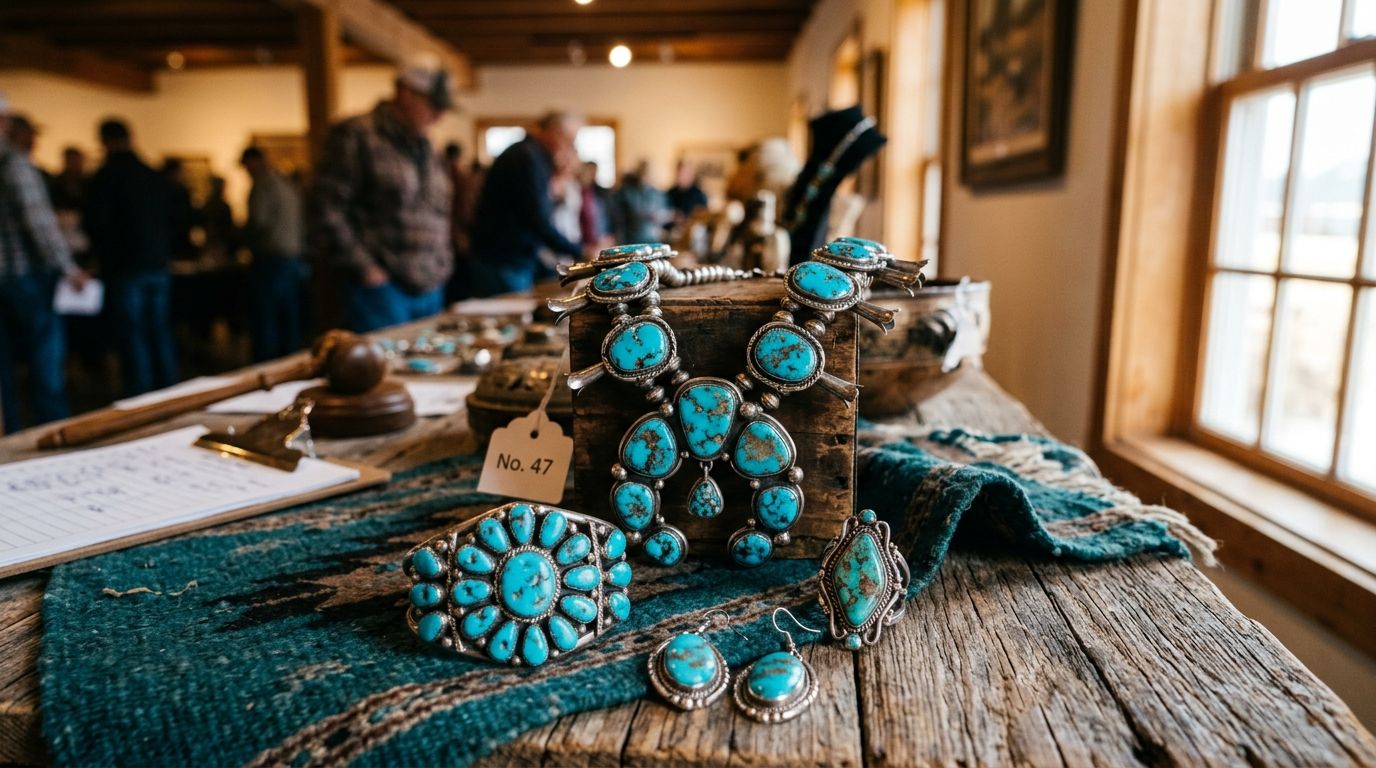
Turquoise jewelry auction bidding for Southwestern style collectors rewards specifics — mine name, maker's hallmark, and stone treatment decide the final price far more than carat weight or metal type ever will.
- Turquoise jewelry auction bidding rewards mine identification and hallmark research over guesswork on generic listings.
- Sleeping Beauty Mine closed in 2012 and Bisbee Mine stopped producing turquoise in 1943 — both drive scarcity premiums.
- Set a hard budget before bidding; buyer's premiums and shipping insurance stack on top of the hammer price.
- Verify Navajo, Zuni, or Hopi maker's marks and request certification before placing any bid in 2026.
- Jewelryroom.com auction listings let collectors research provenance and condition before a sale closes.
Why turquoise jewelry auctions matter for Southwestern style collectors
Southwestern turquoise collectors don't search the way a general jewelry auction buyer does. They search for a mine name, a smith's stamp, or a decade — Sleeping Beauty, Bisbee, Kingman, Navajo, Zuni — and they bid harder once a listing confirms one of those specifics. Jewelryroom.com auction listings that name the mine and maker draw sharper bidding than generic "turquoise ring" listings, because this collector base already knows what real scarcity looks like.
The mine math isn't abstract. The Sleeping Beauty Mine in Arizona, the largest source of the pale, matrix-free robin's-egg blue that defines a lot of mid-century Southwestern jewelry, closed in 2012. The Bisbee Mine, known for deep blue stone with chocolate-brown matrix, stopped producing turquoise in 1943. Every ring, cuff, or squash blossom necklace made from either mine is working from a fixed, shrinking supply, and that scarcity is priced into 2026 auction estimates whether the catalog says so or not.
Build your bidding process for Southwestern turquoise
Verify the mine and stone before you bid
Confirm what you're actually bidding on before you put a number next to it in 2026. Natural, untreated turquoise from a named mine carries real scarcity value; stabilized or reconstituted stone, or dyed howlite passed off as turquoise, does not — and natural turquoise runs a Mohs hardness of 5 to 6, soft enough that a loupe check on wear patterns tells you more than a listing photo ever will.
- Ask for the mine name in writing, not just "Southwestern turquoise"
- Check for a certification or lab report on unset or investment-grade stones
- Compare stone color and matrix pattern against known Sleeping Beauty, Bisbee, and Kingman examples
- Look for consistent color under different light sources — dyed stone often shifts
- Request close-up photos of drill holes or settings that could hide treatment
How to spot fake gemstones at online auctions covers the treatment red flags in more depth before you bid on any colored stone, turquoise included.
Research the maker's mark and hallmark
A stamped hallmark from a known Navajo, Zuni, or Hopi silversmith changes the value math entirely, and Southwestern jewelry has carried maker stamps since the 1870s. Unsigned pieces aren't worthless, but they compete on stone and craftsmanship alone.
- Search the stamp against published silversmith mark directories
- Check catalog notes for family or guild attribution
- Look for consistent stamp placement and depth — recast fakes often blur the mark
- Ask the auction house directly if the listing omits the maker
- Weigh unsigned pieces on stone quality and construction, not name alone
Set your ceiling budget before the auction opens
Decide your maximum number before the first bid, not during the last thirty seconds. Buyer's premiums and shipping insurance add to the hammer price, and Southwestern turquoise pieces with confirmed mine provenance routinely draw several bidders in the closing minutes.
- Set a hard ceiling that already includes the buyer's premium
- Separate your "want" number from your "walk away" number
- Track how similar signed pieces closed in past auctions
- Leave room in the budget for insured shipping on statement pieces
- Never revise your ceiling mid-auction because of bidding momentum
How to set a budget for online jewelry auctions walks through the full math, buyer's premium included.
Read the catalog listing like an appraiser
Treat the catalog description as a legal document, not marketing copy. A complete Southwestern turquoise listing states the mine (or "mine unknown"), the maker if signed, the metal karat or fineness, and any repairs or replaced stones.
- Flag listings that say "turquoise-style" or "turquoise blue" instead of naming the stone
- Note total weight and stone count for cluster or multi-stone pieces
- Check condition notes for re-tipped prongs or replaced stones
- Confirm whether the piece has been cleaned or resized
- Cross-reference catalog photos against any close-up shots provided separately
Place a strategic proxy bid
Manual last-second bidding works if you can watch the clock, but a proxy bid protects your ceiling when three other collectors want the same squash blossom necklace. Set the proxy at your true maximum and let the system manage the increments for you.
- Enter your absolute ceiling, not your opening offer
- Confirm the auction's bid increment schedule before setting the proxy
- Watch for "reserve not met" flags on Southwestern lots with steep starting estimates
- Reconfirm your proxy amount if the listing is revised after questions
- Track competing bid activity in the days before close, not just the final hour
Compare the hammer estimate against retail Southwestern prices
Auction estimates for signed Navajo or Zuni turquoise pieces often run below equivalent retail, because retail carries markup for warranty and instant availability, not for material scarcity. Pull two or three retail comparables before deciding your ceiling is fair.
- Compare stone size and mine, not just carat weight, across listings
- Check whether retail comparables are new production or vintage estate pieces
- Factor the buyer's premium into the auction side of the comparison
- Note maker reputation differences between the two listings
- Adjust for condition — retail pieces are typically unworn
Insure and care for the piece after you win
Turquoise scratches and absorbs oils and chemicals more easily than harder gemstones, so care after the win matters as much as the bid itself. Insure the piece for its appraised value before it ships, not after it arrives.
- Get a post-auction appraisal for insurance scheduling
- Store pieces away from direct sunlight and household chemicals
- Avoid ultrasonic cleaners on turquoise settings
- Re-check prong tightness annually on statement rings and cuffs
- Confirm shipping insurance covers the full hammer price plus premium
Where to buy Southwestern turquoise: option comparison
| Option | Best for | Authentication support | Key limitation |
|---|---|---|---|
| Online estate jewelry auctions | Collectors who want catalog research and condition reports before bidding | Auction house documents maker's marks and stone origin in the listing | Bidding is competitive; no in-person inspection before the sale closes |
| Native-run trading posts and reservation galleries | Buyers who want direct maker provenance | Direct maker attribution at point of sale | Limited to current inventory; rarely vintage or estate pieces |
| General online marketplaces | Casual buyers on a tight budget | Seller-provided description only, rarely verified | High risk of dyed howlite or reconstituted stone mislabeled as natural |
| Local estate sales and pawn shops | Buyers who want to inspect stones by hand first | None — buyer must self-verify | Sparse Southwestern-specific inventory; supply varies by region |
| Retail jewelry stores selling new pieces | Buyers who prioritize warranty over history | Manufacturer certification on new stock | New pieces cost more than comparable vintage stock and carry no mine-scarcity value |
Verdict: online estate auctions with named-mine catalog listings are the strongest option for Southwestern turquoise collectors chasing Sleeping Beauty, Bisbee, or Kingman provenance in 2026 — trading posts win on direct maker relationships, but they don't reach vintage estate inventory.
Browse turquoise jewelry auctions
Research provenance and condition before you bid in 2026.
Common mistakes Southwestern collectors make at auction
- Assuming "turquoise" on the tag means natural, untreated stone — stabilization is common and legal, but it changes the value
- Chasing the word "Navajo" without checking the actual hallmark — attribution without a verifiable stamp is a guess, not a fact
- Ignoring the closed-mine scarcity math — Sleeping Beauty closed in 2012 and Bisbee in 1943, and paying common-stock prices for stone from either mine leaves value on the table
- Skipping the buyer's premium in the mental budget — the hammer price is never the final price
- Bidding on "vintage" claims without provenance research — decades-old attribution needs more than a catalog adjective
FAQ
What's the best mine for Southwestern turquoise jewelry auctions?
Sleeping Beauty and Bisbee turquoise carry the strongest scarcity value at auction because both mines are closed — Sleeping Beauty since 2012 and Bisbee since 1943 — while Kingman material, still in limited production, trades a step below. Confirm mine attribution in writing before bidding either way.
Is natural turquoise better than stabilized turquoise for auction bidding?
Natural, untreated turquoise commands a premium over stabilized or reconstituted stone because stabilization is a resin treatment that increases durability but reduces rarity value. Ask for a lab report or clear catalog disclosure before assuming a piece is natural.
How much does a signed Navajo turquoise ring cost at a jewelry auction?
Pricing depends on the maker, mine, stone size, and current bidding activity, so check the specific listing's estimate and closed-lot history rather than relying on a flat figure. Buyer's premium adds on top of whatever the hammer price shows.
How do I verify a turquoise piece's hallmark before bidding?
Cross-reference the stamped mark against published Southwestern silversmith mark directories and ask the auction house for attribution notes if the catalog omits one. Unsigned pieces can still be genuine, but they should be priced on stone and craftsmanship rather than a maker name.
What's the difference between Sleeping Beauty and Bisbee turquoise?
Sleeping Beauty turquoise is a pale, matrix-free robin's-egg blue from a mine that closed in 2012, while Bisbee turquoise shows a deeper blue with chocolate-brown matrix from a mine that stopped producing turquoise in 1943. Both are prized for the same reason: neither mine still produces.
Should I buy turquoise jewelry at auction or from a reservation trading post?
Auctions give catalog research, condition notes, and access to vintage estate pieces with documented mine provenance, while trading posts give direct maker contact but a narrower, mostly new-production inventory. Choose auction for vintage and rare-mine pieces, trading posts for current-production maker relationships.
How do I avoid overbidding on a turquoise jewelry auction lot?
Set a hard ceiling that already includes the buyer's premium before the auction opens, and don't revise it because of bidding momentum in the final minutes. Track how comparable signed, mine-attributed pieces closed in past auctions to calibrate that ceiling realistically.
Does turquoise jewelry need special insurance after an auction win?
Yes — get a post-auction appraisal and insure the piece for its appraised value before it ships, since turquoise is softer, at a Mohs hardness of 5 to 6, than harder auction gemstones. Standard homeowner policies often cap jewelry coverage well below appraised value.
One last thing
Most turquoise sold today, Southwestern or otherwise, is stabilized rather than natural — a resin treatment that hardens the stone for setting and daily wear. That doesn't make a piece worthless, but it does mean "natural, untreated" is the single most valuable line in a 2026 auction catalog, and it's worth confirming before you bid, not after you've won.


