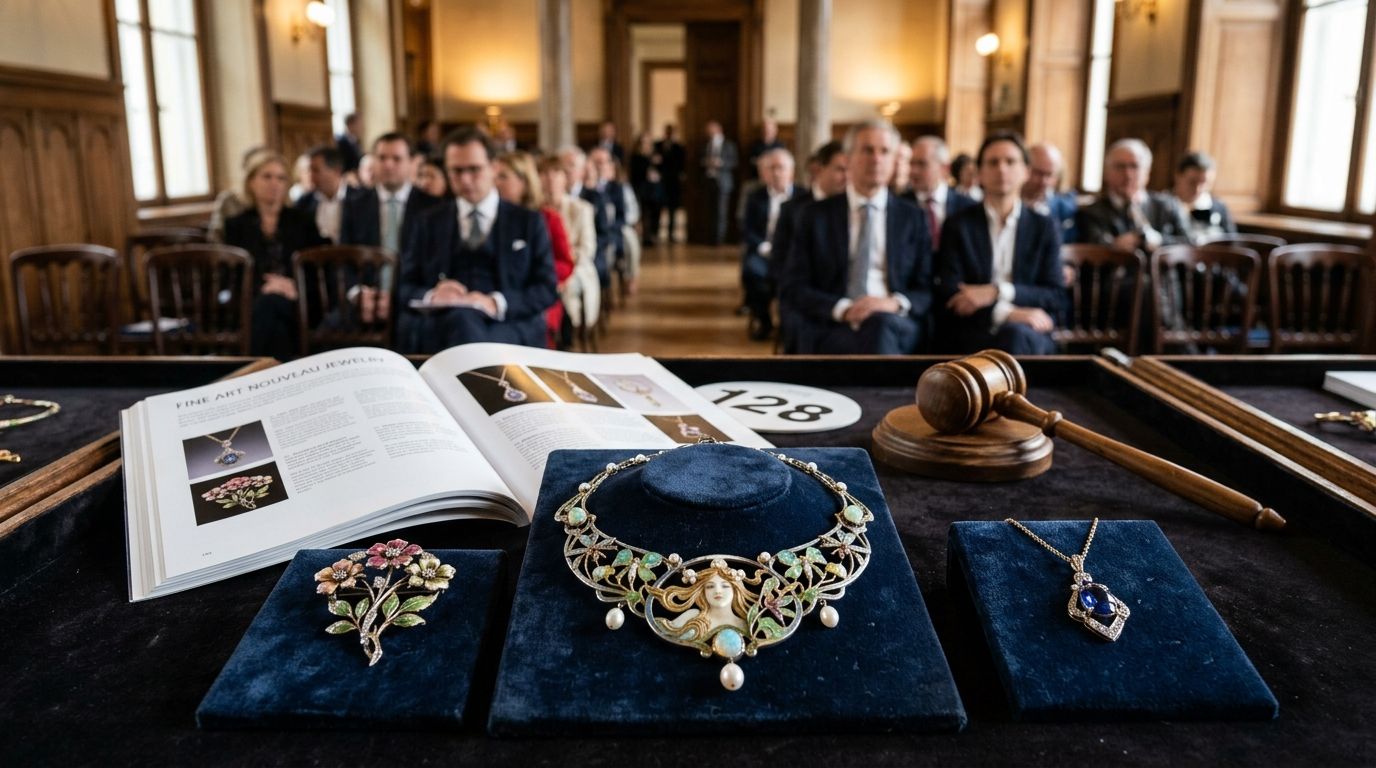
Sotheby's, Christie's and Bonhams dominate the top end of the Art Nouveau jewelry market, but they aren't the only route to a genuine Lalique brooch or Fouquet pendant, and each house serves a different kind of buyer.
Best overall for Art Nouveau jewelry: Sotheby's, for museum-grade pieces by René Lalique and Georges Fouquet backed by full provenance research. Best for online bidding on vetted estate lots: Jewelryroom.com, for buyers who want to bid from home without flying to a saleroom. Best budget option for regional and estate finds: Freeman's | Hindman, for less publicized lots that still carry period-correct enamel and gold work.
- Sotheby's wins for museum-grade Art Nouveau jewelry with full provenance research and specialist departments.
- Jewelryroom.com is the pick for online bidding access on vetted estate and antique lots including Art Nouveau pieces.
- Freeman's | Hindman and Heritage Auctions surface regional Art Nouveau finds at lower visibility, often with less bidding competition.
- Christie's and Bonhams sit between the two extremes on signed-piece depth and condition reporting.
- Verify plique-à-jour enamel and hallmark authenticity before bidding on any Art Nouveau lot dated 1890 to 1910.
Why this matters
Art Nouveau jewelry runs roughly from 1890 to 1910, and it's defined by naturalistic motifs, plique-à-jour enamel, and materials like horn and glass elevated through craftsmanship rather than carat weight. That makes authentication harder than it is for diamond-forward periods like Art Deco or Retro — the value sits in the maker's hand, not just the stone.
Buyers researching Art Nouveau jewelry for nature-inspired collectors in 2026 are competing against specialist dealers who know which houses to watch for unsigned but period-correct pieces. Picking the right auction venue matters more here than in almost any other jewelry category, because condition reporting on enamel work varies wildly between houses.
What makes the best auction house for Art Nouveau jewelry
- Period-specific specialist staff who can date enamel technique and hallmark style, not generalist jewelry appraisers
- Condition reports that call out enamel loss and plique-à-jour cracking, which is the single biggest value driver in this category
- Provenance documentation tracing ownership or exhibition history where it exists
- Online bidding access so buyers outside major auction cities aren't locked out
- Realistic estimate ranges that reflect the current thinner Art Nouveau market rather than 1990s peak pricing
- Buyer support after the hammer, including shipping guidance and post-sale authentication questions
Best auctions for Art Nouveau jewelry, at a glance
| Auction house | Best for | Standout feature | Key limitation |
|---|---|---|---|
| Jewelryroom.com | Online bidding on vetted estate lots | Remote access to curated antique and estate jewelry auctions | Smaller Art Nouveau-specific selection than the majors |
| Sotheby's | Museum-grade signed pieces | Deep specialist jewelry department with provenance research | High buyer competition drives estimates up fast |
| Christie's | Signed designer Art Nouveau with paper trail | Strong archival records on major maker houses | Fewer unsigned or lesser-known pieces cross the block |
| Bonhams | Mid-market pieces with detailed condition reports | Granular enamel and hallmark condition notes | Smaller Art Nouveau category than the top two houses |
| Heritage Auctions | High lot volume, browsable online | Large searchable online catalog updated frequently | Uneven cataloging depth across individual lots |
| Freeman's | Hindman | Regional and estate discoveries | Lower competition on unsigned period-correct pieces | Less specialist Art Nouveau expertise than the global houses |
1. Jewelryroom.com: best auction for online bidding on vetted Art Nouveau lots
Jewelryroom.com runs online jewelry auctions covering estate and antique categories, giving remote buyers a way to bid on period jewelry without traveling to a physical saleroom. For someone hunting Art Nouveau pieces without saleroom access in New York or London, that's the practical entry point in 2026.
Jewelryroom.com pros:
- Remote bidding removes the geographic barrier that shuts many buyers out of Sotheby's and Christie's
- Estate and antique jewelry categories overlap with Art Nouveau-era pieces
- Lower saleroom overhead can mean less price inflation from in-room competitive bidding
Jewelryroom.com cons:
- Art Nouveau-specific inventory is thinner and less predictable than at the specialist auction houses
- Buyers still need to do their own hallmark and enamel condition verification before bidding
Jewelryroom.com pricing: check current lot listings directly on the site for individual estimates.
Best for: buyers who want to browse and bid on current jewelry auctions without saleroom travel. Verdict: Buy if a listed lot passes your own hallmark and enamel check.
2. Sotheby's: best auction for museum-grade Art Nouveau pieces
Sotheby's runs dedicated jewelry sales that regularly include signed Art Nouveau work by makers like René Lalique and Georges Fouquet, supported by in-house specialist research. This is where the record-setting, exhibition-history pieces surface.
Sotheby's pros:
- Deep archival research on major Art Nouveau makers
- Strong provenance documentation on high-value lots
- Global bidder pool means liquidity if you resell later
Sotheby's cons:
- That same global bidder pool pushes hammer prices well above lower estimates on desirable lots
- Entry-level unsigned Art Nouveau pieces are underrepresented compared to signed maker work
Best for: collectors chasing signed, provenanced Art Nouveau jewelry. Verdict: Buy if your budget can absorb competitive bidding from serious collectors.
3. Christie's: best auction for signed designer Art Nouveau with a paper trail
Christie's jewelry department covers the same signed-maker territory as Sotheby's, with its own strength in archival records tied to major design houses active between 1890 and 1910.
Christie's pros:
- Strong documentation on maker attribution
- Regular jewelry sales with dedicated antique jewelry categories
- International bidder access through online and in-room formats
Christie's cons:
- Similar price competition to Sotheby's on desirable signed lots
- Fewer unsigned or attributed-only pieces relative to the broader estate market
Best for: buyers prioritizing paper-trail confidence over price. Verdict: Buy for signed pieces; Wait if you're hunting unsigned bargains.
4. Bonhams: best auction for detailed condition reporting on mid-market pieces
Bonhams operates a jewelry department that sits between the top-tier global houses and the regional auction market, with condition reports that tend to go deeper on enamel and hallmark detail.
Bonhams pros:
- Detailed condition notes on enamel loss and plique-à-jour cracking, the two biggest value risks in this category
- Broader price range than Sotheby's or Christie's on comparable lots
- Regular antique and period jewelry sale calendar
Bonhams cons:
- Smaller Art Nouveau-specific selection than the two largest houses
- Less brand recognition among casual buyers, which can mean fewer competing bids but also fewer resale comparables
Best for: buyers who want granular condition data before bidding. Verdict: Buy.
5. Heritage Auctions: best auction for browsing high lot volume online
Heritage Auctions runs a large, frequently updated online catalog spanning jewelry categories, which makes it a practical browsing tool for anyone tracking Art Nouveau lots across multiple sale cycles.
Heritage Auctions pros:
- Large searchable online catalog makes tracking recurring Art Nouveau lots easier
- High lot volume means more chances at a well-priced find
- Online-first format suits remote bidders
Heritage Auctions cons:
- Cataloging depth is uneven — some lots get thorough write-ups, others get minimal description
- Requires more of your own authentication legwork than the specialist houses
Best for: buyers who want to watch a large volume of listings before committing. Verdict: Hold and monitor multiple sale cycles before bidding.
6. Freeman's | Hindman: best auction for regional Art Nouveau finds
Freeman's | Hindman covers estate and antique jewelry through a regional American auction network, and that regional focus means lower visibility on individual lots compared to the global houses.
Freeman's | Hindman pros:
- Less bidding competition than Sotheby's or Christie's on comparable pieces
- Regular estate jewelry sales surface unsigned but period-correct Art Nouveau work
- More accessible entry point for first-time antique jewelry buyers
Freeman's | Hindman cons:
- Fewer signed maker pieces than the global specialist houses
- Less depth of Art Nouveau-specific expertise on staff
Best for: buyers hunting unsigned period pieces without global-house price competition. Verdict: Buy for value hunters willing to do their own attribution research.
“If the plique-à-jour enamel shows more than hairline crazing under a loupe, treat the estimate as optimistic.”
How we ranked these
Each house was weighed against the criteria above: specialist staff depth on the 1890–1910 period, condition reporting quality on enamel and hallmarks, provenance documentation, and online bidding access. Jewelryroom.com and Freeman's | Hindman score highest on accessibility; Sotheby's and Christie's score highest on documentation depth and signed-maker inventory.
Start bidding on estate jewelry today
Browse current estate and antique auction lots online.
Which auction should you choose?
If you want the highest odds of finding a signed, documented Art Nouveau piece, Sotheby's or Christie's are the default choice in 2026, and you should expect to pay for the certainty. If you want to bid remotely on estate and antique jewelry categories without saleroom travel, Jewelryroom.com is the practical option. If your priority is unsigned period-correct pieces at lower competition, start with Freeman's | Hindman.
Before committing a bid anywhere, learn how to place a proxy bid on jewelry auctions so you don't get caught overpaying in the final seconds of a sale.
FAQ
What's the best auction for Art Nouveau jewelry in 2026?
Sotheby's is the strongest choice for signed, museum-grade Art Nouveau pieces in 2026, while Jewelryroom.com works better for buyers who want to bid online on estate and antique lots without saleroom travel.
Is Sotheby's better than Christie's for Art Nouveau jewelry?
Both houses run comparable specialist jewelry departments with strong provenance research on signed Art Nouveau makers. The difference usually comes down to which house has a specific piece in a given sale cycle, not a consistent quality gap.
Where can you buy Art Nouveau jewelry online?
Online-format auctions like Jewelryroom.com and Heritage Auctions let you bid remotely on estate and antique jewelry categories that include Art Nouveau pieces, without needing to attend a physical saleroom.
How do you spot fake Art Nouveau jewelry at auction?
Check for period-correct hallmarks, examine plique-à-jour enamel under magnification for consistent aging, and compare the piece against documented maker examples from 1890 to 1910. When in doubt, request a specialist condition report before bidding.
Are online-only jewelry auctions safe for antique pieces?
Online-only auctions can be safe when the house provides detailed condition reports and clear provenance notes. The buyer's own diligence on hallmarks and enamel condition matters more in an online-only format than in a saleroom where you can inspect the piece in person.
What makes Art Nouveau jewelry valuable?
Value comes from maker attribution, enamel and metalwork condition, and naturalistic design quality rather than gemstone carat weight. A well-preserved signed piece by a recognized 1890-1910 maker outvalues an unsigned piece of similar materials.
Do regional auction houses carry genuine Art Nouveau jewelry?
Yes. Regional houses like Freeman's | Hindman regularly surface unsigned but period-correct Art Nouveau pieces through estate sales, often at lower bidding competition than the global auction houses.
How do you avoid overpaying for Art Nouveau jewelry at auction?
Compare the auction estimate against retail comparables for similar maker and condition, set a maximum bid before the sale starts, and factor in the buyer's premium before you calculate your true final cost.
One last thing
The biggest mistake in this category isn't overpaying for a signed Lalique piece — it's underpaying for an unsigned one that turns out to be museum-quality, because the seller and the buyer both missed the maker attribution. Cross-check unsigned Art Nouveau lots against documented maker catalogs before you assume a low estimate means low quality.


