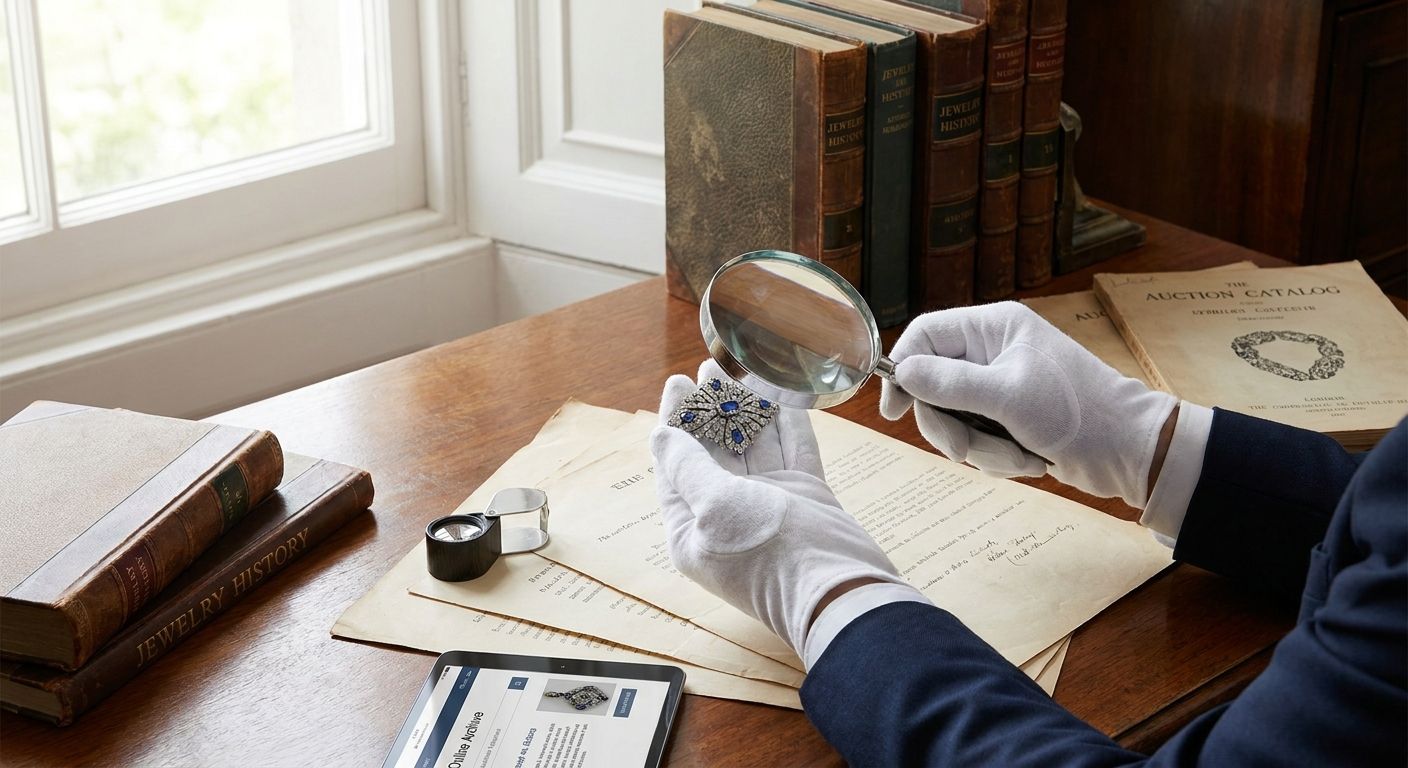
Provenance research for an estate jewelry lot means tracing three things before you bid: the paper trail (certificates, appraisals, prior sale records), the physical evidence stamped into the metal and stone, and the auction house's own disclosure in the catalog notes. Skip any one of the three and you're bidding on a story instead of a piece.
- Research jewelry provenance auction lots by checking hallmarks, gem lab reports, and prior sale history before you bid, not after you win.
- Purity marks like 750 (18k gold), 585 (14k gold), and 925 (sterling silver) confirm metal content even when paperwork is missing.
- Missing documentation on a colored gemstone is common in 2026 estate sales; missing documentation plus no hallmark on a diamond piece is a red flag.
- Jewelryroom.com posts condition reports and available lab documentation on each estate lot so you can verify before placing a bid.
Why this matters
A piece without a verified history sells for less at resale and costs more to insure correctly, because an insurer and a future buyer both want the same paper trail you're trying to build now. Estate auctions move faster than retail, so the research window is short: you usually have days, not weeks, between catalog publication and the closing bid.
Getting provenance wrong isn't just a resale problem. A ring cataloged as "Edwardian style" instead of "Edwardian" is a different asset entirely, and the wording difference matters more than the photo. Before you bid on any lot, run it through the steps below, and read how to authenticate a diamond before bidding if the lot is a diamond piece specifically.
How to research jewelry provenance before bidding at auction
Work through these steps in order. Each one either confirms or contradicts the last, and contradictions are exactly what you're hunting for.
- Read the full catalog description and condition report. Note every word choice — "attributed to" is not the same claim as "signed."
- Check for hallmarks and maker's marks. A loupe or 10x jeweler's magnifier reveals purity stamps and maker's initials the catalog photo won't show clearly.
- Verify gemological lab reports when present. A GIA or AGL report number can be looked up independently against the lab's own database.
- Trace prior ownership and sale history. Ask the auction house for the lot's consignment history or any prior auction record referenced in the notes.
- Cross-check the auction house's track record. A house that discloses condition issues honestly on other lots is more trustworthy on the lot you want.
- Get an independent appraisal before a high-value bid. This matters most above a few thousand dollars, where a misattribution costs real money.
Hallmarks and maker's marks: what they actually prove
A hallmark confirms metal content, not age or maker attribution, and the two get confused constantly. A 750 mark means 18k gold, 585 means 14k gold, 925 means sterling silver, and 950 means platinum — these are standard purity stamps used across most Western jewelry manufacturing, and their absence on a piece claiming solid gold construction is worth flagging immediately.
Maker's marks are a separate signal. A stamped set of initials or a registered symbol can sometimes be matched against maker's mark registries, but a worn or partial stamp often can't be confirmed either way — treat those lots as unverified, not disqualified.
Gemological lab reports: GIA, AGL, and what "no report" means
A GIA report on a diamond is independently checkable through GIA's own report lookup, so if a catalog cites a report number, verify it yourself rather than trusting the catalog transcription. Colored stones carry reports far less often than diamonds do, because grading labs process a smaller share of colored gem submissions overall, so a sapphire or ruby lot with no lab paperwork is normal, not suspicious on its own.
What should raise a flag: a colored stone lot claiming a specific geographic origin (Kashmir, Burma, Colombia) with zero supporting lab documentation. Origin claims on colored stones carry real price premiums, and an unverified origin claim is the single most common overstatement in estate catalog copy in 2026.
Prior sale records: auction archives and estate paperwork
Auction houses keep internal consignment records, and many will share a summary of prior sale history if you ask directly before bidding, not after. If a lot previously sold at a named auction house, that prior lot number is checkable against public auction archives most houses maintain online.
Estate paperwork — original receipts, prior appraisals, insurance riders — carries less legal weight than a lab report but still tells you something: a family that kept the original 1960s receipt for a piece also tends to have kept it in original, unaltered condition.
Why provenance research varies from lot to lot
Provenance depth isn't consistent across an estate catalog, and it shouldn't be treated as if it were. What changes the research burden:
- Piece age — antique pieces (conventionally 100+ years old) rely more on hallmark and style analysis; vintage pieces (roughly 20 to 99 years old) more often carry surviving lab paperwork.
- Gemstone type — diamonds carry GIA reports far more often than colored stones; sapphires and rubies lean on physical inspection.
- Region of prior sale — a piece with a documented sale through a major auction house carries a checkable record; a private-estate-only history usually doesn't.
- Consignment source — a piece consigned directly from an estate carries different documentation than one that passed through multiple dealers first.
- Craftsmanship period markers — mounting style, prong shape, and clasp mechanism can date a piece independently of any paperwork, which matters when paperwork is thin.
- Whether the catalog uses attribution language — "in the style of" versus a maker's name stated outright changes what you're actually buying.
“Missing paperwork on a colored stone isn't a red flag; missing paperwork combined with a missing hallmark on the metal is.”
Is a jewelry piece without provenance worth buying?
A piece without full provenance is still worth buying when the physical evidence holds up — correct hallmarks, period-consistent construction, and an honest catalog description that doesn't overstate attribution. What it's not worth is paying a premium price for an unverified maker or origin claim; price the lot as if the claim doesn't exist, then treat any confirmation as upside.
What's the difference between provenance and authentication?
Provenance is the ownership and sale history of a piece; authentication is confirmation that the piece is what the catalog says it is. A ring can be authenticated as genuine 18k gold with a real diamond and still have zero provenance beyond "estate consignment" — the two questions are separate and both matter before you bid. Read bidding tips for real buyers for how this plays out during live bidding specifically.
How do I verify an estate piece's prior auction history?
You verify prior auction history by asking the consigning house directly for the lot's sale record and cross-checking any referenced auction house name and date against that house's own public archive. Most major houses maintain searchable past-sale databases, and a lot number that doesn't match any record for the claimed sale date is a real problem, not a clerical error to wave off.
Check a lot's documentation before you bid
Browse current estate jewelry lots with condition reports and available lab documentation.
First-time bidders tend to skip steps 4 and 5 above because they take the most legwork, but they're the two steps that catch a misattributed lot before you've committed money. If you're new to estate auctions specifically, first-time auction bidders covers the bidding mechanics that pair with this research process.
FAQ
How do I research jewelry provenance before an auction?
Research jewelry provenance auction lots by checking hallmarks, gem lab report numbers, and prior sale history before bidding, then cross-checking the catalog wording for attribution language like "attributed to" versus "signed." Do this before the auction closes, since most houses won't revise a description after the sale.
What does a 750 hallmark mean on an estate ring?
A 750 hallmark means 18k gold, since 750 represents 75% pure gold content by the standard European purity marking system. It confirms metal content only, not the piece's age or maker.
Is it safe to buy jewelry at auction without a GIA report?
Buying without a GIA report is common and not automatically unsafe, especially for colored gemstones that carry lab reports far less often than diamonds. It becomes riskier when the catalog also makes a specific origin or maker claim with no supporting documentation at all.
What's the difference between antique and vintage jewelry?
Antique jewelry is conventionally at least 100 years old, while vintage covers roughly 20 to 99 years old under common trade usage. The distinction affects both expected documentation and construction style, which is part of what you're checking during provenance research.
How can I verify a GIA report number before bidding?
You can look up a GIA report number directly through GIA's own report-check tool rather than trusting the catalog transcription of it. A number that doesn't return a match, or returns a match for a different stone, is disqualifying on its own.
Do all estate auction lots include a condition report?
Most reputable estate auction catalogs include a condition report per lot, covering visible wear, repairs, and stone integrity. If a lot has no condition report at all, request one directly before bidding rather than assuming the absence means the piece is flawless.
What hallmark purity marks should I know before bidding?
The common purity marks are 750 for 18k gold, 585 for 14k gold, 925 for sterling silver, and 950 for platinum. A piece claiming solid precious metal construction with none of these marks present needs closer physical inspection before you bid.
One last thing
The detail most bidders miss in 2026 estate catalogs: an unverified origin claim on a colored stone carries more real financial risk than a missing maker attribution on a signed piece, because origin claims move price the most and get checked the least. Read the gemstone line in the catalog twice before you read the designer name once.


