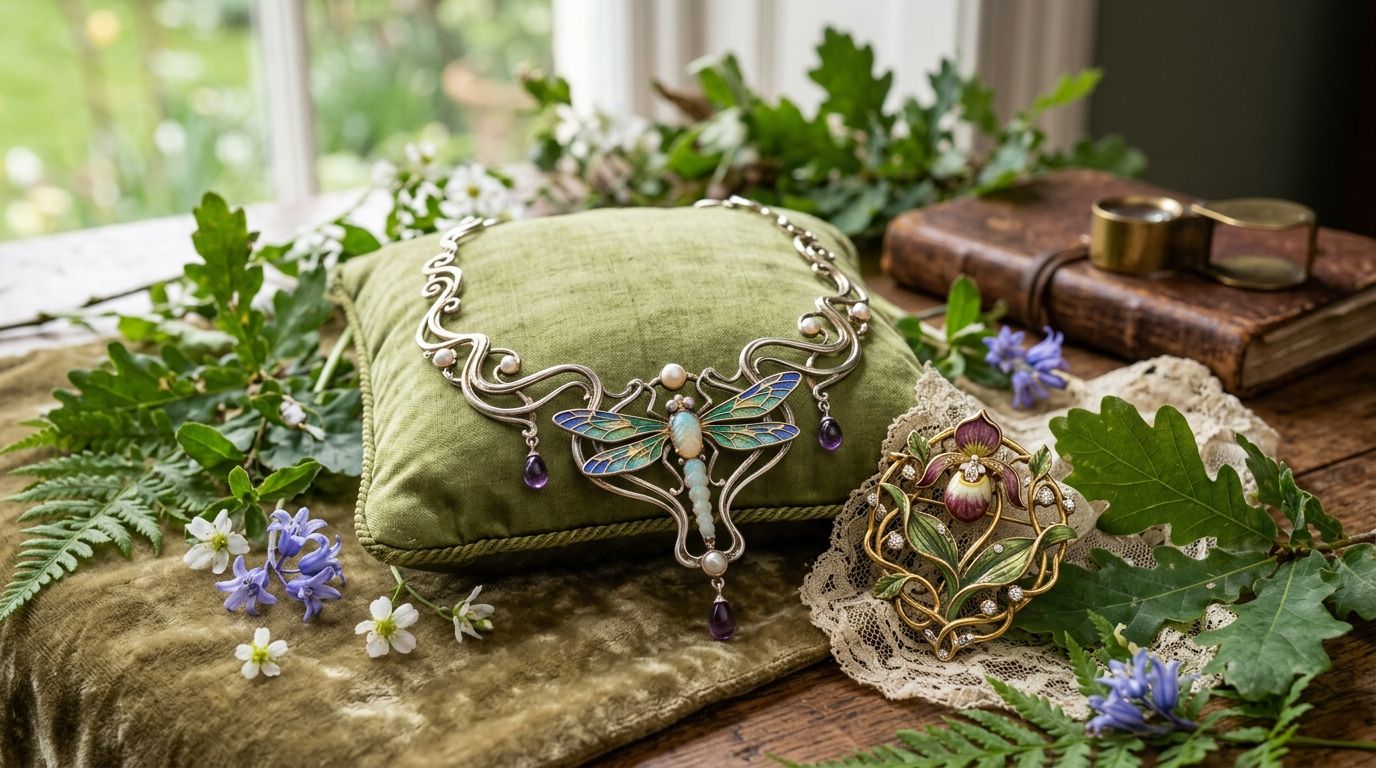
Art Nouveau jewelry for nature-inspired collectors means pieces made roughly between 1890 and 1910 that translate dragonflies, orchids, wisteria, and the female form into gold, enamel, and semi-precious stone — bought today almost entirely through estate sales and specialty auctions rather than retail counters. This segment cares less about carat weight and more about whether the piece captures movement: the whiplash curve, the asymmetry, the sense that metal is growing rather than sitting still.
- Art Nouveau jewelry (1890-1910) is identified by whiplash curves, plique-a-jour enamel, and motifs like dragonflies and orchids rather than by carat weight.
- Moonstone, opal, and horn appear more often in genuine pieces than large faceted diamonds — reversed emphasis is a red flag for reproductions.
- Provenance documentation and maker's marks (Lalique, Gaillard, Vever) matter more for resale value than gemstone grade.
- Set a hard bid ceiling before the auction starts; buyer's premiums routinely add 15-25% on top of the hammer price.
- Jewelryroom.com lists estate Art Nouveau pieces through auction formats with provenance notes attached to each listing.
Why art nouveau jewelry matters for nature-inspired collectors
This segment is buying a design philosophy, not a gemstone spec sheet. Art Nouveau jewelers of the 1890s and 1900s deliberately downgraded diamonds in favor of enamel, horn, glass, and softer stones like moonstone and opal, because the movement's whole point was rejecting the stiff, symmetrical forms that came before it.
That makes the buying calculus different from most estate jewelry categories. A Victorian brooch or an Edwardian tiara gets valued largely on stone quality and metal weight. An Art Nouveau piece gets valued on design integrity, condition of the enamel work, and whether it carries a traceable maker's mark. Collectors chasing this look need a different evaluation checklist than someone shopping Victorian jewelry for a stone-forward piece.
Train your eye for the era's core motifs
Before you place a single bid in 2026, learn to separate genuine Art Nouveau design language from later revival pieces that borrow the look without the intent.
- Look for asymmetrical, flowing lines — true whiplash curves rarely repeat in perfect mirror symmetry
- Check for insect and botanical subjects: dragonflies, peacocks, orchids, wisteria, poppies
- Confirm the female figure motif, when present, shows flowing hair or drapery rather than a static pose
- Note the use of plique-a-jour enamel, translucent enamel set without a metal backing, like stained glass
- Watch for horn and glass alongside gold — period pieces mixed humble and precious materials freely
Inspect materials and stones common to the era
Stone choice is one of the fastest authenticity signals in this category, and it runs opposite to what most jewelry buyers expect.
- Moonstone appears constantly, suited to the era's obsession with moon and water imagery; it is worth comparing against moonstone jewelry for June birthstone buyers to see the stone's range across periods
- Opal shows up often despite its fragility, prized for shifting color rather than clarity
- Amethyst and citrine turn up in softer, muted cuts rather than bright modern brilliant cuts
- Large faceted diamonds are rare as the central focus — a piece dominated by a big solitaire is more likely later or reproduction
- Baroque and freshwater pearls, irregular rather than perfectly round, fit the movement's preference for natural imperfection
Verify the piece's age and maker
A large share of what gets listed as Art Nouveau style online is 1960s-1970s revival work or modern reproduction. Verification separates the two.
- Ask for hallmarks and maker's marks — names like Rene Lalique, Lucien Gaillard, and Henri Vever have documented catalogs you can cross-reference
- Request close-up photos of the reverse side; period settings show hand-finished, slightly uneven backs
- Compare the enamel technique against known plique-a-jour examples, since cold enamel and resin photograph differently under raking light
- Check clasp and pin mechanisms against period hardware styles, since original fittings rarely match later reproduction hardware
- Cross-check the piece against catalog records from auction houses that have sold comparable lots
Set a bidding budget before you shop
Art Nouveau pieces with strong provenance and maker attribution move fast once a bidding war starts, and the final price rarely resembles the opening estimate.
- Decide your absolute ceiling before the auction opens, including buyer's premium, which commonly adds 15-25% to the hammer price
- Separate your budget into design-driven pieces (unsigned but strong motifs) and maker-driven pieces (documented Lalique or Gaillard), because the second group carries a steep premium
- Factor in restoration cost if enamel shows chips or hairline cracks — plique-a-jour repair is a specialist job, not a general jeweler task
- Add a shipping and insurance line separate from the purchase price
- Fix the number in writing before the lot opens, so the ceiling is a decision and not a reaction
Research provenance and auction house reputation
Era authentication only gets you halfway. The paper trail behind the piece and the house selling it matter just as much for resale value later.
- Ask for prior sale records, exhibition history, or family provenance documentation attached to the lot
- Confirm the auction house discloses restoration or repair history in the listing itself, not only on request
- Cross-reference the seller against independent reviews and dispute records before bidding, using the checks in how to verify an auction house's reputation
- Request a condition report specific to the enamel and stone settings, since photos alone hide hairline cracks
- Build your own provenance file as you research, the same discipline covered in researching provenance before an estate jewelry auction
Place your bid strategically
Once the piece is verified and your ceiling is set, execution matters. Late bidding wars on well-documented Art Nouveau lots are common in 2026 because the buyer pool is small but committed.
- Set a proxy bid at your true ceiling rather than chasing the auction in real time
- Watch competing bidder activity on the lot page before committing your maximum
- Track increment size — small jumps near your ceiling usually signal a determined second bidder
- Place your maximum through a proxy bid rather than watching the clock manually
- Walk away at your ceiling; there is always another dragonfly brooch
Plan for insurance and aftercare
A won Art Nouveau lot with plique-a-jour enamel or horn inlay needs different aftercare than a plain gold ring.
- Get a standalone appraisal for insurance rather than relying on the auction estimate
- Store enamel pieces away from temperature swings, since thermal shock is the most common cause of new cracking
- Avoid ultrasonic cleaners entirely on plique-a-jour or opal-set pieces
- Insure the piece before it ships, not after it arrives
- Keep the condition report and provenance file with your insurance documentation
Comparing your buying options in 2026
| Option | Best for | Key limitation |
|---|---|---|
| Specialty jewelry auction (Jewelryroom.com and similar) | Documented estate pieces with provenance notes | Bidding wars push maker-attributed lots well past estimate |
| General estate sale or open marketplace | Budget hunting on unsigned, design-driven pieces | Little authentication support, higher misattribution risk |
| Antique dealer or gallery | Guaranteed authenticity with dealer markup built in | Fixed price, no negotiation, smaller inventory |
| Revival or reproduction retailer | Consistent new-made pieces in the style | Not period-original, no resale value as Art Nouveau |
Verdict: for collectors who want documented, period-original Art Nouveau jewelry rather than stylistic reproductions, a specialty estate auction is the only option here that pairs provenance with competitive pricing — the tradeoff is discipline on your bid ceiling.
Browse current Art Nouveau lots
See active estate listings with provenance and condition notes before you bid.
Common mistakes nature-inspired collectors make
- Chasing motif over maker. A striking dragonfly brooch with no hallmark and no provenance is a design purchase, not an investment. Price it that way.
- Ignoring enamel condition photos. Plique-a-jour hairline cracks are easy to miss in a single listing image and expensive to repair once won.
- Confusing revival pieces for period originals. 1960s-1970s Art Nouveau revival jewelry uses the same motifs with different construction techniques. Verify age, not just style.
- Underbudgeting for buyer's premium. Winning at your ceiling still blows the budget once a 15-25% premium and shipping land on top.
- Skipping insurance until after delivery. Enamel and horn settings are fragile in transit. Insure before the piece ships.
FAQ
What years define Art Nouveau jewelry?
Art Nouveau jewelry dates roughly from 1890 to 1910, sitting between the late Victorian era and early Art Deco. Pieces made later in the same style are classified as revival work, not period-original.
Is Art Nouveau jewelry a good investment in 2026?
Documented, maker-attributed pieces from names like Lalique or Gaillard hold value because supply is fixed and collector demand is steady. Unsigned design-driven pieces carry more resale risk, since value rests on aesthetic appeal rather than provenance.
How can I tell real Art Nouveau jewelry from a reproduction?
Check hallmarks, examine the enamel under raking light for true plique-a-jour, and inspect the reverse for hand-finished, slightly uneven settings. Reproductions copy the motifs but rarely replicate period construction methods.
What stones appear most often in Art Nouveau jewelry?
Moonstone, opal, amethyst, and baroque pearls dominate the era far more than faceted diamonds. A piece centered on a large modern-cut diamond is more likely later work or a reproduction.
Do I need an appraisal before bidding on Art Nouveau jewelry?
Yes, especially for enamel or horn-inlaid pieces where condition drives value. A condition report from the auction house plus an independent appraisal for insurance covers both angles.
How much does a buyer's premium add to an auction win?
Buyer's premiums commonly add 15-25% on top of the hammer price at estate and specialty jewelry auctions. Build that percentage into your bid ceiling before the auction starts.
Are Art Nouveau and Art Deco jewelry the same thing?
No. Art Nouveau favors flowing, asymmetrical nature motifs and enamel work, while Art Deco favors geometric symmetry and calibrated gemstone settings. The two styles sit at opposite ends of the design spectrum despite following each other chronologically.
Can I bid remotely on estate Art Nouveau jewelry?
Most specialty auctions accept proxy bids, letting you set a maximum in advance instead of watching the clock. This is the standard method for collectors bidding on documented lots.
One last thing
The most overlooked detail in this category is not the gold content or the stone grade — it is the reverse side of the piece. Period Art Nouveau settings show hand-finishing marks and slight asymmetry on the back that cast reproductions rarely replicate, because reproduction molds smooth that texture away. Ask for a reverse-side photo before you bid in 2026. A seller who cannot produce one is a bigger warning sign than a missing hallmark.


