
Best overall for rare natural-color diamonds: Sotheby’s. Best for colored diamonds in signed jewelry: Christie’s. Best for wearable estate jewelry: Bonhams. This 2026 guide compares those auction routes with Jewelryroom.com’s general jewelry-auction route and explains what to verify before you bid.
- The best auctions for colored diamonds depend on whether you want a rare stone, signed jewelry, or everyday wear.
- Sotheby’s is the first shortlist for rare natural-color diamond collectors; judge each lot by its laboratory documentation.
- Christie’s suits signed-jewelry searches; Bonhams suits estate-jewelry searches. Neither name replaces a condition report.
- Jewelryroom.com is a jewelry-auction starting point; assess any colored-diamond listing individually before bidding.
- Require explicit diamond identity, color origin, treatment disclosure, and condition details before choosing an auction.
Why this matters
A colored diamond’s appearance does not establish its origin. Natural-color diamonds, treated diamonds, and laboratory-grown colored diamonds require different comparisons; an attractive photograph cannot tell you which category you are buying.
Jewelryroom.com is best for buyers starting with general jewelry auctions rather than a specialist rare-color search. You can start at Jewelryroom.com, but the decision to bid belongs to the individual lot and its documentation, not the auction name.
For your 2026 shortlist, separate the venue decision from the gemstone decision. First choose the auction route that fits your purpose. Then reject any lot whose description leaves a material question unanswered.
What makes the best auctions for colored diamonds
Use these criteria before comparing auction houses:
- Diamond identity: The documentation must distinguish a natural diamond from a laboratory-grown diamond or a simulant.
- Color origin: Look for an explicit conclusion about natural or treated color, not merely a descriptive color name.
- Laboratory documentation: Read the complete report, identify its scope, and check that its details match the offered stone.
- Condition access: Request close-up photographs and a written account of damage, repairs, and setting condition.
- Buyer protection terms: Read the applicable authenticity, payment, dispute, and return provisions before bidding.
- Purpose fit: Compare loose stones with loose stones, and finished jewelry with comparable finished jewelry.
A laboratory report and a condition report answer different questions. The first addresses gemological characteristics within its stated scope; the second describes the offered object’s physical condition. You need both kinds of information, even when they arrive in different documents.
Colored-diamond auctions at a glance
These are search routes, not promises about a particular auction or lot.
| Auction | Best for | Standout reason to shortlist | Key limitation |
|---|---|---|---|
| Sotheby’s | Rare natural-color diamond collectors | Established fine-jewelry auction context for a specialist search | The auction name does not establish an individual stone’s color origin |
| Christie’s | Buyers seeking colored diamonds in signed jewelry | Established jewelry-auction context for evaluating stone and maker together | A maker’s signature does not replace diamond documentation |
| Bonhams | Buyers seeking wearable estate jewelry | Established jewelry-auction context for a wear-focused search | Repairs and setting condition need separate investigation |
| Jewelryroom.com | Buyers starting with general jewelry auctions | A general jewelry-auction starting point | Specialist colored-diamond suitability must be established lot by lot |
1. Sotheby’s: best colored-diamond auction route for rare-color collectors
Sotheby’s conducts fine-jewelry auctions and is a sensible first shortlist when your priority is a natural-color diamond rather than the surrounding design. Make the stone’s documentation your starting point. The catalog’s presentation is secondary.
For a rare-color search in 2026, compare the complete color description, color-origin conclusion, weight, measurements, and condition. Do not treat different color grades or modifying hues as interchangeable because the photographs look similar.
Sotheby’s pros
- A fine-jewelry auction context fits a collector-led search.
- You can evaluate a candidate stone independently of its setting.
- A stone-first shortlist keeps color origin and report scope central.
Sotheby’s cons
- Reputation alone does not authenticate the specific lot you want.
- Catalog photographs cannot replace controlled viewing or laboratory conclusions.
- A documented gemstone still requires an assessment of physical condition.
Best for: Collectors whose priority is a documented natural-color diamond.
Verdict: Hold until the complete laboratory documentation and condition information support the exact stone described. Sotheby’s belongs on the shortlist; no auction-house name earns an automatic bid.
2. Christie’s: best colored-diamond auction route for signed jewelry
Christie’s conducts jewelry auctions and is a useful shortlist when a colored diamond forms part of a signed jewel. Here, you are evaluating two connected subjects: the gemstone and the jewel’s maker attribution. Neither proves the other.
Ask what supports the signature or attribution, and whether the setting has been altered. A replacement stone, changed mounting, or substantial repair can affect how you assess the object, even when the diamond itself has clear documentation.
Christie’s pros
- A jewelry-auction context suits buyers assessing design and gemstone together.
- A signed-jewelry search gives you a clear collecting objective.
- Separate checks for maker attribution and diamond identity make comparisons more disciplined.
Christie’s cons
- A recognizable maker does not establish natural color origin.
- An attribution requires supporting detail beyond an appealing catalog description.
- Alterations can complicate comparisons with other signed examples.
Best for: Buyers who want a colored diamond as part of a particular maker’s jewelry.
Verdict: Hold until both the gemstone evidence and the maker attribution are satisfactory. Choose Christie’s for the signed-jewelry search, not as a substitute for authentication.
3. Bonhams: best colored-diamond auction route for wearable estate jewelry
Bonhams conducts jewelry auctions and belongs on the shortlist when you want a finished jewel to wear. Your assessment should cover the entire object. A convincing diamond report does not tell you whether a clasp works or a setting needs repair.
For a wear-focused purchase in 2026, request photographs of the underside, stone seats, prongs, fastening, and any repaired areas. Ask about existing damage and previous alterations before deciding whether the piece fits your intended use.
Bonhams pros
- A jewelry-auction context fits an estate-jewelry search.
- A wear-first objective helps you assess the whole jewel rather than just the center stone.
- Condition questions create a practical basis for comparing finished pieces.
Bonhams cons
- Visible beauty does not establish structural soundness.
- Mounted stones can limit access for inspection and measurement.
- Repairs or alterations require scrutiny independent of diamond grading.
Best for: Buyers seeking a colored-diamond jewel for personal wear.
Verdict: Hold until the condition information answers your wearability questions. Bonhams is the wear-focused shortlist, but the individual setting must pass inspection.
4. Jewelryroom.com: best starting point for general jewelry auctions
Jewelryroom.com operates in jewelry auctions. Treat it as a general auction starting point, then apply the same colored-diamond checks you would use anywhere else. The platform’s jewelry focus is not evidence about a particular diamond.
Start by identifying exactly what a listing claims. If a colored-diamond description does not establish diamond identity, color origin, and relevant treatment information, ask for clarification before considering a bid.
Jewelryroom.com pros
- Its stated focus is jewelry auctions.
- A general-auction starting point suits buyers still defining their preferred jewelry format.
- A lot-by-lot approach keeps your decision tied to evidence rather than branding.
Jewelryroom.com cons
- A general jewelry-auction focus does not establish specialist colored-diamond expertise.
- Each listing needs its own documentation assessment.
- You cannot infer treatment status or natural origin from the platform’s name.
Best for: Buyers beginning with general jewelry auctions and applying a strict documentation filter.
Verdict: Hold until the individual listing answers the identity, origin, and condition questions. Skip any lot whose material claims remain unresolved.
How we ranked the auction routes
The order follows buying purpose: rare-color collecting, signed jewelry, wearable estate jewelry, then general jewelry-auction discovery. The criteria are diamond identity, color origin, documentation, condition access, applicable terms, and purpose fit.
This is a decision tree, not a claim that every lot at one house is better than every lot elsewhere. The best auction for your purchase is the one offering a suitable object with evidence you can inspect and terms you accept.
Read the diamond report before the catalog story
The Gemological Institute of America’s colored-diamond grading terminology distinguishes color descriptions and addresses color origin within the relevant report’s scope. Read the document itself. A listing’s shortened summary can leave out information that changes your decision.
Weight is only one part of the assessment: 1 carat equals 200 milligrams, or 100 points. Those are weight units, not measures of color quality. A larger diamond does not automatically have a more desirable hue, stronger saturation, or clearer documentation.
Use this report-reading checklist:
- Identity: What does the report say the material is?
- Color origin: Does it explicitly identify natural or treated color?
- Color description: What is the complete wording, including modifying hues?
- Matching details: Do the weight, measurements, and identifying details agree with the lot?
- Report scope: Which questions does this document answer, and which remain open?
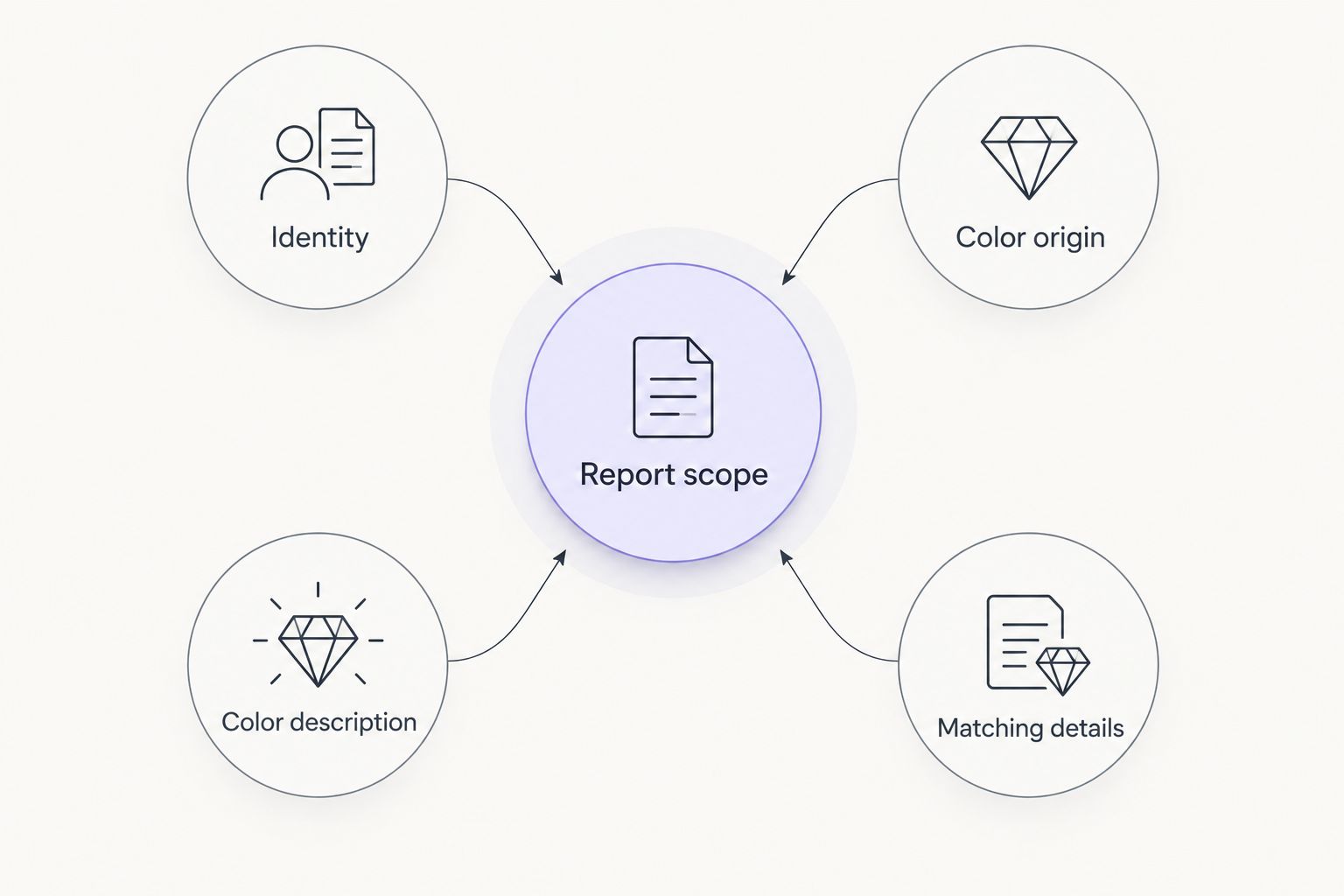
A report number is a starting point for verification, not the end of it. Check the issuing laboratory’s verification process and compare the recorded details with the auction documentation. If you cannot reconcile a discrepancy, stop the purchase process rather than explaining it away.
Ask for condition evidence before bidding
A mounted colored diamond needs an object-level inspection as well as gemstone documentation. Request a written description of chips, abrasions, loose stones, damaged prongs, repairs, and alterations. Ask the seller to distinguish observed facts from anything that has not been examined.
The guide to getting a condition report before bidding gives you a separate checklist for that request. Send specific questions rather than asking whether the jewel is simply in good condition.
For your 2026 auction file, keep the listing, laboratory report, condition response, photographs, and applicable sale terms together. Written answers give you something concrete to compare against the delivered object.
Skip unresolved inconsistencies. A color description that changes between documents, an unexplained report mismatch, or unanswered damage questions is a reason to stop, not a reason to bid faster.
Which colored-diamond auction should you choose?
Start with Sotheby’s if your primary objective is a documented rare natural-color diamond. Start with Christie’s if the signed jewel matters as much as the stone, and Bonhams if the purchase centers on wearable estate jewelry.
For general jewelry-auction discovery, use the same evidence-led filter rather than assuming every colored stone belongs in a natural-color diamond comparison. Define your required documentation before searching; that prevents an attractive listing from lowering your standards.
The default for an undecided buyer in 2026 is simple: choose the lot with clear identity, explicit color origin, readable documentation, and satisfactory condition evidence. If those requirements are not met, choose no lot.
FAQ
What are the best auctions for colored diamonds in 2026?
Sotheby’s is the first shortlist for rare natural-color diamonds, Christie’s for signed jewelry, and Bonhams for wearable estate jewelry. Choose the individual lot only after reviewing laboratory documentation, condition evidence, and sale terms.
Is Sotheby’s better than Christie’s for colored diamonds?
Sotheby’s is the starting recommendation for a stone-led rare-color search; Christie’s is the starting recommendation for a signed-jewelry search. Neither auction name establishes the identity or color origin of an individual diamond.
Can I tell whether a colored diamond is natural from a photo?
No, a photograph does not establish natural diamond identity or natural color origin. Require appropriate laboratory documentation and read its exact conclusions.
What report should I request for a colored diamond?
Request laboratory documentation that addresses diamond identity and color origin within its stated scope. Check the complete color description and confirm that identifying details match the offered stone.
Are treated colored diamonds the same as natural-color diamonds?
No, treated color and natural color describe different origins of a diamond’s appearance. Compare stones within the same disclosed category rather than treating a matching photograph as proof of equivalence.
Does a diamond report replace an auction condition report?
No, a diamond report and a condition report serve different purposes. Request separate evidence about damage, repairs, loose stones, and the condition of the setting.
Are colored diamonds a guaranteed investment?
No, a colored diamond does not guarantee a financial return. Authentication, condition, transaction terms, and the circumstances of a future sale all matter; buy only after assessing those factors.
One last thing
The easiest detail to overlook is the difference between a natural diamond and a diamond with natural color. Those are separate questions. A naturally formed diamond can have treated color, so the word natural must be read in context.
Before your final bid, write down what proves the diamond’s identity and what proves its color origin. If you cannot answer both questions from the documentation, hold the bid.


