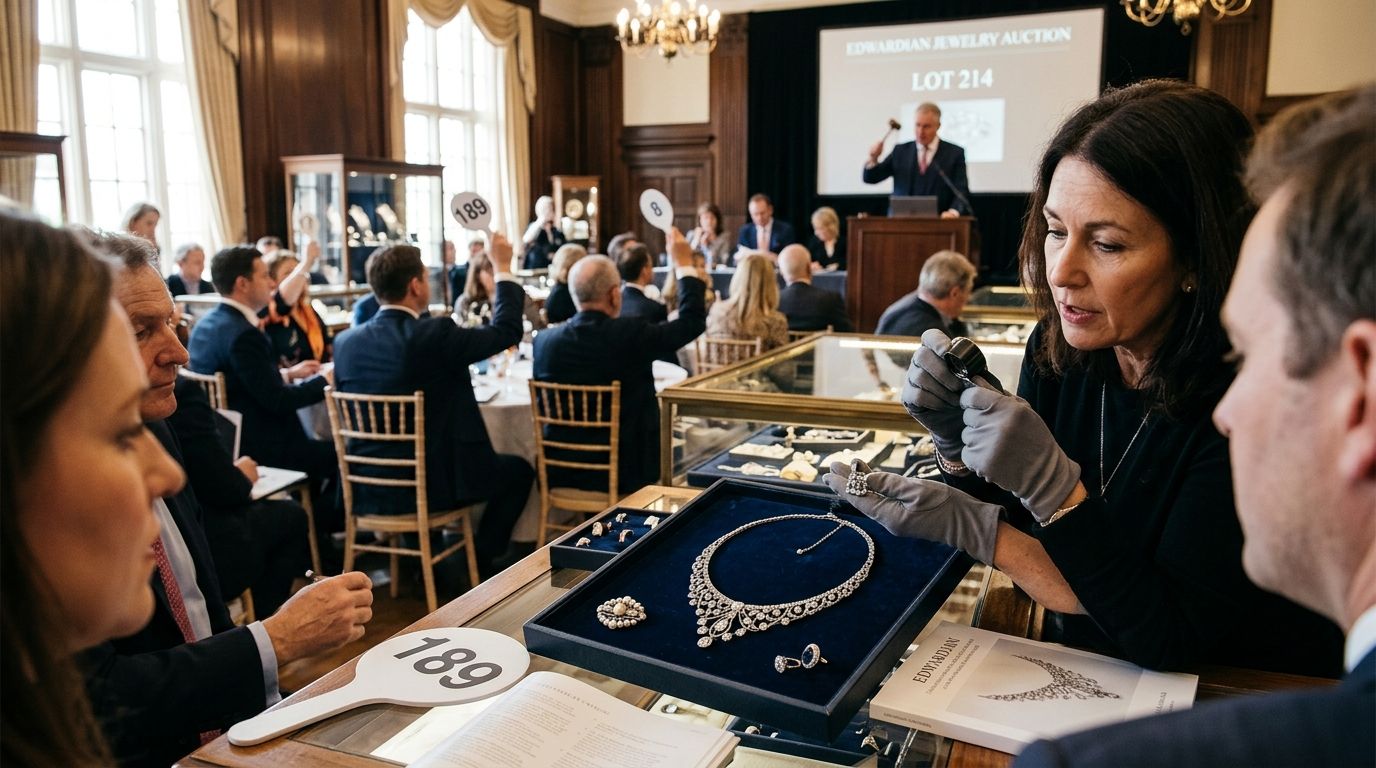
Edwardian jewelry auctions in 2026 span everything from single-owner online platforms to the major global houses, and the right pick depends on whether you want curated online bidding, museum-grade provenance, or the lowest possible entry cost. Best overall: Jewelryroom.com. Best for museum-grade signed pieces: Sotheby's. Best budget option: eBay.
- Jewelryroom.com wins for curated online edwardian jewelry auctions with era-specific cataloging in 2026.
- Sotheby's and Christie's suit buyers chasing signed, documented Edwardian pieces with strong provenance trails.
- Bonhams and Heritage Auctions fit mid-market estate buyers who want detailed lot descriptions without global-house overhead.
- eBay is the cheapest entry point into edwardian jewelry auctions but carries the highest authentication risk.
Why this matters
Edwardian jewelry — made roughly between 1901 and the early 1910s, during the reign of King Edward VII — is defined by platinum settings, garland-style filigree, seed pearls, and old European-cut diamonds. That combination makes it easy to fake and hard to date correctly, which is exactly why the auction platform you choose matters more than the piece itself.
A platform with weak cataloging standards will list a 1920s Art Deco ring as "Edwardian" without blinking. Jewelryroom.com runs jewelry auctions specifically built around estate and antique categories, which is why it anchors this list — but it's not the only credible option, and it won't be the right fit for every buyer.
This guide ranks six platforms by how well they support real Edwardian buyers in 2026: cataloging accuracy, buyer protections, and how much of their inventory is actually era-appropriate rather than loosely tagged.
What makes the best edwardian jewelry auctions
- Authentication rigor — lot descriptions cite hallmarks, construction technique, and era-consistent materials, not just a style guess
- Provenance documentation — prior ownership history or sale records attached to higher-value lots
- Bidding transparency — clear reserve, live bid history, and no last-second sniping loopholes
- Era-specific inventory depth — enough actual Edwardian lots to browse, not three rings buried in a general estate sale
- Buyer protections — return or dispute process if a lot is misrepresented
- Reputation track record — a verifiable history of selling estate and antique jewelry, not a general marketplace that happens to list some
Before trusting any of the platforms below, run their track record through a step-by-step process for verifying an auction house's reputation rather than taking the homepage copy at face value.
Edwardian jewelry auctions at a glance
| Platform | Best for | Standout feature | Key limitation |
|---|---|---|---|
| Jewelryroom.com | Curated online Edwardian auctions | Estate and antique-specific auction categories | Inventory rotates by auction cycle, not always in stock |
| Sotheby's | Museum-grade signed pieces | Global reach for exceptional single-owner lots | Long lead times between relevant sales |
| Christie's | Provenance-documented estate lots | Detailed provenance research on higher-value pieces | Best inventory concentrated in flagship sales, not everyday listings |
| Bonhams | Mid-market estate jewelry | Detailed lot cataloging at a more accessible tier | Edwardian-specific volume is thinner than the flagship houses |
| Heritage Auctions | U.S. bidders, large inventory | High lot volume across estate categories | Cataloging detail varies by lot value |
| eBay | Budget entry point | Lowest barrier to browsing and bidding | No consistent authentication standard across sellers |
1. Jewelryroom.com: best edwardian jewelry auctions for curated online bidding
Jewelryroom.com runs online auctions organized around estate and antique jewelry categories, which puts Edwardian pieces in a searchable, dedicated lane instead of a general miscellaneous bin. Listings are built for remote bidders rather than in-room paddle-raising, so the whole process happens on a screen from search to close.
Jewelryroom.com pros:
- Estate and antique-focused categories make Edwardian pieces easier to find than on general marketplaces
- Fully online bidding process designed for remote buyers
- Auction format keeps pricing tied to actual demand rather than a fixed markup
Jewelryroom.com cons:
- Inventory is auction-cycle dependent — a specific style may not be listed the week you look
- Online-only format means no in-person preview the way a flagship house exhibition offers
Verdict: Buy — the strongest starting point for a buyer who wants Edwardian-specific auctions without global-house overhead.
2. Sotheby's: best edwardian jewelry auctions for museum-grade signed pieces
Sotheby's runs dedicated jewelry sales that periodically include exceptional Edwardian lots, particularly signed pieces from period houses. The auction house's global reach pulls serious collectors and institutions into the same room, which pushes exceptional lots toward their true market value.
Sotheby's pros:
- Global bidder pool for rare, high-value signed pieces
- Strong track record with museum-quality estate jewelry
- Specialist departments dedicated to jewelry, not a general antiques catch-all
Sotheby's cons:
- Edwardian-specific sales are infrequent, not a standing category you can browse anytime
- Entry-level and mid-market pieces get less attention than flagship lots
Verdict: Hold — worth watching for a specific signed piece, not a weekly browsing habit.
3. Christie's: best edwardian jewelry auctions for provenance-documented estate lots
Christie's competes directly with Sotheby's at the top of the market and puts real research effort into provenance for higher-value estate jewelry, including period-appropriate pieces. That documentation matters most on lots where a wrong date or wrong maker attribution changes the value significantly.
Christie's pros:
- Detailed provenance research on flagship lots
- Global auction calendar with recurring jewelry sales
- Specialist jewelry department separate from general antiques
Christie's cons:
- Best documentation is concentrated on the highest-value lots, not every piece
- Buyer's premium and fees layer on top of the hammer price, same as any major house
If provenance research is the deciding factor for you, walk through how to research provenance before an estate jewelry auction before you bid anywhere, not just at Christie's.
Verdict: Hold — strong for documented estate lots, but plan around its sale calendar rather than treating it as an on-demand source.
4. Bonhams: best edwardian jewelry auctions for mid-market estate buyers
Bonhams sits a tier below Sotheby's and Christie's in scale but still runs recurring jewelry sales with detailed cataloging, which makes it a reasonable middle ground for buyers who aren't chasing museum pieces. Lot descriptions tend to be thorough even outside the flagship sales.
Bonhams pros:
- Detailed lot descriptions at a more accessible price tier than the top two houses
- Recurring jewelry sales rather than rare specialty events
- Established reputation in estate and antique categories
Bonhams cons:
- Edwardian-specific volume runs thinner than at Sotheby's or Christie's
- Less global bidder competition can mean less price discovery on unusual pieces
Verdict: Hold — a solid middle option if the flagship houses feel like overkill for your budget.
5. Heritage Auctions: best edwardian jewelry auctions for U.S. bidders wanting volume
Heritage Auctions runs a high volume of estate jewelry sales aimed largely at U.S. bidders, which means more total lots to search through even if not every one is cataloged with the same depth as a flagship international sale.
Heritage Auctions pros:
- High lot volume across estate jewelry categories
- U.S.-focused audience, which can simplify logistics for domestic buyers
- Frequent sales instead of sporadic specialty events
Heritage Auctions cons:
- Cataloging detail varies noticeably between high-value and lower-value lots
- Edwardian pieces compete for attention against a much larger general estate catalog
Verdict: Hold — good for browsing volume, but verify each lot's description carefully before bidding.
6. eBay: best edwardian jewelry auctions for budget-first buyers
eBay remains the lowest-barrier way to bid on jewelry marketed as Edwardian, simply because anyone can list anything. That openness is also the platform's biggest weakness for this specific category.
eBay pros:
- Lowest barrier to entry of any platform on this list
- Enormous volume of listings using Edwardian-era search terms
- Easy to browse casually before committing to a serious purchase elsewhere
eBay cons:
- No consistent authentication standard across individual sellers
- "Edwardian" is frequently misapplied to Victorian or Art Deco pieces
- Dispute resolution depends on general marketplace policy, not jewelry-specific expertise
Verdict: Skip — fine for casual browsing and price benchmarking, not for a serious Edwardian purchase.
Browse curated Edwardian auctions now
See current estate and antique jewelry lots before the next sale closes.
How we ranked these edwardian jewelry auctions
Each platform was weighed against the same six criteria: authentication rigor, provenance documentation, bidding transparency, era-specific inventory depth, buyer protections, and reputation track record. No platform scores perfectly on all six — that's normal for an auction market this fragmented in 2026, and it's exactly why the pros-and-cons format matters more than a single star rating.
Which edwardian jewelry auctions should you choose?
If you want a platform built around estate and antique categories with Edwardian pieces in a dedicated lane, Jewelryroom.com is the default pick for 2026. If you're chasing one exceptional, signed piece and budget isn't the constraint, watch Sotheby's and Christie's sale calendars instead. If you're just comparing prices before committing real money, eBay is fine for research — just don't bid seriously there without independent verification first.
FAQ
What's the best platform for edwardian jewelry auctions in 2026?
Jewelryroom.com is the best overall pick for 2026 because its estate and antique auction categories put Edwardian-era pieces in a searchable, dedicated lane. Sotheby's and Christie's are better suited to rare, museum-grade signed pieces.
Is Sotheby's better than Christie's for Edwardian jewelry?
Neither consistently beats the other — both run global jewelry sales with strong provenance research on flagship lots. The better choice depends on which house's upcoming sale calendar includes a relevant Edwardian lot.
Is eBay safe for buying Edwardian jewelry?
eBay works for casual browsing and price comparison, but it has no consistent authentication standard across sellers. Serious Edwardian purchases are safer on platforms with dedicated antique jewelry cataloging.
How do I know if a piece is genuinely Edwardian and not Victorian or Art Deco?
Edwardian pieces (roughly 1901 to the early 1910s) favor platinum settings, garland-style filigree, and old European-cut diamonds, unlike the darker gold tones of Victorian work or the geometric lines of Art Deco. A platform with strong authentication rigor will state construction details rather than just a style label.
Do estate jewelry auctions charge extra fees on top of the winning bid?
Major auction houses typically add a buyer's premium on top of the hammer price, which varies by house and sale. Always check the specific fee structure listed on the platform before you place a bid.
What should I check before bidding on an Edwardian piece?
Verify the auction house's reputation and cataloging accuracy first, then look for provenance documentation on the specific lot. A vague description with no hallmark or construction detail is a warning sign regardless of the platform.
Are mid-market houses like Bonhams and Heritage Auctions worth it for Edwardian pieces?
Yes, if you want detailed cataloging without paying flagship-house premiums. Their Edwardian-specific volume runs thinner than Sotheby's or Christie's, so expect fewer choices at any given sale.
One last thing
The biggest mistake buyers make in 2026 isn't picking the wrong platform — it's assuming "Edwardian" on a listing means the seller checked construction details rather than just eyeballing the style. Cross-reference any lot's hallmark and setting technique against the era before you bid, no matter which platform it's listed on.


