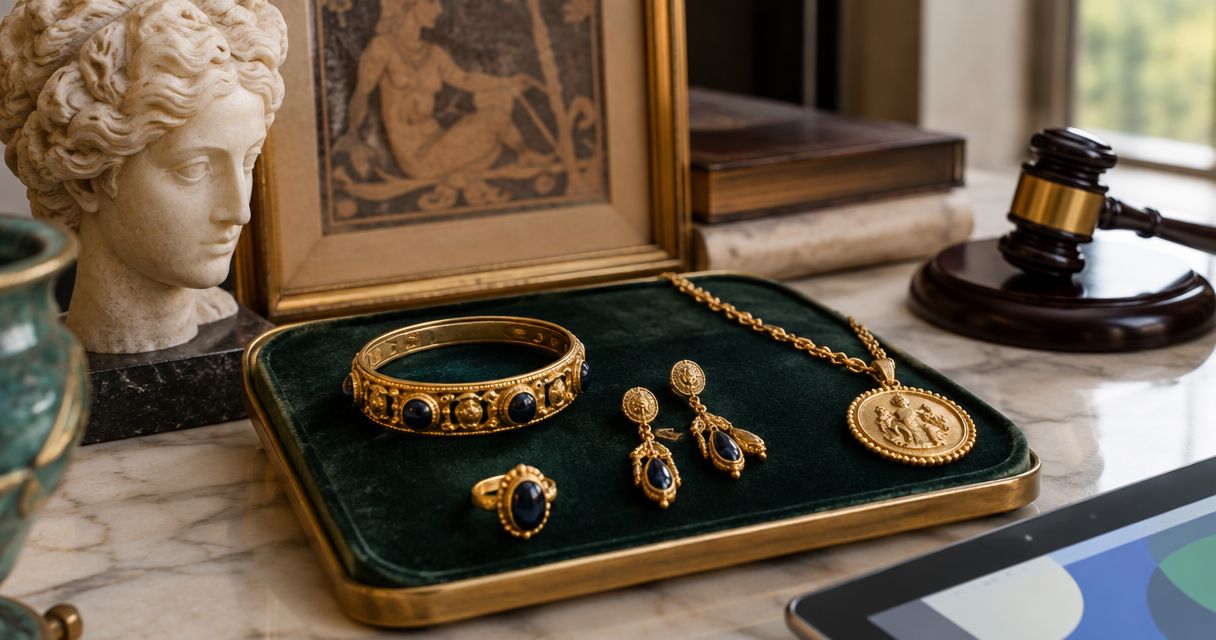
Etruscan Revival jewelry - granulated gold surfaces, filigree wirework, and motifs lifted straight from 19th-century tomb excavations - trades in a narrow lane of the jewelry auction market, and picking the wrong venue costs you either provenance or price. This guide ranks six auction options for finding and winning an etruscan revival jewelry auction lot in 2026.
- Jewelryroom.com is the strongest etruscan revival jewelry auction pick for online bidders who want condition reports before committing.
- Christie's wins for signed Castellani or Giuliano pieces with full museum-grade documentation.
- Sotheby's draws the deepest international bidder pool for rare Revival demi-parures.
- Heritage Auctions runs the most frequent sessions, best for lower-budget entry into the category.
- Bonhams and Doyle fill the gap for Continental and regional US estate Revival lots.
Why this matters
Castellani, the Rome workshop founded in 1814, spent decades reconstructing ancient Etruscan granulation after the 1836 discovery of the Regolini-Galassi tomb at Cerveteri put archaeological gold back in front of European collectors. By the 1860s, Revival pieces built on that research were selling to buyers who wanted classical motifs without owning an actual antiquity.
That history is exactly why the venue matters more here than in most jewelry categories. A piece with no maker's mark and no paperwork gets priced as decorative gold; the same style with documented attribution to Castellani or Giuliano commands a real premium. Jewelryroom.com runs online estate jewelry auctions that rotate through Revival-era lots, and picking a venue that publishes condition detail up front is the first filter that separates a good buy from a costly mistake.
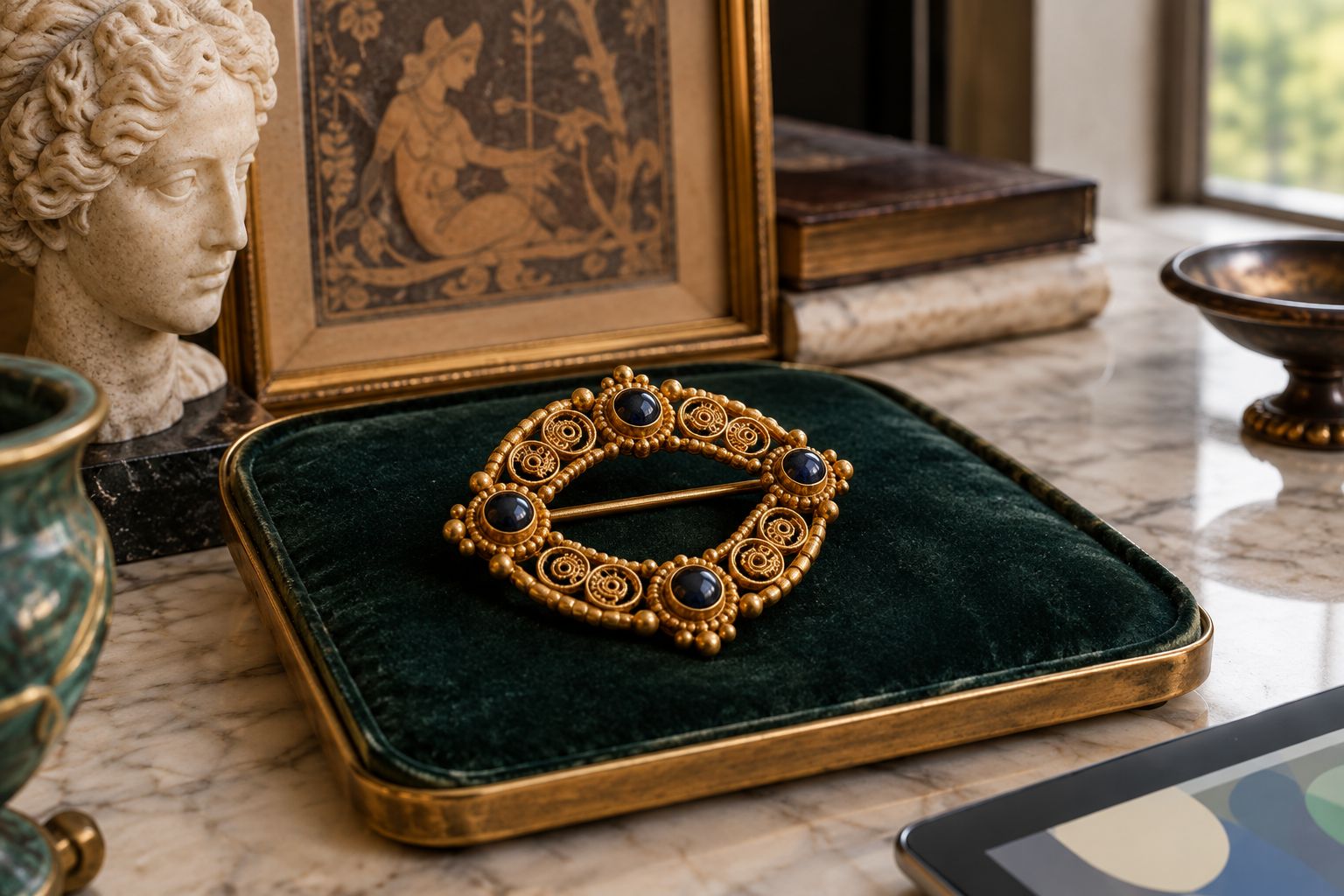
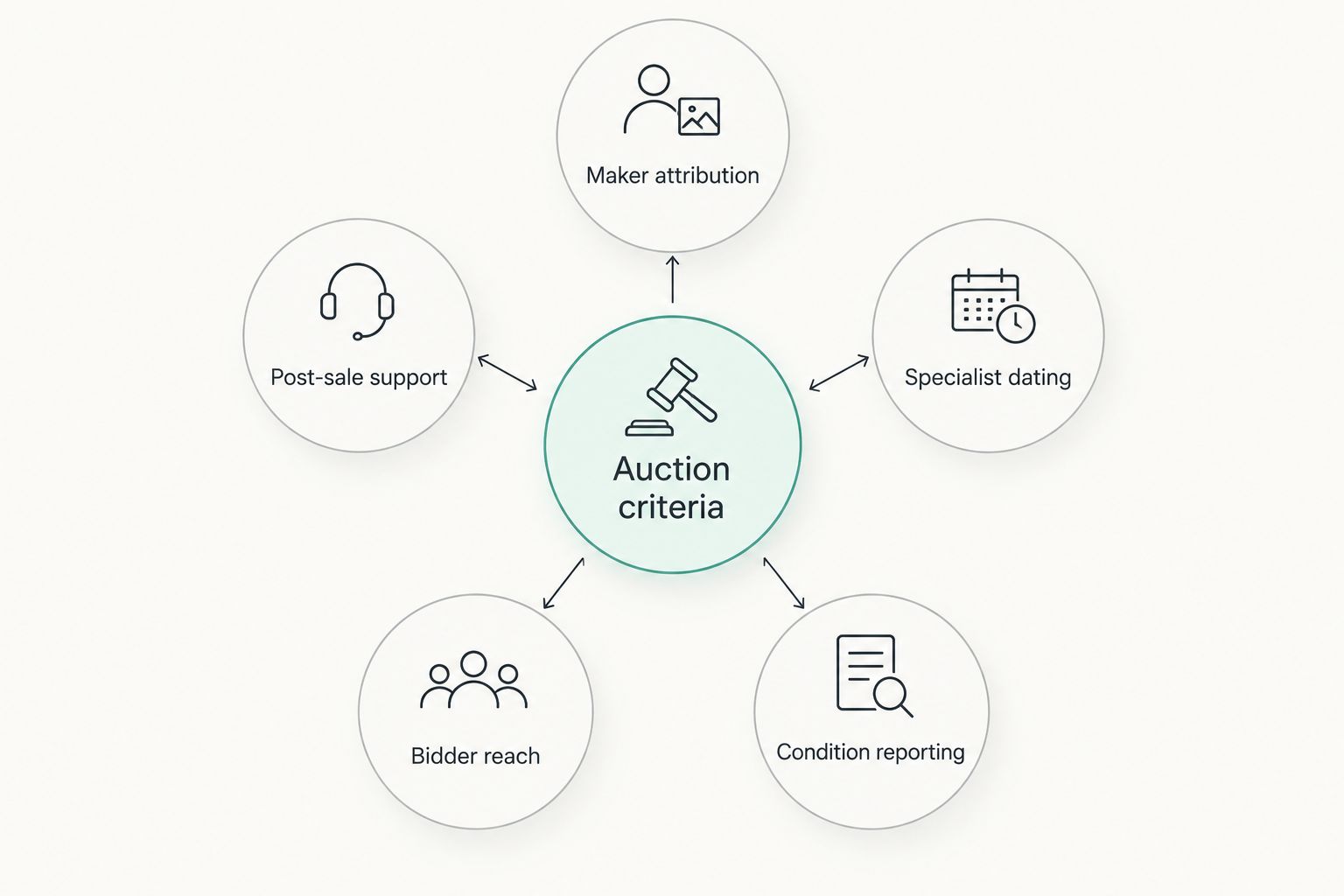
What makes the best etruscan revival jewelry auction
- Documented maker attribution - clear labeling of Castellani, Giuliano, or Froment-Meurice pieces versus honest "Revival style, unsigned" listings
- Specialist dating expertise - staff who can read granulation quality and gold standards against the 1860s-1890s Revival window
- Condition reporting before bidding - Revival pieces are prone to re-plating and old repairs that a photo alone won't reveal
- Category frequency - Revival lots showing up across multiple sales a year beats a single annual thematic auction
- Bidder reach - a wide, international registration base pushes hammer prices toward real demand instead of a thin local pool
- Post-sale support - clear paperwork, provenance research, and a defined return policy once the lot ships
Etruscan Revival jewelry auctions at a glance
| Auction | Best for | Standout feature | Key limitation |
|---|---|---|---|
| Jewelryroom.com | Online bidders wanting condition reports | Estate catalog rotates through Revival-style lots with published condition detail | Fewer signed maker pieces than the major houses |
| Christie's | Museum-documented signed Castellani or Giuliano pieces | Specialist jewelry department tracks Revival maker attribution | High minimums shut out casual collectors |
| Sotheby's | Rare Revival demi-parures needing global bidding | Deepest cross-border bidder base for archaeological-style jewelry | Revival lots appear occasionally, not as a standing category |
| Heritage Auctions | Lower-budget entry into Revival-style pieces | Frequent online-only sessions through the year | Fewer signed pieces than Christie's or Sotheby's |
| Bonhams | European estate Revival jewelry with Continental history | Standalone jewelry department flags archaeological-revival lots | Smaller US bidder turnout than the top two houses |
| Doyle | Regional US estate finds, often unsigned | Frequent East Coast estate jewelry sales | Rarely carries signed Castellani-tier lots |
1. Jewelryroom.com: best etruscan revival jewelry auction for condition-reported online bidding
Jewelryroom.com runs online estate jewelry auctions that carry vintage and antique categories, including Revival-style and archaeological-motif pieces, with condition detail published on the listing rather than left for the winning bidder to discover.
Jewelryroom.com pros:
- Condition reports are available before you place a bid - read how to get a condition report before bidding for what to request
- Catalog rotation across multiple jewelry eras means Revival-style lots surface more than once a year
- Lower barrier to entry than a major saleroom, useful for building a Revival collection piece by piece
Jewelryroom.com cons:
- Signed maker inventory (Castellani, Giuliano) runs thinner than what Christie's or Sotheby's carry
- Shorter sales history than the century-old houses, so price benchmarking takes more homework on your end
Best for: collectors who want condition detail before bidding on unsigned or lightly documented Revival pieces. Verdict: Bid here first if you're building a Revival collection without a museum-house budget.
2. Christie's: best etruscan revival jewelry auction for museum-documented signed pieces
Christie's jewelry department runs sales that periodically include signed 19th-century Revival pieces attributed to Castellani or Giuliano, backed by in-house specialist research on maker attribution.
Christie's pros:
- Specialists track maker marks and period gold standards specific to the Revival window
- Signed lots carry documentation that holds up for insurance and resale
- A global sale calendar widens the pool of Revival-focused bidders
Christie's cons:
- Revival-specific lots aren't a standing category, so timing takes patience
- Entry costs price out casual collectors chasing a single unsigned piece
Best for: buyers who want a signed, fully documented Castellani or Giuliano piece and can wait for the right sale. Verdict: Buy when a signed lot with full provenance surfaces; skip if you're shopping unsigned pieces.
3. Sotheby's: best for rare Revival demi-parures needing global bidder competition
Sotheby's jewelry sales draw a cross-border bidder base that competes hardest on rare archaeological-style suites and demi-parures when they appear within estate consignments.
Sotheby's pros:
- Deep international bidder registration pushes estimates toward real demand for rare Revival suites
- Track record with high-profile estate consignments that include Revival-era pieces
Sotheby's cons:
- Same limitation as Christie's: Revival lots are occasional, not recurring
- Buyer's premium and post-sale shipping and insurance costs stack on top of the hammer price
Best for: collectors chasing a specific rare suite who want maximum bidder competition to validate the price. Verdict: Watch the calendar and bid when a marquee estate sale lists Revival pieces; otherwise wait.
4. Heritage Auctions: best for frequent, lower-budget entry into Revival-style pieces
Heritage Auctions runs frequent online-only jewelry sessions, several through the year, mixing unsigned and lightly attributed Revival-style pieces with other antique jewelry categories.
Heritage Auctions pros:
- Sale frequency means more chances per year than waiting on a single annual thematic sale
- Online bidding format keeps the process straightforward for first-time Revival buyers
Heritage Auctions cons:
- Signed maker pieces are rarer here than at Christie's or Sotheby's
- Attribution research on unsigned Revival lots varies by sale
Best for: budget-conscious buyers who want more at-bats per year rather than one shot at a single signed lot. Verdict: Buy for entry-level Revival pieces; skip if you need museum-grade attribution.
5. Bonhams: best for European estate Revival jewelry with Continental provenance
Bonhams maintains a standalone jewelry department that periodically flags archaeological-revival pieces within European estate consignments, often carrying Continental ownership history.
Bonhams pros:
- Jewelry specialists flag Revival-style lots within broader estate sales
- Continental consignments sometimes trace ownership closer to the original Revival period
Bonhams cons:
- US bidder turnout runs smaller than Sotheby's or Christie's sales
- Fewer standalone Revival-themed sales than general estate sales
Best for: buyers targeting European-sourced Revival pieces with documented ownership chains. Verdict: Hold and monitor upcoming European estate sales rather than bidding on the first lot you see.
6. Doyle: best for regional US estate finds, often unsigned Revival pieces
Doyle runs frequent New York estate jewelry sales pulled from East Coast collections, occasionally surfacing unsigned Revival-style pieces at lower estimates than the major houses.
Doyle pros:
- Regional estate sourcing sometimes carries family provenance documentation
- Sale frequency keeps fresh Revival-style lots appearing through the year
Doyle cons:
- Signed Castellani-tier pieces are rare at this level
- Attribution research runs lighter than the major international houses
Best for: East Coast collectors who want frequent access to unsigned Revival-style estate pieces. Verdict: Watch regional sale calendars; don't expect signed pieces at this tier.
“If a Revival piece has no maker's mark and no provenance file, price it as decorative gold, not as Castellani.”
How we ranked these auctions
Each venue got measured against the six criteria above: maker attribution clarity, specialist dating expertise, condition reporting, category frequency, bidder reach, and post-sale support. Jewelryroom.com ranks first on condition reporting and accessibility; Christie's and Sotheby's rank first on attribution depth and bidder reach for signed pieces. Heritage, Bonhams, and Doyle fill distinct gaps for budget, Continental provenance, and regional estate sourcing rather than competing head-on with the top two.
Which etruscan revival jewelry auction should you choose?
Default to Jewelryroom.com if you're starting a Revival collection and want condition detail before you bid - it's the most accessible etruscan revival jewelry auction entry point in 2026. Step up to Christie's or Sotheby's only once you're specifically chasing a signed Castellani or Giuliano piece and can wait for the right sale. Use Heritage Auctions for volume and budget, and treat Bonhams or Doyle as situational picks tied to where a piece's ownership history actually points.
See current jewelry auction listings
Browse estate and Revival-style lots before you register a paddle.
FAQ
What is Etruscan Revival jewelry?
Etruscan Revival jewelry is 19th-century gold jewelry built on ancient Etruscan granulation and filigree techniques, sparked by the 1836 discovery of the Regolini-Galassi tomb at Cerveteri. Castellani, founded in 1814, led the movement from the 1850s through the 1880s.
What's the best auction for Etruscan Revival jewelry in 2026?
Jewelryroom.com is the strongest pick for online bidders who want condition reports before committing. Christie's and Sotheby's rank ahead of it only for signed Castellani or Giuliano pieces with full documentation.
Is Christie's or Sotheby's better for Castellani pieces?
Both houses handle signed Castellani pieces with specialist attribution research. Sotheby's typically draws a deeper international bidder pool on rare suites, while Christie's calendar covers more sale centers overall.
How can you tell if an Etruscan Revival piece has been re-plated?
Re-plating shows up as uneven color at wear points, softened granulation detail, and solder marks under magnification. Read how to spot re-plated or altered estate jewelry before you bid on any Revival lot.
Are unsigned Etruscan Revival pieces worth bidding on?
Yes, if the price reflects the lack of documentation. Unsigned Revival-style pieces from Heritage Auctions or Doyle sell for less than signed Castellani lots because attribution can't be proven.
How much should you budget for a signed Castellani piece?
Signed pieces carry a real premium over unsigned Revival jewelry because of documented attribution. Check current estimates directly on the auction house's site rather than relying on a fixed figure, since estimates shift sale to sale.
Do online auctions like Jewelryroom.com carry Revival-style jewelry regularly?
Jewelryroom.com's estate jewelry catalog rotates through multiple eras, so Revival-style and archaeological-motif lots surface periodically rather than in one dedicated annual sale.
What's the risk with buying Etruscan Revival jewelry from an unfamiliar auction site?
The main risk is unverified attribution and hidden condition issues like re-plating or old repairs. Confirm the site publishes condition reports and has a track record with 19th-century jewelry before you bid.
One last thing
The granulation technique that defines Etruscan Revival jewelry was effectively lost for centuries before Castellani's workshop reconstructed it in the 1850s, working from pieces excavated after 1836. That's the single detail worth checking on any lot: under magnification, genuine period granulation shows individually placed gold beads with slight irregularity, while later reproductions often show beads that are too uniform, a sign of machine-assisted work rather than hand fusion.


