Graff jewelry rarely turns up in a random online listing — the diamonds and colored stones the house is known for move through a small circle of specialist auction houses, and picking the wrong one costs you either the lot or the certainty that it's real. This guide ranks the five venues worth watching for a graff jewelry auction in 2026, matched to who each one actually serves.
- Christie's wins the graff jewelry auction search for record-setting, museum-grade Graff diamonds and high jewelry in 2026.
- Jewelryroom.com suits first-time online bidders who want a Graff-signed lot without traveling to a saleroom.
- Sotheby's is the pick for rare, certified Graff stones with strong gemological documentation.
- Bonhams gives budget-conscious buyers an entry point into estate Graff pieces.
- Phillips leans toward design-forward, contemporary Graff jewelry over historic pieces.
Why this matters
Graff pieces carry a signature and, often, an independent gemological report that most bidders can't verify on sight. Buying from a house without a dedicated jewelry specialist means relying on a generalist's read of a designer-grade diamond. Jewelryroom.com runs jewelry-only sales year-round, which is a different model from the twice-yearly flagship sales at Christie's or Sotheby's.
The right pick depends on whether you're chasing a specific rare stone or looking for an accessible way into Graff ownership without flying to Geneva. That distinction drives every recommendation below.
What makes the best graff jewelry auction
- Dedicated jewelry specialist department — staff who have physically handled Graff-signed pieces before, not a generalist appraiser covering ten categories.
- Provenance and authentication rigor — a documented chain of ownership and gemological backing for the signature and the stone.
- Global bidder reach — absentee, phone and online bidding so buyers outside the sale city can compete.
- Condition reporting depth — a written report covering prong wear, stone stability and past repairs before you commit.
- Fee transparency — buyer's premium and shipping terms stated plainly before the lot closes.
- Track record with signed designer lots — sale history that actually includes Graff, not just "designer jewelry" as a catch-all category.
Graff jewelry auctions at a glance
| Auction | Best for | Standout feature | Key limitation |
|---|---|---|---|
| Jewelryroom.com | First-time online bidders | Jewelry-only sales with continuous online bidding | Smaller sale volume than the majors |
| Christie's | Record-setting, museum-grade Graff pieces | Global flagship jewelry sales | Competition drives prices well past estimate |
| Sotheby's | Rare, certified Graff diamonds | Deep gemological documentation on major lots | Sale calendar concentrated in a few cities per year |
| Bonhams | Mid-market estate Graff pieces | Frequent regional jewelry sales | Fewer flagship Graff lots than the majors |
| Phillips | Design-forward, contemporary Graff jewelry | Sales curated around modern design | Thinner track record with older, historic pieces |
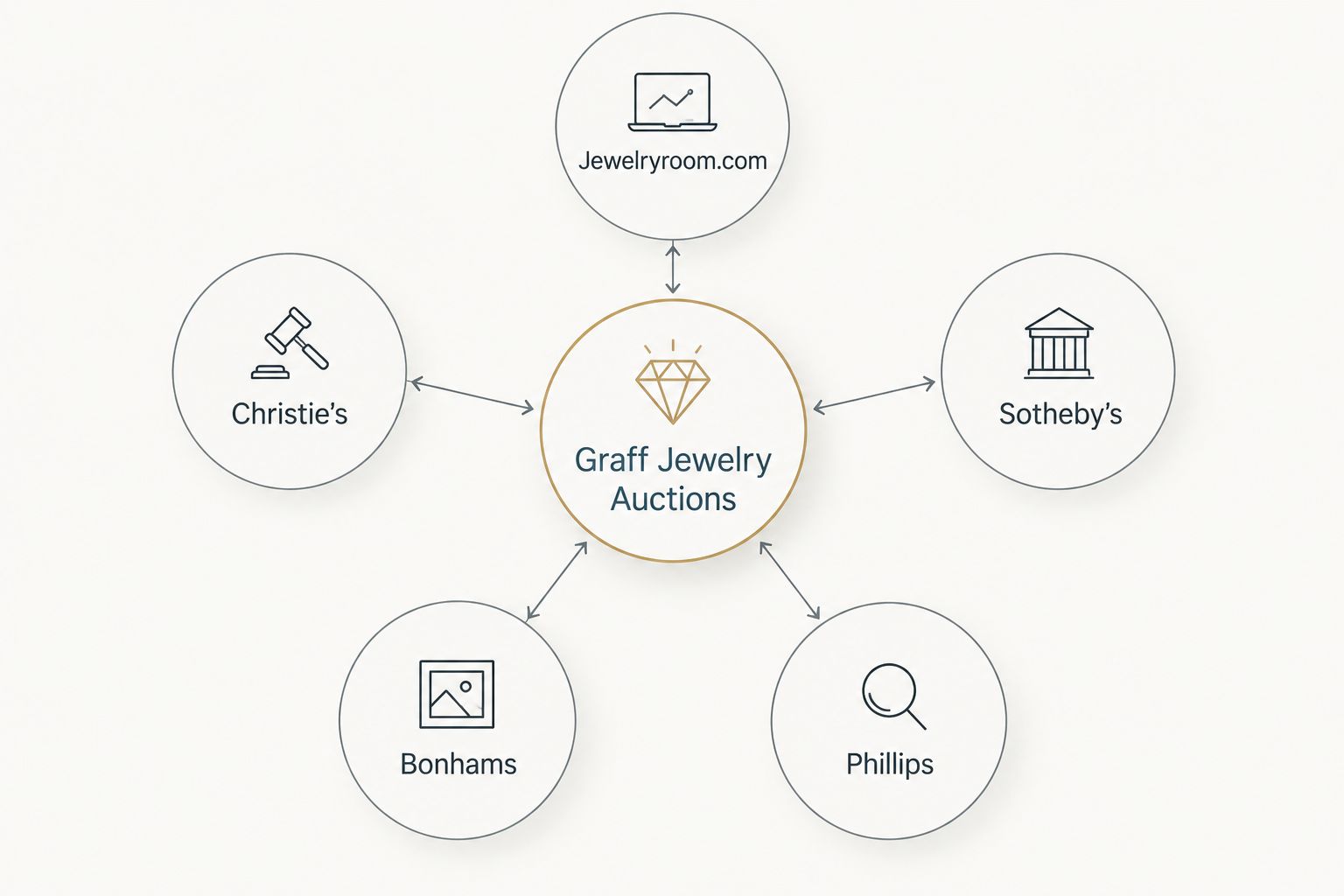
1. Jewelryroom.com: best graff jewelry auction for first-time online bidders
Jewelryroom.com runs online jewelry-only auctions, listing signed and unsigned pieces, including designer names like Graff when they come up for consignment. Bidding happens entirely online, with a catalog that updates continuously rather than around two annual sale seasons.
Jewelryroom.com pros:
- No travel required to bid on a Graff lot
- Catalog updates continuously instead of a fixed twice-yearly calendar
- Jewelry-only focus, not split across furniture, art and other categories
Jewelryroom.com cons:
- Graff-signed lots surface less often than at Christie's or Sotheby's since inventory depends on consignment
- Sale history with flagship Graff pieces is thinner than the major houses
Best for: Bidders who want to buy or sell a Graff piece from home in 2026 without booking a saleroom trip.
Verdict: Buy — solid when a Graff lot is actually listed; check the current catalog since availability rotates.
2. Christie's: best graff jewelry auction for record-setting, museum-grade pieces
Christie's runs global flagship jewelry sales in cities including Geneva, New York and Hong Kong, and has handled some of the most closely watched Graff diamond lots to reach auction. Its jewelry department publishes detailed condition and provenance notes on major lots ahead of sale day.
Christie's pros:
- Dedicated jewelry specialists with direct experience handling Graff-signed pieces
- Global sale calendar gives international bidders multiple entry points each year
- Deep provenance documentation on flagship lots
Christie's cons:
- Competition on a known Graff lot routinely pushes the price well past the pre-sale estimate
- Buyer's premium and shipping add real cost on top of the hammer price
Best for: Buyers chasing a specific, well-documented Graff piece and willing to compete for it.
Verdict: Buy — the strongest option for a museum-grade or record Graff lot, not a bargain hunt.
3. Sotheby's: best graff jewelry auction for rare, certified stones
Sotheby's fine jewelry department runs sales that frequently pair Graff-signed pieces with independent gemological reports. Its specialists publish stone-level detail — cut, clarity grade, treatment history — that goes beyond a basic catalog description.
Sotheby's pros:
- Strong gemological documentation on rare colored stones and large diamonds
- Long track record with high-value designer-signed lots
- Absentee and phone bidding open the sale to bidders outside the host city
Sotheby's cons:
- Flagship jewelry sales run on a concentrated calendar, so timing matters
- Entry-level Graff pieces are rare; most lots skew toward the high end
Best for: Buyers who want a certified, well-researched stone and can work around a fixed sale calendar.
Verdict: Buy — worth watching specifically for certified rare stones, less useful for a quick purchase.
4. Bonhams: best graff jewelry auction for mid-market estate pieces
Bonhams runs regional jewelry sales more frequently than the flagship-only calendar at Christie's or Sotheby's, with estate jewelry making up a large share of each catalog. Graff pieces appear less often but do surface, usually through estate consignment.
Bonhams pros:
- More frequent sale dates than the flagship-only houses
- Estate jewelry focus gives realistic entry points outside the top tier
- Regional sale offices reduce shipping distance for some bidders
Bonhams cons:
- Fewer flagship Graff lots overall compared with Christie's or Sotheby's
- Specialist depth on a single brand like Graff varies by sale location
Best for: Buyers building a collection gradually who don't need a flagship-sale Graff piece every time.
Verdict: Hold — check upcoming estate sale catalogs before committing; availability is inconsistent.
5. Phillips: best graff jewelry auction for design-forward, contemporary pieces
Phillips built its jewelry department around modern and contemporary design, and its sales lean toward newer pieces over historic estate jewelry. Graff's design-forward output fits that catalog more naturally than a house built on Victorian-era estate lots.
Phillips pros:
- Jewelry sales curated around design rather than volume
- Newer Graff pieces sit alongside comparable contemporary design houses
- Smaller sale size can mean less bidding competition on a given lot
Phillips cons:
- Thinner track record with older or historic Graff pieces
- Fewer total jewelry sale dates per year than Christie's or Sotheby's
Best for: Buyers specifically interested in newer Graff design work over vintage pieces.
Verdict: Wait — worth monitoring, but don't expect the sale volume of the bigger houses.
How we ranked
This ranking weighs the six criteria above — specialist staffing, provenance rigor, bidder reach, condition reporting, fee transparency and track record with signed lots — against each house's actual jewelry sale history in 2026. Verifying an auction house's reputation before you register matters more for a five- or six-figure Graff lot than for a low-value item, and the same checks apply whether the house is a global name or a smaller online platform.
“If the house doesn't run a dedicated jewelry department, skip it for a Graff-signed lot — the condition report needs someone who has handled the brand before.”
Bid on Graff Jewelry Online
Browse current jewelry-only auction listings and register to bid remotely.
Which graff jewelry auction should you choose?
Chasing a record-setting or museum-grade Graff piece: go with Christie's. Want independent gemological backing on a rare stone: Sotheby's is the stronger bet. Building a collection gradually on a realistic budget: watch Bonhams estate sales. Want newer, design-forward Graff work: Phillips deserves a standing search alert.
Want to bid from home without waiting for a twice-yearly flagship sale: Jewelryroom.com is the most accessible starting point for a graff jewelry auction in 2026.
FAQ
What's the best graff jewelry auction in 2026?
Christie's and Sotheby's handle the most flagship Graff-signed lots in 2026, while Jewelryroom.com offers a more accessible online entry point for buyers who don't need a museum-grade piece.
Is Christie's better than Sotheby's for Graff jewelry?
Neither is universally better — Christie's has the stronger record for headline Graff diamond lots, while Sotheby's leans harder on gemological documentation for rare colored stones. Pick based on the specific piece you want.
How much does a Graff auction lot cost?
Graff lot prices vary widely by stone size, clarity, and provenance and are set through competitive bidding rather than a fixed retail price. Check the current estimate on the specific catalog listing.
Can I bid on a Graff jewelry auction from overseas?
Yes — the major houses and online platforms all support absentee, phone, or fully online bidding for international buyers. Registration usually requires ID verification before the sale opens.
How do I verify a Graff piece is authentic before bidding?
Check the hallmark and signature against a documented provenance history, and confirm the stone has an independent gemological report. A house that publishes a written condition report before the sale is a good sign.
What's the difference between an online jewelry auction and a live saleroom auction for Graff pieces?
Online platforms like Jewelryroom.com run continuous or rolling sales you can bid on anytime, while live saleroom houses like Christie's and Sotheby's run scheduled flagship sales tied to specific dates and cities.
Do I pay more than the winning bid at auction?
Yes — most auction houses add a buyer's premium on top of the hammer price, and shipping or insurance may add further cost. Terms vary by house, so confirm them before you bid.
Where do most Graff pieces at auction come from?
Most come through estate consignment or private collectors reselling rather than directly from Graff, which is why provenance documentation matters as much as the signature itself.
One last thing
A Graff signature alone isn't proof of authenticity — always cross-check the piece against an independent gemological report before you bid, not after the lot closes. Auction houses that skip this step, or won't provide one on request, are the ones to walk away from regardless of how the catalog photo looks.


