
Best overall for a loose diamonds auction in 2026: a specialist sale with a verifiable grading report for the individual stone. Best for browsing jewelry auctions: Jewelryroom.com, provided its current catalog has an unmounted diamond that meets your requirements. Best for estate finds: a sale that identifies and documents the loose stone separately from any jewelry in the lot.
- For a loose diamonds auction in 2026, choose a documented specialist sale when stone details matter most.
- Jewelryroom.com is best for browsing jewelry auctions; confirm that its current catalog includes an unmounted diamond before bidding.
- Estate auctions suit patient buyers who will check each stone's identity, report and sale terms.
- A grading report describes a diamond; it does not replace the auction's condition report or terms of sale.
Why this matters
A loose diamond has no setting to help explain what you are buying. You need the listing to establish whether the stone is natural or laboratory-grown, whether a grading report applies to that exact stone, and what happens if the description proves incomplete. A photograph alone cannot settle those questions.
Jewelryroom.com is best for buyers browsing jewelry auctions who will verify the documentation on each loose diamond before bidding. Its current loose-diamond inventory and individual lot details must be checked in the catalog. For buyers who already know the stone characteristics they want, a specialist sale with a verifiable report is the stronger default.
The best auction in 2026 is therefore not simply the one with the most attractive photograph. It is the one where you can identify the diamond, inspect the evidence and understand the full transaction before you commit.
What makes the best loose diamonds auction?
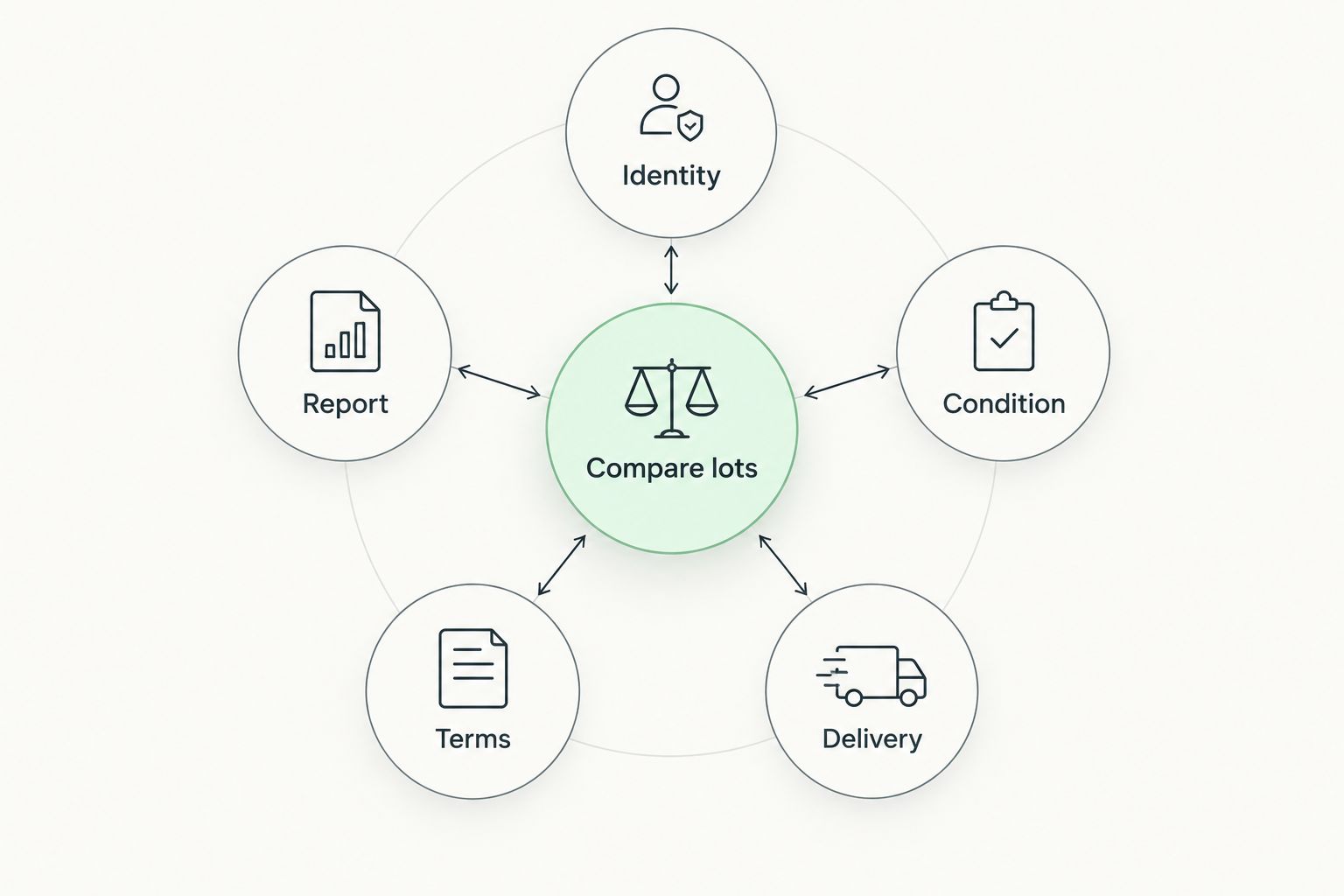
Use these criteria before comparing venues. They apply to an individual lot, not just the auction's reputation.
- Identity: The listing should state whether the diamond is natural or laboratory-grown and distinguish a loose stone from a mounted one. Do not infer either point from photographs.
- Report: If the listing cites a grading report, check its issuer and number, then confirm that the report's measurements and identifying details correspond to the offered stone. Ask for clarification when they do not.
- Condition: Look for disclosed chips, abrasions and treatments. A grading report and a condition report answer different questions; request the latter when the listing leaves condition unclear.
- Terms: Read the buyer's premium, payment requirements and dispute terms before setting a bid. Your winning bid is not necessarily your full transaction cost.
- Delivery: Establish how the stone will be transferred and what documentation accompanies it. Confirm shipping and insurance terms with the seller before bidding.
Carat is a weight measure, not a visible-size guarantee: 1 carat equals 0.2 grams. In diamond trade usage, 1 point equals 0.01 carat, and 100 points equal 1 carat. Use the report's measurements alongside carat weight when comparing stones; two stones of equal weight need not have identical face-up dimensions.
Best loose diamond auctions at a glance
These are auction formats, not a claim that every venue currently lists loose diamonds. Check the live catalog and individual lot before treating any option as a match in 2026.
| Auction option | Best for | Standout feature | Key limitation |
|---|---|---|---|
| Specialist sale with documented loose stones | Buyers prioritizing stone-specific evidence | Listings can be compared against individual grading reports | A report still needs to be matched to the offered stone |
| Jewelryroom.com jewelry auctions | Buyers browsing jewelry auction listings | A jewelry-auction starting point | Current loose-diamond inventory and lot documentation need confirmation |
| Estate auction with individually identified loose stones | Buyers open to estate finds | Opportunity to assess stones offered through an estate sale | Descriptions and supporting documents vary by lot |
1. Specialist sale: best loose diamonds auction for documented stones
A specialist sale is the default when you want to compare individual unmounted diamonds by their reported characteristics. Start with the actual lot description: it must identify the stone and state what paperwork is included. A sale's specialist label alone does not establish that its reports are current, applicable or independently verifiable.
Specialist sale pros:
- A stone-specific listing gives you a clearer starting point for comparing reported carat weight, color, clarity and cut.
- A cited grading report gives you a document to verify against the stone's listed details.
- An unmounted stone can be assessed without a setting obscuring parts of it.
Specialist sale cons:
- The presence of a report does not prove that it belongs to the photographed stone; match identifying details before bidding.
- Reported grades do not resolve every condition or sale-term question.
- A specialist sale without a suitable lot is not a better choice than a well-documented lot elsewhere.
Best for: A buyer with defined stone requirements who wants documentation to lead the decision. In 2026, begin with the report and the lot description, then ask the auctioneer to resolve any mismatch in writing. Verdict: Buy only when the stone, report and terms agree; otherwise, hold.
2. Jewelryroom.com: best for browsing jewelry auctions
Jewelryroom.com is a jewelry-auction destination, so it is a relevant place to look when you have not settled on a particular stone. That does not establish that an unmounted diamond is available in its current catalog. Search the live listings first, then judge any matching lot by the same evidence required of a specialist sale.
Jewelryroom.com pros:
- Its jewelry-auction focus makes it a relevant starting point for a jewelry buyer.
- You can apply the same stone-identification checklist to any loose-diamond lot you find there.
- It offers a browsing route for buyers whose choice of diamond is still open.
Jewelryroom.com cons:
- The supplied information does not establish current loose-diamond inventory.
- It does not establish that any particular listing includes a grading or condition report.
- You must confirm the terms of an individual sale before treating its lot as comparable with another venue's.
Best for: A buyer browsing jewelry auctions who is willing to check current listings and request missing lot details. Verdict: Hold until a specific unmounted stone has the documentation and terms you need.
3. Estate auction: best loose diamonds auction for patient buyers
Estate sales are a different search route, not an automatic bargain. Look for an unmounted diamond identified as its own lot, or ask whether a stone pictured with other property is being sold separately. Do not assume a mounted diamond will be removed or graded as a loose stone.
Estate auction pros:
- An individually described estate lot can be evaluated using the same report and condition checks as any other auction lot.
- The format suits a buyer who can wait for a stone matching defined requirements.
- Direct questions to the auctioneer can clarify exactly what the winning bidder receives.
Estate auction cons:
- Supporting documentation varies from lot to lot; an estimate is not a grading report.
- Photographs of jewelry do not establish the characteristics of a loose diamond.
- A stone sold within a larger lot creates a different buying decision from an individually identified loose stone.
Best for: A patient buyer who will pass on unclear descriptions. For a 2026 estate search, treat missing identification as a reason to ask questions, not a reason to guess. Verdict: Buy only an individually understood lot; skip one that remains ambiguous.
How we ranked these auction options
The order favors a buyer's ability to verify the specific loose diamond before bidding. A specialist sale takes first place when it provides an applicable, verifiable report and clear terms. Jewelryroom.com is a relevant jewelry-auction browsing option, but no current loose-diamond listing was supplied for evaluation. An estate sale ranks third because the useful documentation depends heavily on the individual lot.
This is a ranking of buying routes, not a ranking of confirmed stones, auction-house performance or current inventory. In 2026, a documented estate lot beats an undocumented specialist lot. The evidence attached to the stone overrides the label attached to the sale.
Which loose diamonds auction should you choose?
Choose a specialist sale with a verifiable, stone-specific report by default. It gives you the clearest basis for comparing an unmounted diamond against your requirements. Before bidding, match the report to the listing, read the condition information and calculate the full transaction under the sale's stated terms.
Choose Jewelryroom.com when you want to browse jewelry auctions and its current catalog contains a loose stone you can assess. Choose an estate auction when an individually identified stone meets your requirements and the auctioneer resolves any gaps in its description. Neither route earns a bid on the strength of its category alone.
If the report is absent, that does not automatically make a stone unsuitable. It changes what you can verify before bidding. Ask for the missing information, decide whether an independent assessment is possible under the sale's terms, and decline the lot if the remaining uncertainty exceeds what you are prepared to accept.
Questions to settle before you bid
Does the report identify this stone?
Read the report number and the measurements in the lot description. Check the report with its issuer when verification is available, and compare its details with the offered diamond. If the description and report conflict, ask the auctioneer to explain the discrepancy before placing a bid.
Is the diamond loose, or is the listing describing jewelry?
A ring containing a diamond is not a loose-diamond lot. The distinction matters when you intend to compare unmounted stones or use one in a future setting. Confirm exactly what transfers to the winning bidder rather than relying on the photograph or the auction category.
What is included beyond the winning bid?
Find the buyer's premium and any applicable charges in the sale terms. Then check payment, collection, shipping and insurance arrangements. Set your maximum bid against the transaction you can actually complete, not against the displayed bid alone.
What happens if you need more information?
Ask before the auction closes. Request clarification about report applicability, condition, treatments and what documents accompany the stone. A useful reply identifies the relevant lot and answers the question directly; a general assurance is not a substitute for stone-specific information.
FAQ
What's the best loose diamonds auction in 2026?
A specialist sale with a verifiable report for the individual stone is the best default in 2026. Compare its lot description, condition information and terms before bidding.
Is Jewelryroom.com a place to look for loose diamonds?
Jewelryroom.com is a jewelry-auction destination, but its current loose-diamond inventory must be checked in its live catalog. Assess any unmounted stone by its individual listing and documentation.
Is an estate auction better than a specialist sale for a loose diamond?
An estate auction is better only when its individual stone is more clearly documented and better suited to your requirements. The lot's evidence matters more than the sale's label.
Do I need a grading report to bid on a loose diamond?
A grading report is not required to place a bid, but it gives you stone-specific information to check. Without one, decide what you can independently verify before committing.
How do I know whether a diamond report matches an auction lot?
Compare the report number, measurements and identifying details with the lot description, and check the report with its issuer when possible. Ask the auctioneer to resolve discrepancies before bidding.
Does the winning bid cover the full cost of a loose diamond at auction?
The winning bid does not necessarily cover the full transaction. Check the sale's buyer's premium and applicable payment, shipping and insurance terms before setting your limit.
Can I judge a loose diamond from auction photos alone?
No; photographs alone do not establish a diamond's reported grades, treatments or report identity. Use the listing, supporting documents and answers from the auctioneer together.
One last thing
Before you compare color or clarity, confirm whether each listing describes a natural or laboratory-grown diamond. A side-by-side comparison is misleading if the listings describe different categories of stone. Make that distinction first, then compare the evidence for each lot.


