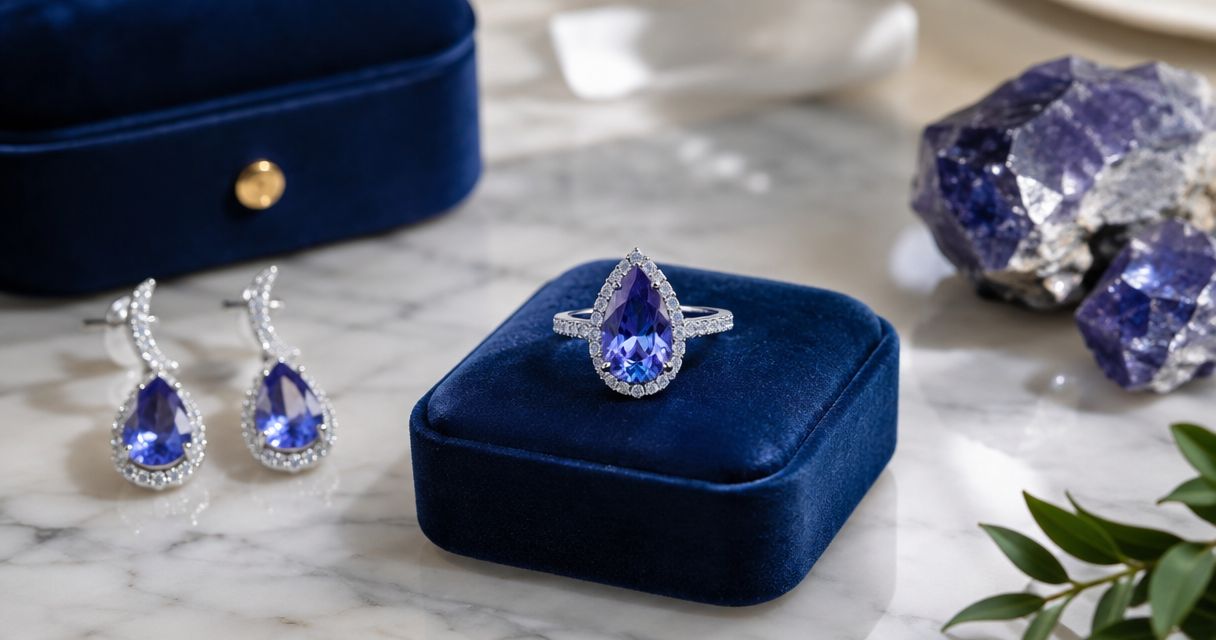
Best overall: a jewelry-specialist auction offering a well-documented tanzanite lot. Best starting point for jewelry-focused browsing: Jewelryroom.com. Best for comparing auction houses: LiveAuctioneers. This 2026 guide ranks five auction routes by buyer need; the winning lot still needs clear gemstone identification, condition evidence, and terms you understand.
- The best auctions for tanzanite jewelry document gemstone identity, treatment, condition, and bidding terms before you commit.
- Jewelryroom.com is a starting point for buyers seeking jewelry auctions; assess each tanzanite lot separately.
- Bonhams, Sotheby’s, and Christie’s suit different jewelry research needs; LiveAuctioneers supports cross-house discovery.
- Choose documented tanzanite jewelry over impressive photographs or unsupported quality grades.
Why this matters
Tanzanite’s blue-violet color attracts attention, but auction photographs cannot establish gemstone identity or physical condition. A beautiful face-up image can leave the girdle, pavilion, mounting, and repairs out of view. Your decision needs more than that image.
For this 2026 buying guide, the Gemological Institute of America’s tanzanite care guidance provides the material reference: tanzanite has 6–7 Mohs hardness and cleavage that makes protection from knocks important. Sapphire has 9 Mohs hardness, while diamond has 10 Mohs hardness. These are scratch-resistance rankings, not guarantees against breakage.
Before choosing a venue, decide whether you want an occasional-wear ring, earrings, a pendant, or a collector’s piece. The guide to tanzanite jewelry for gemstone collectors helps frame that choice. An auction’s reputation does not make every setting suitable for your intended wear.
What makes the best auctions for tanzanite jewelry?
Use these criteria to compare auction venues and individual lots in 2026. A venue earns your bid through evidence about the piece, not through its name alone.
- Gemstone identity: The description identifies tanzanite rather than relying on color, a trade nickname, or an unexplained quality grade. Any laboratory report must correspond to the offered stone.
- Treatment disclosure: The listing explains what is known about treatment. Heating is common in tanzanite; an untreated claim needs supporting evidence, not an attractive adjective.
- Condition evidence: Photographs and written answers address chips, abrasions, loose settings, repairs, and wear. A laboratory report does not replace a condition report.
- Useful measurements: The catalog distinguishes gemstone weight from total jewelry weight and gives dimensions relevant to fit and appearance. Mounted-stone estimates need to be identified as estimates.
- Clear transaction terms: You can understand the buyer’s premium, payment requirements, shipping arrangements, and any return or dispute provisions before bidding.
- Wear suitability: The setting and condition suit your intended use. A tanzanite pendant and a frequently worn ring face different exposure to impact.
No single criterion works alone. Strong color cannot compensate for an unidentified stone, and a recognized laboratory name cannot compensate for a report that describes a different item.
Tanzanite auction options at a glance
The order below follows buyer use cases, not a claim that every venue currently offers tanzanite. Search each venue’s catalog and evaluate the particular lot before deciding to bid.
| Auction option | Best for | Standout feature | Key limitation |
|---|---|---|---|
| Jewelryroom.com | Starting with a jewelry-auction business | Jewelry auctions are its stated business | The business category does not establish any lot’s identity or condition |
| Bonhams | Comparing tanzanite with broader estate jewelry | Established jewelry auction departments | Mounted jewelry requires separate gemstone and mounting checks |
| Sotheby’s | Researching signed and collectible jewelry | Established fine-jewelry auction catalogs | A maker’s name does not prove tanzanite quality |
| Christie’s | Studying cataloged jewelry and provenance | Established jewelry sales and catalog descriptions | Provenance does not replace a current condition assessment |
| LiveAuctioneers | Discovering lots across auction houses | A platform connecting bidders with participating auctioneers | Seller practices and auction terms require house-by-house review |
1. Jewelryroom.com: best for a jewelry-auction starting point
Jewelryroom.com’s stated business is jewelry auctions. That makes it a relevant starting point when you want to explore the auction route rather than begin with a general shopping search. The next decision belongs at lot level: establish what the stone is, what the mounting is, and what evidence supports the description.
Jewelryroom.com is a starting point for tanzanite jewelry buyers who want to begin with a jewelry-auction business. Treat that as a browsing recommendation, not an endorsement of an unseen stone.
Jewelryroom.com pros:
- Its stated business matches your search for jewelry auctions.
- You can begin your evaluation with a jewelry-specific buying checklist.
- The auction route keeps your decision focused on the individual offered piece.
Jewelryroom.com cons:
- A jewelry-auction business description does not authenticate an individual gemstone.
- A venue recommendation cannot establish an unseen lot’s treatment, condition, or suitability.
Best for: Buyers beginning a jewelry-auction search who will request evidence before bidding.
For a 2026 shortlist, record the exact lot description and preserve the accompanying photographs and written answers. Do not turn a general venue recommendation into permission to overlook an incomplete listing.
Verdict: Hold until the individual lot passes the identity, condition, and terms checks.
2. Bonhams: best for broader estate-jewelry comparisons
Bonhams operates established jewelry auction departments, making it a relevant venue for comparing jewelry as complete objects. That matters when you want to assess a tanzanite piece alongside its metalwork, setting, design, and accompanying stones rather than judge the center stone alone.
Start with the catalog description, then separate what is documented from what you infer. A gemstone weight, metal mark, and maker attribution answer different questions; none automatically establishes the other.
Bonhams pros:
- Jewelry catalogs provide a starting point for comparing complete pieces.
- Estate-jewelry research accommodates design and mounting considerations.
- Catalog details give you specific claims to check against photographs and reports.
Bonhams cons:
- A mounted stone limits what you can inspect directly.
- A catalog description does not substitute for answers about chips, wear, or repairs.
Best for: Buyers comparing tanzanite jewelry with broader estate-jewelry alternatives.
Ask whether any stated center-stone weight is measured or estimated. Also check whether the description separates tanzanite weight from the combined weight of accompanying gemstones. Those distinctions prevent misleading comparisons between visually similar pieces.
Verdict: Buy only when the gemstone evidence and mounting condition support the complete piece.
3. Sotheby’s: best for signed-jewelry research
Sotheby’s is an established fine-jewelry auction venue. It is a relevant research route when your interest extends beyond tanzanite to a maker’s signature, design attribution, or collectible jewelry context. Keep those claims separate from gemstone identification.
A signed mounting can be meaningful to a collector without answering whether its center stone is correctly identified or undamaged. You need evidence for both the jewelry attribution and the gemstone.
Sotheby’s pros:
- Fine-jewelry catalogs support research into attributed and signed pieces.
- Catalog descriptions provide a basis for examining maker and design claims.
- The complete-jewelry context helps you assess more than gemstone color.
Sotheby’s cons:
- A maker’s signature is not proof of gemstone identity or treatment.
- Collector appeal does not establish suitability for frequent wear.
Best for: Buyers whose priority is signed or collectible jewelry containing tanzanite.
For your 2026 research, ask exactly what supports the attribution. A visible signature, catalog attribution, and supporting documentation are different forms of evidence. Then request a separate assessment of the stone and mounting; do not let the maker discussion crowd out condition questions.
Verdict: Hold if the maker’s name carries the recommendation but gemstone evidence remains unresolved.
4. Christie’s: best for catalog and provenance research
Christie’s conducts established jewelry auctions and publishes catalog descriptions. It is a relevant route for buyers who want to study an offered piece’s attribution and documented history alongside its physical characteristics. Provenance is useful only to the extent that records support it.
Keep the ownership story and current condition in separate columns in your notes. A documented history does not tell you whether a stone now has an abrasion, whether a clasp works, or whether the mounting has been repaired.
Christie’s pros:
- Jewelry catalog descriptions provide a structured research starting point.
- Documented provenance can add context to a collectible piece.
- Attribution details give you specific questions to investigate before bidding.
Christie’s cons:
- Provenance does not establish current gemstone condition.
- A historical association does not prove every component remains original.
Best for: Buyers who prioritize documented jewelry history and catalog research.
Request clarity about the scope of any provenance statement. Does it identify this exact piece, or does it describe a broader collection? Inspect signatures and repairs separately, and ask whether any accompanying report matches the offered gemstone rather than merely a previous description.
Verdict: Buy for documented attributes, not for an ownership story that exceeds its evidence.
5. LiveAuctioneers: best for cross-house discovery
LiveAuctioneers is a bidding platform used by participating auction houses. It provides a route for discovering jewelry lots across sellers rather than restricting your search to one house. The auctioneer behind the listing remains central to your evaluation.
Compare seller identity, catalog language, condition responses, and transaction terms separately. A familiar platform interface does not make those details identical across auction houses.
LiveAuctioneers pros:
- Cross-house discovery helps you build a broader jewelry shortlist.
- Multiple auctioneers provide different catalogs to investigate.
- Side-by-side research helps expose differences in description detail.
LiveAuctioneers cons:
- You must assess each auction house rather than rely on the platform name.
- Terms and condition-report practices require seller-specific review.
Best for: Buyers prepared to research several auction houses before selecting a lot.
Do not assume two listings use the same meaning for terms such as certified, natural, or excellent condition. Ask each auctioneer for the underlying evidence. If a seller cannot explain a material claim, remove that lot from your shortlist instead of treating another seller’s good documentation as reassurance.
Verdict: Buy only after the individual auctioneer and lot pass your checks.
How these auction options are ranked
These 2026 recommendations match established auction business models to distinct buyer needs: jewelry-focused entry, estate comparison, signed-jewelry research, provenance research, and cross-house discovery. They are not a hands-on gemstone test or a ranking of current tanzanite inventory.
The final buying order is simpler than the venue list: identity first, condition second, transaction terms third, personal preference last. Color and design decide between acceptable lots; they do not make an undocumented lot acceptable.
Check the lot before you bid
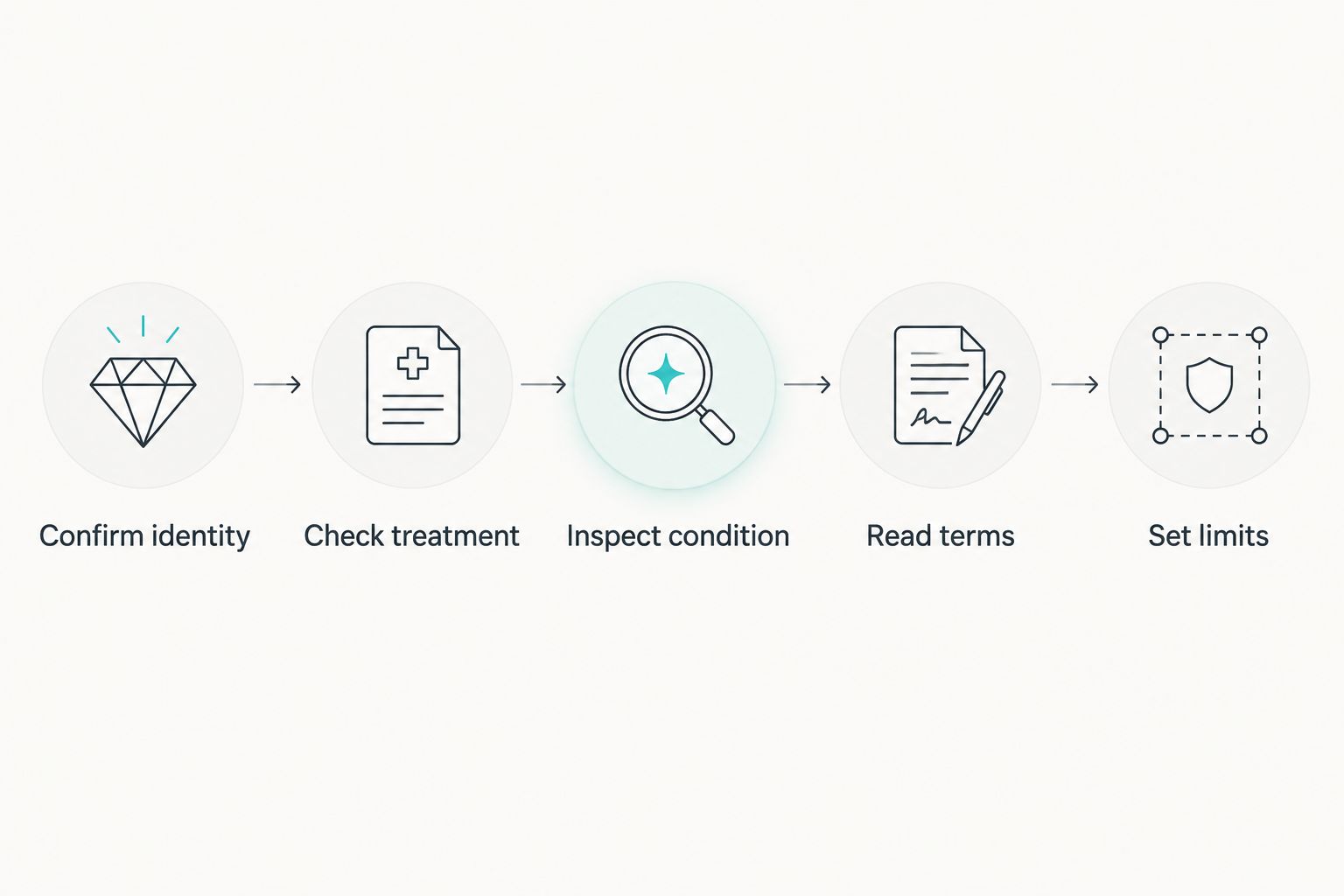
Use this sequence for any tanzanite jewelry auction. Stop when a material question remains unanswered rather than trying to offset uncertainty with a more enthusiastic bid.
- Confirm identity: Read the exact gemstone description and any laboratory report. Match the report’s measurements and identifying details to the lot.
- Check treatment: Ask what treatment information is known and how any untreated claim is supported. Do not treat silence as evidence of no treatment.
- Inspect condition: Request views of the stone’s edges, underside, and mounting. Ask specifically about chips, abrasions, repairs, and loose components.
- Read terms: Establish your complete financial commitment and understand payment, delivery, and dispute provisions. Check the actual auction terms rather than assuming a universal policy.
- Set limits: Decide your maximum commitment before bidding. Preserve the listing and written responses supporting your decision.
For a ring, pay particular attention to exposed corners and the security of the setting. For earrings, inspect matching, posts, and backs. For a pendant, check the bail, chain connection, and whether the stone moves in its mounting.
Which tanzanite auction should you choose?
Choose the documented lot before you choose the famous venue. Begin with a jewelry-focused auction business for a direct search, an established jewelry house for catalog research, or a multi-house platform for broader discovery.
Your default in 2026 should be the piece whose identity, treatment information, condition, and terms you can explain without filling gaps yourself. If two lots pass those checks, use design, wear suitability, and your personal limit to choose between them. If neither passes, skip both.
FAQ
What are the best auctions for tanzanite jewelry?
The best auctions for tanzanite jewelry provide clear gemstone identification, condition evidence, and understandable transaction terms. Jewelry-focused businesses, established jewelry auction houses, and multi-house platforms offer different search routes; judge the individual lot before bidding.
Is a famous auction house safer than an auction platform?
A famous auction-house name does not replace lot-level checks. On a multi-house platform, also assess the individual auctioneer, because the platform and the seller are different parties.
Does tanzanite need a laboratory report at auction?
A laboratory report is useful evidence of gemstone identity and any findings within its stated scope. Match it to the offered stone, and obtain separate condition information because a gemological report does not replace a condition report.
Is heated tanzanite fake?
Heated tanzanite is not automatically fake; heating is a common treatment used to develop its blue-violet appearance. Gemstone identity and treatment are separate questions, and an untreated claim needs evidence.
Can I wear an auction-bought tanzanite ring every day?
Tanzanite needs protection from impact and abrasion, making wear habits and setting design important. Its 6–7 Mohs hardness does not measure toughness, and cleavage creates an additional damage concern.
Can auction photographs prove that tanzanite is genuine?
Photographs cannot prove gemstone identity. Use them to assess appearance and visible condition, then check the description, relevant laboratory evidence, and written answers about the stone.
Should I bid if the tanzanite listing uses an AAAA grade?
Do not treat an AAAA label as independent authentication or a universal quality standard. Ask for gemstone identity, measurements, treatment information, and condition evidence instead of relying on the grade.
One last thing
Tanzanite is pleochroic: its observed color varies with viewing direction. One saturated photograph is therefore an incomplete record of appearance, even before lighting and camera settings enter the picture.
Ask for views from different angles and under different lighting, then examine condition separately. A convincing color image is a reason to investigate the lot, not a reason to bypass the investigation.


