
Bidsquare brings auction-house catalogs across categories into one place, making it useful when you collect more than jewelry. That breadth is less relevant when your search is exclusively for jewelry auctions. The best Bidsquare alternative in 2026 is Jewelryroom.com if you want a jewelry-focused starting point; LiveAuctioneers if you want another broad auction marketplace.
- For Bidsquare alternatives focused on jewelry auctions, start with Jewelryroom.com and evaluate each lot before bidding.
- LiveAuctioneers and Invaluable suit buyers who want auction-house catalogs across several collecting categories.
- Sotheby’s suits buyers seeking jewelry through an established auction house rather than a multi-house marketplace.
- eBay suits listing-by-listing jewelry searches, but not every listing uses an auction format.
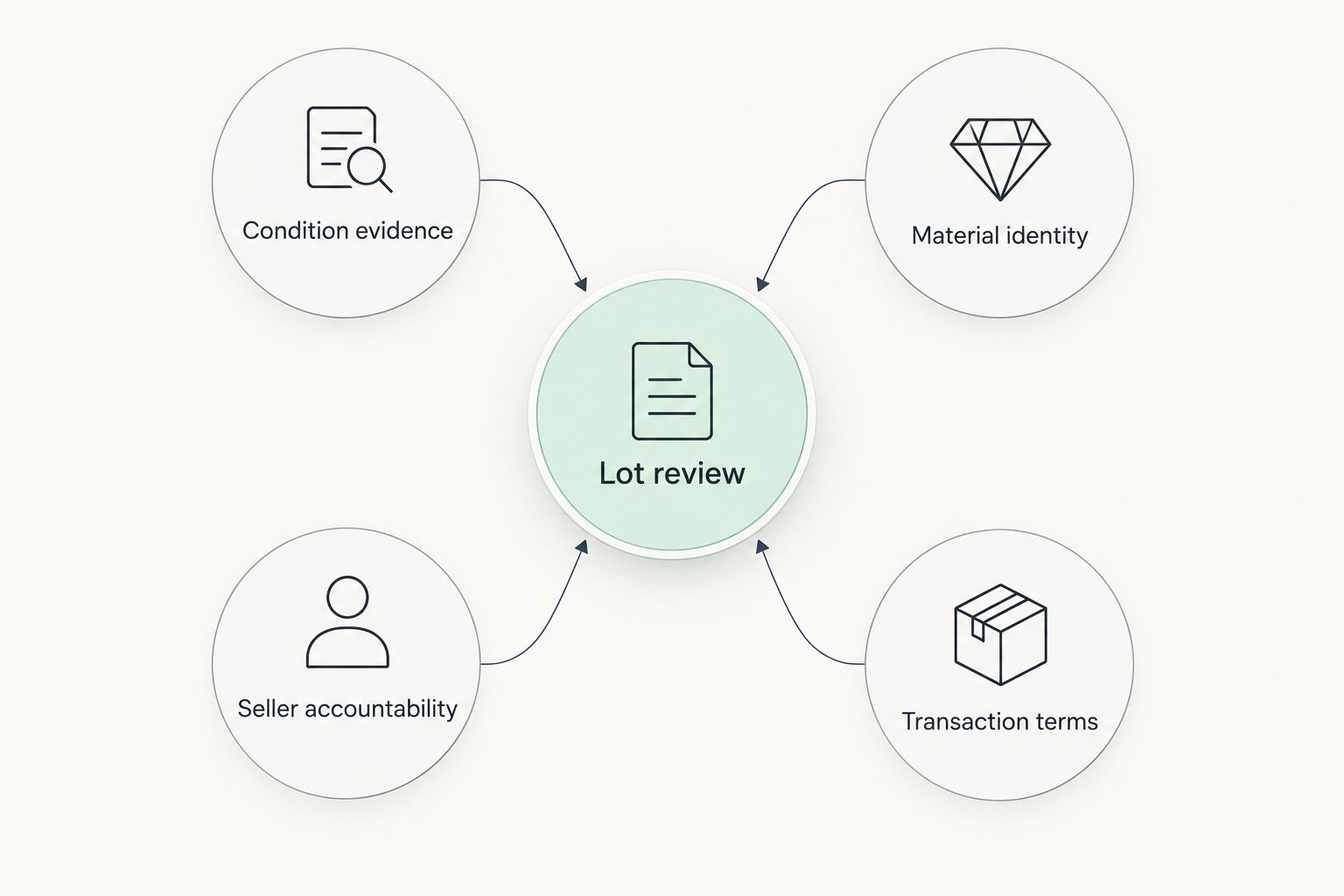
- Choose by condition evidence, seller accountability, and sale terms—not the platform name alone.
Why this matters
Choosing an auction website and choosing a jewelry lot are separate decisions. A platform helps you discover an object; the catalog description, supporting documents, and seller’s terms determine whether you should bid.
For your 2026 shortlist, separate jewelry-focused destinations from broad marketplaces and individual auction houses. These are different ways to shop, not interchangeable promises about authenticity, returns, or delivery. A better search experience does not replace a better-supported lot.
This comparison ranks alternatives by shopping fit. It does not rank individual sellers, certify objects, or assume that every auction on a platform follows identical rules.
Bidsquare alternatives at a glance
| Option | Best for | Defining feature | How it differs from Bidsquare | Main trade-off |
|---|---|---|---|---|
| Bidsquare | Collectors browsing auction-house catalogs across categories | Multi-house auction discovery | The benchmark for this comparison | A broad catalog still requires lot-level research |
| Jewelryroom.com | Buyers starting specifically with jewelry auctions | Jewelry auction focus | A category-specific starting point rather than a broad collecting search | Not the starting point for an all-category collecting brief |
| LiveAuctioneers | Buyers comparing jewelry with other collectibles | Multi-house auction marketplace | Another route to auction-house catalogs | You still need to evaluate the auctioneer and sale terms |
| Invaluable | Buyers researching objects across auction-house catalogs | Broad auction marketplace | An alternative discovery route for multi-category collecting | Marketplace discovery does not settle jewelry-specific questions |
| Sotheby’s | Buyers seeking jewelry through a named auction house | Auction-house jewelry sales | An auction-house route rather than a multi-house marketplace | A single-house search is narrower than a marketplace search |
| eBay | Buyers searching individual jewelry listings | Marketplace with auction and fixed-price formats | Seller-by-seller shopping rather than primarily auction-house catalogs | Listing format and evidence require close attention |
The useful comparison is not which site has the longest list of features. It is which route matches the object you want and the research you are prepared to do. Keep Bidsquare on the shortlist when it already connects you with suitable auction houses.
1. Jewelryroom.com: best for jewelry-focused auction searches
Jewelryroom.com is a jewelry auction destination. Start here when your brief is jewelry rather than a mix of furniture, art, decorative objects, and accessories. The recommendation is about category fit—not a claim that every lot is the right purchase.
A focused destination gives your search a clear starting point. You still need to assess the description, condition evidence, and transaction terms for the particular piece you are considering.
Where this option shines
- Its stated business is jewelry auctions, matching a jewelry-specific buying brief.
- It is a relevant first stop when you do not need an all-category collecting marketplace.
- It lets you begin with the category you intend to buy rather than treating jewelry as one part of a broader search.
Where this option falls short
- A jewelry-only brief does not serve buyers assembling a shortlist across unrelated collecting categories.
- Category focus alone does not establish a gemstone’s identity, treatment history, or a piece’s condition.
- A focused search is not a substitute for comparing the evidence attached to competing lots.
| Dimension | This jewelry auction destination | Bidsquare |
|---|---|---|
| Starting point | Jewelry auctions | Auction-house catalogs across categories |
| Best-fit brief | Jewelry-specific buying | Multi-category collecting |
| Evidence to review | Individual lot description and supporting documents | Individual lot description and supporting documents |
| Decision rule | Choose for category fit, then assess the lot | Choose for auction-house access, then assess the lot |
Best for: Buyers whose 2026 search begins and ends with jewelry auctions.
Verdict: Hold a place on your shortlist; bid only after the lot passes your checks.
2. LiveAuctioneers: best for broad auction-house browsing
LiveAuctioneers is an online marketplace connecting buyers with auction-house sales across collecting categories. It is a close alternative when you like Bidsquare’s broad browsing model and want another place to discover catalogs. The model remains auction-house shopping, not a single retailer’s jewelry collection.
Use it to compare objects and identify auctioneers whose catalogs match your interests. Then investigate the sale itself. A marketplace listing is the beginning of due diligence, not the end.
Where LiveAuctioneers shines
- Its multi-category format suits buyers who collect jewelry alongside other objects.
- Auction-house catalogs provide a route to researching the seller behind a lot.
- It offers another discovery channel without requiring you to abandon broad auction browsing.
Where LiveAuctioneers falls short
- Breadth does not answer whether a particular gemstone has been treated or whether a clasp needs repair.
- You need to review the participating auctioneer’s terms rather than assume one set of rules covers every sale.
- Buyers interested only in jewelry still need to narrow a broader collecting search.
| Dimension | LiveAuctioneers | Bidsquare |
|---|---|---|
| Shopping model | Multi-house auction marketplace | Multi-house auction platform |
| Category scope | Jewelry and other collectibles | Jewelry and other collecting categories |
| Seller research | Investigate the auctioneer handling the lot | Investigate the auctioneer handling the lot |
| Selection basis | Relevant catalogs and documented lots | Relevant catalogs and documented lots |
Best for: Buyers who want another broad auction marketplace rather than a jewelry-only destination.
Verdict: Hold alongside Bidsquare and compare the actual sales.
3. Invaluable: best for cross-category auction research
Invaluable is another auction marketplace covering jewelry, art, antiques, and other collectibles. Choose it as an additional research route when your priority is comparing auction-house catalogs. Its broad model is closer to Bidsquare than to a jewelry-specific destination.
The useful question is whether a catalog contains an object that meets your brief. Finding similar-looking jewelry on different platforms does not establish that the pieces have equivalent materials, condition, or provenance.
Where Invaluable shines
- Its category breadth suits collectors researching several types of objects.
- Auction-house catalogs support searches organized around a seller or collecting interest.
- It provides an alternative route for discovering jewelry within a wider auction search.
Where Invaluable falls short
- Broad discovery still leaves you responsible for jewelry-specific questions.
- Terms must be checked for the relevant auctioneer and sale.
- A catalog photograph alone cannot establish stone identity or the extent of previous repairs.
| Dimension | Invaluable | Bidsquare |
|---|---|---|
| Primary role | Auction discovery across houses | Auction discovery across houses |
| Best-fit search | Cross-category research | Cross-category research |
| Jewelry assessment | Review each lot’s evidence | Review each lot’s evidence |
| Reason to choose | A relevant auction-house catalog | A relevant auction-house catalog |
Best for: Collectors comparing jewelry with other auction categories in 2026.
Verdict: Hold as a parallel research channel, not an automatic upgrade.
4. Sotheby’s: best for an auction-house-led jewelry search
Sotheby’s conducts jewelry auctions as an auction house. That makes it a different kind of alternative: you are choosing a named house rather than searching across independent houses through a marketplace.
Where Sotheby’s shines
- A house-led search suits buyers who want to research one auction organization and its jewelry sales.
- Jewelry catalog entries provide a starting point for questions about attribution, materials, and provenance.
Where Sotheby’s falls short
- Searching one house is narrower than searching a multi-house marketplace.
- The auction-house name does not remove the need to read condition information and sale terms.
Best for: Buyers who prefer an auction-house-led route to jewelry.
Verdict: Hold when the house’s sale matches your brief; skip it as a substitute for broad marketplace browsing.
5. eBay: best for individual-listing jewelry searches
eBay combines auction and fixed-price listings across many categories, including jewelry. It fits a buyer willing to assess individual sellers and listing formats. It is not a direct replacement for an auction-house catalog experience.
Where eBay shines
- Listing-by-listing searches suit buyers with a specific object or style in mind.
- Different selling formats let you distinguish bidding from fixed-price shopping.
Where eBay falls short
- Not every jewelry listing is an auction.
- You need to establish what evidence supports each seller’s description rather than assume a cataloging standard.
Best for: Buyers comfortable researching individual sellers and comparing listing evidence.
Verdict: Hold for targeted searches; skip if you specifically want auction-house-led cataloging.
Why people switch from Bidsquare
The defensible reasons to explore alternatives concern shopping fit. They do not require claims about outages, fee changes, or dissatisfaction with Bidsquare.
- Category focus: Choose a jewelry auction destination when your buying brief excludes other collectibles.
- Another discovery route: Add LiveAuctioneers or Invaluable when you want to compare relevant auction-house catalogs.
- House-led buying: Consider Sotheby’s when you want to research a named auction house and its jewelry sales.
- Listing-led shopping: Consider eBay when you want to evaluate individual listings and sellers rather than concentrate on auction-house catalogs.
Switching platforms does not fix an incomplete description. If the same uncertainty follows you from site to site, change your research process before changing your bidding destination.
Check the lot before choosing the platform
For a jewelry purchase in 2026, use the same checks everywhere. Ask for written answers to unresolved questions before you make a bid, and retain the relevant description and correspondence.
Condition evidence
Request close views of settings, clasps, ring shanks, and visible repairs. Ask whether stones are loose, components are missing, or alterations are described. Read the guide to getting a condition report before bidding before treating attractive photographs as sufficient evidence.
Material identity
Separate metal fineness from gemstone identity. On the karat scale, 24-karat gold represents pure gold, while 18-karat gold is 75% gold; a 750 fineness mark denotes that same proportion. A mark is a clue to investigate, not proof that the entire object is correctly described.
Ask whether a stone is identified as natural, laboratory-grown, or an imitation, and whether treatments are disclosed. Those descriptions are not interchangeable.
Seller accountability
Identify who conducts the sale and who answers questions about the lot. Read the relevant terms for disputes, returns, and description errors. Do not transfer assumptions from a previous purchase to a different seller.
Transaction terms
Check payment requirements, applicable charges, delivery arrangements, and insurance responsibilities before bidding. Establish your own spending limit using the complete transaction obligations, not just the bid you enter.
A clear answer is more useful than a familiar platform name. Wait when a material uncertainty remains unresolved. Another website cannot make an undocumented claim reliable.
When staying with Bidsquare is the right call
Stay with Bidsquare when its auction-house catalogs match your collecting interests and the relevant seller provides satisfactory lot information. A broad platform is useful if jewelry is only one part of what you collect.
There is also no need to replace Bidsquare just to research another sale. Your 2026 shortlist can include several discovery routes while your bidding rule stays consistent: choose the supported object, understand the obligations, and stop at your limit.
FAQ
What’s the best Bidsquare alternative for jewelry auctions in 2026?
Jewelryroom.com is the best starting point in this comparison for a jewelry-specific auction search. LiveAuctioneers and Invaluable fit buyers who want broader auction-house catalogs. Assess each lot before bidding.
Is LiveAuctioneers better than Bidsquare?
Neither is automatically better for every buyer. Both offer routes to auction-house sales across categories, so choose according to the relevant catalog, seller, lot evidence, and sale terms.
Is Invaluable a direct alternative to Bidsquare?
Yes, Invaluable is an alternative for browsing auction-house catalogs across collecting categories. Its broad shopping model makes it more comparable to Bidsquare than a jewelry-only destination.
Can I use eBay instead of Bidsquare for jewelry auctions?
Yes, eBay has jewelry auction listings, but it also has fixed-price listings. Confirm the format and investigate the individual seller and supporting evidence before treating a listing as an auction-house equivalent.
Is Sotheby’s the same kind of platform as Bidsquare?
No, Sotheby’s is an auction house, while Bidsquare provides access to auction-house catalogs. Choose Sotheby’s for a house-led search rather than as a like-for-like multi-house marketplace replacement.
Does a jewelry auction listing guarantee authenticity?
A listing alone does not prove authenticity. Review the description, supporting documents, applicable guarantees, and the seller’s terms; ask for clarification when identity or attribution is unclear.
What should I check before bidding on jewelry online?
Check condition evidence, material identity, seller accountability, and transaction terms. Resolve questions about repairs, stone descriptions, payment, delivery, and insurance before committing to a bid.
Should I leave Bidsquare if I only buy jewelry?
You do not need to leave Bidsquare to add a jewelry-focused destination to your research. Keep whichever routes produce relevant, well-documented lots and apply the same bidding standards across them.
One last thing
Write down your unanswered question before opening another auction site. If it concerns a stone’s identity, a repair, or a seller’s obligations, the next useful action is a written clarification—not more browsing.
Choose the evidence before you choose the platform. A supported description and clear terms matter more than where you discovered the piece.


