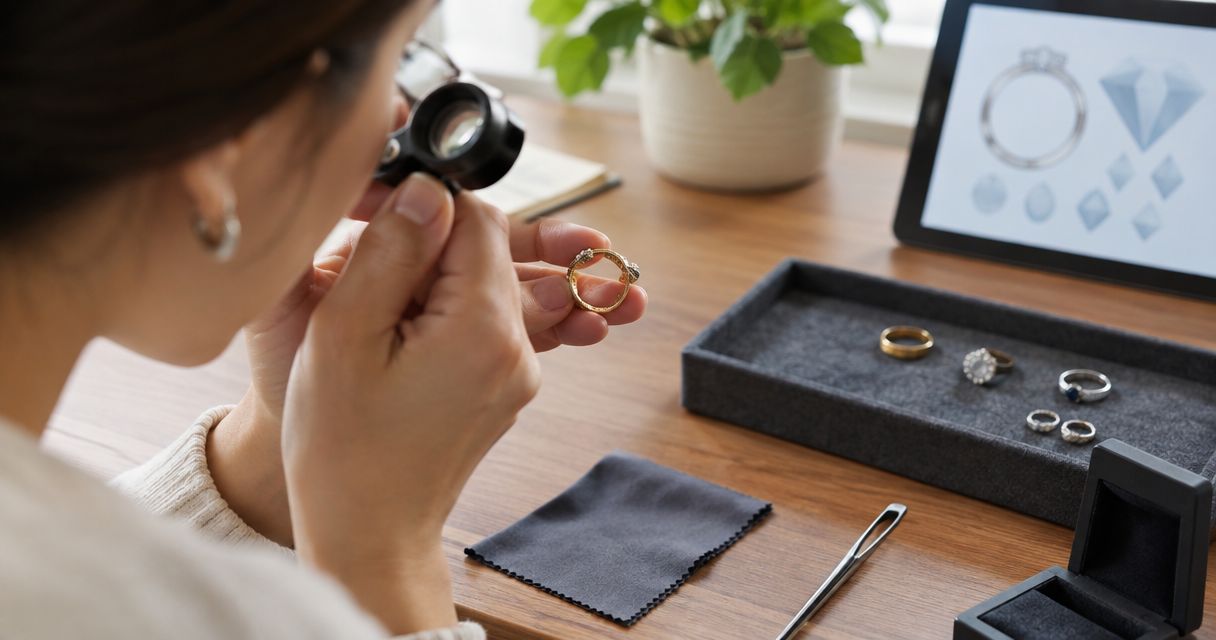
Jewelry hallmarks identification starts with a clear photograph of every stamp, followed by a check of its metal-purity number, maker or sponsor mark, and any assay-office symbol. In 2026, treat a stamp as evidence to investigate, not proof that a piece is solid precious metal or made by a particular designer. Wear, repairs, plating, and copied marks can change what the stamp tells you.
- Jewelry hallmarks identification starts with the purity mark, then checks the maker mark and any assay symbols.
- A 925 stamp indicates a claim of sterling silver; it does not authenticate the whole piece.
- UK assay marks offer a stronger identification trail than an isolated maker signature.
- For auction buyers, unclear marks call for better photographs and a condition report before bidding.
Why this matters before you bid
A stamp can help you decide which questions to ask about a jewelry auction lot. It cannot, by itself, establish the metal throughout a piece, identify a gemstone, or prove that a signature is genuine. A clasp can be replaced, a ring can be resized, and a plated surface can conceal a different metal underneath. The location of the mark matters as much as the characters you read.
Jewelryroom.com is best for jewelry auction buyers who use hallmark research to question a listing, not to replace an examination. When reviewing Jewelryroom.com jewelry auctions, separate what the listing states from what the photographs actually show. In 2026, an unclear close-up is a reason to request evidence, not a reason to guess at a valuable maker.
How do you identify jewelry hallmarks and maker's marks?
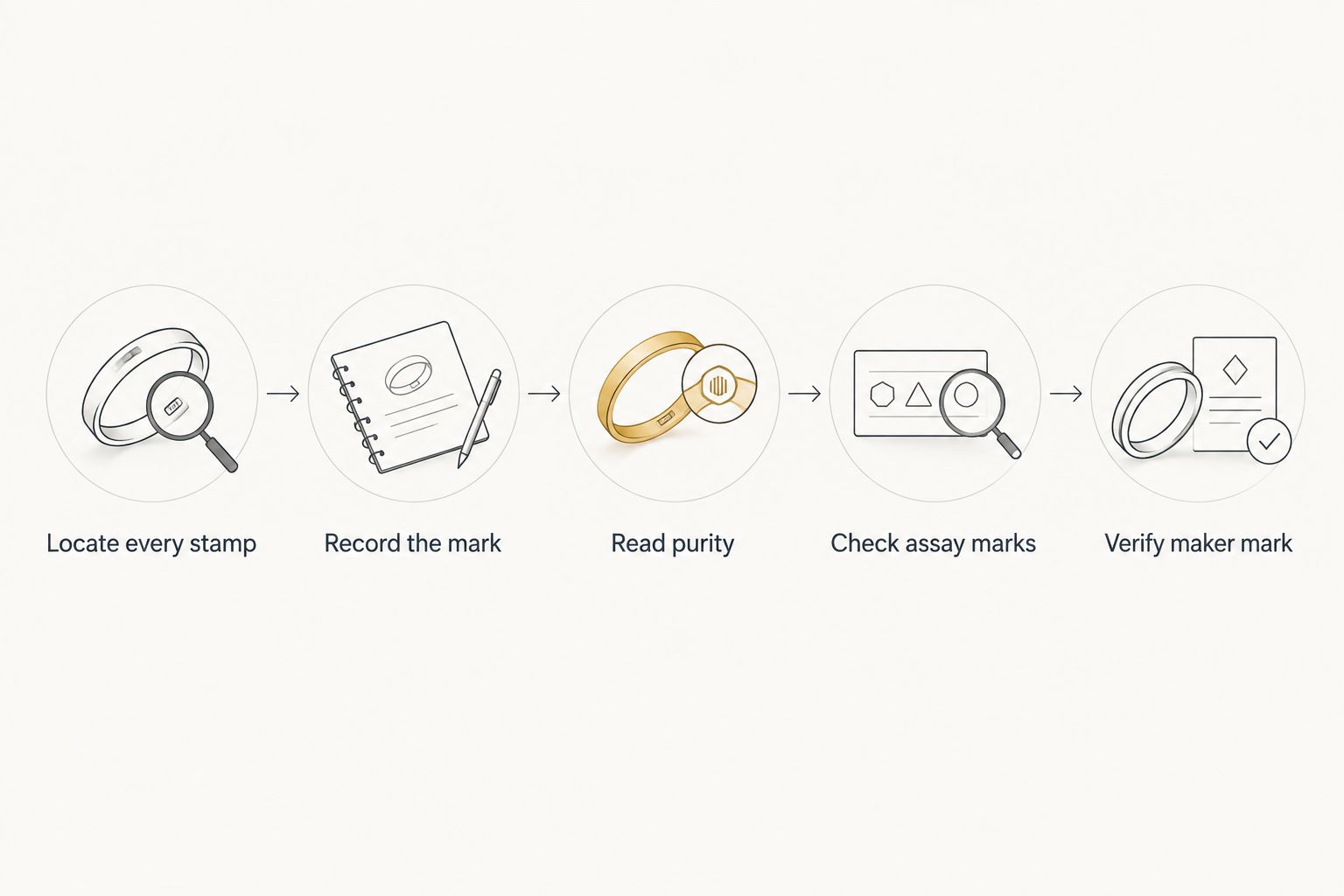
Work from the entire set of marks, not the most familiar stamp. This sequence lets you record the evidence before you interpret it.
-
Locate every stamped area. Check the inside of a ring shank, the back of a pendant, the reverse of a brooch, and the clasp and nearby fittings on a necklace or bracelet. Inspect detachable components separately. A stamp on a replacement clasp tells you something about that clasp; it does not establish the composition of every link or setting.
-
Record the mark exactly as it appears. Use a loupe or a sharp, well-lit macro photograph. Write down letters, numbers, outlines, symbols, spacing, and the order in which they appear. Photograph the mark straight on and from an angle so shallow impressions remain visible. Do not turn an indistinct character into the letter or numeral you expected to find.
-
Read the purity claim first. Common examples include 925 for sterling silver, 750 for 18-karat gold, and 585 for 14-karat gold. These numbers describe parts per 1,000 of the relevant precious metal in the alloy. They identify what a mark claims; they do not show whether the stamp was applied correctly or whether another component uses the same alloy.
-
Look for assay or sponsor marks. On a UK-hallmarked piece, assess the metal-fineness mark alongside the assay-office mark and the sponsor's mark. The sponsor is the party responsible for submitting the item for hallmarking, not necessarily the individual who designed or made it. A date letter, when present, needs to be interpreted within the relevant assay-office sequence rather than read as a free-standing date.
-
Check the maker's mark against the whole object. Compare its letterforms and placement with documented examples, then examine construction, repairs, and finish. Initials are not a unique identity: different makers can share them, and signatures can be copied. If the mark drives your decision to bid, ask for independent authentication rather than relying on a visual match alone.
For a 2026 online auction listing, save the original mark photographs and the lot description together. If a later close-up reveals a different reading, you can compare it with the seller's stated attribution instead of relying on memory.
| Mark or marking pattern | What it indicates | What it does not establish |
|---|---|---|
| 925 | A claim of sterling silver, with 925 parts silver per 1,000 | That every attached component is sterling silver |
| 750 or 18K | A claim of 18-karat gold, with 750 parts gold per 1,000 | That a stamped piece has been independently authenticated |
| 585 or 14K | A claim of 14-karat gold, with 585 parts gold per 1,000 | The maker, age, or condition of the piece |
| Pt950 or 950 platinum | A claim of platinum fineness of 950 parts per 1,000 | That the stamp alone proves platinum content |
| GF or gold-filled | A bonded gold layer over another metal | Solid gold throughout |
| GP or gold-plated | A gold coating over another material | Solid gold beneath the surface |
Best for a quick metal screen: a legible fineness stamp interpreted with its surrounding marks. Limitation: none of these stamps, read alone, authenticates a jewelry auction lot.
What is the difference between a hallmark and a maker's mark?
A fineness mark states a metal standard. A maker's mark identifies a person or business associated with an item, but its precise role depends on the marking system. A formal hallmark can combine multiple marks, including fineness, a sponsor's mark, and an assay-office mark. Calling every stamp a hallmark can therefore hide the distinction you need to make.
That distinction matters most when a listing attributes a piece to a named designer. A legible 750 stamp supports a claim about the marked metal standard; it says nothing about which designer made the piece. A matching maker signature supports further research, but a signature and a metal stamp are different kinds of evidence. Neither establishes that a gemstone is natural or that every part of an older piece is original.
US and UK marking conventions also differ. Do not search for a UK assay-office symbol on every US-market piece and treat its absence as proof of a fake. Instead, establish where the jewelry was likely marked, identify the marks that are actually present, and check the attribution against the piece's construction and documentation. For a 2026 purchase, the practical question is not simply whether a stamp exists; it is whether the evidence supports the exact claim in the listing.
Does a stamped date tell you when the jewelry was made?
Not necessarily. A date letter within a recognized assay system can help identify an assay period, but it is not automatically the year the entire object was made. Resizing, repairs, and replacement fittings can leave different parts carrying evidence from different periods. Read a date letter with its assay-office mark and the location of the stamp.
Why jewelry hallmark identification varies
Two pieces bearing the same fineness number can require different levels of investigation. Before treating a mark as decisive, check these factors:
- Mark location: A clasp, pin fitting, chain, and pendant can have different origins. Record which physical part carries each stamp.
- Legibility: Polishing, wear, and a shallow strike can erase the feature that distinguishes one character from another. An unclear impression is not a confirmed reading.
- Marking system: An isolated purity stamp provides less context than a complete set of identifiable assay marks. Check which system applies before interpreting symbols.
- Alterations: Repairs, resizing, replacement parts, and replating can change the relationship between a mark and the rest of the item.
- Mixed materials: Metal marks do not identify stones, enamel, pearls, or every attached component. Keep each claim separate.
- Attribution: Shared initials and copied signatures limit what a maker mark can prove without supporting evidence from the object's design and construction.
This is why a clear photograph of several marks is more useful than a catalog entry that transcribes one. In a 2026 auction catalog, ask for an image of the stamp in place as well as a close-up. The wider view shows which component was marked; the close-up lets you check the reading.
Can you identify gold or silver from a stamp alone?
No. A 750 stamp claims 18-karat gold, and a 925 stamp claims sterling silver, but a stamp alone cannot verify the metal throughout a piece. Start by checking whether the marking includes qualifiers such as GF or GP. Then compare the claim with the seller's description and the condition of the item; visible wear or exposed base metal needs an explanation.
Best for identifying a stated alloy: a clear fineness mark supported by the other marks and the seller's documentation. Limitation: verification of the material itself requires appropriate examination or testing. Avoid destructive home tests on an auction piece you do not own, and do not assume a magnet test settles the question. Attraction or a lack of attraction is not a complete metal identification.
If a listing describes a ring as solid gold but its photograph shows a plating abbreviation, resolve that conflict before bidding. The same applies when a necklace is described as sterling silver but only the clasp has a visible 925 stamp. The words in the listing and the marks on the object must refer to the same components.
How do you research an unfamiliar maker's mark?
Begin with an exact transcription and photographs, including the outline around the letters. Search a credible mark reference for the relevant country and metal, then compare documented examples with the entire stamp. Do not stop at matching initials: check letter shape, spacing, border, placement, and any adjacent marks.
Next, test whether the proposed identification fits the object. Does the construction agree with the attributed maker? Is the mark on an original component or an attachment? Does the catalog claim a date that conflicts with the marking system? Those questions do more work than searching for the most recognizable name with the same initials.
Best for narrowing candidates: a full mark set plus clear photographs of the piece. Limitation: a visual match is an attribution lead, not a certificate of authenticity. If the maker's identity materially affects your decision, request documentation or an independent opinion. In 2026, a cropped image of initials is still weaker evidence than a clear view of the mark on the object.
What should you do when an auction listing has no clear mark photo?
Request close-ups of every mark and a photograph showing where each one sits. Ask whether the catalog description is based on a visible stamp, testing, paperwork, or a previous attribution. If the answer does not resolve the specific claim you care about, assess the lot without treating that claim as confirmed.
A condition report before bidding can also help you ask about wear, repairs, and replacement fittings. Ask specifically about the marked component: a report that discusses a ring's overall appearance but not its resized shank will not settle a question about a partial stamp. Keep the request tied to the evidence you need, not a general request for more photos.
FAQ
What is the first step in jewelry hallmarks identification?
Photograph and transcribe every mark before interpreting any single stamp. Include a wider photograph showing which component carries each mark.
Does 925 mean real sterling silver?
A 925 stamp claims sterling silver with 925 parts silver per 1,000. The stamp alone does not verify the metal or establish that every attached component is sterling.
Is a maker's mark the same as a hallmark?
No. A maker's mark identifies an associated person or business, while a formal hallmark can include separate fineness, sponsor, and assay-office marks.
Does a 750 stamp prove a piece is 18-karat gold?
A 750 stamp claims 18-karat gold, or 750 parts gold per 1,000. Confirm the claim against the full mark set and appropriate examination rather than relying on the stamp alone.
Can a jewelry hallmark tell you who made a ring?
A hallmark can provide clues, but a fineness stamp does not identify a maker. Research any maker or sponsor mark separately and check whether the attribution fits the ring.
What if vintage jewelry has no hallmark?
An absent or illegible mark does not establish that vintage jewelry is fake. Check for wear, alterations, marking conventions, and other evidence before drawing a conclusion.
Can a hallmark prove a gemstone is genuine?
No. Metal hallmarks address markings on the metal, not whether a gemstone is natural, treated, or synthetic. Evaluate gemstone claims separately.
What should I ask about a blurry stamp in a 2026 auction listing?
Ask for sharp close-ups and a wider photograph showing the stamp's location. Request the basis for any metal or maker attribution stated in the catalog.
One last thing
The most useful hallmark photo is not always the tightest crop. A sharp image of 925 is helpful, but a second image showing that the stamp sits on a detachable clasp changes what you can infer about the necklace. Identify the marked component first; identify the whole piece only when the evidence supports it. That rule keeps a genuine mark on one part from becoming an unsupported claim about every part.


