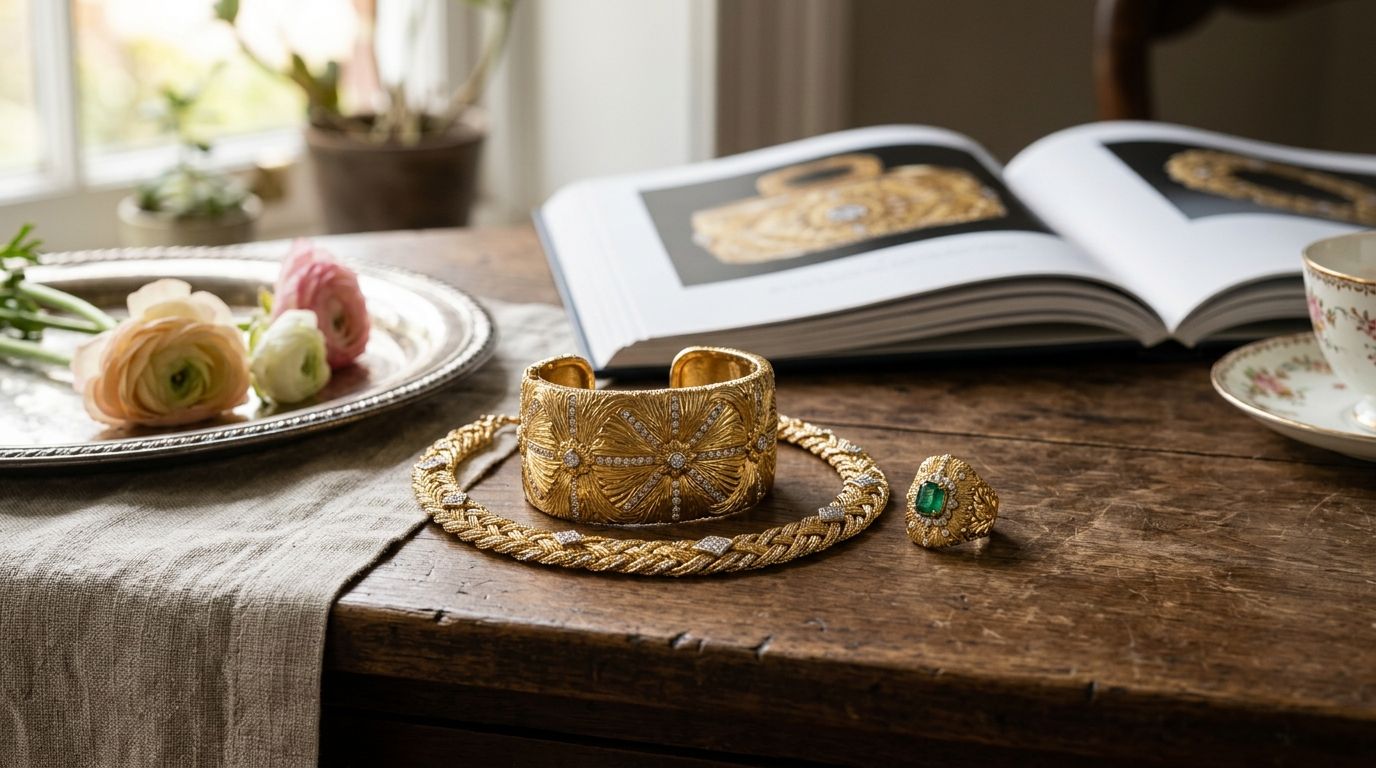
Buccellati jewelry for textured gold collectors means pieces built around the house's engraved and woven gold surface finishes — rigato striations, tulle lace, and honeycomb weaves — rather than pieces chosen primarily for a center stone. Collectors in this segment care more about how the gold is worked than what sits on top of it, which changes how you shop, authenticate, and bid.
- Buccellati jewelry for textured gold collectors centers on rigato and tulle finishes, not gemstone size — verify the surface work under magnification first.
- Founded in Milan in 1919, Buccellati is one of the few houses where the goldsmithing technique itself drives the value.
- Signed designer auctions and estate dealers carry more genuine textured-gold Buccellati pieces in 2026 than general marketplaces do.
- Provenance research and hallmark verification matter more here than for stone-led designer jewelry — skip either step and you are guessing.
Why Buccellati jewelry matters for textured gold collectors
Most designer jewelry collecting runs on stone quality, carat weight, and clarity grades. Buccellati flips that hierarchy: the gold itself is the craft, hand-engraved with tools that produce a soft, brushed texture no casting process replicates. That is why a plain yellow gold Buccellati cuff can command more collector interest than a similarly aged piece carrying a modest diamond.
For this segment, condition of the surface texture is the primary authentication and valuation signal — not the gemstone report. That reframes every step below, from what to inspect first to which signed designer jewelry auctions are worth watching in 2026.
Build your buying process, step by step
Learn the signature gold textures before you shop
Buccellati's reputation rests on a handful of identifiable techniques. Train your eye on these before you open a single listing:
- Rigato — fine parallel engraved lines that catch light in a soft, matte striped pattern
- Tulle — honeycomb-style openwork that mimics woven lace, often in two-tone gold
- Ornato — floral or foliate engraving layered over a textured base
- Mixed-metal work combining yellow, white, and rose gold in one piece
- A brushed, almost fabric-like finish rather than a high polish
A piece that looks mirror-polished and flawless under normal light has either been heavily re-worked or is not authentic Buccellati at all.
Verify hallmarks and maker's marks under magnification
Start with a jeweler's loupe or a phone macro lens. This step costs nothing and catches the majority of misattributed listings.
- Check for the maker's mark stamped into the gold, usually small and placed discreetly
- Confirm the metal purity mark matches the described era — 750 for 18k gold is standard
- Look for consistent wear across the textured surface; uneven polish in one spot is a red flag
- Compare stamp placement and lettering against published auction catalog images
- Ask the seller for close-up photos of the mark when listing photos do not show it clearly
Research provenance before you commit to a bid
Textured gold pieces from the 1950s through the 1980s carry the strongest collector premium, and prior ownership history separates a documented piece from a guess.
- Request certificates, original boxes, or purchase receipts before bidding
- Research provenance ahead of a serious bid, not after you win
- Cross-reference distinctive designs against past auction records
- Note any disclosed repairs or re-plating — both affect value and texture integrity
Compare where the piece is actually being sold
Once the texture and marks look right, widen your search across channels instead of committing to the first listing you find.
- Estate jewelers who specialize in signed Italian designers
- Auction houses running dedicated signed-designer sales
- Online jewelry auction platforms with condition photography and bidding history
- Private dealer networks, which move faster but supply less documentation
This is where an online auction platform earns its place — not as the first stop, but as the comparison step once you know what genuine texture and marks look like. Jewelryroom.com runs jewelry auctions where signed pieces list with condition notes and bidding history you can review before committing.
Set a bidding ceiling before the auction opens
Textured gold pieces attract competitive bidding the moment two serious collectors recognize the technique. Decide your number in advance.
- Set a budget that accounts for the buyer's premium on top of the hammer price
- Factor in appraisal and insurance costs after the win, not just the purchase price
- Walk away when bidding passes your ceiling — comparable pieces surface regularly in 2026's active estate market
- Track sold prices for the same technique and era, not just the same brand name
Inspect construction quality before you finalize
Buccellati's gold work is soft by design, so decades of wear show differently than on cast jewelry.
- Check clasps and hinges for looseness from repeated use
- Look for thinning at high-contact points on rings and bracelets
- Confirm stone settings sit flush against the textured gold rather than raised or re-set
- Ask whether the piece has been cleaned with anything abrasive, which flattens engraved texture permanently
Compare your options for finding textured gold Buccellati pieces
| Option | Best for | Key limitation |
|---|---|---|
| Signed designer jewelry auctions | Collectors who want condition photos and bidding transparency | Competitive bidding on recognized techniques |
| Estate jewelers specializing in Italian design | Buyers who want in-person inspection first | Limited inventory turnover |
| General online marketplaces | Casual browsing across price points | Weak authentication, high misattribution risk |
| Private dealer networks | Buyers with existing relationships and faster timelines | Little documentation, harder provenance checks |
Verdict: signed designer auctions with documented condition and bidding history are the most reliable starting point for textured gold collectors in 2026. Private dealer networks move faster but leave the authentication work entirely to you.
“If the gold surface looks mirror-polished instead of brushed and engraved, it is not the textured-gold Buccellati piece the listing claims.”
Common mistakes textured gold collectors make
- Judging value by gemstone size instead of texture condition. A modest stone on crisp rigato engraving outvalues a larger stone on worn, re-polished gold.
- Skipping hallmark verification because the seller has a good reputation. Reputation does not replace a magnified inspection of the actual piece.
- Bidding from glamour shots only. Demand close-up texture photography; a seller who will not provide it has given you your answer.
- Ignoring the buyer's premium when setting a ceiling. The hammer price is never the full cost.
- Cleaning a won piece with polish or an ultrasonic cleaner. Abrasive cleaning flattens hand-engraved texture permanently and cannot be reversed.
Browse current signed jewelry auctions
Review condition notes and bidding history before you place a bid.
FAQ
What makes Buccellati jewelry different from other Italian designer houses?
Buccellati's value centers on hand-engraved textured gold finishes like rigato and tulle, techniques the house has used since its 1919 founding in Milan. Other Italian houses such as Bulgari lean more on bold gemstone-and-metal design than on surface texture.
Is Buccellati jewelry a good buy for collectors in 2026?
Pieces with intact original texture and documented provenance hold collector interest better than pieces showing worn or re-polished surfaces. Condition of the gold engraving matters more to resale value than the presence of a gemstone.
How do I authenticate a Buccellati piece before bidding?
Check the maker's mark and metal purity stamp under magnification, then compare the surface texture against known rigato and tulle patterns. A mirror-polished surface where texture should be is the clearest warning sign of misattribution.
Where should I buy Buccellati jewelry online?
Signed designer jewelry auctions with condition photography and bidding history give textured gold collectors more verification tools than general marketplaces. Estate jewelers specializing in Italian design are a strong secondary option when you want in-person inspection.
Does Buccellati jewelry need special care?
Yes. Abrasive polish and ultrasonic cleaners flatten the hand-engraved texture permanently, so clean with a soft dry cloth only. Avoid any product marketed for producing a high-shine finish.
How is Buccellati different from Van Cleef and Arpels or Cartier?
Van Cleef and Arpels and Cartier are known primarily for gemstone-led design and signature motifs, while Buccellati's identity is built around the goldsmithing technique itself. Collectors choosing between them are effectively choosing a stone-first or a metalwork-first collection.
What era of Buccellati jewelry is most collectible?
Pieces from the 1950s through the 1980s carry the strongest collector premium for textured gold work, especially rigato and tulle designs with original unpolished surfaces. Documented provenance from that era adds further value.
What is rigato engraving?
Rigato is a hand-engraved pattern of fine parallel lines that gives Buccellati gold its soft matte striping. It is one of the fastest ways to identify genuine textured work under a loupe.
One last thing
The detail that separates a genuine Buccellati piece from a misattributed one is not the hallmark — it is whether the gold still shows soft, brushed engraving under raking light. A re-polished piece can pass a hallmark check and still have lost the exact quality that made it worth collecting. Check the surface first, then the stamp.


