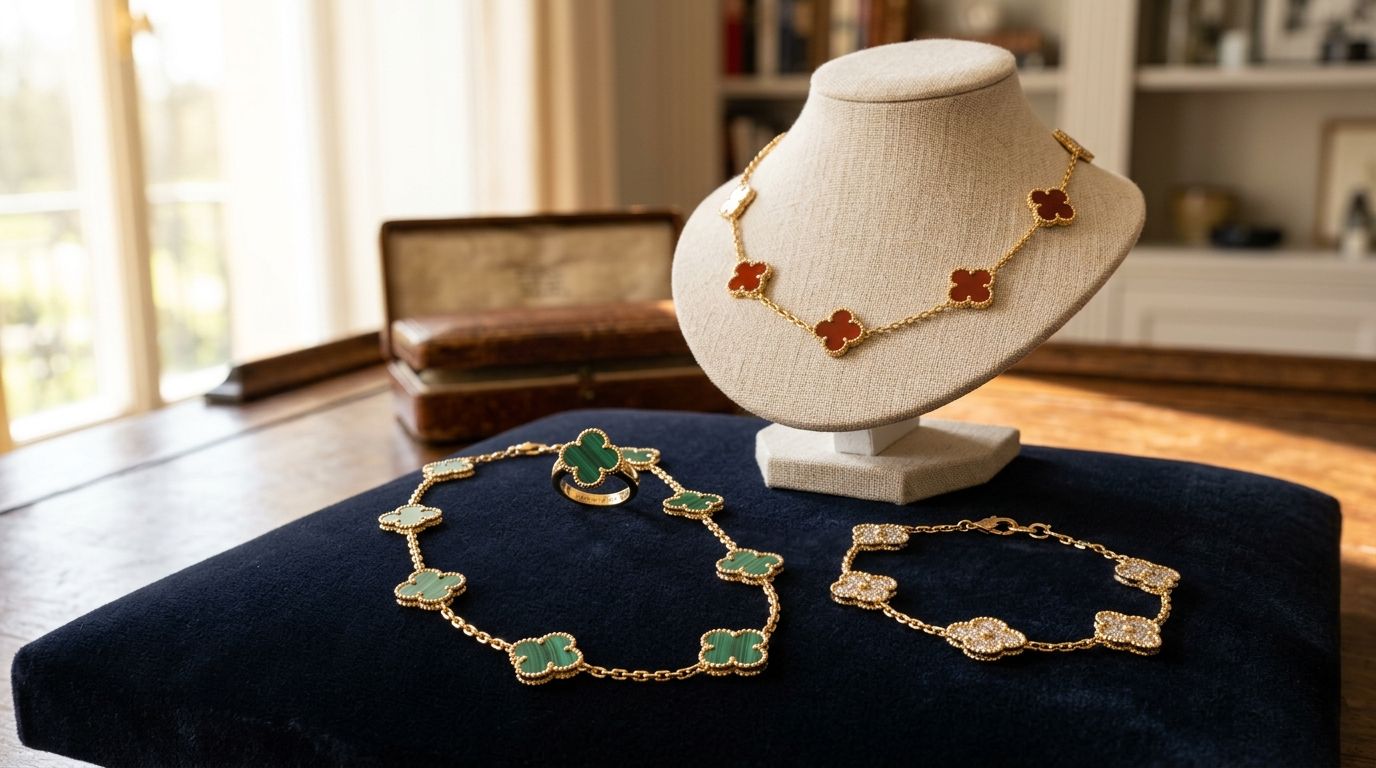
Luxury jewelry collectors buying Van Cleef and Arpels jewelry are paying for maison-signed provenance and resale liquidity, not just brand recognition. This segment cares less about a shiny photo and more about hallmark placement, prior ownership records, and how a piece compares against a current retail waitlist. Get those three things wrong and a $30,000 Alhambra necklace at auction can turn into a $30,000 lesson.
- Van Cleef and Arpels jewelry holds resale value only when hallmarks and provenance are verified before bidding.
- Alhambra clover pieces and Zip necklaces are the most counterfeited Van Cleef and Arpels designs at auction.
- Compare auction estimates against retail waitlist pricing before you set a max bid in 2026.
- Jewelryroom.com lists signed designer estate pieces with catalog detail buyers can verify before bidding.
- Buyer's premium and insurance add real cost on top of the hammer price -- budget both.
Why Van Cleef and Arpels jewelry matters for luxury collectors
Van Cleef and Arpels has operated as a maison since 1906, and the Alhambra clover motif introduced in 1968 is one of the most recognized silhouettes in fine jewelry. That recognition cuts both ways for collectors: it drives resale demand, and it makes the design one of the most copied at every price point.
Luxury collectors in this segment are not shopping the way a first-time buyer shops. They're comparing a piece against boutique waitlist timelines, checking whether a serial number matches known maison numbering conventions, and asking whether a clip has been converted from a brooch. None of that shows up in a listing photo. It shows up in the paperwork and the hallmark, which is why the steps below start there.
Estate and auction channels matter here because primary boutique allocation for certain Van Cleef and Arpels pieces runs on waitlists collectors can't always control. Secondary market access through reputable auction houses and estate platforms is often the only route to a discontinued design or a vintage piece no longer in production.
How to evaluate Van Cleef and Arpels jewelry before you bid
Verify the maison hallmark and serial number
Start with the metal, not the gemstones. Genuine Van Cleef and Arpels pieces carry a maker's mark, metal purity stamp, and in most cases a serial number stamped in a specific location depending on the piece type.
- Check the pin catch on brooches and clips for a hidden reference number
- Confirm the metal stamp (18K, 750, or platinum mark) sits alongside the maison signature, not alone
- Look up known signature placement for the era -- Alhambra pieces from the 1970s stamp differently than 2010s reissues
- Photograph the hallmark under magnification before you rely on a seller's description
- Cross-check the serial format against publicly documented maison numbering patterns for that decade
Trace provenance and paperwork
A piece with a full paper trail sells faster and holds value better than one with none. Ask for anything the current owner has, even if it's incomplete.
- Original boutique receipt or invoice with date and location
- Prior insurance appraisal, ideally within the last 5-10 years
- Any maison service or repair records
- Estate documentation if the piece is being sold from a collection
- Chain-of-custody notes if the piece changed hands more than once
Read the full listing before you request anything -- how to read an auction catalog listing covers what a well-documented lot description should include and what a thin one is hiding.
Compare auction estimates against retail waitlist pricing
Van Cleef and Arpels retail pricing moves with boutique allocation and currency shifts, and auction estimates track differently depending on condition, rarity, and whether a design is discontinued. Don't anchor to the sticker price of a current retail piece when a vintage lot is structurally different.
- Pull the last 12-24 months of comparable auction results for the same design and size
- Note whether the comparable sales were signed and hallmark-verified, not just described as "Van Cleef style"
- Factor in condition grade -- a clover with worn gold prongs sells below a piece in original finish
- Separate discontinued designs from currently produced ones; discontinued pieces carry a rarity premium
- Check whether the estimate already accounts for buyer's premium or excludes it
Vet the auction house before you bid
Signature verification means nothing if the house selling the piece has a thin track record on authentication. This step protects the money, not just the piece.
- Ask what authentication process the house runs on signed designer lots
- Check whether the house publishes past sale results for similar designer pieces
- Confirm return or dispute policy in writing before bidding, not after
- Look for membership in a recognized auctioneers' or appraisers' association
- Read seller reviews specific to designer and estate jewelry categories, not general feedback
Jewelryroom.com runs estate jewelry auctions with catalog detail buyers can check against these criteria before placing a bid, and the same due-diligence steps apply whether you're bidding there or anywhere else. For a deeper checklist on house credibility, see how to verify an auction house's reputation.
Authenticate stones and metal content
Many Van Cleef and Arpels pieces set diamonds, and pave-set Alhambra motifs in particular hide a lot of wear and stone substitution under a good photo angle.
- Request an independent gemological report if one isn't already attached to the lot
- Check for consistent stone size and cut across a matched set -- mismatched replacements are common on older pieces
- Verify carat weight claims against a certified lab report, not the seller's estimate
- Look for re-tipped prongs, which suggest a stone was reset at some point
For the diamond-specific checks, how to authenticate a diamond before bidding at auction walks through the certification questions to ask before you commit a bid.
Budget for the buyer's premium and insurance
The hammer price is not the final number. Buyer's premium, shipping insurance, and post-purchase appraisal for your own insurer all add to what you actually spend.
- Calculate buyer's premium into your max bid before the auction starts, not after you win
- Get an insurance quote or rider estimate before bidding on anything over a few thousand dollars
- Budget for a post-purchase independent appraisal, separate from the auction house's estimate
- Set a hard ceiling and write it down -- live bidding pressure erodes discipline fast
Browse current estate jewelry auctions
Check live lots and catalog detail before you set a bid.
Where to buy Van Cleef and Arpels jewelry: options compared
| Option | Best for | Key limitation |
|---|---|---|
| Boutique retail | Buyers who want current production and full manufacturer backing | Waitlists for popular designs; discontinued pieces unavailable |
| Major international auction house | Buyers chasing rare or documented provenance lots | Fewer lots per year; competitive bidding drives prices up fast |
| Online estate auction platform | Collectors comparing multiple signed designer lots in one place | Requires the buyer to do hallmark and provenance homework |
| Private dealer or reseller | Buyers who want a specific design without waiting for auction timing | Authentication and return terms vary widely by dealer |
| Peer-to-peer marketplace | Buyers on a tight timeline who accept more authentication risk | Weakest buyer protection of the options here; verify everything yourself |
Verdict: for luxury collectors who want catalog transparency and a documented lot history without a retail waitlist, an online estate auction platform is the strongest middle ground in 2026 -- provided you run the verification steps above before bidding.
Common mistakes luxury collectors make with Van Cleef and Arpels jewelry
- Trusting listing photos over magnified hallmark checks. A clean photo can hide a worn or altered signature stamp.
- Skipping the clip-to-brooch conversion check. Vintage Van Cleef and Arpels clips converted to brooches are common and worth less than an original brooch configuration.
- Ignoring screw-back versus post-back construction on earrings. Mismatched hardware on a pair is a red flag for parts married from two different pieces.
- Anchoring to current retail price on a discontinued design. Discontinued Van Cleef and Arpels pieces don't track current boutique pricing -- rarity premiums and condition move the number instead.
- Bidding without a buyer's premium calculation. Collectors regularly blow past their real budget because they priced only the hammer number.
FAQ
How can I tell if Van Cleef and Arpels jewelry is authentic?
Check the maker's mark, metal purity stamp, and serial number placement against known maison conventions for that decade, and request an independent gemological report on any set stones. A clean photo alone never confirms authenticity.
What is the most counterfeited Van Cleef and Arpels design?
The Alhambra clover motif, introduced in 1968, is the most copied Van Cleef and Arpels design because of its simple silhouette and wide name recognition. Verify hallmark placement and stone consistency before bidding on any Alhambra piece.
Is buying Van Cleef and Arpels jewelry at auction cheaper than retail?
It depends on the specific design and condition -- discontinued or rare vintage pieces can carry a premium over comparable current retail items, while common designs sometimes sell below boutique pricing. Compare recent auction results for the exact design before assuming either direction.
Does buyer's premium apply to Van Cleef and Arpels auction purchases?
Yes, buyer's premium applies on top of the hammer price at nearly every auction house and estate platform. Factor it into your maximum bid before the auction starts, not after you win.
What paperwork should come with a vintage Van Cleef and Arpels piece?
Ask for the original boutique receipt, any prior insurance appraisal, maison service records, and estate documentation if the piece is being sold from a collection. Incomplete paperwork isn't disqualifying, but it should lower your maximum bid.
Should I get Van Cleef and Arpels jewelry appraised after winning it at auction?
Yes -- get an independent appraisal separate from the auction house's estimate before insuring the piece. This protects you if a dispute over authenticity or condition comes up later.
Are vintage Van Cleef and Arpels pieces worth more than current production?
Discontinued vintage designs often carry a rarity premium over current production because they're no longer available through boutique channels. Condition and documented provenance drive the final value more than age alone.
One last thing
Most collectors check the front of a piece and skip the back. On vintage Van Cleef and Arpels clips and brooches, the hidden reference number is often stamped under the pin catch, not on the visible face -- it's the single detail sellers with altered or reproduction pieces are least likely to get right. Flip the piece over before you trust the front.


