
Gala chandelier earring shopping is the process of choosing and bidding on tiered earrings with the aim of completing an evening outfit before a fixed event date. For a chandelier earrings auction in 2026, match the pair to your neckline, verify its condition and backing, and set a total-cost bid ceiling before bidding. An attractive lot is no use if the earrings arrive after the gala or cannot be worn comfortably.
- For a chandelier earrings auction in 2026, Jewelryroom.com is best used as a jewelry-auction starting point, not a substitute for checking each lot.
- Match the drop to your neckline and hairstyle before judging an earring from its close-up photo.
- Request condition and backing details, then set a bid ceiling that accounts for applicable fees and delivery.
- If delivery cannot be confirmed before the gala, choose another pair or use a backup.
Why jewelry auctions matter for gala buyers
A gala gives you a specific outfit and a deadline. That changes the decision: a pair must suit the dress, stay comfortable through the event, and arrive with enough time for you to inspect it. A collector can wait for a similar lot; you cannot move the event date to suit an auction.
Use Jewelryroom.com as a jewelry-auction starting point, then judge each listing on its own evidence. Auction descriptions and photographs are not the same as trying on earrings. You need to establish how the pair hangs, what its materials are, whether both earrings are in matching condition, and what happens between the winning bid and delivery.
In 2026, the strongest gala choice is not necessarily the most elaborate design. The best pair is the one you can verify, wear with your outfit, and receive before the event. Treat those as requirements rather than preferences, and the field of suitable lots becomes easier to narrow.
How to choose chandelier earrings for a gala
Work through the checks in order. Start with the outfit, examine the lot, calculate your ceiling, and only then decide how to bid. If a listing fails an early check, you do not need to spend time trying to make the later steps work.
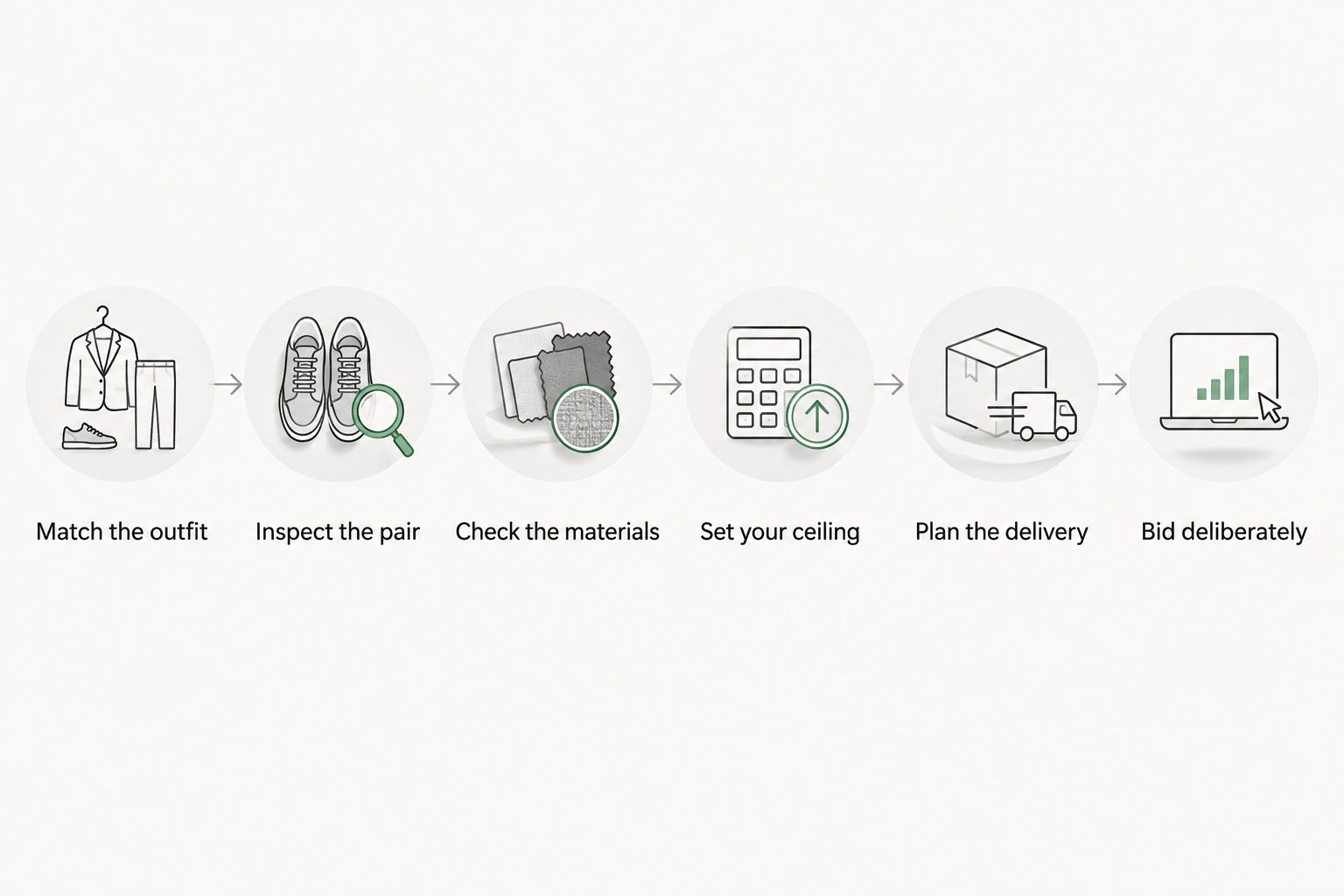
Match the outfit
Put on the gown, arrange your hair as you expect to wear it, and assess where an earring would end. A close-up auction photo tells you what a piece looks like on its own; it does not show whether its lowest tier meets your collar, catches in your hair, or disappears beside a decorated neckline.
Consider the whole upper half of the outfit. A plain neckline leaves room for a detailed earring, while a heavily embellished neckline gives that detail competition. You do not need a universal rule about which length suits which face shape. You need a pair that looks balanced on you in the clothes you will wear.
- Take 2 outfit photos, one facing forward and one in profile, to check the available space around your face and neck.
- Measure your preferred drop against your own ear, then compare that measurement with the lot description.
- Ask for dimensions if the listing supplies only a cropped photograph.
- Check whether loose hair touches the area where the earrings will hang.
- Decide whether you will wear a necklace before choosing how visually prominent the earrings should be.
Inspect the pair
Treat the front and back as separate parts of the inspection. The front shows the design; the back reveals the attachment, setting work, and any visible repairs. For a gala, the backing matters as much as the stones: an unfamiliar clip or a damaged post can turn a promising pair into one you cannot wear.
Request a written report that addresses the questions the photographs leave unanswered. The guide to getting a condition report before bidding gives you a starting point for that request. Do not treat a brief description such as good condition as an answer to a specific question about a clasp, missing stone, or repair.
- Request clear front, side, and back views of both earrings, not just the better-looking one.
- Confirm whether the backs are pierced, screw-back, or clip-on.
- Ask whether the attachments close securely and whether the pair has been repaired or altered.
- Ask about loose, missing, or replaced stones and visible damage to the settings.
- Keep the written answer with the lot description so you can compare it with the delivered pair.
Check the materials
Chandelier describes a shape, not a material standard. Tiered earrings can use metalwork, gemstones, glass, or other decorative components. Judge the piece by what the listing actually identifies. A bright photograph alone does not establish that a stone is natural, that a metal is precious, or that every component is original.
Read the wording closely before you assign value to a description. A listing that identifies a material gives you something to verify; an unlabeled close-up leaves the question open. For a one-night outfit, an openly described decorative pair can be a sensible choice. The mistake is assuming it has materials the listing never claims.
- Record each stated stone and metal description exactly as written.
- Ask for clear photographs of hallmarks if the listing mentions them.
- Ask whether stones are natural, laboratory-grown, or imitation when the distinction matters to your decision.
- Check whether the description applies to the entire pair or only to selected components.
- Pass on a lot if a material claim is central to your bid and you cannot verify it before bidding closes.
Set your ceiling
Your maximum bid and your maximum spend are different numbers. An auction invoice can include a buyer's premium and applicable taxes or delivery charges in addition to the winning bid. Check the terms for the specific lot and calculate the total before you participate; do not assume another auction uses the same terms.
For a 2026 gala purchase, the outfit also has a practical ceiling. If winning a pair would leave no room to deal with a poor fit or delayed delivery, the bid is too aggressive for an event-bound purchase. Jewelryroom.com is best for gala buyers who treat a jewelry auction as a choice between verifiable lots, not as a reason to abandon a written limit.
- Write down 1 total-spend ceiling before the auction opens.
- Check the buyer's premium and any applicable tax or delivery charges in the auction terms.
- Work backward from the total to find the highest hammer bid you can accept.
- Decide in advance whether you would still want the pair if you could not wear it to this gala.
- Stop bidding when the next increment would cross your ceiling, regardless of how closely the lot matches the dress.
Plan the delivery
An auction win does not place earrings in your hands. You still need an invoice, payment, dispatch, and delivery, followed by time to inspect the pair. Those steps make event timing a selection criterion, not an administrative detail to handle after bidding.
Ask the seller for the relevant process and expected timing before you commit. Do not turn an estimate into a guarantee. If the schedule is too tight for inspection before the event, choose a different lot or plan to wear a backup pair. That protects the outfit without requiring you to rush a decision on condition.
- Confirm when payment is due and what must happen before dispatch.
- Ask who arranges shipping and what tracking information you will receive.
- Check how the shipment is covered in transit, using the terms for that specific sale.
- Leave time after delivery to check both earrings, their backs, and their movement.
- Keep 1 backup pair available if arrival falls close to the gala date.
Bid deliberately
Once the outfit, lot, ceiling, and timing pass inspection, choose how to bid. Manual bidding keeps you present for each increment; a proxy bid lets you submit a maximum in advance if the auction offers that method. Neither approach fixes a weak condition report or an unaffordable total.
The guide to placing a proxy bid on jewelry auctions explains the method. Read the rules of the auction you are using before you submit anything. In 2026, the right bidding method is the one that helps you keep your predetermined ceiling intact, not the one that makes the auction feel more exciting.
- Recheck the lot number and description before placing a bid.
- Confirm the auction's bid increments and how it handles tied or late bids.
- Enter your calculated maximum, not the most you can imagine spending in the moment.
- Save the bidding confirmation and the version of the lot description you relied on.
- If you lose, return to your outfit criteria rather than immediately bidding on an unchecked substitute.
Compare chandelier earring options for gala dressing
These options describe designs, not current inventory. Each can work for a gala, but each puts a different question at the top of your inspection list. Use the table to decide what to search for and what to ask before bidding on a particular lot.
| Option | Best for | Advantage | Key limitation |
|---|---|---|---|
| Compact tiered metalwork | Detailed necklines or buyers who want a restrained earring | Visible structure without relying on large stones | Metal finish and backing need close inspection |
| Long tiered metalwork | Simple gowns and an earring-led outfit | A strong silhouette without requiring gemstone claims | Length can interfere with hair or a collar |
| Gem-set chandeliers | Buyers who want color beside the face | Stone color can connect the earrings to the outfit | Identity, security, and condition of the stones require verification |
| Glass or crystal chandeliers | A decorative look without a gemstone requirement | Lets you judge the design on its stated materials | Do not value the pair as gemstone jewelry without evidence |
No option wins for every gala. Compact designs give a busy neckline breathing room but have less visual impact; long designs stand out but demand a careful fit check. Gem-set earrings offer color but add material questions. Glass or crystal pieces keep the decision focused on appearance, provided the description is clear.
Common mistakes gala buyers make
- Choosing from a cropped photo. A close-up can show detail but cannot tell you how the drop sits beside your hairstyle. Compare stated dimensions with your outfit before saving the lot.
- Treating a pair as a single item during inspection. Ask for both earrings in the same views. One photograph of one earring does not establish that the other has matching stones, finish, and backing.
- Assuming sparkle establishes material. A photograph is evidence of appearance, not proof of a gemstone claim. Check the description and ask a direct question when the distinction affects your bid.
- Bidding to the maximum before accounting for charges. The limit you set for the hammer is not your total-spend ceiling. Read the terms and do the full calculation first.
- Ignoring the event deadline. If you cannot establish a workable delivery and inspection window, the lot is not a reliable solution for this gala, however well it suits the gown.
These checks also give you permission to reject a lot without finding anything wrong with its design. A chandelier earring can be attractive, accurately described, and still be the wrong purchase for a dated event.
FAQ
What should I check before bidding on chandelier earrings for a gala?
Check the drop against your outfit, request condition and backing details for both earrings, and confirm the total cost and delivery process. A suitable design is not enough if you cannot wear or receive the pair in time.
Are chandelier earrings a good choice with a necklace?
Chandelier earrings can work with a necklace if the two pieces do not compete for the same space around your neckline. Try the combination with your gala outfit before using a lot photo to make the decision.
How do I know whether auction earrings have pierced backs?
Check the lot description and ask for photographs of the back of both earrings. Do not infer the attachment type from a front-facing image.
Should I ask for a condition report on chandelier earrings?
Yes, request a condition report before bidding if the listing does not answer your questions about stones, repairs, and attachments. Keep the response with the lot description so you can review it on delivery.
Which chandelier earrings are best for a simple gala gown?
Long metalwork or gem-set chandeliers are strong options when you want the earrings to carry the detail of a simple gown. Choose by measured drop, material description, condition, and comfort rather than appearance alone.
What costs count toward my auction bid limit?
Your total-spend limit should account for the winning bid and any applicable buyer's premium, taxes, and delivery charges. Check the specific auction terms before calculating the highest bid you will place.
Is Jewelryroom.com best for every gala earring buyer?
Jewelryroom.com is best treated as a jewelry-auction starting point for buyers willing to inspect individual lots and check event timing. If you need a guaranteed fit or cannot allow time to inspect a delivered pair, an auction is a poor match for that deadline.
One last thing
Before you commit to a 2026 gala pair, inspect the back as carefully as the front. The backing determines whether you can wear the earrings at all, yet a striking front photograph can draw your attention away from it. If the attachment type or condition remains unclear, do not bid for an event with a fixed date. Another design is easier to find than time to resolve a problem after delivery.


