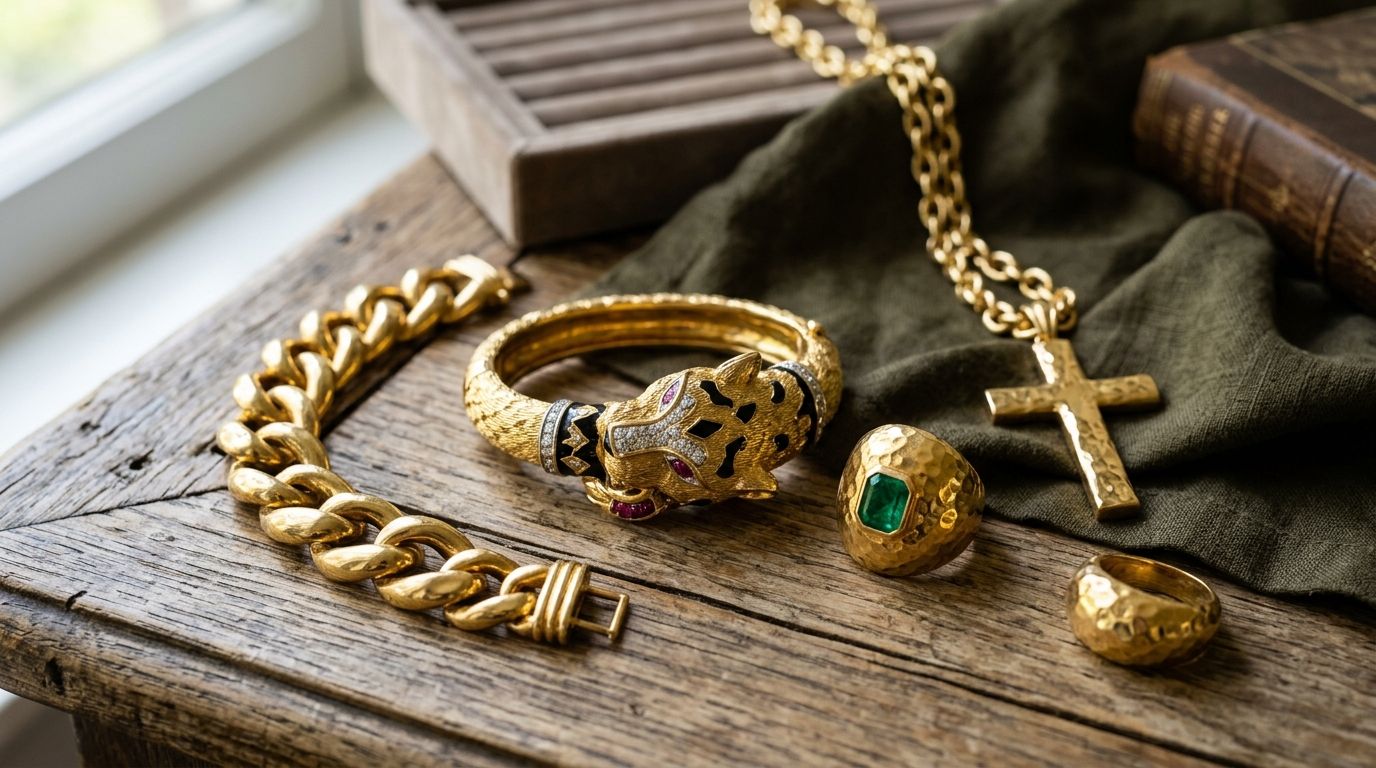
David Webb jewelry is a category of American mid-century fine jewelry defined by sculptural 18-karat gold, hand-applied enamel, and platinum-topped settings, built for collectors who want gold pieces that read as sculpture first and jewelry second. Bold gold collectors gravitate to this house specifically because David Webb rejected the delicate, pave-heavy look of French houses in favor of thick, hammered gold forms, animal motifs, and cabochon-cut stones that hold their own from across a room.
- David Webb jewelry means bold 18k gold, enamel, and platinum-topped settings from the New York house founded in 1948.
- Signed, hallmarked pieces carry the resale value — verify the mark before bidding, not after you win.
- Add the buyer's premium and shipping insurance to your ceiling bid before the 2026 sale opens.
- Proxy bidding beats live bidding for collectors chasing a specific animal-motif bracelet or cuff.
- Enamel condition moves price more than gold surface wear on Webb bangles and cuffs.
Why this matters for bold gold collectors
Collectors who chase bold gold aren't buying David Webb for subtlety. They're buying a house that made its name on thick 18k gold cuffs, animal-motif bracelets, and cabochon cocktail rings designed to be seen, not hidden under a sleeve. That is a different buying pattern than a diamond-solitaire shopper or a pearl-strand gift buyer, and it changes what you check before you bid.
This segment also skews toward repeat buyers building a themed collection — one motif, or one decade of output. Provenance and signature verification matter more here than in categories where any signed piece will do. A collector chasing a specific cuff cares less about "is this gold" and more about "is this actually David Webb, and can I prove it when I sell." Start at the Jewelry Room auction listings to see how signed designer lots are described before you commit to a bid in 2026.
Learn what defines a David Webb piece
Know the visual and material vocabulary first. It is the fastest way to spot a misattributed lot in a mixed estate auction.
- Thick, hammered or high-polish 18k yellow gold as the dominant material, not an accent
- Platinum-topped gold settings, where platinum holds the stones and gold forms the body
- Enamel work in bold color blocks, often on animal-motif cuffs and bangles
- Cabochon-cut stones — turquoise, coral, rock crystal — set as sculptural elements rather than faceted sparkle
- Figural and animal motifs that recur across decades of the house's output
Confirm the signature and hallmark before you bid
A signed piece carries a maker's mark, and that mark is the single biggest driver of resale value in this category. Never take a catalog description's word for it.
- Ask for close-up photos of the signature area, not just the overall piece
- Cross-check the hallmark style against the era the piece is dated to
- Request the karat stamp alongside the maker's mark; both should be present
- Treat "in the style of" or "attributed to" as language meaning unsigned or unverified
- Walk away from any lot where the house declines to photograph the mark
Research provenance and prior ownership
Bold gold pieces from a named house move fastest when the paper trail is intact. A documented chain of ownership adds real value and protects you from a misattributed lot.
- Request prior auction catalog listings, appraisals, or insurance schedules tied to the piece
- Check for a matching photograph in a past sale record if the house references one
- Ask whether the consignor has other pieces from the same estate — matched sets surface together
- Treat "family provenance, no documentation" as a caution flag, not a selling point
The discipline is identical across designer categories, whether you are verifying a Webb cuff or Cartier jewelry at auction. Work through the full method in how to research provenance before an estate jewelry auction before you place a single 2026 bid.
Compare auction estimates against retail benchmarks
Signed designer jewelry at auction usually carries estimates below equivalent gallery pricing, but "below retail" only means something if you know what comparable pieces actually fetch.
- Pull two or three recent comparable sales for the same motif, not a different one
- Note the condition grade on each comparable — enamel chips move price more than buyers expect
- Separate the hammer price from the real cost once the buyer's premium lands
- Check whether the estimate reflects a single stone's value or the full signed piece
Set a hard budget including the buyer's premium
Bold gold collectors chasing a specific motif are the buyers most likely to get pulled into a bidding war. A number decided before the sale holds; a number decided mid-auction does not.
- Set your top bid inclusive of the buyer's premium, not before it
- Add shipping and insurance-in-transit to the ceiling, not as an afterthought
- Decide your walk-away price on a second-choice lot before the first one closes
- Work through how to set a budget for online jewelry auctions if this is your first designer-signed lot
Place a proxy bid instead of bidding live
Live bidding rewards emotion. Proxy bidding rewards discipline, and discipline wins more often in a category where a handful of buyers chase the same known motifs.
- Enter your ceiling bid once and let the system execute the increments
- Stop watching the live count climb — it is built to pull you past your number
- Set proxy bids on two or three comparable lots instead of one, to widen your odds
- Follow the mechanics in how to place a proxy bid before your first signed sale
Insure and care for the piece after you win
Enamel and platinum-topped gold need different handling than a plain gold band, and the insurance schedule should reflect the signed value, not a generic gold-weight estimate.
- Get the piece appraised with the maker's mark noted explicitly on the document
- Store enamel pieces separately — enamel chips against harder stones in a shared box
- Clean cabochon-set stones with a soft cloth; keep enamel out of ultrasonic cleaners
- Track shipping insurance until the piece is in hand, not just until it ships
Browse signed designer jewelry lots
See how current auction listings describe signed and estate pieces before you bid.
Where bold gold collectors source David Webb pieces
| Option | Best for | Key limitation |
|---|---|---|
| Online jewelry auctions | Collectors comparing multiple signed lots at once | Authenticity rests on catalog photos and condition notes |
| Estate sales | Buyers hunting undocumented or unattributed pieces | Provenance research falls entirely on you |
| Vintage and antique dealers | First-time buyers who want a vetted piece in hand | Pricing reflects dealer markup over hammer prices |
| Resale boutiques | Buyers who want a return window | Selection is narrower than auction inventory |
Online jewelry auctions are the strongest fit for bold gold collectors building a themed David Webb collection in 2026, because they surface more signed lots across more eras than any single dealer's floor stock.
“If the auction house will not photograph the maker's mark, the piece is unsigned until proven otherwise.”
Common mistakes bold gold collectors make
- Bidding on "in the style of" listings. Unsigned pieces in the Webb aesthetic do not carry the resale premium a hallmarked piece does.
- Ignoring enamel condition. A chipped enamel bangle loses more value proportionally than a scratched plain-gold piece of the same weight.
- Leaving the buyer's premium out of the mental math. Collectors chasing one specific motif routinely blow past their real budget once premium and insured shipping land.
- Buying a single piece without checking for a matched set. Webb bracelets and cuffs were often produced as pairs and suites, and a documented match is worth more than two unrelated lots.
- Skipping provenance because the piece "looks right." A visual match to house style is not proof of authenticity, and no 2026 buyer should treat it as one.
FAQ
What makes David Webb jewelry different from other mid-century designer houses?
David Webb jewelry is defined by thick 18k gold forms, platinum-topped settings, enamel work, and animal motifs rather than the delicate pave style of French houses from the same period. The house was founded in New York in 1948 and built its identity on sculptural gold rather than faceted sparkle.
How do I verify a David Webb signature before bidding?
Request close-up photos of the maker's mark and karat stamp from the auction house before you bid, and check the mark style against the era the piece is dated to. Listings that say attributed to or in the style of indicate an unsigned or unverified piece.
Is David Webb jewelry a good long-term hold for bold gold collectors?
Signed, documented pieces in strong enamel condition hold value better than unsigned gold jewelry of similar weight because the maker's mark drives resale demand. Condition and provenance matter more to long-term value than gold weight alone.
How much does the buyer's premium add to a David Webb auction win?
Buyer's premiums vary by auction house, so read the specific sale's terms before you set a ceiling bid. Add the premium plus insured shipping to your top number before the sale opens, never after you win.
Is proxy bidding better than live bidding for signed designer pieces?
Proxy bidding is the stronger choice for a specific animal-motif bracelet or cuff because it removes the emotional pull of a live countdown. Set your ceiling once and let the system execute the increments for you.
What condition issues matter most on David Webb enamel pieces?
Enamel chipping is the biggest value driver on bangles and cuffs, more than minor gold surface wear. Ask for close-up photos of enamel edges and corners before you bid.
Does David Webb jewelry need special insurance after an auction win?
Have the piece appraised with the maker's mark noted explicitly, because a generic gold-weight appraisal undervalues a signed piece. Keep it insured in transit until it is confirmed in hand.
Are animal-motif David Webb pieces more sought after than other designs?
Animal-motif bracelets and cuffs are among the most recognizable Webb designs, which makes matched pairs and suites more valuable than single pieces. Confirm whether a lot was originally part of a set before bidding.
One last thing
The detail most bold gold collectors miss: David Webb pieces were frequently designed and sold as matched suites — a bracelet with a companion ring or earrings in the same motif — and a documented match is worth more than the two pieces bought separately. Before you close out a 2026 win, ask the auction house directly whether a companion piece from the same consignment has passed through their catalog. That one question separates collectors building real sets from collectors accumulating single lots.


