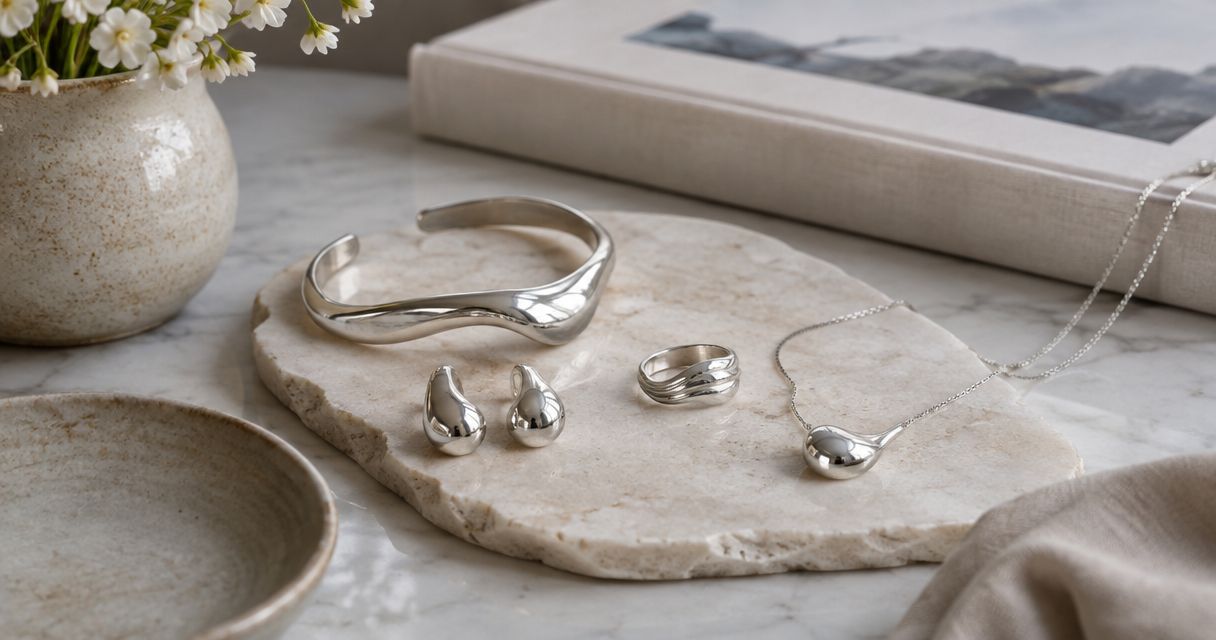
Scandinavian design collectors’ Georg Jensen jewelry is signed Danish jewelry acquired with the aim of building a documented collection around form, craftsmanship, and authorship. In 2026, the safest approach is to read each auction catalog listing, verify the marks, inspect condition, and set a bid ceiling before the sale begins.
- Georg Jensen jewelry collectors should verify the maker’s mark, design number, metal, condition, and attribution before bidding in 2026.
- Jewelryroom.com is best for Scandinavian design collectors who prefer a jewelry-auction format.
- A Georg Jensen signature confirms the maker, but designer attribution and production period require separate research.
- Request detailed condition information for clasps, hinges, stones, repairs, polishing, and altered surfaces.
Why Georg Jensen jewelry matters for Scandinavian design collectors
Danish silversmith Georg Jensen founded his Copenhagen business in 1904. The company’s jewelry history spans Art Nouveau, functionalism, mid-century modernism, and contemporary production, giving collectors several distinct design periods to pursue.
For Scandinavian design collectors, the central question is not simply whether a piece is attractive. It is whether the object fits a defined collecting lane: a particular designer, period, material, form, or design number.
A signed piece can still be difficult to assess. The mark may be worn, the original surface may have been heavily polished, a stone may have been replaced, or a seller may attribute an in-house design to a better-known collaborator without documentation. Those details affect how confidently the piece can be cataloged and compared with other examples.
Jewelryroom.com is best for Scandinavian design collectors who want to evaluate Georg Jensen jewelry through a jewelry-auction format. Its role is the auction setting; authentication still depends on the marks, photographs, condition information, and documentation attached to each lot.
In 2026, collectors should separate three questions that sellers often compress into one description:
- Is the piece genuinely marked Georg Jensen?
- When was this example produced?
- Who designed the model?
How to buy Georg Jensen jewelry as a Scandinavian design collector
Define your collecting lane
Start by deciding what belongs in your collection. A narrow brief makes auction comparisons more useful because you are comparing related objects instead of treating every signed silver piece as interchangeable.
A collector focused on early naturalistic forms uses different criteria from someone seeking postwar sculptural jewelry. Material also changes the search: sterling silver offers a broad field, while gold pieces require a separate set of comparisons.
- Choose a period, such as early workshop, mid-century, late-century, or contemporary production.
- Choose a form, such as brooches, necklaces, rings, bracelets, earrings, or cufflinks.
- Decide whether named-designer attribution is required or optional.
- Separate sterling silver, gold, and mixed-material pieces in your records.
- Record the design numbers already represented in your collection.
Read the marks before the description
The photographed marks provide evidence that marketing language cannot replace. Georg Jensen marks changed over time, while additional stamps can identify metal fineness, production origin, or a model number.
Sterling silver is commonly marked 925, meaning 925 parts silver per 1,000. Gold pieces can carry an 18-karat or corresponding fineness mark. A metal mark identifies composition; it does not independently prove who designed the piece or when that particular example was produced.
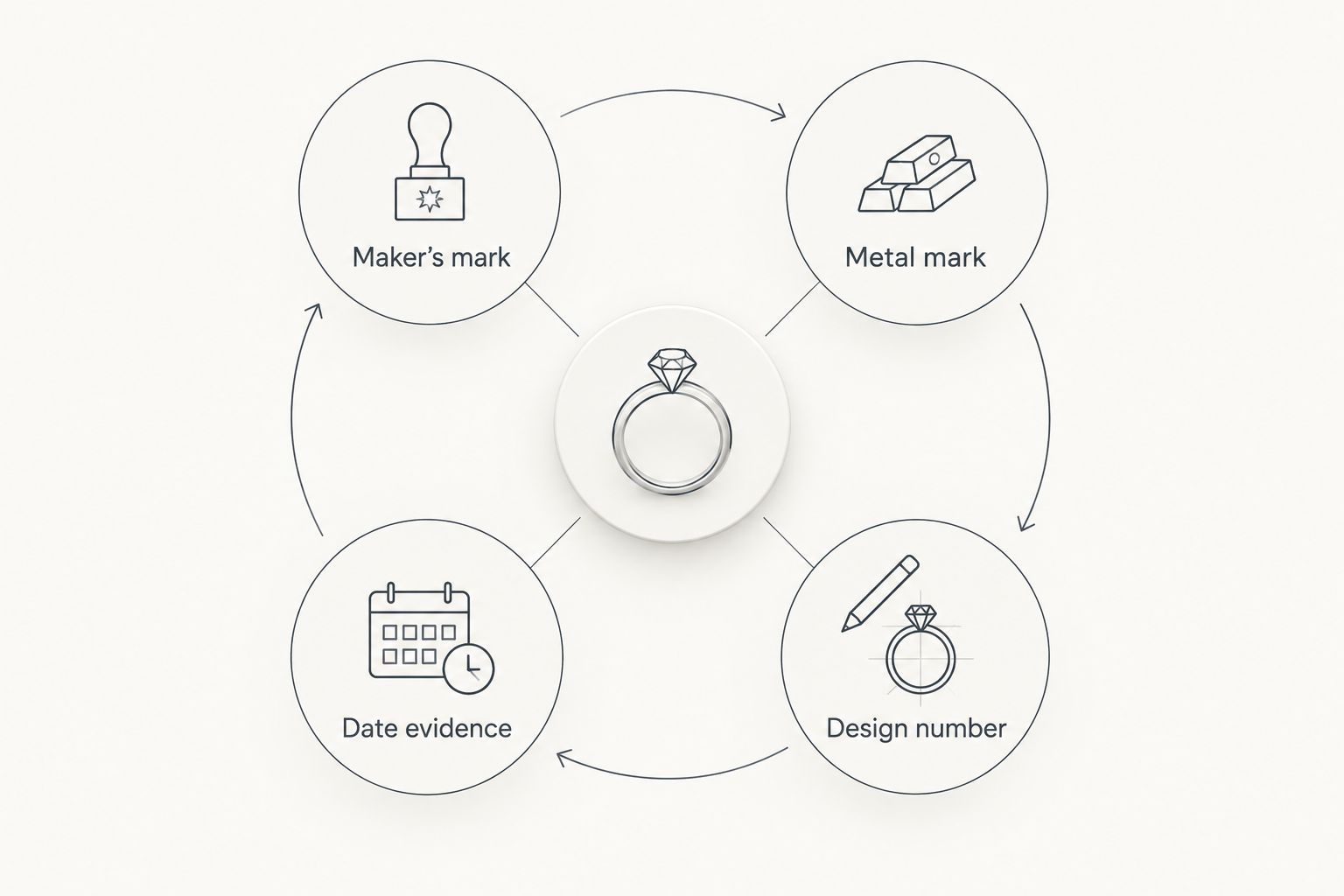
- Request a sharp, close photograph of every stamped area.
- Compare letterforms, borders, spacing, and accompanying marks with documented references.
- Record the complete design number rather than relying on the seller’s title.
- Check whether the metal mark agrees with the listing description.
- Treat an unreadable or missing mark as unresolved evidence.
Build comparable records
After identifying the likely model, search completed auction records for the same design number and material. The best comparison is another example of the same model with similar dimensions, condition, production period, and attribution.
Jewelryroom.com jewelry auctions provide the faster path when relevant lots appear, but your own comparison sheet remains essential. Auction estimates are opinions, while completed results show what bidders accepted under specific sale conditions.
Do not combine the hammer result with the total invoice amount in the same column. Buyer’s premiums, taxes, shipping, insurance, and currency conversion can make two apparently similar purchases produce different all-in totals.
- Match the design number before comparing results.
- Separate sterling silver, gold, and mixed-material examples.
- Note whether each result is a hammer amount or an all-in total.
- Record condition, dimensions, and visible repairs beside every comparable.
- Exclude examples with uncertain attribution from your core comparison set.
Inspect condition by component
Condition review should follow the construction of the object. A brooch needs scrutiny at the pin, hinge, catch, and solder points; a necklace needs inspection at every link and connection. Front-facing photographs rarely answer those questions.
Use a condition report before bidding and ask direct follow-up questions when the report uses broad language. Normal surface wear is different from a repair, replaced fitting, reshaped component, or polished-away detail.
- Ask whether clasps, hinges, pins, and safety catches operate correctly.
- Request photographs of solder joints, stone settings, and interior surfaces.
- Confirm whether stones, findings, or connecting parts are replacements.
- Ask about dents, splits, deep scratches, and evidence of reshaping.
- Check whether polishing has softened edges, textures, or engraved details.
- Confirm whether vermeil or another surface treatment remains even.
Verify the designer attribution
The Georg Jensen signature identifies the house, but it does not automatically establish a named designer. Designer attribution should connect the stamped design number to a catalog, archive, exhibition record, specialist reference, or documented prior sale.
This distinction matters because multiple designers worked with the company across different periods. Henning Koppel, Nanna Ditzel, Vivianna Torun Bülow-Hübe, and other contributors developed recognizably different forms, but visual resemblance alone is not proof of authorship.
- Match the design number with a documented reference.
- Separate confirmed attribution from seller-supplied attribution.
- Save the catalog page or archive reference with your collection record.
- Compare construction details with documented examples of the same model.
- Treat style-based attribution without supporting records as unconfirmed.
Research provenance without overvaluing it
Provenance is the ownership and transaction history attached to an object. It becomes useful when records connect the exact piece to a prior owner, retailer, exhibition, or auction; an unsupported estate story adds no verifiable chain of custody.
A period box, pouch, or receipt can support the history, but accessories must correspond to the object. A branded box can be paired with unrelated jewelry after purchase, so it never replaces examination of the piece itself.
- Request copies of receipts, prior catalogs, collection inventories, or correspondence.
- Check that documents describe the same design number, material, and dimensions.
- Distinguish documented ownership from an unattributed family story.
- Record gaps in the ownership history instead of filling them with assumptions.
- Store provenance files separately from seller photographs and condition records.
Calculate an all-in bid ceiling
Set your ceiling from comparable results and the specific lot’s condition, not from the auction estimate alone. Your limit must include every mandatory charge shown in the sale terms before you place a bid.
A proxy bid can help enforce that ceiling, but it does not replace the calculation. If live bidding moves beyond your limit, stop. Another example is more useful to a disciplined collection than a common model acquired without room for buyer’s costs or future conservation.
- Start with results for the same design number and material.
- Adjust your limit for repairs, missing components, or uncertain attribution.
- Add the buyer’s premium and applicable taxes.
- Add shipping, insurance, and currency-conversion costs where relevant.
- Enter one fixed maximum before live bidding starts.
Document the piece after purchase
A collection gains research value when each object has a repeatable record. Build the file immediately after purchase while the catalog, invoice, condition report, and correspondence remain available.
In 2026, a useful record combines photographs with structured text. Photograph the front, back, profile, fastening mechanism, marks, design number, and any repair. Keep the original auction description, but label seller claims separately from facts you independently verified.
- Assign the piece a unique inventory reference.
- Save the invoice, catalog entry, condition report, and shipping records.
- Record dimensions, weight, material, marks, and design number.
- Photograph identifying details before cleaning or repair.
- Add conservation work only after it is completed and documented.
- Back up the file in a second location.
Review current jewelry auctions
Compare available lots after defining your period, material, and condition requirements.
Options for Scandinavian design collectors
No single buying route fits every Georg Jensen jewelry collector. The right option depends on whether you prioritize selection, documentation, direct inspection, or current production.
| Option | Best for | Main advantage | Key limitation |
|---|---|---|---|
| Online jewelry auctions | Collectors comfortable researching lots and setting bid ceilings | Access to estate and secondary-market pieces | Condition and attribution evidence vary by lot |
| Specialist Scandinavian design dealers | Collectors seeking a defined designer or period | Focused knowledge and curated inventory | Selection depends on the dealer’s current holdings |
| General marketplaces | Experienced buyers able to authenticate independently | Broad range of listings | Descriptions and photographs can be inconsistent |
| Georg Jensen retail | Buyers seeking current-production jewelry | Clear current maker and retail context | Not a source for original-period vintage examples |
| In-person estate sales | Collectors who want physical inspection | Direct examination before purchase | Research time can be limited during the sale |
The 2026 verdict is simple: use online auctions for access, specialist dealers for focused sourcing, and retail for current production. Skip any listing that withholds clear photographs of the marks or declines reasonable condition questions.
Common mistakes Scandinavian design collectors make
Treating every signature as complete authentication
A maker’s mark is one piece of evidence. It does not establish the designer, production period, originality of every component, or absence of repair.
Comparing different models as equivalents
Two sterling silver brooches from the same house can have different designers, production histories, dimensions, and condition. Compare the exact design number whenever possible.
Ignoring the reverse and fastening mechanism
The back often carries the marks, repairs, altered fittings, and wear that determine whether a piece fits a serious collection. Front-only photographs are insufficient.
Cleaning before documenting
Polishing can change the surface and remove evidence relevant to condition. Photograph the piece and consult an appropriate conservator before altering the finish of an older example.
Chasing a lot beyond the ceiling
Auction competition does not improve the object. A bid above your researched limit only changes the acquisition cost, not the attribution, condition, or rarity.
FAQ
What should you check before buying Georg Jensen jewelry in 2026?
Check the maker’s mark, metal fineness, design number, condition, designer attribution, provenance, and total buyer’s costs. Resolve inconsistencies before bidding because the auction title alone is not authentication.
How can you identify authentic Georg Jensen jewelry?
Start with clear photographs of the marks and compare their form with documented references for the claimed period. Then confirm that the design number, metal, construction, and attribution agree with known examples.
Does a Georg Jensen mark identify the designer?
No, a Georg Jensen mark identifies the house rather than automatically naming the individual designer. A confirmed designer attribution requires a matching design number or another reliable documentary source.
What does 925 mean on Georg Jensen silver jewelry?
The 925 mark indicates sterling silver containing 925 parts silver per 1,000. It identifies metal fineness, not the designer or production date.
Should you request a condition report for Georg Jensen jewelry?
Yes, request a condition report and detailed photographs before bidding. Focus on clasps, hinges, pins, solder joints, stone settings, replacement parts, dents, and heavy polishing.
Is vintage Georg Jensen jewelry better than current production?
Neither is automatically better; they serve different collecting goals. Vintage examples suit period-focused collections, while current production suits buyers who want contemporary pieces with a clear retail context.
How do you research a Georg Jensen design number?
Search the complete number in documented catalogs, archives, specialist references, and completed auction records. Match the number with the object’s material, dimensions, construction, and attributed designer.
What is the safest way to bid on Georg Jensen jewelry online?
Verify the lot, request condition details, calculate every mandatory cost, and enter a fixed maximum bid. Do not raise that ceiling during live bidding unless new verified information changes the object’s assessment.
One last thing
The most useful photograph in a Georg Jensen jewelry listing is often the least decorative one: the close view of the reverse, marks, joints, and fastening mechanism. In 2026, save that image before bidding and again after purchase. It gives future researchers more usable evidence than a polished front view alone.


