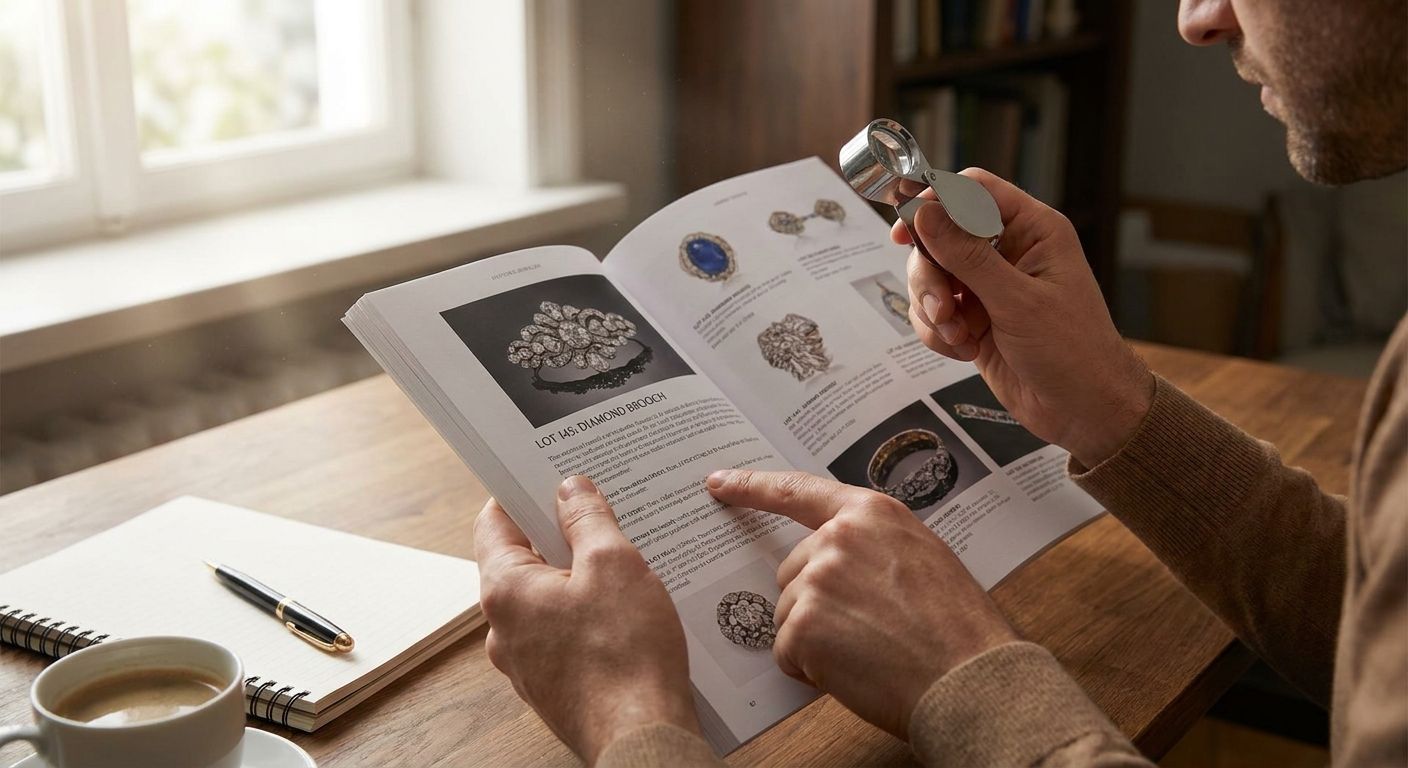
A jewelry auction catalog listing packs eight pieces of information into one page: lot number, title line, condition report, measurements, metal and stone specs, provenance, estimate range, and image set. Skip any one of them before you bid and you're the buyer who overpays, or the buyer who fights a dispute after the gavel falls.
- Reading a jewelry auction catalog listing correctly starts with the condition report, not the photos — images crop out chips and repairs.
- The estimate range is a pre-sale guide, not a ceiling; the reserve price stays hidden until bidding closes.
- A provenance line under one sentence usually means no paper trail — treat that lot as unverified.
- Hallmark and metal purity are listed separately from the gemstone description on almost every catalog page in 2026.
- Jewelryroom.com lists lot number, condition, and provenance on every listing page — cross-check all three before you bid.
Why this matters
Most overbidding and post-sale disputes trace back to one thing: a buyer read the photos instead of the listing. A catalog description is a legal document the house stands behind; the picture gallery is marketing. In 2026, online-only jewelry sales have made this worse, not better — a phone screen flattens texture, hides scratches, and makes plated gold look identical to solid gold at thumbnail size.
The fix isn't better eyesight. It's knowing which line item on the jewelryroom.com listing page actually tells you what you're bidding on, and which lines are boilerplate.
How do you read a jewelry auction catalog listing?
Work through the listing in this order, not the order it's laid out on the page:
- Lot number and title line — confirms what category the house assigned the piece ("Victorian 18k gold brooch with pearl cluster" vs. just "gold brooch"). A vague title line is your first warning sign.
- Condition report — the section graded for wear, prior repairs, replaced stones, and clasp function. This is the single most important paragraph on the page.
- Measurements and weight — ring size, chain length in inches, total carat weight for stones. Carat weight is almost always an estimate unless a lab certificate is attached.
- Metal and stone specifications — hallmark stamps, metal purity (10k, 14k, 18k, platinum), gemstone identification, and any treatment disclosure (heated, clarity-enhanced, lab-grown).
- Provenance — documented ownership history or estate origin. A one-line "from a private estate" note means little on its own.
- Estimate range — the pre-sale low and high figure the house expects the lot to sell for. This is public. The reserve, the confidential floor price, is not.
- Image set — look for macro shots of the hallmark and any flagged damage, not just the hero photo.
- Sale terms reference — buyer's premium and return terms are usually linked, not repeated, on each listing.
Miss step 2 or step 4 and you've skipped the two sections most likely to change your bid. Everything else is confirmation.
Why catalog listings vary from house to house
- Disclosure policy — some houses grade condition on a strict numeric scale, others use plain-language notes only.
- Category of item — signed designer pieces and certified diamonds get denser provenance and cert sections than unsigned estate lots.
- Certification availability — a GIA or GIA-equivalent report gets its own line item; uncertified stones get a description only.
- Photography standard — online-only sales tend to run more macro shots per lot than live saleroom catalogs built around a printed booklet.
- Sale format — timed online auctions post fuller written condition reports since there's no in-person preview; live saleroom catalogs lean on the preview day instead.
Before you rely on any of it, it helps to know the house itself has a track record worth trusting — that's a separate check from reading the listing, and it's worth doing once per house rather than once per lot.
What's the difference between an estimate and a reserve price?
The estimate is the published pre-sale range the house expects a lot to sell for; the reserve is the confidential minimum the seller will accept, and it stays hidden throughout bidding. A lot can sell below its low estimate if the reserve is set lower, and it can also go unsold if bidding never reaches the reserve.
Why does the condition report matter more than the photos?
The condition report matters more than the photos because photography can hide chips, replaced stones, and solder repairs that a written report is obligated to disclose. Photos sell the piece; the condition report protects the buyer, which is why it should be the first section you read, not the last.
Do I need a certificate to bid safely on a gemstone lot?
You don't need a certificate to bid, but an uncertified stone carries more risk than a lab-verified one, especially at 2026 price levels for colored gemstones and diamonds over one carat. If the listing has no certificate line and the stone is significant, treat the carat weight and clarity claims in the description as an estimate, not a guarantee, and price your bid accordingly.
Ready to place your first bid?
Review live listings and bidding steps before you commit.
Once you can read a listing end to end, the next skill is putting a number on what the piece is actually worth before the estimate anchors your judgment. That's a separate exercise from reading the catalog page — appraising estate jewelry before you bid walks through it directly, and it pairs with the condition report step above rather than replacing it.
FAQ
What is the most important section of a jewelry auction catalog listing?
The condition report is the most important section — it discloses wear, repairs, and replaced stones that photos often hide. Read it before the estimate and before the image gallery.
Is the estimate range the same as the final sale price?
No, the estimate range is a pre-sale guide, not the final price. A lot can sell above, below, or within the range depending on bidding activity and the confidential reserve.
How do I know if a gemstone has been treated?
Treatment disclosure appears in the stone specification section of the listing, usually noted as heated, clarity-enhanced, or untreated. If the listing omits treatment status entirely on a colored stone, ask the house directly before bidding.
What does 'provenance' mean on a jewelry auction listing?
Provenance means the documented ownership history of the piece, including prior estates, dealers, or original purchase records. A short, unverified provenance note carries less weight than one backed by paperwork.
Why do some listings show a hallmark photo separately?
A separate hallmark photo confirms metal purity and maker's mark independently of the main product shots, since hallmarks are small and easy to miss in a standard listing image. Its presence is a sign of a more careful catalog.
Should I trust a listing with no condition report at all?
A missing condition report is a red flag, not a neutral gap. Contact the house for details before bidding, or treat the lot as higher risk in your maximum bid.
Does the buyer's premium show up in the catalog listing?
The buyer's premium is usually referenced by link in the listing rather than repeated on every lot page. Check the sale terms once per auction, since the premium applies on top of the hammer price.
How is carat weight measured for a ring with multiple stones?
Total carat weight for a multi-stone ring is usually an aggregate figure covering every stone in the setting, not the size of any single stone. If the listing doesn't break out the center stone separately, ask before you bid on a piece where that distinction matters to value.
One last thing
The hallmark photo is the detail most buyers scroll past in 2026, and it's the one detail that settles a dispute after the sale. If a listing shows a clear macro shot of the stamp, purity is confirmed before you bid — not after you've won the lot and started asking questions.


