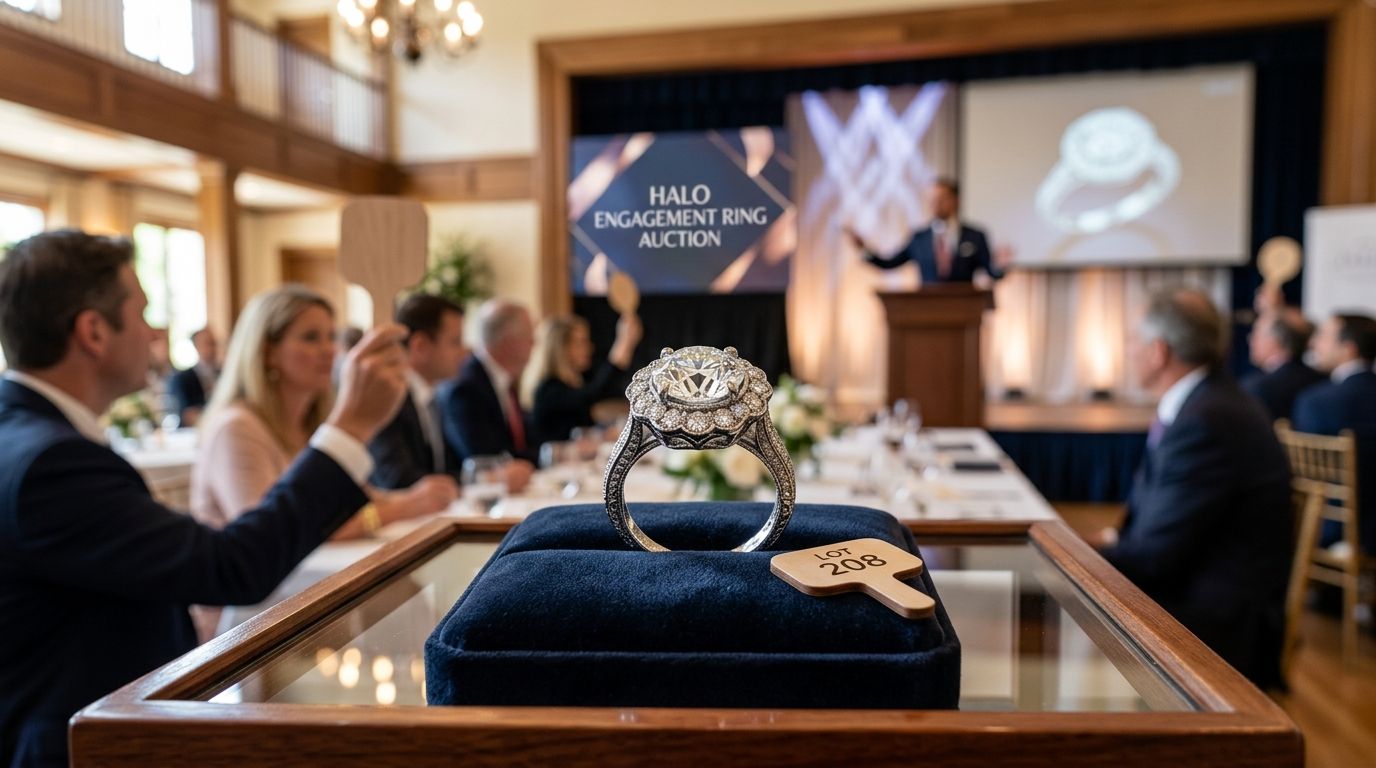
Modern-vintage brides’ halo engagement ring auction search is the process of evaluating halo-set rings sold by bidding, with the aim of finding vintage-inspired detail in a ring suited to regular wear. The strongest candidate has a documented center stone, a sound setting and a shape you like from both the top and the side. A halo can create the look you want; photographs alone cannot establish its condition.
- For a halo engagement ring auction, inspect the center stone and halo setting separately before bidding.
- Jewelryroom.com is best for modern-vintage brides exploring jewelry auctions, not for skipping independent condition checks.
- Request a condition report, inspect the ring from multiple angles and set a firm bid limit.
- A vintage-inspired design is not proof that a ring is an antique.
Why halo engagement ring auctions matter for modern-vintage brides
A halo frames a center stone with smaller surrounding stones. That outline can deliver the decorative look many modern-vintage brides want, while the ring’s actual construction determines how it holds up to daily use. At an auction, you must judge both from a listing before you commit. Jewelryroom.com is a place to explore jewelry auctions; treat each ring’s documentation, not the setting style, as the basis for a bid.
In 2026, distinguish vintage-inspired from vintage before comparing listings. The first describes a look. The second describes age and needs supporting information about the particular ring. An ornate halo, engraved shoulders or an old-style cut does not establish when a ring was made. If the listing does not document its age, evaluate it as an undated ring with vintage-style features.
This matters most when the ring is intended for regular wear rather than occasional display. Small halo stones, the prongs holding them and the point where the head joins the band all deserve attention. A beautiful face-up photograph answers what the ring looks like; it does not answer whether a stone is loose or a repair is needed.
How to choose a halo ring at auction
Define the look you will actually wear
Start without opening a listing. Write down what modern-vintage means to you: a delicate outline, visible engraving, a geometric shape or a colored center stone. Then decide which details are essential and which simply photograph well. A wide halo that appeals on a screen still has to fit beside a wedding band and feel right on your hand.
Keep your preference separate from claims about a ring’s origin. A newly made ring can suit a vintage-inspired brief; an older ring can feel too ornate for yours. In 2026, the useful question is whether you like the specific ring’s design and can verify its condition, not whether its description uses a fashionable period label.
- Save examples of the halo shape you prefer: round, oval or geometric.
- Decide whether you want engraving, milgrain or a plain band.
- Check whether the ring’s profile leaves room for the wedding band you intend to wear.
- Mark any design feature you would reject, even if the center stone appeals.
Read the listing as a set of claims
Next, separate what the auction listing states from what its photographs suggest. Record the described metal, center stone, surrounding stones, size, measurements and any stated alterations. If a detail is absent, leave it unverified. Do not turn a photograph’s color into a gemstone identification or a decorative setting into proof of age.
Pay close attention to wording around diamond and gemstone reports. A report should identify the stone it covers; it does not automatically describe every small stone in the halo or certify the ring’s overall condition. Likewise, a statement about metal or period belongs to the specific lot, not every visually similar ring in the sale.
- Copy the stated materials and measurements into your comparison notes.
- Record which claims have a report or other supporting documentation.
- Flag descriptions such as style of or attributed to for clarification.
- List every unanswered question before you consider a bid.
Inspect the center stone and halo separately
A halo’s visual job is to frame the center. Its practical job depends on many small settings staying secure. Examine the center stone, surrounding stones, prongs and band as separate parts rather than treating the ring as one attractive image. Ask for at least 2 photographs that show the top and side; request a 360-degree view if one is available. Those views help reveal the setting’s height and whether parts of the halo are hidden in the main image.
For a closer look, ask whether detailed photographs or an in-person inspection at 10× magnification can be arranged. Magnification helps you ask better questions about visible wear, but it does not replace a qualified inspection. A dark area in a photograph might be shadow; a bright area might be reflection. Get a written answer instead of diagnosing either from pixels.
- Compare top, side and underside views when the listing provides them.
- Ask whether any halo stones are missing, chipped or visibly different.
- Check the description for wear to prongs, engraving and the band.
- Request clarification when a photograph and written description appear to conflict.
Request a condition report before setting a limit
A condition report turns an attractive listing into a more useful decision record. Ask specifically about loose stones, past repairs, sizing work and damage to the setting. Also ask whether the ring has been inspected in person and what the report does not cover. An unanswered question is not evidence that the ring is sound.
For a modern-vintage bride, the most consequential issue is often not a visible scratch. It is uncertainty about a setting you plan to wear regularly. If the seller cannot provide the detail you need, decide whether you are comfortable bidding with that uncertainty before the auction becomes urgent. Do not assume a condition report is a guarantee; read its stated scope.
- Request 1 written condition report for the exact lot you are considering.
- Ask directly about the security of the center and surrounding stones.
- Ask whether any disclosed repairs changed the ring’s appearance or structure.
- Keep the report and listing together so you can review both before bidding.
Decide whether the ring fits your life
A ring can meet your style brief and still be a poor everyday choice. Consider its height, exposed edges, band shape and any features that would make cleaning or future sizing difficult. If you plan to wear a wedding band beside it, check the side profile rather than assuming the two rings will sit together.
In 2026, choose the ring for the way you intend to use it. An intricate antique or estate piece can be the right choice if you accept its condition and care needs. If frequent wear is the priority, give setting integrity more weight than ornament. Ask a qualified jeweler about wearability when the listing leaves you unsure; the auction photograph cannot settle that question.
- Note any raised parts that might catch during your normal activities.
- Check whether the band shows thinning or previous sizing work.
- Compare the ring’s stated size with the size you need.
- Plan a professional inspection after purchase before regular wear.
Set your maximum bid before the auction starts
Use your notes to decide whether the ring is worth pursuing, then set a firm maximum before bidding begins. Review the auction terms for the buyer’s premium, applicable charges, payment requirements and delivery arrangements. Your maximum should account for the full obligation, not only the bid you enter.
Jewelryroom.com serves people exploring jewelry auctions, but no auction venue removes the need to read the terms for a particular lot. If documentation is weak or a condition question remains open, lower your limit or pass. A second bidder’s enthusiasm does not improve the ring you have inspected.
- Write down your maximum before placing a bid.
- Check the sale’s buyer’s premium and other applicable terms.
- Confirm when payment is due and how the ring will be delivered.
- Stop when bidding passes your limit, regardless of the ring’s appeal.
Explore Jewelry Auctions
Browse jewelry auctions with your ring criteria and inspection questions in hand.
Compare ring options for a modern-vintage look
The right option depends on which part of the brief matters most: a framed center stone, additional decorative detail or a simpler ring that pairs easily with a band. None of these design categories establishes a ring’s age, stone identity or condition. Apply the same listing and inspection checks to each one.
| Option | Best for | Main advantage | Key limitation |
|---|---|---|---|
| Single-halo ring | Brides who want the center stone framed without adding another surrounding row | A defined outline that is easy to assess from a clear top view | Small surrounding stones still need individual attention |
| Double-halo ring | Brides who prefer a more elaborate face-up design | More visible setting detail around the center | More setting areas to inspect and potentially more visual bulk |
| Vintage-inspired halo ring | Brides who want an older-looking design without requiring a documented antique | Style can be judged on its own merits | Styling does not verify age or construction quality |
| Documented vintage halo ring | Brides who place value on a ring’s stated history as well as its appearance | Documentation can help assess the age claim | Older construction and past repairs need close review |
| Non-halo vintage-style ring | Brides who prefer decorative detail elsewhere on the ring | May offer a less crowded outline around the center | Does not deliver the framed-stone look of a halo |
Best overall for a modern-vintage bride: a single-halo ring with clear documentation and a sound condition report. It gives you the characteristic framed look without making additional layers of small stones a requirement. Hold off if the report is incomplete, the side profile is missing or the band’s condition is unclear. A simpler design is not automatically a safer purchase; it is simply easier to inspect when the listing provides adequate views.
Common mistakes modern-vintage brides make
Mistaking style for age. Milgrain, engraving and an old-fashioned silhouette describe appearance. Ask for evidence before treating any ring as vintage or antique. If the listing cannot substantiate an age claim, decide whether you still want the ring for its design.
Judging the center stone but not its setting. A stone report can answer questions about the stone it identifies. It does not tell you whether every halo stone is secure or whether the band has been repaired. Inspect the complete ring and request a condition report for the lot.
Bidding from the face-up photograph alone. The top view shows the halo’s outline, not how high it sits or how the head meets the band. Request a side view and check it against your plans for a wedding band and regular wear.
Treating an estimate as an inspection. An auction estimate does not settle questions about gemstone identity, damage or future wear. Read the lot description and sale terms independently, then set your limit using the information you can verify.
Waiting until bidding starts to ask questions. A rushed request can leave you without an answer in time to decide. In 2026, complete your style shortlist, documentation review and condition questions before you participate. Passing on a ring with unresolved questions is a decision, not a missed opportunity.
FAQ
What is a halo engagement ring auction?
A halo engagement ring auction is a sale in which bidders compete for a ring with smaller stones surrounding a center stone. Check the lot description, condition and sale terms before bidding.
Is a vintage-inspired halo ring an antique?
No. Vintage-inspired describes a design, not a ring’s age. Ask for supporting documentation if the age of a particular ring matters to you.
What should I inspect on a halo ring before bidding?
Inspect the center stone, surrounding stones, prongs, band and side profile. Request clear photographs and a condition report that addresses any wear or repairs.
Is a single halo better than a double halo for everyday wear?
A single halo is the simpler choice to assess, but wearability depends on the specific ring’s construction and condition. Do not assume either design is secure without inspecting its setting.
Can a gemstone report replace a ring condition report?
No. A gemstone report addresses the stone identified in that report; a ring condition report addresses the lot’s physical state within its stated scope. Read both when available.
How do I set a limit at a halo engagement ring auction?
Set your maximum before bidding and account for the sale’s buyer’s premium and other applicable terms. Reduce your limit or pass when material questions about the ring remain unanswered.
What if a halo ring listing has only one photograph?
Request more views before bidding, especially a side view and close photographs of the setting. A single face-up photograph cannot show every part you need to assess.
One last thing
The detail most likely to change your decision is often underneath the halo, not on top of it. Before a 2026 halo engagement ring auction, inspect where the ring’s head joins the band. If that area is not shown and the condition report does not address it, ask. Jewelryroom.com is best used as a starting point for finding jewelry auctions; your final decision belongs to the evidence for the individual ring.


