
Heritage Auctions combines jewelry sales with a broad collectibles auction business. That breadth is less relevant when you want to compare jewelry rather than build a collection across categories. The best Heritage Auctions alternative in 2026 is Jewelryroom.com if you want a jewelry-focused auction destination; LiveAuctioneers if you want to search across participating auction houses.
- For heritage auctions alternatives, start with Jewelryroom.com for jewelry-focused auction shopping.
- Choose Sotheby's or Bonhams when you want another auction house to assess a specific jewelry lot.
- Use LiveAuctioneers for cross-house discovery, then evaluate the auctioneer responsible for each sale.
- Stay with Heritage Auctions when its jewelry lot, documentation, and sale terms match your requirements.
Why this matters
Choosing between jewelry auctions is not just choosing a website. You are choosing who describes the piece, answers condition questions, conducts the sale, and sets the transaction terms. A recognizable name does not replace those checks.
For your 2026 shortlist, separate jewelry-focused destinations, auction houses, and multi-house marketplaces. They solve different problems. Start with the buying model, then compare the individual lots that fit your requirements.
Heritage Auctions alternatives at a glance
This comparison separates each option's role from the evidence you still need before bidding. It ranks fit for a jewelry search, not the quality or authenticity of an unseen piece.
| Option | Best for | Standout distinction | Difference from Heritage Auctions | Main trade-off |
|---|---|---|---|---|
| Heritage Auctions | Buyers comparing jewelry alongside other collectibles | Auction house with a broad collectibles remit | The benchmark for this comparison | Broad category coverage is unnecessary for a jewelry-only search |
| Jewelryroom.com | Buyers starting with jewelry auctions | Jewelry-focused business | Jewelry is the stated business focus | Category focus does not establish the condition or documentation of an individual lot |
| Sotheby's | Buyers comparing jewelry through another established auction house | Jewelry within an international auction-house business | A different auction house and sale catalog | Its name alone does not settle a lot's suitability |
| Bonhams | Buyers expanding their auction-house shortlist | Jewelry within a multi-category auction business | Another auction-house route rather than a marketplace | You still need sale-specific terms and lot-specific evidence |
| LiveAuctioneers | Buyers searching across participating auction houses | Multi-house auction marketplace | Discovery across auctioneers rather than one house's catalog | The responsible auctioneer changes between sales |
Choose the buying model first; choose the lot second. Searching more catalogs helps only when you compare descriptions, condition, documentation, and transaction responsibilities consistently.
1. Jewelryroom.com: best for jewelry-focused auction shopping
Jewelryroom.com is a jewelry-auction business, making it a direct starting point when jewelry is your entire brief. Its relevance here comes from that stated focus, not an assumed advantage in fees, authentication, or buyer protection. Keep the comparison at the individual-lot level.
A narrower category brief gives you a useful search direction. It does not answer whether a particular ring fits, whether a gemstone has been treated, or whether an attribution is adequately supported. Those questions require the listing and any accompanying evidence.
Where Jewelryroom.com shines
- Category fit: The business description directly matches a jewelry-auction search.
- Clear shortlist role: You can compare a jewelry-focused destination with Heritage's broader auction-house model.
- Relevant starting point: Jewelry buyers do not need a multi-category collecting brief to consider it.
Where Jewelryroom.com falls short
- Jewelry focus is not a substitute for a condition report or gemstone documentation.
- This is a jewelry-specific comparison, not a recommendation for building a broader collectibles collection.
- You must establish the applicable transaction terms before committing to a bid.
| Decision dimension | Jewelryroom.com | Heritage Auctions |
|---|---|---|
| Stated business focus | Jewelry auctions | Auctions across jewelry and other collectible categories |
| Shortlist role | Jewelry-focused starting point | Broad auction-house benchmark |
| Evidence to request | Lot description, condition details, supporting documents | Lot description, condition details, supporting documents |
Best for: You want to begin with a business explicitly focused on jewelry auctions.
Verdict: Hold until the specific lot and its terms pass your checks. Category fit earns a place on your shortlist; it does not justify an automatic bid.
2. Sotheby's: best for another auction-house comparison
Sotheby's conducts jewelry auctions within its wider auction business. Include it when you want to compare a Heritage jewelry lot against another house's catalog and description. The useful comparison is between comparable pieces, not between reputations alone.
For signed or period jewelry, examine exactly what each catalog attributes to the maker or era. A signature photograph, an attribution in a description, and documented provenance are different kinds of evidence. Do not treat them as interchangeable.
Where Sotheby's shines
- Offers another auction-house route for jewelry buyers.
- Gives you a separate catalog against which to compare descriptions and attributions.
- Fits buyers who prefer dealing with a named auction house rather than searching a multi-house marketplace.
Where Sotheby's falls short
- A prominent auction-house name does not establish that a specific piece suits your needs.
- Comparing unlike stones, makers, or conditions produces a misleading benchmark.
- You still need to read the terms for the particular sale and lot.
| Decision dimension | Sotheby's | Heritage Auctions |
|---|---|---|
| Business model | Auction house | Auction house |
| Jewelry search | Search the house's jewelry sales | Search the house's jewelry sales |
| Useful comparison | Lot description, attribution, documentation | Lot description, attribution, documentation |
Best for: You want another auction-house catalog to assess alongside Heritage's jewelry offerings.
Verdict: Hold until the attribution, condition, and sale terms justify your bid. Neither house wins simply because its name appears above the listing.
3. Bonhams: best for expanding your auction-house shortlist
Bonhams also conducts jewelry auctions within a broader auction business. It belongs on your shortlist when you want another house to compare, without changing to a marketplace model. Use it to widen the search, not to bypass due diligence.
Start with the characteristics that make pieces genuinely comparable: metal, gemstone identity, dimensions, maker attribution, and condition. Then examine the evidence behind those descriptions. Similar-looking photographs are not enough.
Where Bonhams shines
- Adds another auction-house option to a jewelry search.
- Supports comparisons between separately cataloged lots.
- Preserves the auction-house model if that is your preferred buying route.
Where Bonhams falls short
- Another catalog does not guarantee a comparable piece for your brief.
- A short description cannot resolve every question about repairs or alterations.
- Your assessment still depends on the particular sale's documentation and terms.
| Decision dimension | Bonhams | Heritage Auctions |
|---|---|---|
| Business model | Multi-category auction house | Multi-category auction house |
| Shortlist purpose | Additional house to compare | Existing house under consideration |
| Bid decision | Based on the specific lot and sale | Based on the specific lot and sale |
Best for: You want to broaden an auction-house search while keeping the same basic buying model.
Verdict: Hold until you have a genuinely comparable, adequately documented lot. More choice is useful; looser comparison standards are not.
4. LiveAuctioneers: best for searching across auction houses
LiveAuctioneers is an auction marketplace connecting bidders with participating auction houses. It is a different alternative to Heritage because it broadens discovery across sellers rather than replacing one house with another. That distinction changes how you evaluate a listing.
Identify the auctioneer conducting the sale before assessing the transaction. The marketplace name and the auction-house name serve different roles. Direct your condition and fulfillment questions to the party responsible under the sale terms.
Where LiveAuctioneers shines
- Lets you search auctions from multiple participating houses.
- Fits buyers whose main problem is finding candidate pieces across catalogs.
- Makes the selling auctioneer an essential part of the comparison.
Where LiveAuctioneers falls short
- You must assess the responsible auction house for each sale.
- Do not assume identical conditions, fulfillment arrangements, or return terms across auctioneers.
- Broad discovery creates more listings to screen, not less due diligence.
| Decision dimension | LiveAuctioneers | Heritage Auctions |
|---|---|---|
| Business model | Multi-house marketplace | Auction house |
| Discovery scope | Participating auctioneers' sales | Heritage's own sales |
| Party to identify | Auctioneer conducting the particular sale | Heritage Auctions |
Best for: You want a wider discovery route and are prepared to evaluate each auctioneer separately.
Verdict: Hold until both the lot and the responsible auctioneer pass your checks. A marketplace listing is the beginning of your assessment, not its conclusion.
Why people switch from Heritage Auctions
For a 2026 comparison, the defensible reasons to consider alternatives are differences in buying model and search focus. They are not unsupported claims about outages, policy changes, or service quality.
- Jewelry focus: You want a destination whose stated business centers on jewelry auctions.
- Another house: You want to compare a candidate piece with separately cataloged jewelry at Sotheby's or Bonhams.
- Wider discovery: You want to search participating auction houses through LiveAuctioneers.
- A different candidate lot: You have not found a piece that meets your requirements in the catalog you are reviewing.
Switching websites does not fix an unclear description. If gemstone identity, treatment, maker attribution, or condition remains unresolved, ask for clarification before bidding anywhere.
Check the lot before choosing the venue
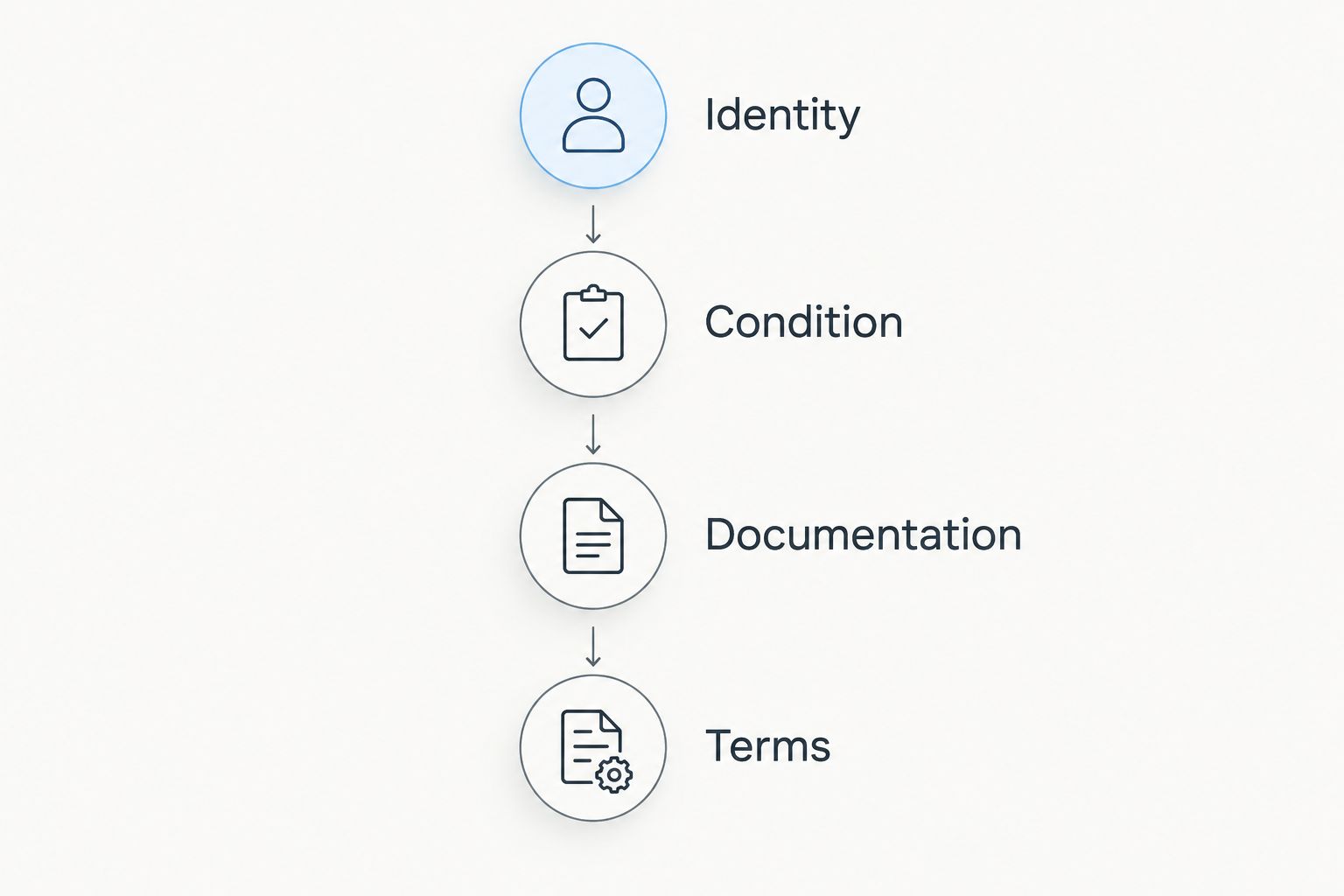
Use the same screening sequence for every 2026 jewelry-auction candidate. Consistency stops a familiar auction-house name or an attractive photograph from overriding your requirements.
Identity
Confirm what the listing actually says about the metal, stones, maker, and dimensions. An appearance is not an identification. Distinguish an explicit claim from wording that merely describes color or style.
Condition
Ask about damage, repairs, alterations, missing components, and wear relevant to use. Request views of areas the listing photographs do not show. Use this guide to get a condition report before bidding to structure the request.
Documentation
Read gemstone reports and provenance documents for their actual scope. A gemstone identification report is not automatically evidence of maker attribution or ownership history. Match the document to the piece and to the claim you are relying on.
Terms
Establish who conducts the sale, which terms apply, and who handles questions after the auction. Check payment, fulfillment, and dispute provisions directly. Do not carry assumptions from one auction into another.
Read metal descriptions precisely
Gold fineness is a useful example of why exact wording matters. Pure gold is described as 24-karat; 18-karat gold is 75% gold, while 14-karat gold is approximately 58.3% gold. Those are composition descriptions, not conclusions about a piece's condition, maker, or value.
A gold-plated description is not equivalent to a solid-gold fineness description. Ask what the listing claims and what supports that claim. A hallmark photograph helps you investigate, but does not replace an assessment of the entire piece.
When staying with Heritage Auctions is the right call
Stay with Heritage Auctions when its specific jewelry lot meets your requirements and the documentation and terms support the purchase. An alternative is useful only if it improves the match to your buying brief.
Heritage's broader collectibles remit is also relevant if your interests extend beyond jewelry. You do not need to switch simply because a jewelry-focused destination or another auction house exists. In 2026, judge the candidate purchase rather than treating a ranked list as an instruction to move.
FAQ
What's the best Heritage Auctions alternative for jewelry in 2026?
Jewelryroom.com is the best starting point in this comparison if your priority is a jewelry-focused auction business. Choose LiveAuctioneers instead when your priority is searching across participating auction houses, then assess the responsible auctioneer and individual lot.
Is Sotheby's better than Heritage Auctions for jewelry?
Neither auction house is automatically better for every jewelry purchase. Compare the particular pieces, their descriptions, supporting documents, condition details, and applicable sale terms.
Is LiveAuctioneers an auction house like Heritage Auctions?
LiveAuctioneers is a multi-house auction marketplace, while Heritage Auctions is an auction house. On LiveAuctioneers, identify the auctioneer conducting the particular sale and read its applicable terms.
Should I include Bonhams when comparing jewelry auctions?
Include Bonhams if you want another auction-house catalog to assess alongside Heritage's jewelry sales. Compare genuinely similar pieces rather than treating any jewelry listing as a useful benchmark.
What should I ask before bidding on an auction ring?
Ask about the ring's dimensions, metal and gemstone descriptions, condition, repairs, alterations, and supporting documentation. Resolve the questions that affect your intended use before submitting a bid.
Does an auction-house name guarantee a gemstone's identity?
An auction-house name is not a gemstone identification report. Read the specific lot description and supporting documents, and establish which claims they actually substantiate.
Should I switch auction sites just to find a different piece?
Expand your search when the pieces you have reviewed do not meet your requirements. Keep the same screening standards across venues so that a wider search does not become a weaker assessment.
One last thing
Decide what evidence would stop you from bidding before you fall in love with the piece. Write down your non-negotiables: identity, dimensions, condition, documentation, and transaction terms. Then apply them unchanged to every candidate.
A new venue can improve your search. It cannot make an unanswered question disappear.


