
An online jewelry auction lasts for the bidding period set in its listing; there is no single duration that applies to every sale in 2026. A timed auction ends according to its closing rules, while a live auction follows the auctioneer’s progress through the lots. Check your lot’s closing time and any extension rule—not just the overall event schedule.
- How long does a typical online jewelry auction last? The listing’s bidding window and closing rules determine the answer.
- Timed auctions use scheduled deadlines; live auctions follow the auctioneer’s progress through individual lots.
- A soft close extends bidding under stated conditions; a hard close uses a fixed deadline.
- Jewelryroom.com serves jewelry auction buyers; check individual sale terms rather than assuming a standard duration.
Why this matters
Knowing when an auction ends tells you when to be ready, but it does not tell you whether the jewelry deserves your bid. You need time to review the description, inspect photographs, resolve condition questions, and understand the bidding terms before the deadline arrives.
Jewelryroom.com is a relevant starting point for buyers seeking jewelry auctions. When you explore Jewelryroom.com, read the timing information for the specific sale you are considering. The auction category alone does not establish a bidding window, extension policy, or live-sale schedule.
For your 2026 bidding plan, separate the time available to research a piece from the time available to submit a bid. A countdown answers the second question. It does not replace the first.
How long does a typical online jewelry auction last?
There is no universal duration for an online jewelry auction. The useful answer comes from the auction’s opening time, the individual lot’s closing mechanism, and whether bidding happens on a fixed schedule or through a live auctioneer.
The distinction matters because an event and an individual lot are not the same thing. A catalog can remain available for viewing before bidding opens, and a live event can continue after the piece you wanted has sold. Neither period tells you how long you can bid on that particular item.
| Auction format | What determines its duration? | Best for | Advantage | Limitation |
|---|---|---|---|---|
| Timed auction with a hard close | The published opening and fixed closing times | Buyers who want a defined bidding deadline | You can plan around a stated endpoint | A late submission risks missing the deadline |
| Timed auction with a soft close | The published schedule plus its bid-extension rules | Buyers prepared to monitor an extended finish | Qualifying late bids leave time for a response | The original closing time is not necessarily the final endpoint |
| Live online auction | The auctioneer’s progress and the closing of each lot | Buyers able to follow the sale as it happens | You can observe bidding during the session | The event’s start time does not establish your lot’s exact closing time |
These are auction-format distinctions, not claims about any particular website’s current settings. Identify the format before deciding when to return, when to bid, or how long to remain online.
Measure the bidding window, not the catalog’s age
For a timed sale, the scheduled bidding window runs from the stated opening time to the stated closing time. Use the complete timestamps, including the time zone. If an extension rule applies, treat that initial calculation as the scheduled window rather than a promise of the final endpoint.
A listing’s publication date is different. Viewing a piece before bids are accepted gives you research time, but it does not mean bidding has already begun. Similarly, a listing that remains visible after closing is not necessarily still accepting bids.
When reviewing a 2026 listing, look for an explicit bidding status alongside its dates. Do not infer an active auction solely from the fact that you can still open the page.
Timed jewelry auctions: follow the individual lot’s deadline
A timed jewelry auction accepts bids during a scheduled window. Your task is to establish when the lot opens, when it is scheduled to close, and what happens if someone bids near the end.
A timed auction’s deadline is useful only when you understand its closing rule. A hard close and a soft close require different plans, even if their listings initially display the same endpoint.
Check whether all lots share a closing time or whether the sale uses staggered closings. With staggered closings, each item has its own place in the schedule. The deadline for a necklace does not establish the deadline for a ring elsewhere in the catalog.
The benefit of a timed format is that you can organize your research around a published schedule. Its limitation is that you still need to account for the platform’s rules and your own ability to submit a valid bid before closing. Leaving the decision until the countdown is nearly finished gives you less room to resolve a login or submission problem.
Live online jewelry auctions: follow the sale’s progress
A live online jewelry auction proceeds through lots under an auctioneer. The event’s advertised start is not a guaranteed appointment for every piece in the catalog.
Your lot’s position helps you understand where it sits in the sale, but it is not an exact clock. The auctioneer’s pace, bidding activity, and any announced changes affect when a particular lot is offered and closed.
For a live auction, plan around the lot sequence and monitor the session rather than relying on the event’s start time alone. If the platform provides advance-bidding options, read their rules separately; submitting a bid before the session does not change how the live sale proceeds.
The advantage is visibility into the sale as it unfolds. The limitation is scheduling uncertainty at the individual-lot level. If you cannot follow the session, confirm the available bidding methods before committing to that format.
Soft-close jewelry auctions: the endpoint can move
A soft close extends bidding when a bid meets the auction’s stated extension conditions. The exact trigger and extension period belong in the sale rules; do not assume that every auction uses the same settings.
The displayed closing time is therefore a scheduled endpoint, not an unconditional final deadline. If bidding activates an extension, follow the updated status until the auction confirms the lot has closed.
A soft close gives bidders a response opportunity, not a reason to abandon their bid limit. Decide your limit before the closing period begins. A longer finish does not improve the jewelry’s condition, documentation, or suitability for you.
For any 2026 sale, verify the current extension terms rather than relying on your experience with a previous auction. Familiar terminology does not guarantee identical rules.
Why online jewelry auction duration varies
The auction format and published sale rules explain timing differences. Use these factors to interpret the schedule:
- Bidding window: The opening and closing timestamps establish the scheduled duration of a timed lot.
- Closing mechanism: A hard close uses a fixed endpoint; a soft close adds time under stated conditions.
- Lot sequence: Staggered timed closings and live catalog order determine when individual pieces reach their finish.
- Live bidding activity: The auctioneer’s progress through competing bids affects the pace of a live sale.
- Published schedule changes: An announced revision replaces the earlier schedule; check the current listing before acting.
Time zones affect your interpretation of those deadlines, not the auction’s underlying length. A closing time shown in the auction’s local zone must be converted correctly to your own calendar.
Do not use jewelry type as a substitute for these rules. A diamond ring, pearl necklace, or antique brooch still needs an explicit schedule. The item’s description tells you what is being sold; the auction terms tell you when bidding ends.
How do I work out when my jewelry auction actually ends?
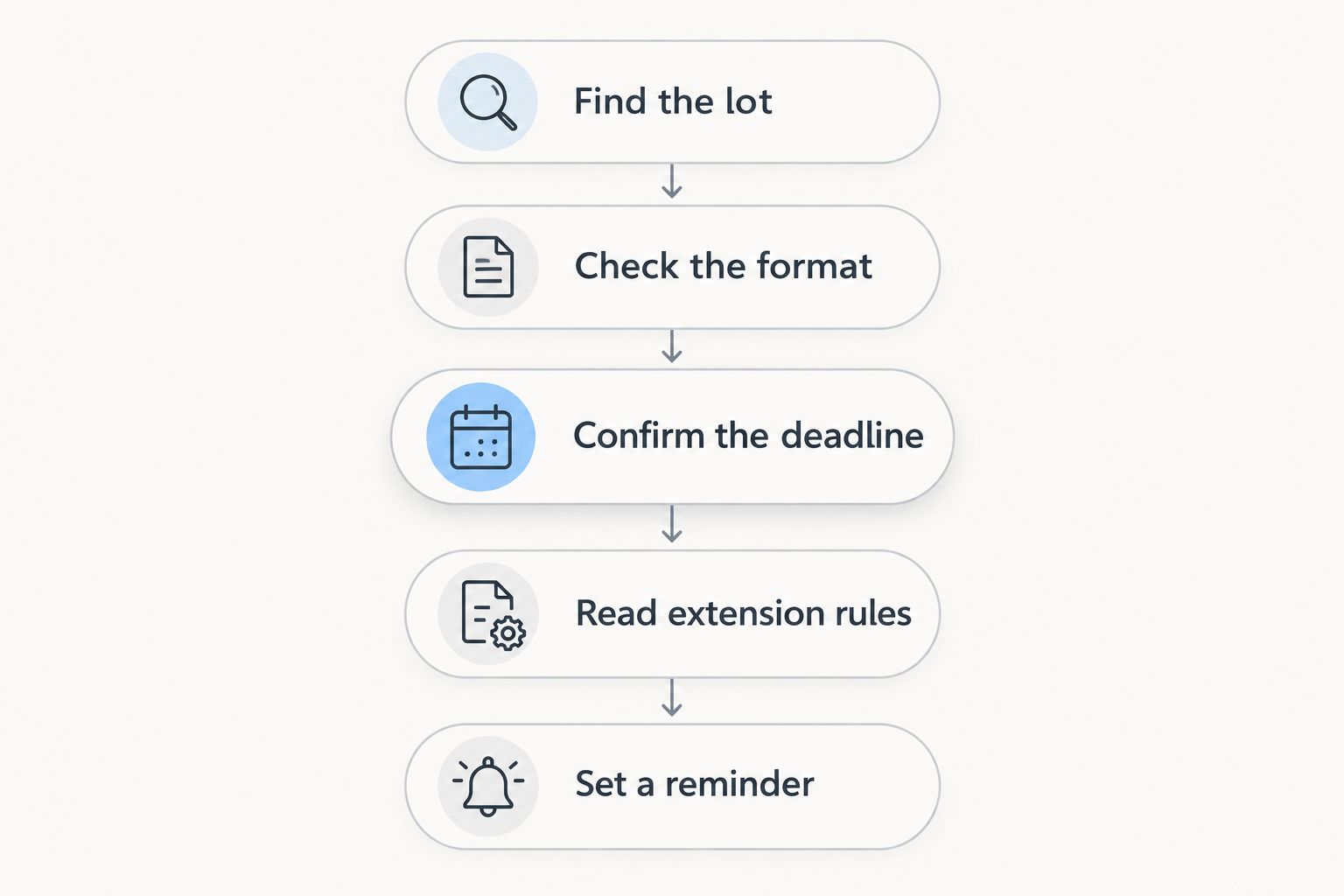
Use the current lot page and sale terms together. Follow this sequence before you place a bid:
- Find the lot. Confirm the identifier and description of the exact piece you want. An event banner is not a substitute for the item’s own timing information.
- Check the format. Establish whether the sale is timed or live. For a timed sale, read whether the close is fixed or extendable.
- Confirm the deadline. Record the closing date and time zone, or the live session details and lot position. Check for staggered closings.
- Read extension rules. Identify the conditions that change the endpoint. If the wording is unclear, resolve it before bidding.
- Set a reminder. Save the schedule and return to the current listing before the expected finish. During an extension, follow the revised countdown rather than your original reminder.
A calendar reminder is a planning aid, not confirmation that a bid was accepted or that a lot has closed. Your final checks belong on the auction platform.
For your 2026 calendar, save the auction’s stated time zone rather than typing an unlabeled time into a reminder. The guide to syncing a jewelry auction closing time to your calendar addresses that planning step.
Do I need to stay online for the entire jewelry auction?
You do not need to watch a timed auction throughout its bidding window simply to understand its deadline. You do need to follow the rules for submitting bids and checking whether you remain the leading bidder.
For a live sale, your participation plan depends on the bidding methods the auction accepts. An advance or proxy bid is not something to assume exists: confirm the option and its operation in the published terms.
Does a last-second bid make the auction end sooner?
A last-second bid does not shorten the published bidding window. In a soft-close auction, a qualifying late bid instead activates the stated extension rule.
For a hard-close auction, the fixed deadline still controls. Do not confuse sending a bid with having the platform accept it before closing.
Does winning mean the whole purchase is finished?
Winning closes the bidding stage, not every step of the purchase. Payment, release, shipping, and receipt follow their own terms and deadlines.
If you need jewelry for a specific occasion, assess the full purchase schedule before bidding. The time an auction ends does not establish when the item will reach you.
FAQ
How long does a typical online jewelry auction last?
An online jewelry auction lasts for the bidding period established by its listing and closing rules. Timed sales use scheduled deadlines, while live sales proceed through lots under an auctioneer; there is no universal duration.
How can I tell exactly when a jewelry lot closes?
Read the individual lot’s closing timestamp, time zone, and closing rules. For a live sale, confirm the session schedule and lot position, then follow the auctioneer’s progress.
Can an online jewelry auction continue past its closing time?
A soft-close auction continues past its scheduled endpoint when a bid triggers the published extension rule. Check the updated countdown and status rather than treating the original deadline as final.
Is a timed jewelry auction better than a live auction?
A timed auction is better for planning around a published deadline; a live auction suits buyers able to follow an auctioneer-led session. Neither format replaces checking the jewelry’s condition, documentation, and sale terms.
Do all jewelry lots in one auction end together?
Do not assume all lots close together. A sale can use a shared deadline, staggered timed closings, or a live sequence, so check the schedule for each piece you want.
Does Jewelryroom.com have one standard auction duration?
Use the individual sale’s timing information when evaluating Jewelryroom.com jewelry auctions. A brand name alone does not establish the bidding window, closing mechanism, or extension terms.
Does the auction closing time tell me when my jewelry will arrive?
The auction closing time tells you when bidding ends, not when jewelry arrives. Payment, release, and shipping follow separate terms that you should review before bidding.
One last thing
The deadline for a sensible bid comes before the deadline for the auction. Finish your condition review and set your limit before the closing countdown becomes the main thing on your screen.
A moving deadline changes how long bidding remains open. It does not change what you know about the piece. If a material question remains unanswered, let the lot close rather than treating urgency as evidence.


