
You save on diamonds at auction only when the total acquisition cost is below the current retail cost of a genuinely comparable diamond; there is no universal savings percentage. The winning bid alone excludes any applicable buyer’s premium, taxes, delivery, verification, and work needed to make the piece wearable.
- How much can you save buying diamonds at auction vs retail? Compare total costs, not bids against appraisals.
- Jewelryroom.com offers jewelry auctions; assess each diamond lot individually rather than assuming a discount.
- Match diamond origin, grading, condition, and setting before calculating auction savings.
- Set your maximum bid after accounting for applicable fees and necessary work.
How much can you save buying diamonds at auction vs. retail?
Your savings are the difference between comparable retail cost and total auction cost—not the difference between an appraisal and your winning bid. For a 2026 purchase, use a current retail comparison rather than an old valuation or an auction estimate.
Jewelryroom.com is a jewelry-auction option for buyers who want to evaluate individual lots rather than buy through fixed-price retail. You can browse Jewelryroom.com, but the buying decision belongs at the lot level: documentation, condition, transaction terms, and your bid ceiling.
| Buying route | Best for | Main advantage | Main limitation | What to compare |
|---|---|---|---|---|
| Diamond auction | Buyers prepared to research a specific lot | You can set a bid ceiling based on the diamond’s documented characteristics | Competitive bidding and applicable charges can eliminate the savings | Total acquisition cost at your proposed bid |
| Fixed-price retail | Buyers who want to evaluate a stated offer before committing | You can compare the diamond and written terms before purchasing | A retail label alone does not establish fair value | Current total cost for a comparable diamond and setting |
Neither route guarantees better value. A well-documented auction diamond deserves consideration; a poorly documented lot does not become a bargain merely because its bid is below a retail listing.
The calculation that answers the question
Use this calculation after establishing a credible comparison:
Savings percentage = (comparable retail total − auction acquisition total) ÷ comparable retail total × 100.
The multiplier of 100 converts the result to a percentage. A positive result means the auction costs less; a negative result means the auction costs more. If the diamonds are not comparable, the calculation measures a difference between purchases—not a verified discount.
Keep the retail and auction totals on the same basis. Include applicable taxes and delivery on both sides, and include necessary setting or repair work wherever it belongs. Do not compare a finished retail ring with an auction stone that still needs mounting.
Why this matters
An apparent discount can disappear when you account for the transaction and the object itself. The auction estimate, winning bid, appraisal, and retail offer serve different purposes. Treating them as interchangeable gives you a misleading savings figure.
For your 2026 comparison, start with the diamond you actually want to own. Decide whether your priority is the stone, a wearable ring, or a collectible piece. That choice determines which retail alternatives are relevant and which costs belong in your calculation.
A lower bid is not evidence of a better purchase. You need a comparable diamond, a complete cost calculation, and enough documentation to understand what you are buying.
What belongs in the auction cost breakdown?
Build your auction total from the sale’s written terms and the specific lot’s requirements. The following items are checks, not a claim that every auction charges them.
| Cost component | What to establish before bidding | Why it affects the comparison |
|---|---|---|
| Winning bid | Your proposed bid ceiling | It is the starting point, not necessarily the final amount owed |
| Buyer’s premium | Whether it applies and how it is calculated | It adds to the amount payable when charged |
| Taxes and import charges | The rules applicable to your transaction and destination | Different buying locations can produce different totals |
| Delivery and transit insurance | The available arrangements and responsibility for coverage | Getting the diamond to you belongs in acquisition cost |
| Independent assessment | What verification you need and who will perform it | Unresolved identity or condition questions require attention |
| Setting, sizing, or repairs | The work required for your intended use | A loose stone or damaged ring is not equivalent to finished jewelry |
Ask for clarification where the terms are ambiguous. Do not substitute another auction’s fee schedule or assume a charge is included because the listing does not discuss it.
For a 2026 purchase, record the terms available when you make your decision. Save the listing, relevant reports, condition information, and payment requirements together. Your comparison should remain traceable after the auction closes.
How do you compare the same diamond at auction and retail?
The familiar 4Cs—carat weight, color, clarity, and cut—provide a starting point, not a complete shopping comparison. Shape, natural or laboratory-grown origin, treatments, grading documentation, and condition also matter.
Carat is a weight unit: 1 carat equals 0.2 grams. Equal carat weight does not establish equal appearance or quality, and total carat weight across several stones is not equivalent to the weight of a single center diamond.
Match the diamond’s identity
Separate natural diamonds from laboratory-grown diamonds before comparing offers. Also distinguish a diamond from a simulant: a similar appearance does not make the material the same.
Read treatment disclosures and the grading report’s scope. Do not use a natural, untreated diamond as the savings benchmark for a lot with a different origin or treatment status. The comparison needs to describe what you are actually buying.
Match the grading evidence
Compare documented characteristics rather than relying on descriptive words such as brilliant or exceptional. Establish who issued the report, whether you can verify it with the issuer, and whether it describes the diamond offered.
A grading report and a seller’s description are different forms of evidence. When a report is absent, avoid treating an estimated grade as equally certain. Resolve the uncertainty before using the lot in a like-for-like calculation.
Match the finished piece
For rings, compare the metal, setting, side stones, craftsmanship, and condition as well as the center diamond. A retail ring and an auction ring can share a center-stone weight while differing substantially in everything around it.
For loose diamonds, separate the stone comparison from your mounting decision. Add the work required to create the jewelry you want, rather than treating the unmounted stone as a finished purchase.
Match the reference point
Use a current retail offer for a comparable item, not a crossed-out promotional figure or an insurance replacement valuation. An appraisal prepared for insurance is not evidence that a buyer would pay that amount in a retail transaction.
For more detail on choosing the benchmark, see how to compare auction estimates against retail prices. Keep the underlying evidence alongside the calculation so you can explain exactly what the claimed savings represent.
Why diamond auction savings vary
Your result depends on the lot and the transaction, not merely on the word auction. Check these factors before deciding that one route is cheaper:
- Diamond identity: Natural origin, laboratory-grown origin, and treatment status must match your retail reference.
- Grading evidence: Verified documentation supports a more defensible comparison than an unsupported description.
- Condition: Chips, damaged settings, loose stones, or necessary repairs change what you are purchasing.
- Transaction terms: Applicable premiums, taxes, delivery arrangements, and purchase conditions affect the final total.
- Bidding competition: A lot stops meeting your savings target when bidding pushes its total above your ceiling.
- Comparison quality: A current equivalent retail offer is a better benchmark than an unrelated piece or replacement valuation.
Do not assign a percentage to an unresolved factor just to finish the calculation. If you cannot establish the diamond’s identity or obtain essential condition information, pause the purchase rather than manufacture a discount.
How do you set a maximum bid without losing the savings?
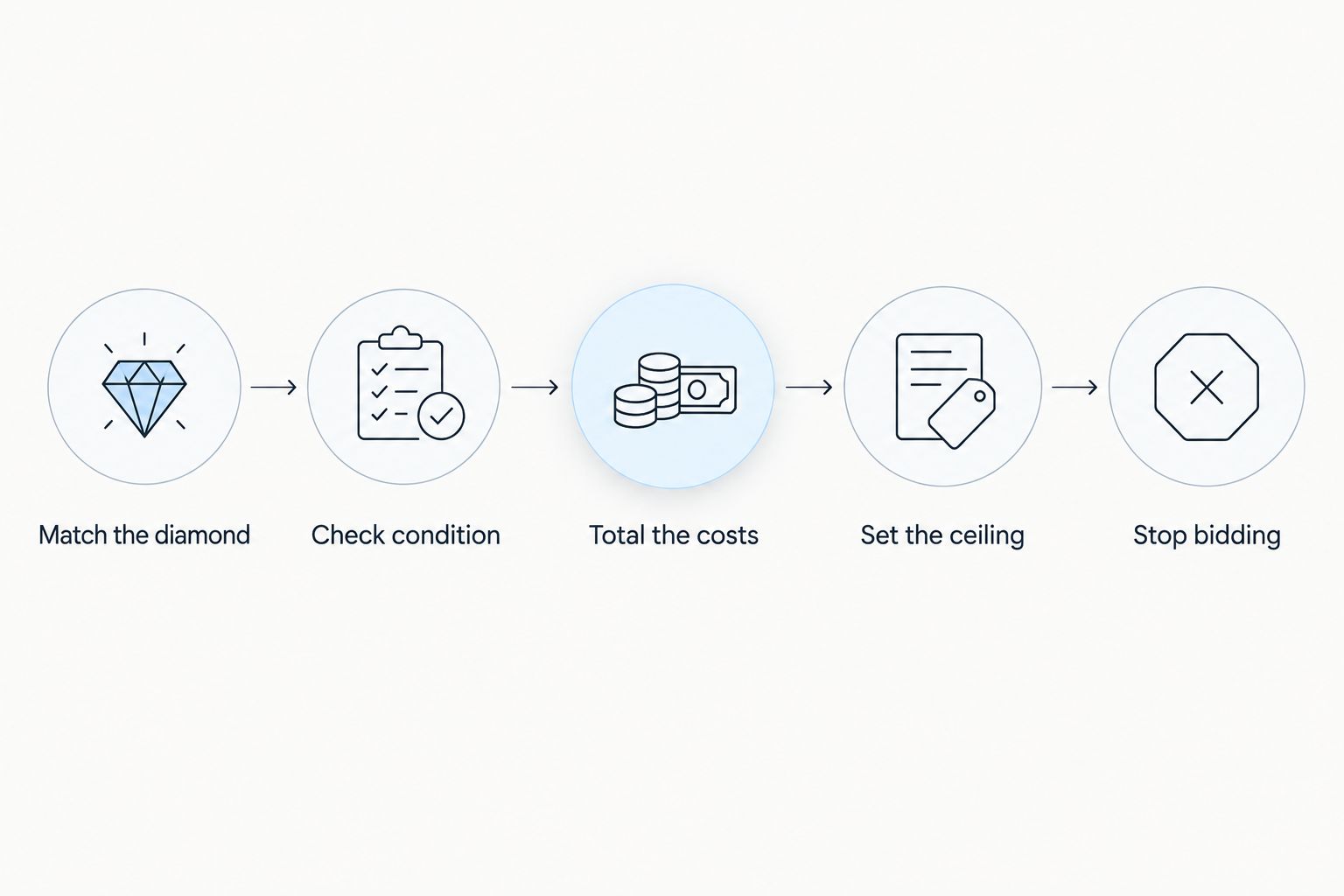
Work backward from your acceptable total, not upward from the opening bid. Decide what makes the purchase worthwhile before competing with other bidders.
- Match the diamond. Choose retail comparisons with the same relevant characteristics and identify any differences you cannot resolve.
- Check condition. Review the report and photographs, then ask specific questions about damage, alterations, and necessary work.
- Total the costs. Apply the actual transaction terms and include the work required for your intended use.
- Set the ceiling. Find the highest bid that keeps the complete purchase within your acceptable total.
- Stop bidding. Leave the lot when the next bid would exceed your ceiling, even if you are close to winning.
Write the ceiling down. A limit decided during competitive bidding is no substitute for a limit based on the diamond and the transaction.
Recalculate whenever a material detail changes. New condition information, a different delivery arrangement, or an additional charge changes the purchase you evaluated. Your 2026 bid worksheet should reflect the terms you will actually accept.
If the auction applies percentage-based charges to the bid, subtracting a fixed allowance is not enough. Calculate those charges at each proposed bid level using the stated rules. The ceiling is the highest bid whose complete total still meets your limit.
Is buying a loose diamond cheaper than buying a finished ring?
A loose diamond and a finished ring are not equivalent purchases. Compare the loose stone with comparable loose stones first, then add the mounting and work required if your goal is a wearable ring.
Best for choosing the stone separately: a loose-diamond purchase lets you evaluate the stone independently of an existing setting. The limitation is that the finished result requires additional decisions and work; the auction bid does not describe the complete project.
Best for evaluating an existing design: a finished ring lets you assess the diamond and setting together. The limitation is that sizing, wear, or repairs can affect its suitability. Neither format establishes savings by itself.
Does an appraisal prove that an auction diamond is a bargain?
An appraisal does not prove auction savings. Its purpose and valuation basis must be understood before you use it as a reference.
An insurance replacement valuation addresses a different question from what you would pay for a comparable diamond today. Treat an appraisal as a document to examine, not a retail offer you have avoided paying.
Ask what was examined, which characteristics were established, and what valuation purpose the document serves. Then return to current comparable offers when calculating the buying decision.
Should you choose retail when the costs are close?
Best for deciding between closely matched offers: choose the purchase whose documented item and written terms better fit your needs. Compare inspection access, return conditions, verification, timing, and any included work without assuming either route provides them.
A small difference in total cost is not the whole decision. If one option leaves essential questions unresolved, it is not equivalent to an offer that answers them. Record those differences separately instead of presenting them as measurable savings.
FAQ
How much can you save buying diamonds at auction vs retail?
There is no universal savings percentage. Calculate the difference between current comparable retail cost and total auction acquisition cost, then divide by the retail total and multiply by 100.
Are diamonds always cheaper at auction?
Diamonds are not always cheaper at auction. Competitive bidding, applicable charges, and necessary work can bring the total above a comparable retail offer.
What should I add to the winning diamond bid?
Add every applicable transaction charge and the work needed for your intended use. Check the written terms for premiums, taxes, delivery, insurance, and any other charges rather than assuming they apply.
Can I compare diamonds using carat weight alone?
Carat weight alone does not establish comparable diamonds. Also compare origin, shape, color, clarity, cut information, treatment disclosures, documentation, and condition.
Is an auction estimate the same as retail value?
An auction estimate is not the same as a current retail offer. Use a genuinely comparable retail item as your benchmark rather than treating the estimate as proof of savings.
Does Jewelryroom.com guarantee savings on diamond auctions?
Do not treat Jewelryroom.com jewelry auctions as a guaranteed discount. Evaluate the individual lot, its documentation, the applicable terms, and your complete purchase total.
How should I compare auction and retail diamonds in 2026?
Use current 2026 retail comparisons and the terms applicable to the auction purchase. Match the diamond and finished piece, then compare complete totals on the same basis.
One last thing
A discount against an appraisal can coexist with an overpayment against retail. The reference point decides what your savings claim means.
Before bidding, write down the comparable retail item and why it matches. If you cannot explain the match without relying on the appraisal figure, you have not established the savings. Buying through Jewelryroom.com or another auction does not change that rule.


