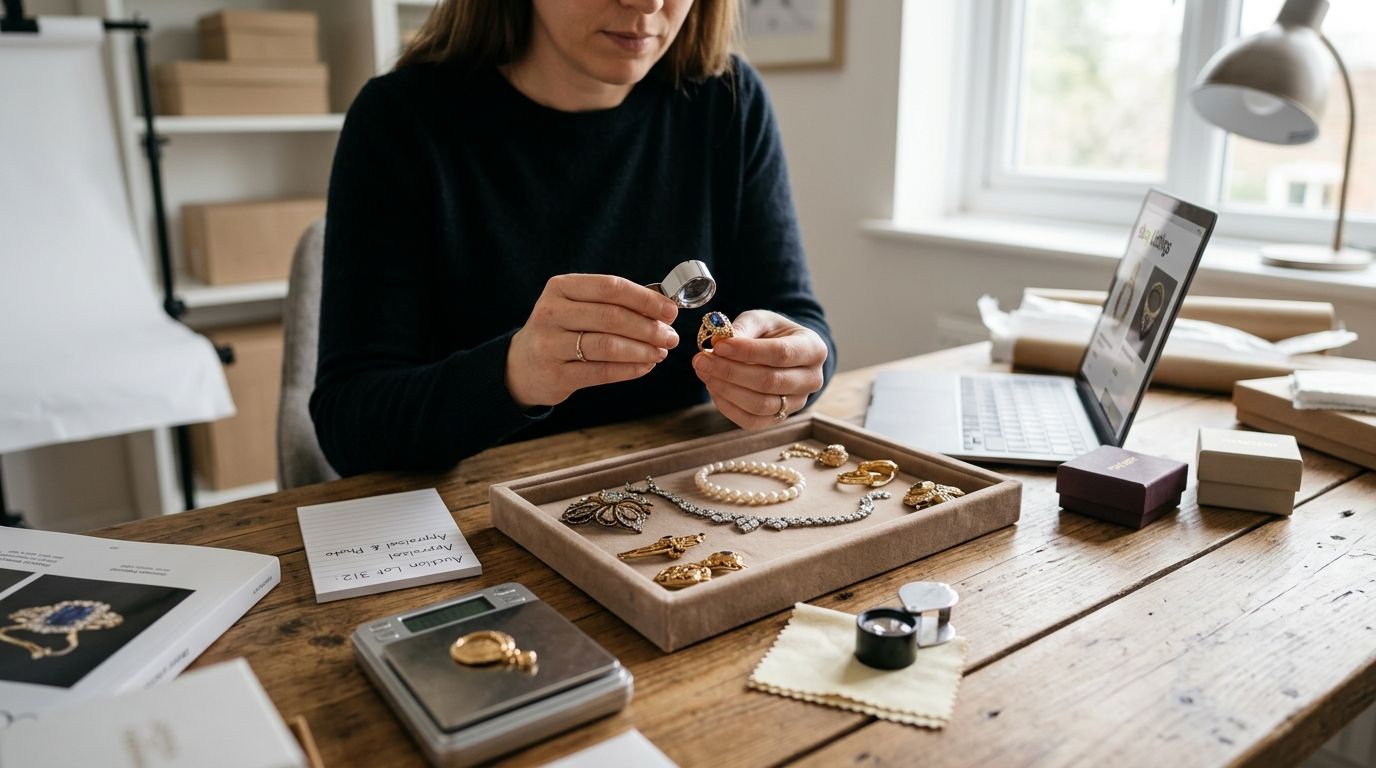
You resell jewelry won at auction by picking the right channel first — consignment auction house, online marketplace, or specialty jewelry buyer — based on what the piece actually is: signed designer pieces and certified diamonds do best going back into auction, while plain gold and uncertified stones move faster through a specialty buyer or private sale. Most sellers miss the second layer of fees: a buyer's premium already cut into what you paid, and a seller's commission — commonly 20% to 40% at consignment houses — comes out of whatever you resell the piece for. Get a fresh appraisal before you list anything in 2026; the hammer price you paid almost never matches current resale value.
- To resell jewelry won at auction, match the piece to the channel: consignment auction for signed or certified pieces, specialty buyers for plain gold and loose stones.
- Seller's commissions commonly run 20% to 40% at consignment auction houses — budget for that before setting a price.
- Get a current appraisal before listing; the price you paid at the hammer rarely equals 2026 resale value.
- Certification, provenance, and hallmark documentation move a piece faster and closer to full market value than a fresh polish.
Why this matters
Winning a piece at auction and reselling it are two separate transactions with two separate fee structures, and treating them as one is how sellers lose money. The buyer's premium you paid going in doesn't disappear — it's sunk cost — and the commission you pay going back out is a fresh expense on top of it.
Jewelry that moves fast at resale usually has three things: a certificate (GIA or equivalent), a signature or maker's mark, and clean provenance. Jewelry without those sits longer and sells for less relative to melt or gem value, regardless of how good it looks in hand.
Jewelryroom.com runs live jewelry auctions, which makes it a reasonable place to check current bidding on comparable pieces before you decide where to list your own — you want a real market price, not a guess.
How to resell jewelry you won at auction
Follow these steps in order. Skipping the appraisal step is the single most common reason sellers underprice a piece.
- Get a current appraisal — not the one from your purchase. Values shift, and a 2026 appraisal reflects current metal and gem prices.
- Pull your documentation — GIA or lab certificate, the original auction invoice, any provenance paperwork. Missing paperwork is the fastest way to lose 20% or more off an offer.
- Match the piece to a channel — signed designer work and certified diamonds go back to auction; plain gold, small diamonds, and pieces without a signature go to a specialty buyer.
- Price against comparable recent sales, not against what you paid. Auction results and dealer offers move independently of your purchase price.
- List with full disclosure of condition, repairs, and any resizing — undisclosed repairs are the top reason resale deals fall through late.
- Negotiate the commission or premium where the channel allows it; consignment terms are rarely fixed at the first number quoted.
Where to resell: channel comparison
| Channel | Best for | Fee structure | Verdict |
|---|---|---|---|
| Consignment auction house | Signed designer pieces, certified diamonds, estate jewelry with provenance | Seller's commission, commonly 20-40% | Buy-in if your piece has papers and a name |
| Online marketplace | Common gold, mid-tier gemstones, pieces with broad buyer appeal | Listing and payment processing fees | Hold for pieces without strong documentation |
| Specialty jewelry buyer | Plain gold, loose stones, damaged or dated pieces | Buyer sets a flat offer, no commission | Buy-in for a fast, low-effort sale |
| Private sale | Pieces with a known collector niche (tanzanite, cameo, art deco) | No formal commission, but slower to close | Wait unless you have a buyer already lined up |
Why resale value varies
Resale offers on jewelry won at auction swing widely, and the swing usually traces back to a short list of factors:
- Certification — a GIA-certified diamond gets firmer offers than an uncertified stone of similar size, because the buyer isn't taking on grading risk.
- Maker's signature — pieces from recognized houses hold value better than unsigned pieces of comparable materials.
- Metal purity and hallmark — clear 10k, 14k, or 18k stamps speed up offers; unmarked gold gets tested and discounted for the buyer's uncertainty.
- Condition and repair history — undisclosed resizing or repair work gets discovered during inspection and knocks the offer down, sometimes after you've already agreed to a price.
- Provenance — auction invoices and prior ownership history matter more for estate and antique pieces than for modern manufactured jewelry.
- Market timing — gemstone and gold prices move; a piece that sat in a drawer for two years may resell for more or less than it would have at purchase, independent of the piece itself.
If you're still holding the piece and unsure what channel fits, appraise estate jewelry before bidding walks through the same appraisal logic you need before a resale listing.
Check current auction prices first
See what comparable pieces are bidding at before you set a resale price.
Do you need a new appraisal before reselling jewelry from auction?
Yes — get a current appraisal before reselling jewelry won at auction, because the value you paid at the hammer reflects that day's bidding, not today's metal and gem prices. An appraisal from more than a year or two ago is treated as outdated by most consignment houses and specialty buyers. Skipping this step is the most common reason sellers accept lowball offers without realizing it.
Is it better to resell through the same auction house you bought from?
It's often better to resell through the same auction house if the piece is signed or certified, since that house already has your provenance on file and can move faster to relist it. For plain gold or uncertified pieces, a specialty buyer usually nets more after fees than a second auction commission. Before committing either way, insure jewelry purchased at auction covers what to keep documented in case a piece is damaged or lost between the two transactions.
How long does it take to resell jewelry after an auction win?
How long it takes to resell jewelry after an auction win depends entirely on the channel: specialty buyers can close in days since they're making a flat offer, while consignment auction listings can take weeks to months to reach the next scheduled sale. Private sales for niche categories — tanzanite, cameo, mid-century modern pieces — tend to take the longest because they wait on a specific collector rather than a general audience.
FAQ
How much does it cost to resell jewelry won at auction?
Reselling jewelry won at auction typically costs a seller's commission of 20% to 40% at consignment auction houses, on top of the buyer's premium already paid at purchase. Specialty buyers instead offer a flat price with no separate commission.
Is it better to sell jewelry at auction or to a private buyer?
Auction resale works better for signed designer pieces and certified diamonds because a wider pool of bidders competes on price. A private buyer often works better for plain gold or common gemstones where auction commissions would eat too much of the value.
Do you need a GIA certificate to resell a diamond?
You don't strictly need a GIA certificate to resell a diamond, but pieces without one get discounted offers because the buyer takes on grading risk. Getting the stone certified before listing usually raises the offer more than the certification costs.
Can you resell jewelry won at auction immediately?
You can resell jewelry won at auction immediately, but most sellers wait for a fresh appraisal first since the hammer price rarely matches current resale value. Reselling too fast, before documentation is in order, tends to produce lower offers.
What documentation increases resale value the most?
A GIA or lab certificate combined with the original auction invoice increases resale value the most, since both remove uncertainty for the next buyer. Provenance paperwork matters more for antique and estate pieces than for modern manufactured jewelry.
Do specialty jewelry buyers pay less than auction houses?
Specialty jewelry buyers often pay less per item than a strong auction result, but they charge no seller's commission and close in days instead of weeks or months. For plain gold and small stones, the net amount can end up similar either way.
One last thing
Most sellers spend money on cleaning and polishing before a resale listing and skip the one thing that actually moves the offer: paperwork. A buyer or auction house pays for certainty — a GIA report, a hallmark stamp, an auction invoice — far more than they pay for shine. Get the documentation in order before you touch a polishing cloth.


