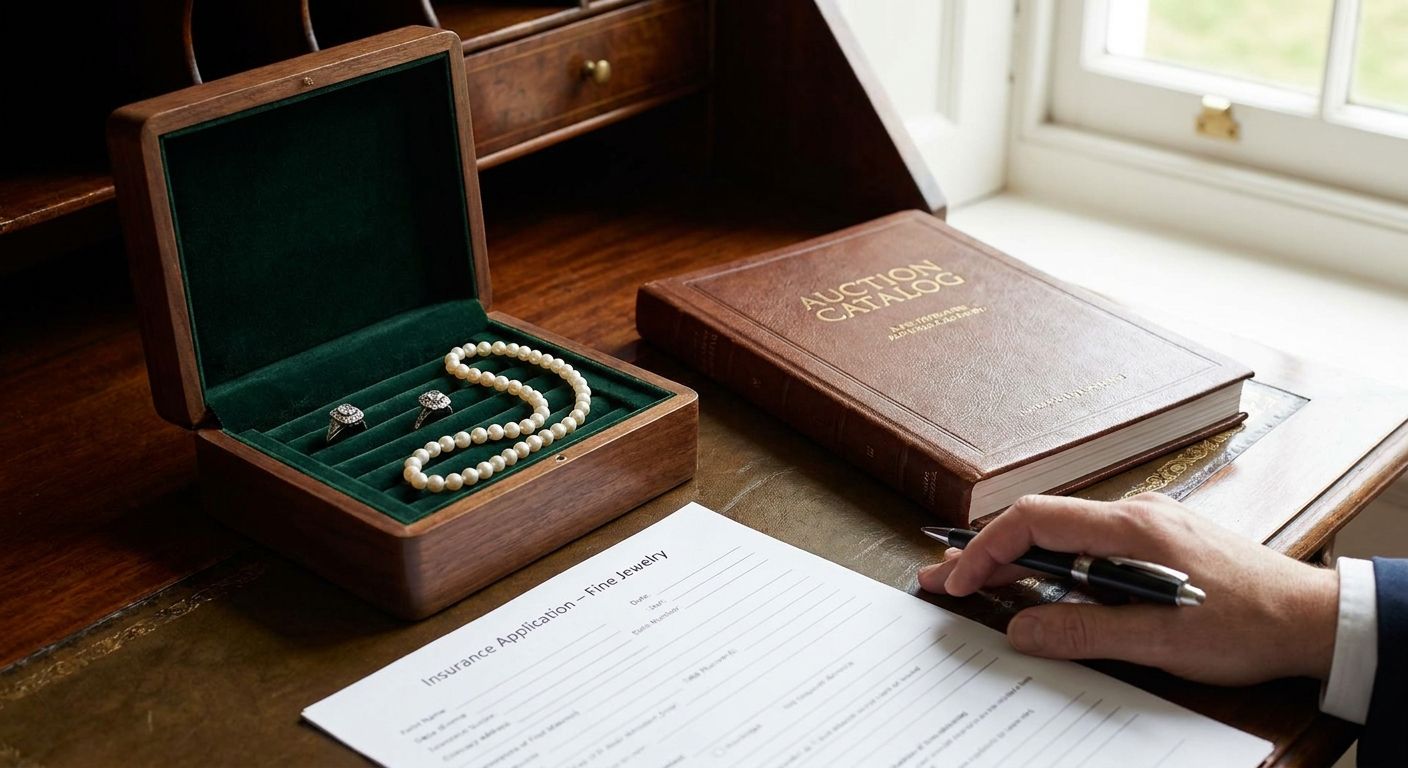
Insuring jewelry purchased at auction means getting it off your homeowners policy's thin jewelry sublimit and onto a scheduled personal property floater or a standalone jewelry policy, backed by an independent appraisal that reflects replacement value, not the hammer price you paid.
- A scheduled personal property floater, not a standard homeowners policy, is the right way to insure jewelry purchased at auction.
- Standard homeowners and renters policies typically cap unscheduled jewelry claims around $1,000 to $2,000 per item.
- Insure the appraised replacement value, not the auction hammer price -- the two numbers rarely match in 2026.
- Get an independent appraisal within 30 days of winning the lot, before any policy paperwork gets filed.
- Scheduled jewelry coverage typically runs 1% to 2% of appraised value per year, based on published industry rates.
Why this matters
Auction buyers lose coverage for one reason more than any other: they assume the receipt from the sale is proof of value for an insurer. It isn't. An invoice shows what you paid on auction day; an insurer wants an appraised replacement value, which can run higher or lower than the hammer price depending on the lot and the house. Skip the appraisal step and a claim in 2026 gets paid out at whatever the adjuster decides your unscheduled jewelry sublimit allows -- often a few hundred dollars on a piece that cost thousands.
Bidders who research an auction house's reputation before bidding tend to also get the insurance step right, because they're already thinking about documentation and provenance instead of just price.
How do you insure jewelry purchased at auction?
- Get an independent appraisal within 30 days of winning the lot. Use an appraiser who didn't handle the sale -- insurers want a neutral valuation, not the auction house's own estimate.
- Pick the right policy vehicle. A scheduled personal property floater (an endorsement added to an existing homeowners or renters policy) covers most auction wins; a standalone jewelry policy suits higher-value pieces.
- Submit the appraisal, the auction invoice, and any provenance paperwork to the insurer. The invoice proves purchase; the appraisal sets the insured value; provenance records support the claim if the piece is ever contested.
- Confirm agreed-value terms before you sign. Agreed value pays the stated amount on a total loss with no depreciation argument; actual-cash-value policies can deduct for wear, and that gap matters more on estate and antique pieces.
- Re-appraise every 2 to 3 years, or immediately after any resizing, cleaning, or repair that could affect the piece's condition or value.
Homeowners or renters rider: the baseline option
Adding jewelry to an existing homeowners or renters policy through a rider is the cheapest route, but it comes with a low ceiling. Most standard homeowners and renters policies cap unscheduled jewelry claims around $1,000 to $2,000 total, and that cap usually covers every piece of jewelry you own combined, not per item. Best for: low-value auction wins under a few hundred dollars where a full floater isn't worth the paperwork. Skip for anything with a diamond center stone, signed designer piece, or estate provenance attached.
Scheduled personal property floater: the standard for auction wins
A floater is a separate line item added to your policy that names the specific piece, its appraised value, and its agreed-value terms. It typically has no deductible, covers loss, theft, and mysterious disappearance, and follows the piece anywhere in the world. Premiums for scheduled jewelry floaters commonly run 1% to 2% of appraised value annually, a range published across most jewelry insurers. Best for: the majority of auction buyers insuring a single high-value ring, necklace, or bracelet. Buy.
Standalone jewelry insurer: when the piece is the highest-value asset you own
Dedicated jewelry insurers write policies separate from your homeowners coverage entirely, which matters if a large auction win would otherwise push your home policy's total jewelry sublimit past its comfort zone. These policies often include worldwide coverage and agreed-value payouts with less friction at claim time than a general insurer bundling jewelry alongside home contents. Best for: collectors carrying several scheduled pieces or a single lot that represents a meaningful share of net worth. Buy if you already own two or more scheduled items.
| Option | Value basis | Best for | Verdict |
|---|---|---|---|
| Homeowners/renters rider | Sublimit, ~$1,000-$2,000 total | Low-value single wins | Skip for anything over a few hundred dollars |
| Scheduled personal property floater | Agreed value, appraisal-based | Most auction buyers | Buy |
| Standalone jewelry insurer | Agreed value, per-policy | Collectors with multiple scheduled pieces | Buy for high-value or multi-piece collections |
Why jewelry insurance costs vary for auction wins
- Appraised value basis -- agreed-value policies price against the full appraisal, not the discounted hammer price you may have paid.
- Gemstone type and rarity -- colored stones like ruby, sapphire, and tanzanite carry different risk pricing than diamonds due to harder-to-replace sourcing.
- Provenance documentation completeness -- a lot with full chain-of-title paperwork is easier and cheaper to underwrite than one with gaps.
- Storage and security habits -- a home safe or bank deposit box versus a jewelry box on a dresser changes the insurer's risk calculation.
- Claims history -- prior jewelry claims on your policy or a co-applicant's policy raise renewal premiums.
- Actual-cash-value vs. agreed-value terms -- agreed-value coverage costs more upfront but removes depreciation arguments at claim time.
Do you need a new appraisal before insuring jewelry won at auction?
Yes, a new independent appraisal is required by most insurers before they'll write a scheduled floater on jewelry won at auction. The auction invoice only documents what you paid; the appraisal sets the replacement value the policy actually insures. Get this done within 30 days of the lot closing, before the piece leaves the auction house's custody chain if possible.
Is the auction hammer price enough to set insured value?
No, the hammer price alone is not enough to set insured value on a jewelry auction win. Auction prices reflect what one bidder was willing to pay that day, which can sit well below or above current retail replacement cost depending on demand, provenance, and how many bidders competed for the lot. An independent appraisal converts that price into a defensible insured value an underwriter will actually accept.
Does insurance cover jewelry lost in shipping from the auction house?
A standard homeowners jewelry rider usually does not cover shipping in transit; a scheduled personal property floater typically does, since most floaters follow the item worldwide from the moment of purchase. Confirm the effective date with your insurer before the lot ships -- some policies only activate coverage once the piece reaches your named residence, leaving a gap during transit that a separate in-transit endorsement can close.
Read the auction catalog listing carefully before bidding -- shipping terms and insurance responsibility during transit are often buried in the fine print, and knowing them before you win the lot avoids a coverage gap after.
Buyers who skip an independent appraisal before bidding tend to also skip it after winning, which is exactly the sequence that leaves a claim underpaid. Do the appraisal twice if needed -- once to set a bidding ceiling, once to set the insured value.
Provenance paperwork does double duty: it supports your bid decision and it supports your insurance claim later. Researching provenance before an estate jewelry auction gives the insurer a paper trail that speeds up claims processing if the piece is ever lost, stolen, or damaged.
Once the piece is insured, how you store and clean it affects both claim eligibility and appraisal renewal. Caring for jewelry won at auction the right way keeps the condition consistent with what the appraisal documented, which matters at claim time.
FAQ
How much does it cost to insure jewelry purchased at auction?
Scheduled jewelry floaters typically run 1% to 2% of appraised value per year in 2026, based on published industry rates. A homeowners rider costs less but caps claims around $1,000 to $2,000 total across all jewelry.
Do I need an appraisal to insure jewelry won at auction?
Yes, most insurers require an independent appraisal within about 30 days of purchase to set the insured value. The auction invoice alone doesn't satisfy underwriting requirements.
Is a scheduled floater better than a homeowners rider for auction jewelry?
A scheduled personal property floater is better for most auction wins because it insures agreed value with no deductible, versus a homeowners rider that typically caps total jewelry claims at $1,000 to $2,000.
Does jewelry insurance cover items lost during shipping from an auction house?
Scheduled personal property floaters typically cover in-transit loss worldwide, while standard homeowners riders usually do not. Confirm the policy's effective date before the lot ships to avoid a coverage gap.
Can I insure jewelry for the hammer price I paid at auction?
No, insurers set coverage based on an independent appraisal's replacement value, not the auction hammer price. The two figures often differ, sometimes significantly.
How often should I update my jewelry insurance appraisal?
Update the appraisal every 2 to 3 years, and immediately after any resizing, repair, or cleaning that could affect the piece's condition or value.
What documents does an insurer need for an auction jewelry claim?
Insurers typically want the independent appraisal, the original auction invoice, and any provenance documentation for the piece. Complete paperwork speeds up claim payouts significantly.
Is agreed-value coverage worth the extra cost over actual cash value?
Agreed-value coverage is worth it for most auction pieces because it pays the stated insured amount on a total loss with no depreciation deduction. Actual-cash-value policies can reduce a payout based on wear, which matters more on estate and antique jewelry.
One last thing
The single most common reason auction jewelry claims get underpaid in 2026 isn't fraud or a hidden exclusion -- it's a buyer who never updated the appraisal after the auction closed and tried to insure the piece off the invoice alone. Get the appraisal first, pick the floater second, and the claim conversation later becomes a formality instead of a fight.


