To assess a conflict-free diamond auction lot before bidding, ask for written sourcing evidence tied to that specific stone, check what each document actually covers, and leave unresolved claims unresolved. A grading report establishes gemological characteristics, not a complete ethical history, and a seller's assurance is not the same as independently documented provenance.
- A conflict-free diamond auction claim needs lot-specific sourcing evidence, not just a grading report.
- The Kimberley Process covers rough-diamond trade; it does not certify every polished diamond's full ethical history.
- Separate diamond authentication, provenance, and responsible-sourcing checks before deciding whether to bid.
- For Jewelryroom.com jewelry auctions, assess the individual lot rather than treating the platform name as sourcing proof.
How do you tell if a diamond is conflict-free before bidding?
Check the claim, the evidence, and the connection to the actual diamond. These are 3 separate checks: a document can be genuine without covering the claim, and a sourcing statement can describe a supplier without identifying your stone.
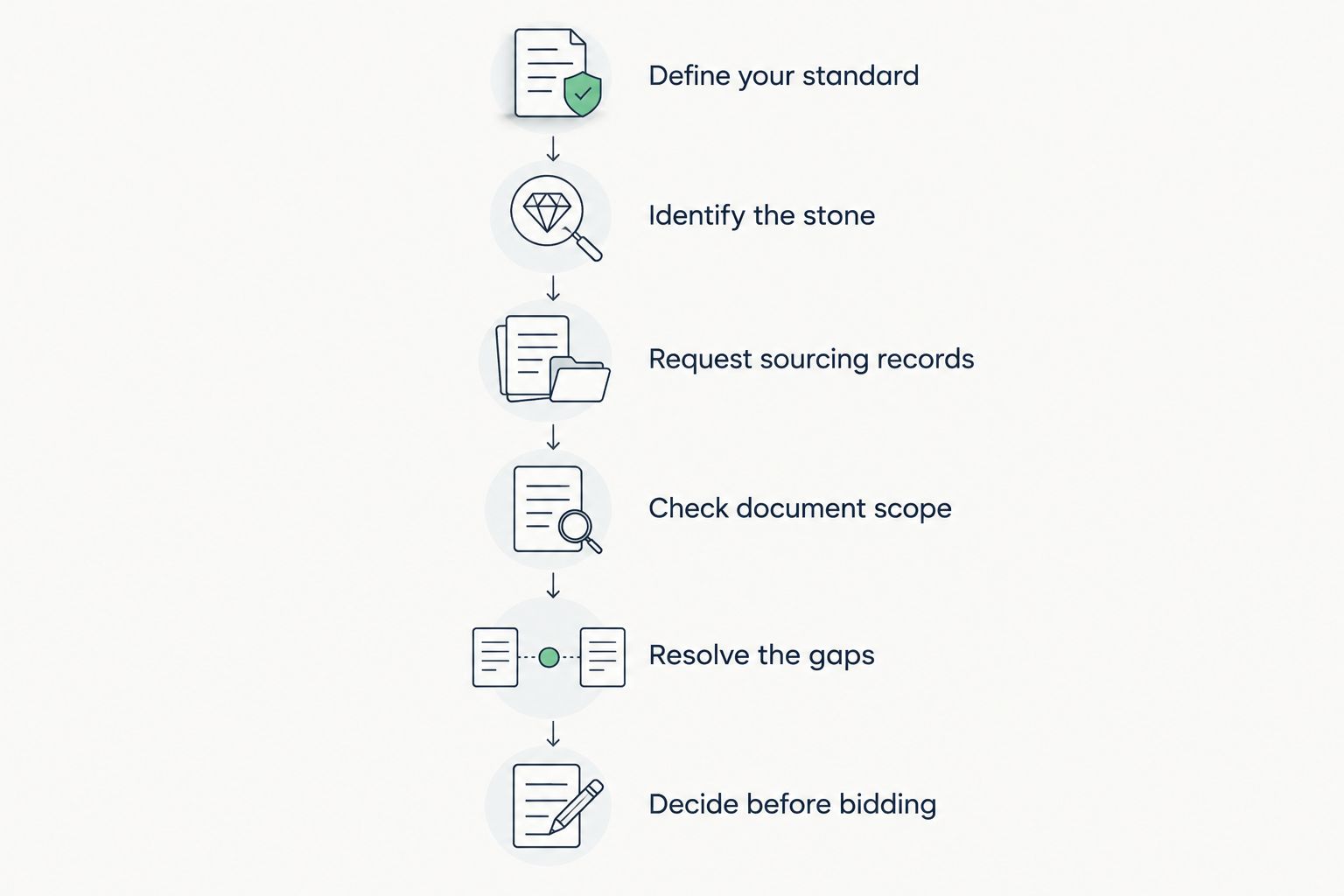
Use these 6 steps before placing a bid. Keep diamond identification separate from provenance; the guide to researching a gemstone's certification before bidding explains the document-checking side of that distinction.
1. Define your standard
Decide what you require before contacting the seller. Avoiding diamonds that finance rebel movements is a narrower standard than requiring evidence about labor conditions, environmental practices, or the entire supply chain.
For a 2026 purchase, write down which claims matter to you. If country of mining origin is essential, a statement that a diamond was purchased from a legitimate supplier does not answer your question.
2. Identify the stone
Ask for the full grading report, the report number, and photographs of any identifying inscription described in the listing. Compare the report's stated characteristics with the lot description.
Record the lot identifier alongside those documents. An inscription or report number helps connect records to a stone, but neither independently establishes the diamond's mining origin or ethical history.
3. Request sourcing records
Ask what supports the conflict-free description: supplier declarations, transaction records, origin documentation, or a documented chain of custody. Request copies or a clear written explanation of what is available.
Do not treat a collection-wide statement as proof for 1 lot. Ask the seller to explain exactly how the supplied records connect to the diamond you intend to buy.
4. Check document scope
Read the document's purpose, issuer, identifying details, and limitations. Distinguish a grading report from an origin report, and distinguish both from a seller's own declaration.
Check the issuing organization's verification process independently. A valid document still needs to answer the sourcing question; authenticity alone does not expand its scope.
5. Resolve the gaps
Ask direct follow-up questions about missing links. If records start at a wholesaler, ask whether anything establishes the diamond's earlier history rather than assuming the wholesaler's location is its mining origin.
Keep unanswered questions in your decision record. A seller's inability to supply historical paperwork does not prove conflict involvement, but it also does not substantiate a conflict-free claim.
6. Decide before bidding
If the evidence does not meet your sourcing standard, skip the lot. Do not substitute enthusiasm for the ring, a familiar platform name, or an approaching auction close for the documentation you required.
Save the listing, supplied records, and written responses before bidding. Check the auction's applicable terms separately rather than assuming you can resolve provenance concerns after winning.
Why this matters
A diamond can be authentic, accurately graded, and insufficiently documented for your ethical requirements. Those conclusions concern different questions. Combining them into a single impression of trust leaves the sourcing question unanswered.
For Jewelryroom.com jewelry auctions, the best-fit buyer checks provenance before bidding. The auction format provides a way to buy jewelry; the individual lot's evidence determines whether its sourcing claims meet your requirements.
In 2026, assess ethical wording by its stated scope rather than by how reassuring it sounds. Conflict-free, traceable, and responsibly sourced are not interchangeable claims. Ask the seller to define the wording used in the listing and identify the evidence supporting it.
What does each diamond document actually prove?
Compare documents by the question they answer, not by whether they look official. The Kimberley Process Certification Scheme's published scope concerns international trade in rough diamonds and conflict diamonds associated with rebel movements financing conflict against legitimate governments; it is not a blanket assessment of every ethical issue.
GIA's published educational guidance distinguishes diamond grading from geographic-origin reporting. For your 2026 review, read the actual report type and its limitations rather than treating every laboratory document as an origin certificate.
| Evidence | Best for | What it supports | What it does not establish alone |
|---|---|---|---|
| Diamond grading report | Checking described characteristics | The stone characteristics within the report's scope | A complete sourcing or human-rights history |
| Kimberley Process certificate | Reviewing a relevant rough-diamond shipment | Compliance documentation within the scheme's rough-diamond trade scope | An individual polished stone's complete ethical history |
| Supplier warranty statement | Reviewing a written sourcing representation | What the supplier represents about the covered goods | Independent verification of every claim |
| Origin documentation | Assessing a stated origin claim | The origin information supported by that document's method and scope | Every later supply-chain transaction or labor condition |
| Transaction and custody records | Connecting documented transfers | The recorded links between identified parties and goods | Events outside the documented chain |
| Estate or ownership records | Reviewing later ownership history | The ownership events the records identify | The original mine or extraction conditions |
Each evidence type has a use and a limit. Stronger assessment comes from relevant records that agree with one another and identify the same stone—not simply from collecting more documents.
Does the Kimberley Process prove a polished diamond is ethical?
The Kimberley Process does not, by itself, prove a polished diamond's full ethical history. Its certification scheme addresses rough-diamond trade within a defined conflict-diamond framework. Broader questions about labor, environmental harm, and later trading relationships require evidence beyond that scope.
A retail or auction buyer therefore should not expect a rough-shipment certificate to function as a complete personal certificate for a mounted diamond. Ask how any cited shipment documentation connects through cutting, trading, and setting to the lot being offered.
For a 2026 bid, distinguish scheme participation from stone-specific traceability. A seller naming the Kimberley Process explains the framework being cited; it does not automatically establish an unbroken record for the diamond in front of you.
Is a supplier warranty enough before you bid?
A supplier warranty is a written representation, not independent proof of every upstream event. The World Diamond Council's System of Warranties provides industry warranty language for diamond transactions; read the actual statement and identify which goods and transaction it covers.
Ask who issued the warranty, who received it, and how the auction lot is connected to the covered goods. A statement copied into general website text has a different evidential role from documentation associated with the relevant transaction.
Treat a warranty as one part of the record, not a replacement for the record. If your standard requires documented mining origin, ask for origin evidence directly rather than accepting a broader sourcing assurance as an equivalent.
Are estate diamonds automatically conflict-free?
Estate diamonds are not automatically conflict-free because prior ownership does not establish mining origin. An old ring, a family history, or a period-style setting answers a different question from whether the stone's original sourcing is documented.
Pre-owned jewelry is a route for buyers who want an existing piece rather than a newly made one. Its limitation for provenance-focused buyers is that ownership records and original extraction records are different kinds of evidence.
Ask whether the diamond is documented as original to the setting and whether records describe later replacements. Do not infer the stone's age or origin solely from the style of the mounting.
Why conflict-free diamond evidence varies
The available evidence depends on what was recorded and whether those records remain connected to the stone. These factors explain differences in documentation; none independently proves that a diamond is conflict-free:
- Record continuity: Each documented transfer helps establish a chain; an unexplained gap remains a gap.
- Document scope: A grading report, origin report, and supplier declaration answer different questions.
- Stone identification: Records need identifying details that connect them to the offered diamond.
- Ownership history: Later family or estate records do not necessarily reach back to extraction.
- Changes to jewelry: Replacing a center stone separates the current diamond's history from the mounting's history.
- Claim breadth: Evidence supporting a narrow conflict-related statement does not automatically support broader ethical claims.
When evaluating Jewelryroom.com lots, apply the same document standard you would apply to any jewelry auction. Neither the platform name nor the attractiveness of a piece replaces lot-specific evidence.
What should you ask the seller in writing?
Send a focused request that separates identity, sourcing, and the seller's representation. Ask for existing documents rather than asking only whether the diamond is ethical; a broad question invites a broad answer.
Use this checklist for your 2026 correspondence:
- What does conflict-free mean in this lot description?
- Which documents support that claim for this diamond?
- What identifying details connect those documents to the lot?
- Is mining origin documented, or is the statement limited to supplier assurances?
- Which parts of the supply chain are documented, and which are unknown?
- Does the evidence cover every diamond in the piece or only the center stone?
- Will the written sourcing representation identify the purchased lot?
Keep the response in its original form. If the seller narrows a listing's claim during correspondence, make your decision using that narrower explanation rather than the original headline wording.
When should you walk away from a diamond auction lot?
Walk away when a sourcing condition essential to your purchase remains unsupported. You do not need to prove misconduct to decide that the available evidence is inadequate for your requirements.
Pause when the seller substitutes a grading report for provenance, provides documents with inconsistent identifiers, or refuses to clarify what a claim covers. Those issues justify further checking or skipping the lot; they are not, on their own, proof that the diamond financed conflict.
If you browse Jewelryroom.com, keep the same rule: choose the lot only after reviewing the evidence relevant to your standard. Consider the jewelry's design and condition separately so that enthusiasm for the piece does not settle the provenance question.
FAQ
Can I tell if a diamond is conflict-free just by looking at it?
No, appearance cannot establish whether a diamond is conflict-free. You need sourcing evidence connected to the stone; visual inspection addresses different questions.
Does a diamond grading report prove ethical sourcing?
A diamond grading report does not, by itself, prove ethical sourcing. Read the report's scope and request separate provenance or sourcing documentation.
Does Kimberley Process compliance cover every ethical concern?
No, Kimberley Process compliance does not cover every ethical concern. The scheme addresses rough-diamond trade within its defined conflict-diamond scope, not every labor or environmental issue.
Is an estate diamond automatically conflict-free?
An estate diamond is not automatically conflict-free. Previous ownership and the age of a setting do not establish the diamond's original mining conditions.
What if the auction seller cannot document the diamond's origin?
An undocumented origin means the origin claim remains unverified; it does not prove conflict involvement. Skip the lot if documented origin is a condition of your purchase.
Can a laser inscription prove a diamond's provenance?
A laser inscription alone does not prove provenance. It can help connect a stone to an associated record, but that record's scope determines what it establishes.
Should I request evidence for the small diamonds in a ring too?
Request evidence for every diamond covered by the claim if your sourcing standard applies to the whole ring. Do not assume documentation for a center stone also covers the surrounding stones.
One last thing
Check the smallest stones, not just the centerpiece. A ring can contain a documented center diamond while leaving the sourcing of its surrounding diamonds unexplained.
Before bidding, ask whether the written sourcing statement covers the entire piece. A claim about one stone is not a claim about every stone.