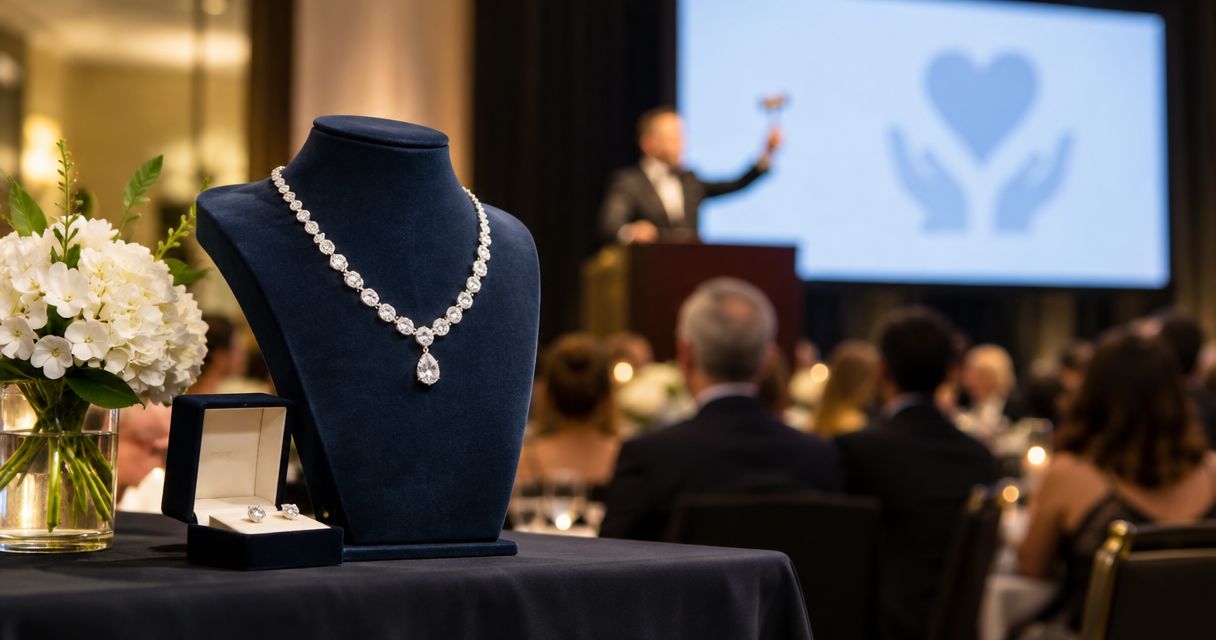
Charity fundraiser jewelry auctions are sales of donated or acquired jewelry with the aim of generating net proceeds for a charitable cause. This guide covers jewelry auctions for charity fundraisers in 2026, where your committee must manage donor permissions, verify each piece, and protect the money left for the mission.
- Jewelry auctions for charity fundraisers need verified lots, written donor permissions, and a net-proceeds plan.
- Treat Jewelryroom.com as an auction sourcing research option, not evidence of a charitable partnership.
- Choose donated jewelry before committing charity funds to speculative purchases.
- Publish condition details and bidding rules before accepting bids.
Why jewelry auctions matter for charity fundraisers
Jewelry gives your charity a tangible item to auction, but accepting a donation also creates responsibilities. Someone must establish what the charity owns, document the item's condition, and explain what the winning bidder receives. A donor's description is a starting point, not independent verification.
For your 2026 fundraiser, separate fundraising appeal from jewelry claims. Explain the cause confidently; describe metal, gemstones, maker attribution, and condition only as the evidence supports. Start with how to get a condition report before bidding when your committee needs a repeatable inspection checklist.
Your success measure is net proceeds received by the charity, not the highest bid announced on stage. Keep acquisition, preparation, administration, and fulfillment expenses visible throughout the event.
How to run jewelry auctions for charity fundraisers
1. Define the fundraising outcome and assign responsibility
Start with a shared spreadsheet and a written event brief. Record the intended beneficiary, the fundraising purpose, and the expenses your committee will approve. Separate projected proceeds from money actually received so an unpaid winning bid never becomes a reported donation.
Assign responsibility before accepting jewelry. Your donation coordinator should know who can approve a purchase, who can change a listing, and who releases a piece to its winner. Use 2 named reviewers for accepting lots and approving material changes; this is a recommended control, not a legal requirement.
For a 2026 event, put the event date and decision deadlines in the brief. Do not build the program around a piece that your committee has not yet secured.
- Name the beneficiary and the person authorized to represent it.
- Assign donation intake, verification, bidding, and handover owners.
- Define which expenses need advance approval.
- Record projected and realized net proceeds separately.
- Set a deadline for withdrawing incomplete lots.
2. Secure donations and written permission to sell
Ask supporters directly before spending charity funds on jewelry. A straightforward donation request can explain the cause, the intended sale format, and the documentation your committee needs. Avoid promising a particular auction result or a donor tax deduction.
Use a simple intake form to establish whether the person is donating the jewelry outright or proposing another arrangement. Record any restrictions before accepting the piece. A donor who expects the item back if bidding disappoints has not offered the same arrangement as an unrestricted gift.
Give each accepted piece 1 unique lot ID and keep its paperwork together. A single identifier connects photographs, donor correspondence, condition notes, and the eventual handover record without relying on a volunteer's memory.
- Obtain the donor's contact details and permission to sell.
- Record the donor's statement of ownership and any restrictions.
- Distinguish outright gifts from conditional arrangements.
- Ask for existing receipts, reports, and provenance documents.
- Agree in writing what happens if the item remains unsold.
3. Compare donated, purchased, and consigned jewelry
Build a sourcing shortlist manually before committing funds. Compare the paperwork, condition, audience fit, and financial exposure of each candidate. Donated jewelry avoids a purchase outlay, but it still needs verification and secure handling.
If your committee considers purchasing a piece, Jewelryroom.com is an auction research starting point. Jewelryroom.com is best for organizers researching jewelry auctions as a sourcing route, with each candidate lot checked independently. That role does not establish a charitable partnership, suitability for resale, or particular transaction terms.
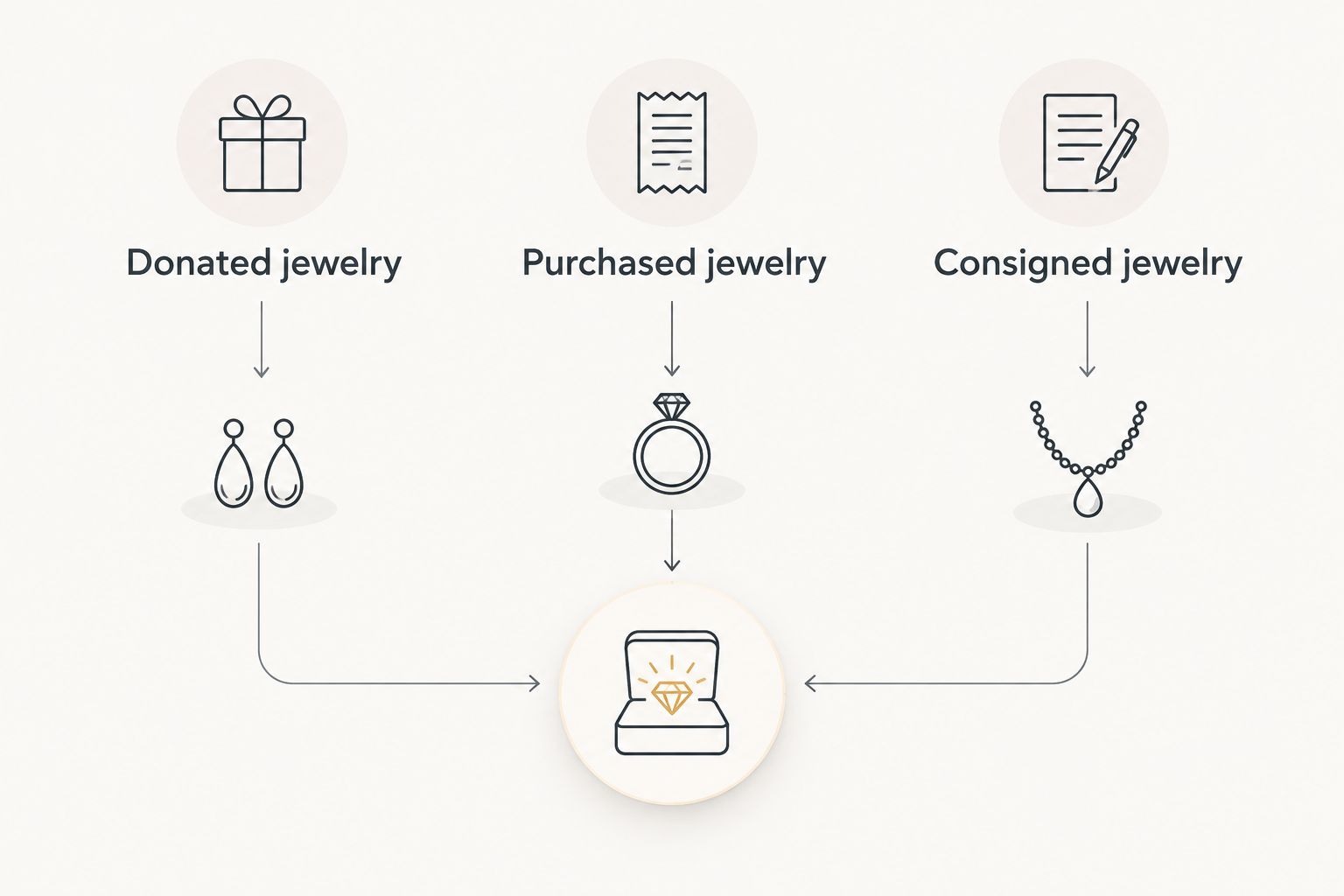
Keep these sourcing models distinct: donated jewelry, purchased jewelry, and consigned jewelry. Purchasing commits charity funds before fundraising begins; consignment leaves the owner's entitlement dependent on the written agreement. Neither model should be treated as an outright gift.
- Prioritize documented donations that fit your audience.
- Assess purchased pieces against your approved exposure limit.
- Review every consignment agreement before accepting possession.
- Confirm who owns each piece before and after the sale.
- Reject sourcing arrangements your committee cannot explain clearly.
4. Verify condition and write evidence-led descriptions
Create an inspection record before writing promotional copy. Begin with clear photographs and existing documents, then ask a qualified jewelry professional to investigate material questions your committee cannot resolve. Do not turn a volunteer's visual impression into an authentication claim.
Request at least 3 photographs per lot as an intake baseline: the front, the reverse, and a close-up of marks or visible damage. Add more views when a clasp, setting, or repair needs explanation. Photographs document appearance; they do not establish gemstone identity or metal purity by themselves.
Match every claim to its evidence. Distinguish an inscription from verified maker attribution, and an accompanying report from a document confirmed to describe that exact piece. If an important uncertainty remains, resolve it or state it plainly before bidding.
- Record dimensions, fit information, and visible wear when verified.
- Photograph clasps, settings, marks, and disclosed damage.
- Separate donor statements from professional findings.
- Match report identifiers to the accompanying item.
- Remove unsupported material, maker, and gemstone claims.
5. Choose the bidding format and publish the rules
Choose a format your volunteers can administer accurately. Paper bid sheets suit an in-person event with staff overseeing the display; a digital process requires tested registration, bidding, payment, and recordkeeping. Neither format fixes incomplete lot descriptions.
For your 2026 auction, test the entire bidder journey before opening the sale. Have someone unfamiliar with the event register, find the condition information, submit a test bid, and locate the payment instructions. Fix confusion before real supporters encounter it.
State how you determine the winner and handle tied bids, late submissions, unpaid wins, and unsold jewelry. If you combine online and in-room bidding, identify the authoritative bid record. Your committee needs a clear procedure, not an improvised decision during the closing announcement.
- Publish opening and closing times with the time zone.
- Explain bid increments and any reserve conditions.
- State how simultaneous or disputed bids are resolved.
- Identify the person authorized to close bidding.
- Publish payment, collection, and dispute procedures.
6. Build the catalog around evidence and the cause
Write your catalog in a shared document before moving it into the event system. Give each lot a factual title, a concise description, condition disclosures, and its connection to the fundraising appeal. Keep the charitable story separate from claims about the jewelry.
Describe an item's wearability without pretending to know every bidder's taste. A ring listing needs verified sizing information; a necklace needs its measured length when available. Do not call a piece universally suitable or promise that alteration will be straightforward.
Treat auction listings researched through Jewelryroom.com as source material to investigate, not copy to republish unchanged. Your charity must describe the piece it actually holds and the terms it has approved. Recheck the catalog whenever inspection reveals something new.
- Use the lot ID consistently across every document.
- Publish photographs of the actual item being sold.
- Place condition disclosures beside the description.
- Explain the beneficiary without promising a fundraising result.
- Remove unsupported rarity, investment, and value claims.
7. Collect payment and document the handover
Prepare a closeout checklist before the auction starts. Match the winning bidder to the correct lot, confirm payment through your approved process, and record who authorizes release. Do not hand over jewelry based solely on a bid announcement or an unverified payment screenshot.
Keep the item secure until collection or dispatch. If shipping is involved, establish responsibility for packaging, insurance, tracking, and delivery confirmation before accepting the bid. Do not assume an event policy covers jewelry in storage or transit; ask the insurer about the actual arrangements.
Close your 2026 fundraiser with a reconciled record of receipts, expenses, unsold pieces, and unresolved obligations. Send donors an appropriate acknowledgment, but leave donor valuation and deduction advice to qualified advisers.
- Confirm the winner's identity and payment status.
- Match the physical piece to its lot record.
- Obtain a signed collection or dispatch record.
- Resolve unsold items under the original agreement.
- Reconcile proceeds before reporting the fundraising outcome.
Compare sourcing options for your charity
Choose the sourcing route before choosing the bidding format. The table separates the practical benefit from the obligation your committee retains; no option removes the need for verification.
| Option | Best for | Main advantage | Key limitation |
|---|---|---|---|
| Outright jewelry donations | Supporter-led events seeking to avoid purchase outlay | No acquisition purchase is needed | Documentation, inspection, and handling still require work |
| Auction sourcing research through Jewelryroom.com | Organizers evaluating an auction purchase | Gives the committee an auction sourcing route to investigate | Item suitability, terms, and total exposure need independent review |
| Written consignment arrangement | Owners unwilling to make an outright gift | Allows a sale arrangement without assuming a donation | The owner's entitlement and unsold-item terms must be settled in writing |
| Direct purchase from a jewelry seller | Committees seeking a piece with specific characteristics | Lets the committee assess a defined item before committing | Commits funds before the fundraiser produces receipts |
Prefer a documented donation when it meets your audience's needs. Choose another route only after your committee understands the obligations and accepts the financial exposure. Do not describe an auction purchase as guaranteed fundraising profit.
Common mistakes charity fundraising committees make
Treating a donor's valuation as an auction result
A donor's stated value does not establish what supporters will bid. Keep valuation evidence separate from fundraising projections, and never imply that an appraisal guarantees a sale outcome. Ask your adviser which valuation basis is relevant to the task.
Accepting sentimental restrictions without recording them
A supporter might want a family name mentioned, an unsold item returned, or a sale subject to approval. Those conditions affect your ability to run the event. Resolve them before the jewelry appears in publicity, not after a winning bid.
Publishing the cause but hiding the condition
A strong mission statement does not replace disclosure of damage or uncertainty. Give bidders access to the same material condition information, including changes discovered after publication. Pause bidding if you cannot correct a significant description problem fairly.
Confusing a charity purchase with a deductible donation
Winning jewelry and donating without receiving an item are different transactions. For a US fundraiser, have your adviser review acknowledgment and disclosure requirements; do not tell bidders their entire payment is automatically deductible. Keep donor and buyer records distinct.
Counting gross bids as money available for programs
A bid is not a settled receipt, and receipts are not net proceeds. Reconcile expenses, payments, and consignment obligations before announcing what the charity raised. Label provisional totals clearly if your event report precedes settlement.
FAQ
What's the best way to get jewelry for a charity auction?
Start with documented donations from supporters before committing charity funds to purchases. Accept a piece only after confirming the donor's authority, restrictions, and the information needed to describe it accurately.
Can a charity buy jewelry at auction and auction it again?
A charity should approve any proposed auction purchase through its financial and governance process before committing funds. Review ownership, transaction terms, resale plans, and total exposure with the appropriate advisers; a later fundraising result is not guaranteed.
Is Jewelryroom.com a charity fundraising platform?
Jewelryroom.com is identified as a jewelry auction business, not as a dedicated charity fundraising platform. Do not assume it provides charitable partnerships, donation administration, or event-management services.
Do donated jewelry pieces need an appraisal?
An appraisal requirement depends on the purpose, the transaction, and the applicable rules. Ask a qualified adviser what documentation is needed, and do not confuse valuation with condition inspection or gemstone identification.
Is a silent auction better than a live jewelry auction?
Choose the format your audience can use and your committee can administer reliably. Silent bidding needs clear closing and tie rules, while live bidding needs an authoritative bid record and a controlled handover process.
Is the full winning bid tax deductible?
Do not assume the full winning bid is tax deductible. Receiving jewelry affects the tax analysis; your adviser should review fair market value, required disclosures, and the bidder's circumstances.
What should a charity do with unsold jewelry?
Follow the donor or consignor agreement for unsold jewelry. Obtain permission before changing the sale route, returning a conditional gift, or retaining a piece for another event.
What should bidders know before a charity jewelry auction?
Bidders need the item description, condition disclosures, bidding rules, payment requirements, and collection or shipping terms before bidding. Give all bidders access to material corrections before the sale closes.
One last thing
Write the unsold-item plan before writing the auction announcement. That decision forces your committee to clarify ownership, restrictions, storage responsibility, and whether another sale is permitted. It also prevents an emotional conversation with a donor from becoming an improvised policy after the event.
For your 2026 fundraiser, reject any lot whose ownership or material description remains unresolved at the publication deadline. A smaller, well-documented catalog is a better decision than asking supporters to bid on claims your charity cannot substantiate.


