
Choose Jewelryroom.com if you want a jewelry-focused auction destination; choose EBTH if you want to explore jewelry alongside estate-sale categories such as art, furniture, and collectibles. This 2026 comparison separates that genuine difference in scope from the lot-level evidence, purchase terms, and delivery arrangements you should check before bidding.
- Jewelryroom.com vs EBTH is primarily a choice between jewelry-focused auctions and broader estate-sale discovery.
- Jewelryroom.com jewelry auctions suit buyers starting with a jewelry-specific shopping goal.
- EBTH is better for buyers who want jewelry alongside other estate-sale categories.
- Neither platform’s category focus replaces condition checks, gemstone documentation, or a full-cost budget.
Why this matters
Choose the auction destination for your search, then choose the lot for its evidence. Those are separate decisions. A jewelry-focused business does not make every gemstone documented, and a broad estate-sale business does not make every jewelry listing unsuitable.
For a 2026 purchase, start with your actual objective: finding a particular type of jewelry or exploring estate objects across categories. Then apply the same standards to the listings that interest you. A platform preference should never excuse an unanswered question about the item you are buying.
At a glance
| Dimension | Jewelryroom.com | EBTH |
|---|---|---|
| Best for | Buyers with a jewelry-specific shopping goal | Buyers exploring jewelry and other estate-sale categories |
| Jewelry-only search | Better aligned with a jewelry-focused brief | Better aligned with a broader estate-shopping brief |
| Standout feature | Jewelry-auction focus | Estate-sale breadth across categories |
| Discovery | Start with the jewelry you want | Explore jewelry within a wider estate assortment |
| Material evidence | Judge the individual listing and supporting documents | Judge the individual listing and supporting documents |
| Condition | Inspect the specific piece; category focus is not proof | Inspect the specific piece; estate context is not proof |
| Delivery and purchase terms | Check the terms applicable to your lot | Check the terms applicable to your lot |
| Pricing model | Auction bidding; assess the complete purchase obligation | Auction bidding; assess the complete purchase obligation |
Jewelryroom.com wins for a jewelry-specific shopping goal
Jewelryroom.com jewelry auctions are best for buyers whose shopping brief begins and ends with jewelry. That is a fit verdict, not a claim about authentication, fees, or the quality of every listing.
Start with a written brief. Specify the item type, metal, stone preference, dimensions, and intended use. A ring for everyday wear requires a different evaluation from a brooch intended for occasional use, even when both appeal to the same collector.
The advantage of a focused destination is its match to that brief. The limitation is equally clear: jewelry focus alone does not establish that a particular piece meets your requirements.
EBTH is the stronger fit when jewelry is only part of your search. If your shopping list also includes furniture or art, its broader estate-sale scope matches that task more directly.
A jewelry-focused destination wins on category alignment
If you already know you want a necklace, ring, or pair of earrings, begin with the jewelry itself rather than a general estate-shopping session. Keep your comparison anchored to the same item type and intended use.
For example, compare rings by their stated metal, measurements, stone description, and condition. Do not treat two visually similar rings as equivalent when one listing explains those details and the other leaves material questions unanswered.
The benefit is a disciplined search. The tradeoff is narrower exploration: a jewelry-specific approach does not serve a buyer who also wants to browse unrelated estate objects.
Category alignment earns a starting preference, not an automatic bid. Move to the competing platform whenever it presents a better-documented piece that meets your brief. The individual lot remains the final decision.
EBTH wins on estate-sale breadth
EBTH, short for Everything But The House, offers online estate-sale auctions across categories, including jewelry. That breadth is its clearest distinction from a jewelry-focused auction destination.
EBTH is best for estate shoppers who want jewelry alongside art, furniture, and collectibles. You do not need to limit the shopping task to a single category.
Breadth also creates a practical tradeoff. If you arrive with a precise jewelry requirement, unrelated categories do not help you evaluate metal content, gemstone identity, or wear. Keep those questions attached to the jewelry listing rather than the surrounding assortment.
Estate context is not the same as provenance. A piece appearing in an estate sale does not, by itself, establish its maker, age, ownership history, or gemstone origin. Require supporting evidence for whichever of those claims matters to your purchase.
EBTH wins for cross-category discovery, not gemstone certainty
Choose EBTH when the shopping experience is exploratory: you want to compare an accessory with other estate objects rather than pursue only a predetermined jewelry specification. Its broad category scope fits that approach.
Discovery and verification require different habits. You can discover a piece because its design appeals to you, but you should evaluate it using its description, measurements, photographs, and supporting records.
Before bidding, write down what attracted you. Was it the design, the stated material, a maker attribution, or a claimed period? Then identify the evidence supporting that particular attraction.
If you like the appearance regardless of attribution, assess it on that basis. If your interest depends on a named designer or a natural gemstone, do not substitute visual resemblance for documentation. EBTH’s discovery advantage does not settle the identity of an individual piece.
Both require lot-level evidence for metals and gemstones
Neither platform wins this dimension on category scope alone. For a 2026 jewelry purchase, separate identification claims from descriptive language: metal fineness, gemstone identity, treatment disclosure, and measurements answer different questions.
A carat measures gemstone weight: 1 carat equals 200 milligrams. It does not tell you a stone’s face-up dimensions, quality, or identity. Likewise, 18-karat gold denotes 75% gold by mass, while 14-karat gold denotes approximately 58.3% gold. These definitions help you read a description; they do not authenticate the object carrying a mark.
Use these evidence categories consistently:
- Metal identity: Read the stated metal and fineness; distinguish solid metal from plating.
- Stone identity: Look for clear language about natural, laboratory-grown, or imitation material.
- Treatment disclosure: Check what the description actually states about treatment.
- Supporting documents: Match any report to the described stone rather than relying on a document’s presence alone.
The better listing is the one that substantiates the claims you are paying attention to. A platform name cannot supply missing evidence.
Both need the same condition checks
Condition is a lot-level decision, not a platform-wide award. Read the description alongside the photographs, and resolve any conflict before committing to a bid.
For rings, inspect the band, setting, and visible stone edges. For necklaces and bracelets, examine links, clasps, and attachment points. For earrings, check the fastening arrangement and whether the pair’s measurements and appearance match your expectations.
Ask specific questions rather than requesting a general reassurance. “Is the clasp functional?” produces a more useful answer than “Is it in good condition?” Similarly, ask about a visible repair or worn setting directly.
Use this guide to get a condition report before bidding when the listing leaves a purchase-critical question unresolved.
Neither jewelry specialization nor estate-sale context replaces a condition assessment. If an unanswered issue would change your decision, stop before bidding rather than assigning it an optimistic answer.
Neither wins delivery without matching your requirements
The useful delivery comparison is whether the arrangements applicable to a particular lot work for you. For a 2026 purchase, check the delivery destination, collection requirements if applicable, handling arrangements, and any stated responsibilities for loss or damage.
Do not infer delivery terms from another item or a previous purchase. Read the terms associated with the transaction you are considering.
If you need jewelry for an event, work backward from the date you need it in hand. Include any inspection, sizing, or repair you intend to arrange after receipt; do not assume those tasks are part of the auction purchase.
Also distinguish delivery questions from return questions. Knowing how an item reaches you does not establish whether you can return it.
The winner is the lot whose written arrangements meet your needs. Neither platform earns a blanket logistics win from its category focus.
Both use auction bidding; compare the complete obligation
Both options belong in an auction comparison, where your bid is part of a transaction governed by the applicable terms. The tradeoff is straightforward: you control your bidding limit, but you do not determine whether competing bids exceed it.
For your 2026 comparison, distinguish the bid from the complete purchase obligation. Check whether buyer charges, taxes, delivery, or other transaction-specific costs apply. Include any independent inspection or alteration you plan to commission, without treating that work as a platform service.
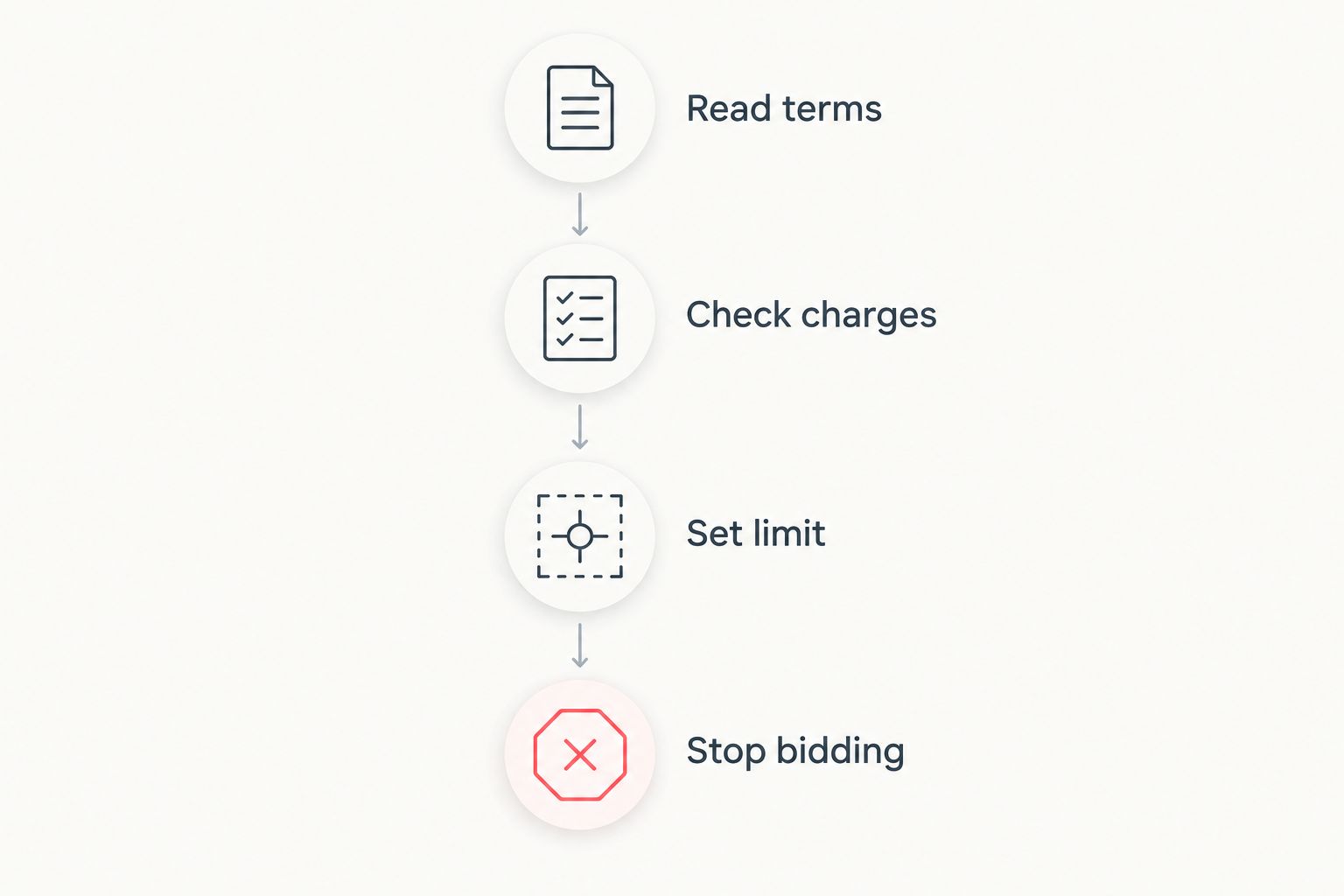
Use a consistent decision process:
- Read terms: Establish what winning the lot commits you to.
- Check charges: Identify applicable amounts before setting your limit.
- Set limit: Choose a ceiling based on the complete obligation.
- Stop bidding: Keep that ceiling when competition increases.
A higher competing bid does not improve the item’s documentation or condition. Neither platform wins on value until you compare the actual lot and its complete terms.
Final verdict: choose by shopping goal, then verify the lot
Choose Jewelryroom.com if you are a jewelry-first buyer
Your shopping brief is a piece of jewelry, not a collection of estate objects. You want to begin in a jewelry-auction setting and assess listings against a defined material, design, and condition requirement.
Jewelryroom.com is the named winner for that jewelry-first profile. Keep the recommendation within its proper scope: category fit is the reason to start there, not a substitute for checking an individual listing.
Choose EBTH if you are a cross-category estate shopper
Your interests extend beyond jewelry to objects such as art, furniture, and collectibles. You value an estate-sale destination that includes those categories rather than a jewelry-only shopping task.
EBTH is the named winner for that broader estate-shopping profile. Its limitation is that breadth does not answer jewelry-specific questions for you; the listing still needs to support your decision.
For either profile, the practical 2026 rule is the same: a well-matched platform gets your attention, but a well-supported lot earns your bid.
| Dimension | Winner |
|---|---|
| Jewelry-specific shopping goal | Jewelryroom.com |
| Jewelry-only category alignment | Jewelry-focused destination |
| Estate-sale breadth | EBTH |
| Cross-category discovery | EBTH |
| Material evidence | Tie: decide by the individual listing |
| Condition | Tie: inspect the specific piece |
| Delivery and purchase terms | Lot-dependent; no blanket winner |
| Pricing model and value | Lot-dependent; compare the complete obligation |
FAQ
Is Jewelryroom.com better than EBTH for jewelry auctions?
Jewelryroom.com is the better starting fit for a jewelry-specific shopping goal; EBTH is the better fit for broader estate shopping. Choose the individual lot only after checking its description, condition, documentation, and terms.
What is EBTH best for?
EBTH is best for buyers who want to explore jewelry alongside other estate-sale categories. Its cross-category scope suits shoppers interested in objects such as art, furniture, and collectibles as well as jewelry.
Which auction site is cheaper for jewelry?
Compare the complete obligation for the actual lots rather than assuming either platform is cheaper. Read the applicable charges, taxes, delivery arrangements, and purchase terms before setting your bidding limit.
Does buying from a jewelry-focused auction prove a gemstone is natural?
No, a jewelry-focused auction setting does not prove that an individual gemstone is natural. Check the listing’s identity language and any supporting gemological documentation for the specific stone.
Does estate jewelry automatically mean antique jewelry?
No, estate jewelry is not automatically antique jewelry. Establish the piece’s age through supporting evidence rather than inferring it from the estate-sale setting.
What should I ask before bidding on a ring online?
Ask about the ring’s stated metal, stone identity, measurements, setting condition, and visible repairs. Resolve any question that would change your willingness to buy before submitting a bid.
Can I assume auction jewelry is returnable?
No, do not assume auction jewelry is returnable. Read the terms applicable to the transaction and distinguish ordinary returns from any process addressing a description dispute.
One last thing
Write your reason to walk away before you write your maximum bid. An unresolved stone identity, an unsuitable measurement, or an unclear purchase term is easier to respect as a boundary when you define it before bidding.
Keep that boundary separate from competition. Another bidder’s enthusiasm is not evidence about the jewelry.


